Quick Answer
There isn't a magic number of index funds you need to own. One fund can hold thousands of investments. Five funds can hold many of the same stocks. What matters is whether your funds, together, give you the mix of investments you want for your goals, timeline, and comfort with risk.
Before adding another fund, ask: What does this fund own? What does it add that I don't already have? And does it fit my plan?
Let me show you why those questions beat counting ticker symbols.
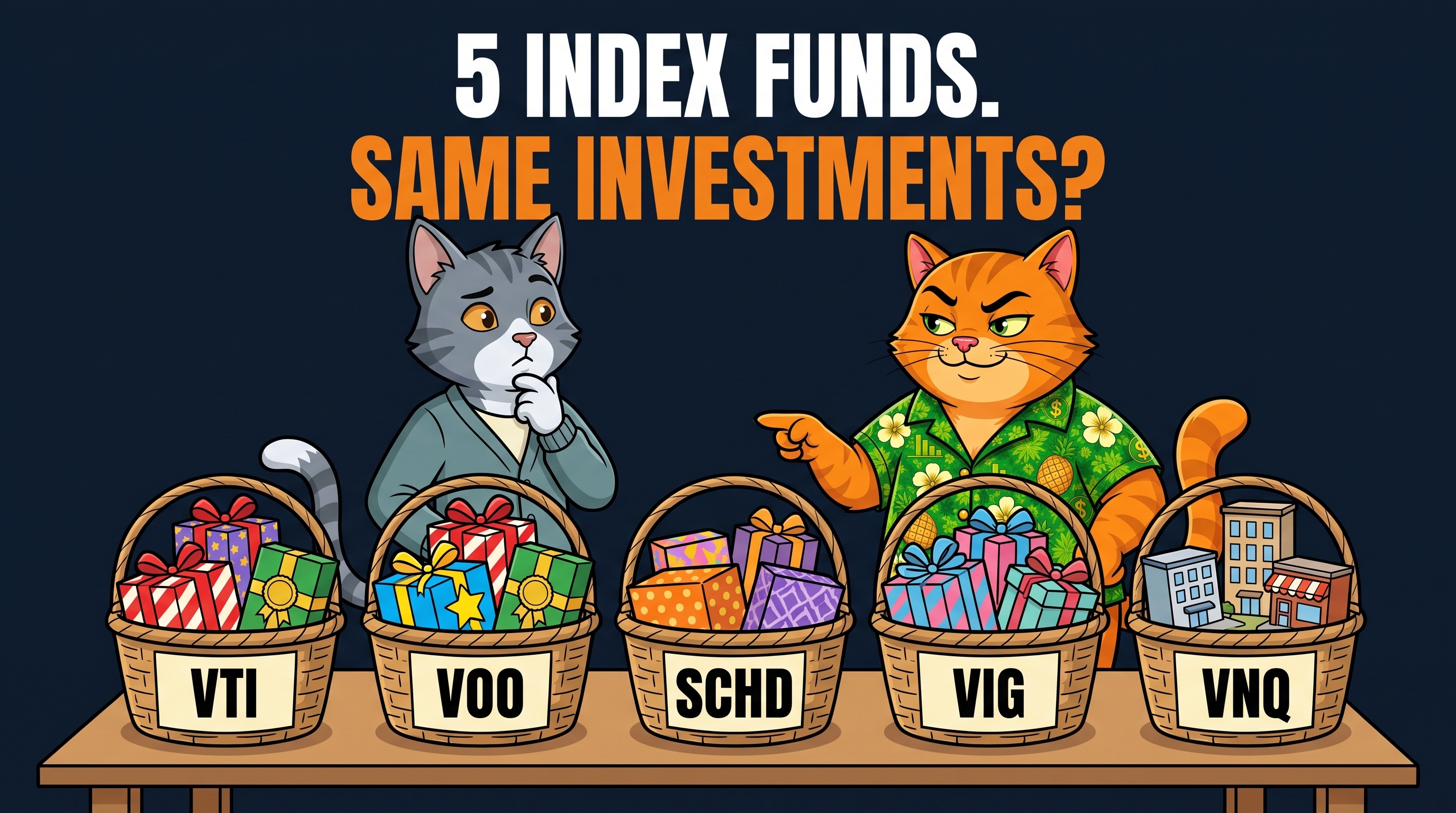
Oliver Has Five Index Funds. He Thinks He's Covered.
Oliver started investing a little while ago. He read about index funds, opened an account, and did what felt sensible: he bought a few different ones.
Then a few became five.
Here is his portfolio:
| Fund | Oliver's allocation | What it focuses on |
|---|---|---|
| VTI | 20% | Broad U.S. stock market |
| VOO | 20% | S&P 500 companies |
| SCHD | 20% | U.S. dividend-paying companies selected by index rules |
| VIG | 20% | U.S. companies with a history of growing dividends |
| VNQ | 20% | Publicly traded U.S. real estate companies and REITs |
| Total | 100% |
He feels pretty good about it. Five funds. Different names. Different strategies. Surely that's plenty of diversification.
I ask him one question.
"Oliver, what do you own inside those funds?"
He knows the tickers. He doesn't know the answer.
And that's where our lesson starts.
The Fund Overlap Test: Five Labels, Some of the Same Companies
Think of an index fund as a basket holding investments selected to follow a particular index. An index ETF trades on an exchange; an index mutual fund is bought and sold through the mutual fund's pricing process. Different packaging, same basic idea: each fund follows a set of rules for what it owns.
Now look at Oliver's first two baskets.
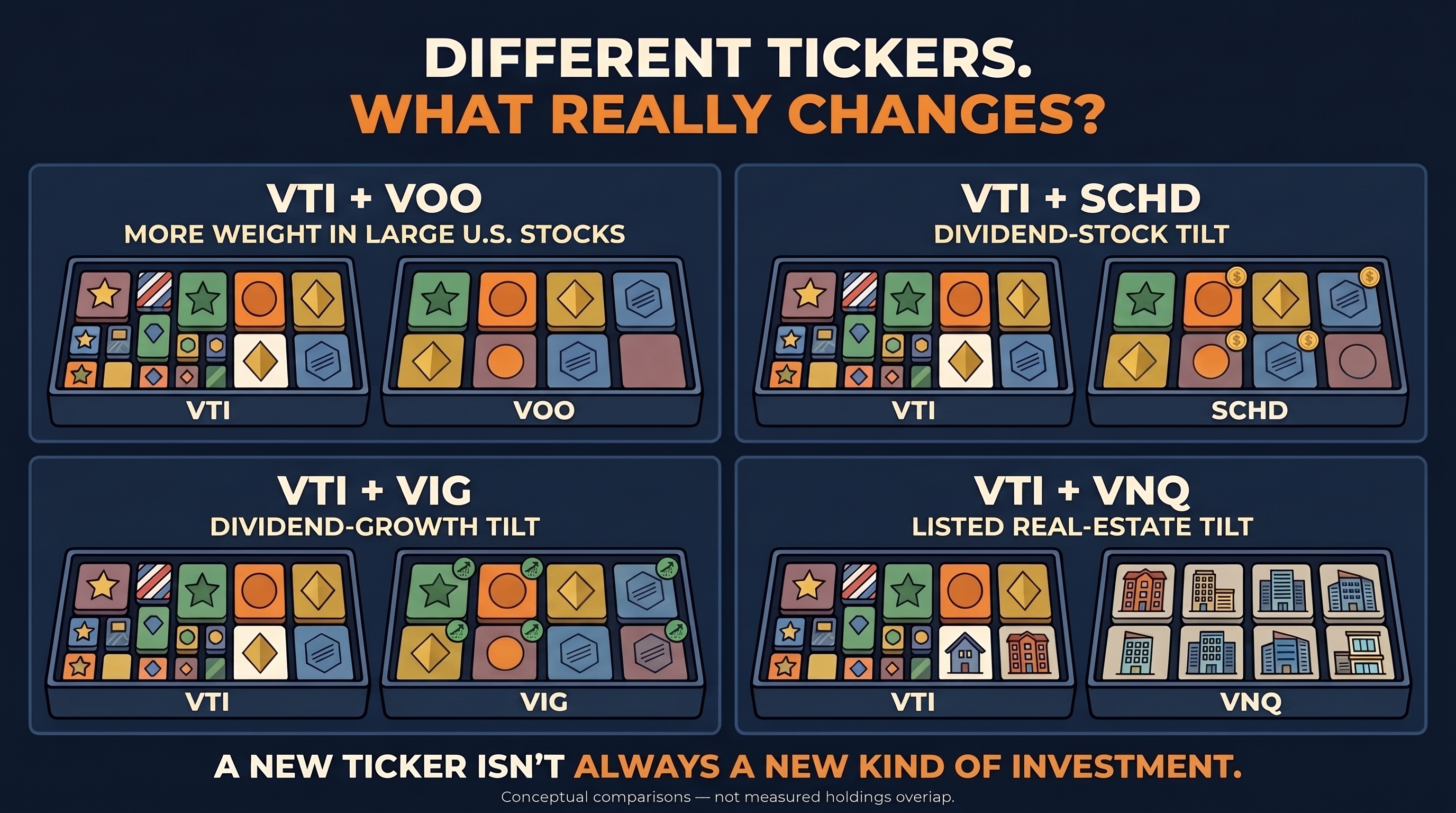
VTI aims to cover the broad U.S. stock market, including large, midsize, and smaller companies. VOO follows the S&P 500, which represents large U.S. companies.
That means the companies in VOO are generally also represented in VTI. Buying both doesn't create a new country or a new asset class. It usually increases Oliver's emphasis on the large U.S. companies he already owns through VTI.
Is that automatically bad? No. He might want that emphasis. But he should know he's choosing it.
Then there's SCHD, which follows a dividend-focused U.S. stock index, and VIG, which follows an index of companies with a record of dividend growth. Their selection rules differ, and they won't necessarily own identical stocks. But both still invest in U.S. equities, many of which can also appear in a broad-market fund.
Oliver hasn't necessarily bought four independent sources of growth. He's bought four ways of owning U.S. stocks, with different weights and selection rules.
VNQ looks different. It concentrates on publicly traded real estate investment trusts (REITs) and other real estate-related stocks. That changes Oliver's sector exposure—how much of his money is tied to real estate businesses. But it doesn't turn that slice into a bond fund, a savings account, or direct ownership of a rental house. It's still stock-market exposure, with its own risks.
Here's the distinction I want Oliver to remember:
A new ticker is not necessarily a new kind of investment.
The Fund Overlap Test
| Comparison | What is similar? | What actually changes? |
|---|---|---|
| VTI + VOO | Both own large U.S. companies | More weight toward S&P 500 stocks than VTI alone |
| VTI + SCHD | Both invest in U.S. stocks | Added emphasis on stocks meeting SCHD's dividend and quality screens |
| VTI + VIG | Both invest in U.S. stocks | Added emphasis on companies meeting dividend-growth criteria |
| VTI + VNQ | Both have U.S. equity exposure, including possible real estate overlap | A more concentrated tilt toward listed real estate businesses |
These are directional comparisons of investment objectives, not calculated holdings-overlap percentages. Holdings and weights change. To measure overlap at a particular date, compare each fund's published holdings and their portfolio weights for the same reporting period.
The SEC's Investor.gov makes a similar point: even if you own several mutual funds or ETFs, you should check their underlying holdings rather than assume you're diversified just because you own several funds. Source: Investor.gov — Asset Allocation and Diversification.
Different Tickers Can Lead to Nearly the Same Place
Oliver's next question is a good one: "Okay, but what if I buy funds from different companies?"
Changing the fund company doesn't necessarily change the investments.
Take these examples:
- VTI, VTSAX, and FSKAX all provide broad exposure to the U.S. stock market. VTI and VTSAX are ETF and mutual-fund share classes of the same Vanguard fund; FSKAX is a separate Fidelity mutual fund pursuing similar broad-market exposure. They aren't identical products, but owning all three isn't the same as investing in three unrelated markets.
- VOO and BSPIX both track the S&P 500. Their fund structures, expenses, and access arrangements can differ, but their underlying market target is essentially the same.
- SWISX and VXUS both invest outside the United States, but they're not interchangeable. SWISX focuses on developed international stock markets; VXUS covers developed and emerging international stock markets. That difference matters.
A ticker tells you which fund you're looking at. It doesn't tell you whether that fund fills a gap in your portfolio.
Real Index Funds Compared: Exposure and Expenses
These are examples for learning, not a shopping list or endorsements. Expense ratios are annual fund operating expenses expressed as a percentage of fund assets. The approximate cost column assumes a steady $10,000 invested for a full year, ignores market movement, and excludes other possible trading, account, and tax costs.
| Fund | Structure | Main exposure | Published annual expense ratio | Approx. per $10,000/year |
|---|---|---|---|---|
| VTI | ETF | Broad U.S. stocks | 0.03% | $3.00 |
| VTSAX | Mutual fund | Broad U.S. stocks | 0.04% | $4.00 |
| FSKAX | Mutual fund | Broad U.S. stocks | 0.015% | $1.50 |
| VOO | ETF | S&P 500 stocks | 0.03% | $3.00 |
| BSPIX | Mutual fund | S&P 500 stocks | 0.10% | $10.00 |
| SCHD | ETF | U.S. dividend-oriented stocks | 0.06% | $6.00 |
| VIG | ETF | U.S. dividend-growth stocks | 0.04% | $4.00 |
| VNQ | ETF | U.S. listed real estate equities | 0.13% | $13.00 |
| SWISX | Mutual fund | Developed international stocks | 0.06% | $6.00 |
| VXUS | ETF | Developed and emerging international stocks | 0.05% | $5.00 |
| FXNAX | Mutual fund | Broad U.S. investment-grade bonds | 0.025% | $2.50 |
Expense-ratio snapshot checked October 20, 2026, against issuer or fund-research pages. Pre-publication recheck completed October 27, 2026 — 11 of 11 figures confirmed unchanged, no corrections required (7 confirmed directly against SEC/issuer filings; VTI, VXUS, SWISX, and FXNAX confirmed via direct issuer-page verification by Allen on October 26, 2026). The underlying disclosures have different effective dates, and fees can change. BSPIX is an institutional share class; eligibility, transaction fees, and account access can matter. Always check the current prospectus and the costs that apply to your account. Sources appear at the end.
Notice what this table doesn't tell you: which fund will perform best, which one you should buy, or whether you need any of them.
The cheapest fund isn't automatically the best fit. Two funds can charge different fees while tracking different indexes. Two funds can track the same index but be available under different account rules. And an expense ratio is only one piece of the decision.
So Is One Index Fund Enough? What About Two or Three?
Here's the answer nobody can give you from a fund count alone: it depends on what the fund holds and what job you need it to do.
Consider three illustrations, not model portfolios:
One fund: A broadly diversified, all-in-one fund may hold U.S. stocks, international stocks, and bonds inside a single product. One ticker can represent several asset classes. You still need to examine its allocation, costs, and whether it fits your goals.
Two funds: Someone might use one broad U.S. stock fund and one international stock fund to spread their stock investments across more countries. That's broader geographic exposure, but it's still an all-stock mix. It can fall sharply when stock markets struggle.
Three funds: Someone else might use U.S. stocks, international stocks, and bonds in separate funds. Now there's a different asset class in the mix. Bonds carry risks too—including interest-rate and credit risk—and they can lose value. Adding them doesn't make losses impossible.
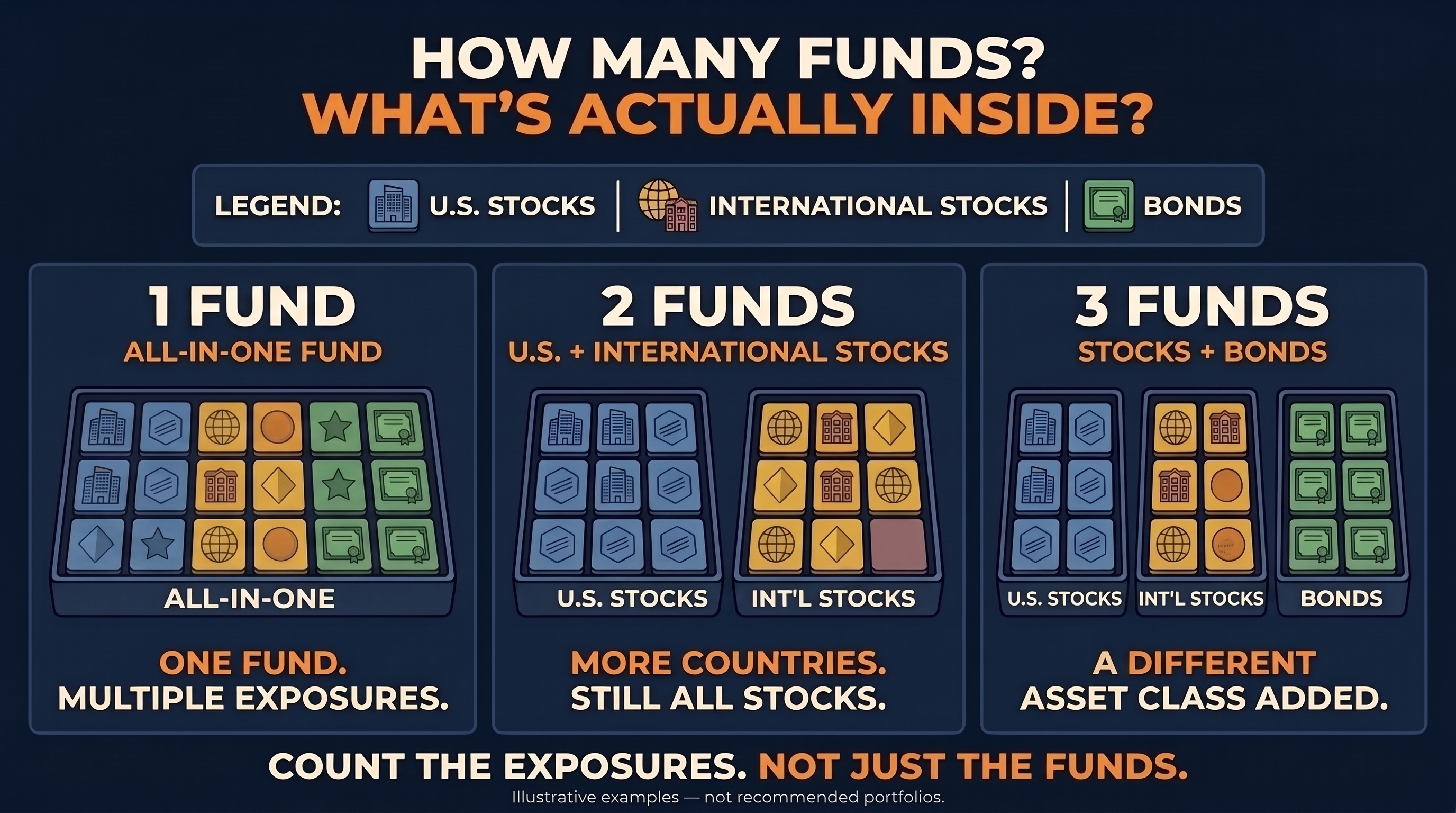
You can create different mixes with fewer funds, more funds, or a single all-in-one fund. And three funds chosen carelessly can overlap more than two chosen deliberately.
The important idea is asset allocation: how your money is divided among types of investments. That's different from counting how many funds you own.
Your time horizon and tolerance for losses matter here. Money you may need soon is a different problem from money you won't touch for decades. A portfolio that looks fine during a rising market may feel very different when its value drops.
Diversification can help manage some risks. It does not guarantee a profit or prevent losses.
What About International Funds, Bonds, and REITs?
Oliver sees three unfamiliar directions and wants to know which one "counts" as diversification.
The answer isn't a simple yes-or-no stamp.
International stock funds: SWISX and VXUS are useful examples because they show that "international" isn't one single category. Developed markets and emerging markets have different exposures and risks. International investing also brings currency and country-related risks. If your existing funds only hold U.S. companies, international equities can broaden your geographic exposure—but they remain stocks.
Bond index funds: FXNAX is an example of a fund tracking a broad U.S. investment-grade bond market. Bonds behave differently from stocks in some environments, so this is a more meaningful asset-class distinction than adding a second U.S. large-cap stock fund. But bonds are not risk-free or guaranteed to rise when stocks fall.
REIT index funds: VNQ focuses on listed real estate businesses. That can increase exposure to a specific part of the stock market, not provide a completely separate, dependable shelter from stock-market declines. A broad U.S. stock fund may already own some of those businesses.
None of those categories is automatically required for every reader. The question is whether the exposure serves your plan, not whether it makes your ticker list longer.
Three Questions Before You Add Another Fund
This is the checklist I'd rather see on Oliver's desk than a target number of funds.
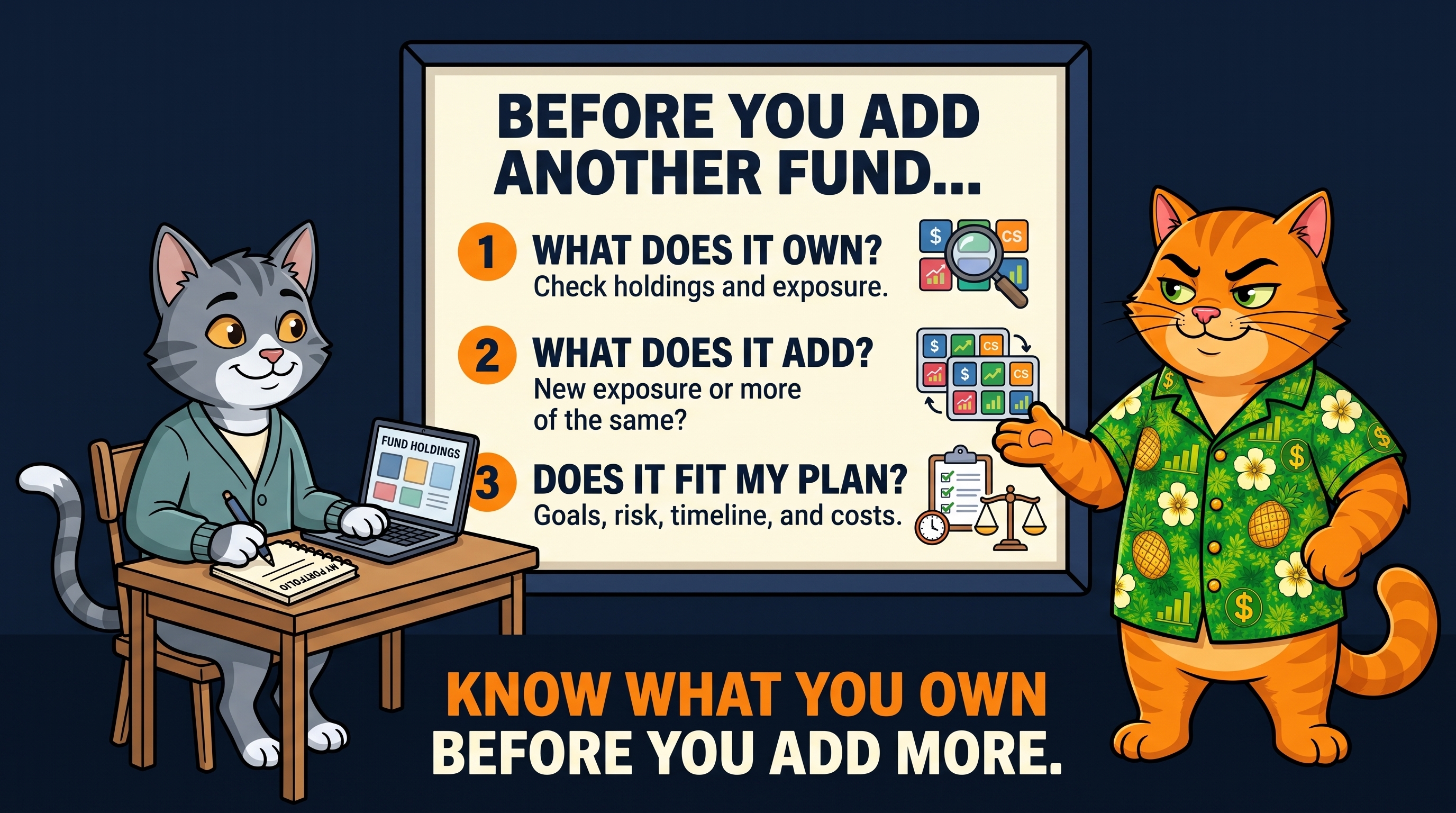
1. What does it actually own?
Find the fund's official page or prospectus. Look for the index it tracks, the countries or asset classes it invests in, its sector mix, and its largest holdings. Don't stop at the fund's name.
2. What would it add—or overweight?
Compare it with what you already own. Does it add international companies, bonds, or another exposure you intentionally want? Or does it mostly buy more of the same U.S. stocks?
Overlap isn't a violation. It's a choice. Make it an informed one.
3. Does it fit my goals and costs?
Think about when you'll need the money, how much volatility you can handle, and what allocation you're trying to maintain. More funds also doesn't mean less risk by itself — a wider spread of stock funds can still fall together in a broad market decline. If you want the mechanics of how that kind of loss actually happens, Can You Lose Money in an Index Fund? The Honest Answer walks through it. Then review the fund's expense ratio, any account or transaction costs, investment minimums, and tax considerations relevant to your account.
If you're unsure how those pieces fit together, consider talking with a qualified financial professional who can evaluate your circumstances.
One extra caution: Don't rush to sell an existing fund just because you discover overlap. Selling in a taxable account can create capital gains taxes, and switching funds can involve other costs. Understanding your portfolio comes before making changes.
Oliver's Answer
Oliver started with five funds because five felt safer than one.
Now he knows better than to judge his portfolio by its ticker count.
He can see that VTI and VOO share much of their underlying U.S. large-company exposure. SCHD and VIG give him different rules for selecting U.S. stocks, not entirely new asset classes. VNQ gives him a real estate tilt, but it's still equity exposure.
That doesn't tell him to dump four funds. It tells him what to investigate next: Does he actually want those tilts, and how do they fit his investment goals?
He closes the trading screen and opens the fund information pages instead.
Good move, Oliver.
I love fishing, but I don't measure a good day by how many lures are in my tackle box. I want to know what each one is for.
Same idea here.
Don't collect index funds just to collect them. Know what each one brings to the boat.
Before you buy another fund—or make changes to the ones you own—do your own research and decide what makes sense for your goals. I'm Chuck, a personal finance enthusiast, not a licensed financial advisor. I'm here to help you understand the choices, not make them for you.

Chuck Finance is for entertainment and informational purposes only. Chuck is not a licensed financial advisor, and nothing in this post constitutes professional financial, investment, legal, or tax advice. Always consult a qualified professional before making financial decisions.
This post is not sponsored, contains no affiliate or referral links, and does not recommend any fund, brokerage or issuer. Fund descriptions and fees are a dated snapshot for learning, not a recommendation.
Sources and Data Notes
Investor education
Fund objectives and expense ratios (issuer or issuer-linked fund disclosures, checked October 20, 2026; pre-publication recheck completed October 27, 2026 — 11 of 11 figures confirmed unchanged, no corrections required. VTI, VXUS, SWISX, and FXNAX confirmed via direct issuer-page verification by Allen, October 26, 2026.)
- Vanguard — VTI — 0.03%, dated April 28, 2026.
- Vanguard — VOO — 0.03%, dated April 28, 2026.
- Vanguard — VTSAX and product list — 0.04% in 2026 product listing.
- Fidelity — FSKAX — 0.015%, dated April 29, 2026.
- iShares — BSPIX — gross and net expense ratios 0.10% in current prospectus; see prospectus for underlying precision.
- Schwab Asset Management — SCHD — 0.06%.
- Vanguard — VIG — 0.04%, dated May 28, 2026.
- Vanguard — VNQ — 0.13%, dated May 28, 2026.
- Schwab Asset Management — SWISX — 0.06%.
- Vanguard — VXUS — 0.05% in 2026 product listing.
- Fidelity — FXNAX — 0.025%, dated October 30, 2025, the latest figure verified for this draft.
Editorial note: Fund descriptions and fees are a dated snapshot, not a recommendation. The article intentionally does not claim measured portfolio overlap percentages or rank funds by expected returns.