
Where the 15% Rule Actually Comes From
Fidelity's guideline is to aim for saving 15% of your pretax income for retirement, including employer contributions. It's simple, memorable, and a genuinely reasonable place to start.
But even Fidelity doesn't pretend fifteen percent works the same for everybody. Their own guidance changes depending on when you start saving, when you plan to retire, and the lifestyle you're trying to support. Fifteen percent is a starting point. Theo treated it like an answer.
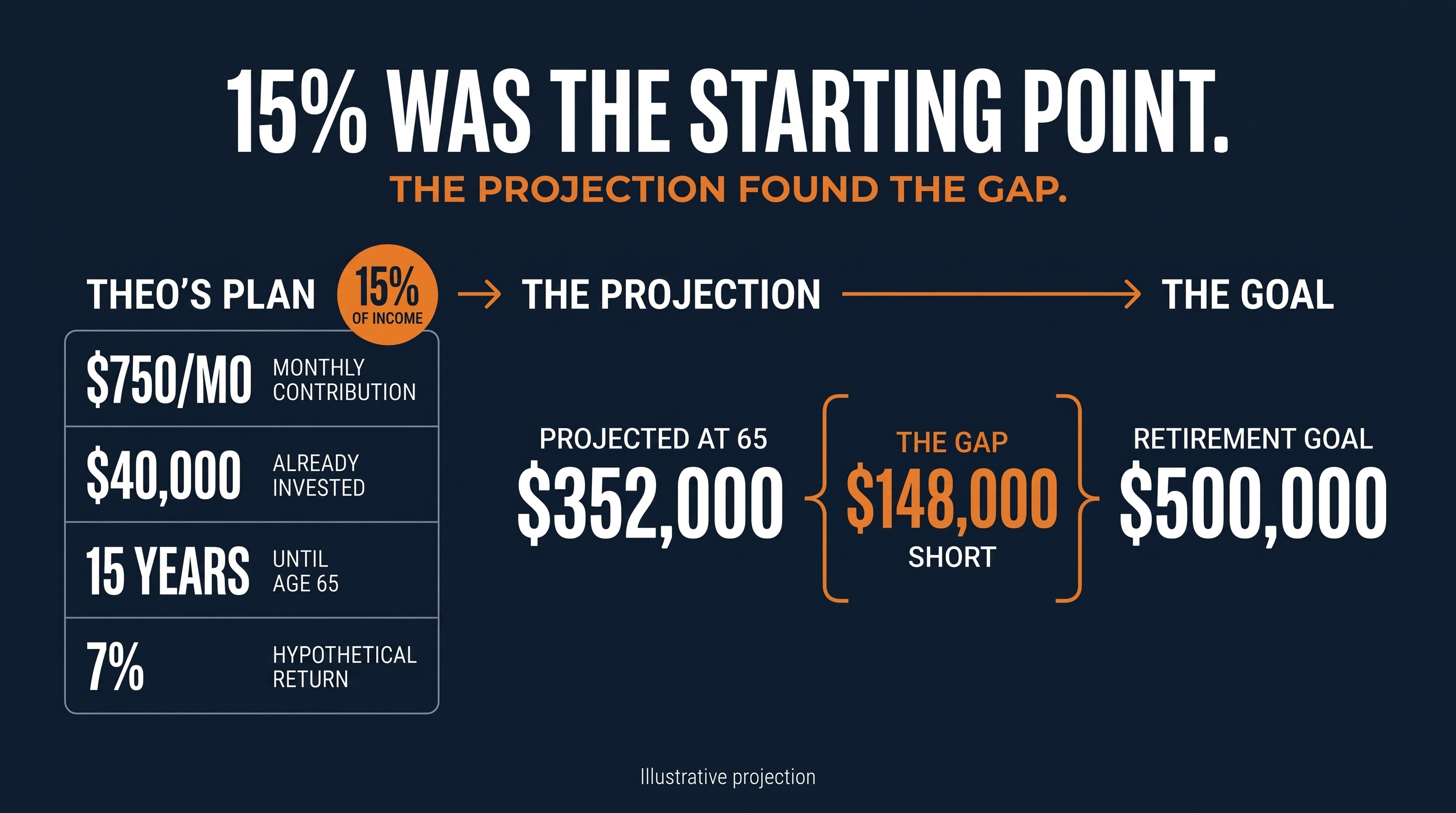
Here's his situation, run as a clearly-labeled hypothetical: Theo is fifty years old. He wants $500,000 invested by sixty-five — fifteen years from now. He's already got $40,000 invested. He makes $60,000 a year, and his total retirement contributions — including any employer contribution — equal 15% of his pretax income: $750 a month.
To run the projection forward, we need one assumption — a hypothetical 7% annual return, compounded monthly. That's an illustration, not a promise. Markets don't hand you 7% on schedule every year.
The Result: Theo's $352,000 (And His $148,000 Gap)
Run Theo's $40,000 starting balance and his $750 monthly contribution forward for fifteen years, and he ends up with about $352,000.
His goal was $500,000. He's short by about $148,000.
Theo did the percentage right. The percentage never knew where Theo was trying to go.
The Four Numbers a Percentage Can't See
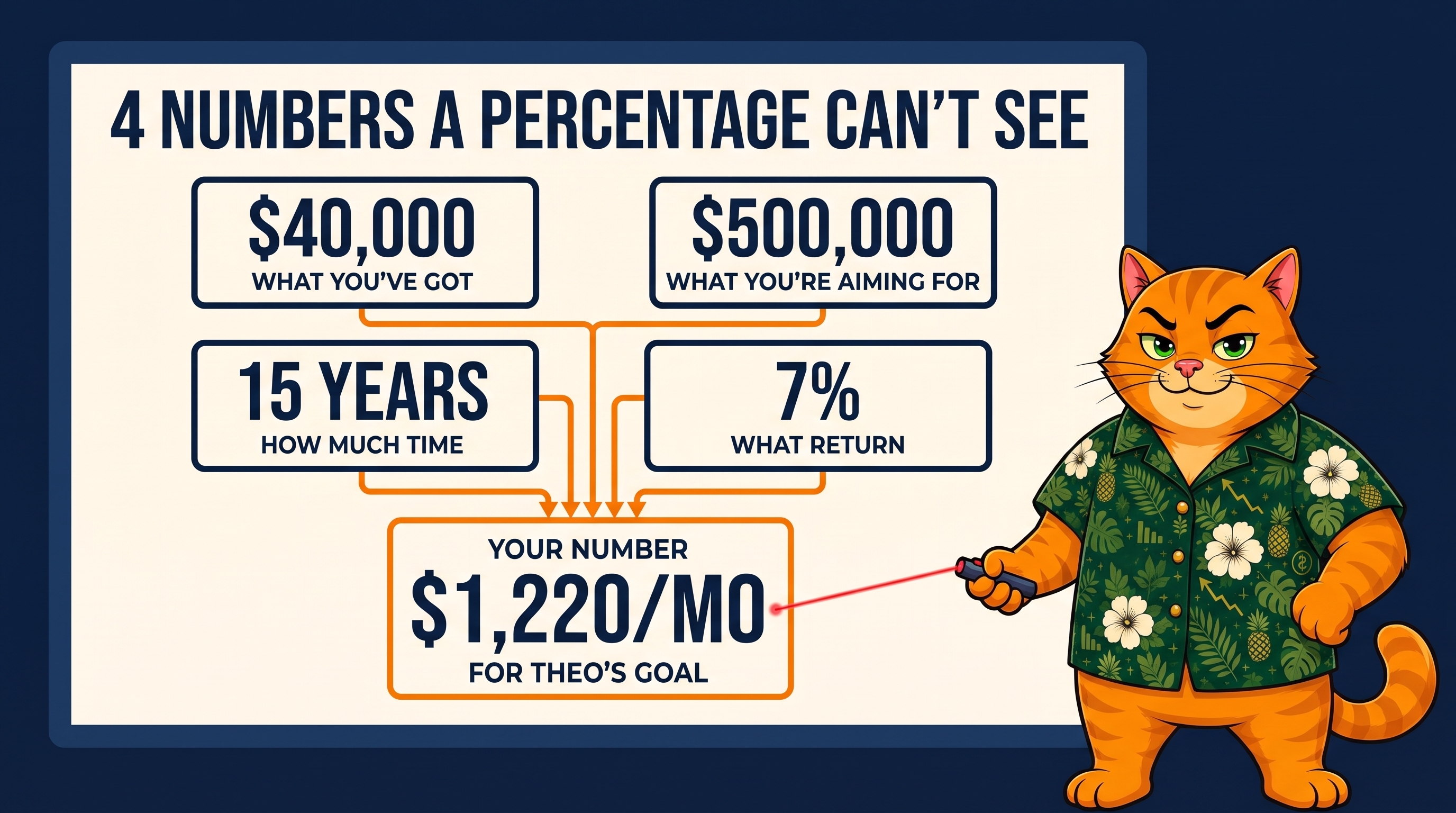
Fifteen percent isn't wrong. It's incomplete. A percentage is missing four pieces of information Theo actually needs: what he's already got, what he's aiming for, how much time he has, and what return he's assuming. Change any one of those four, and the monthly number changes.
Watch what happens when Theo gets five more years instead. Same $40,000 head start. Same $750 a month. Same hypothetical 7% return. But instead of fifteen years, give him twenty.
He ends up with about $552,000 — past his $500,000 goal. Same monthly contribution. Same starting balance. Five more years. A completely different answer.
Time isn't a footnote in this calculation. It's most of the calculation.
Working the Math Backward
Instead of asking "what does 15% get me," you can ask the question the other way: "what monthly contribution actually gets me to my goal?"
Using Theo's same assumptions, the answer for his $500,000-in-fifteen-years goal is about $1,220 a month — not $750. That's roughly $470 more every month than the guideline ever told him to set aside.
That's where the percentage runs out of answers. It gave Theo a habit. It never gave him his number.
The Four-Number Check
Current balance, goal amount, years remaining, and assumed return rate — the four inputs a monthly contribution calculator actually needs
If you're investing $750 a month and a calculator using your real numbers says your goal needs $1,220, that $470 gap is information a flat 15% rule would never have shown you.
And knowing the $1,220 figure doesn't magically put another $470 in anyone's checking account. The calculator answers one question — what your goal requires. Your actual finances answer another — what you can reasonably contribute right now. When those two numbers don't match, that's not a percentage problem. It's a tradeoff to solve: increase the contribution, extend the timeline, adjust the target, or some combination of the three. Those are real choices. A flat 15% never tells you they exist.
You don't need a perfect target to use this — a rough number still beats no number, since it can run through the same four questions a precise one can. And you don't need to do the exponents by hand: free retirement and investment calculators run this exact math in seconds. The math was never the hard part. Knowing which four numbers to hand it was.
The Average Contribution Rate Is Below 15%
Vanguard tracks what people actually put into workplace retirement plans. In its How America Saves 2026 report, the average total contribution rate for 2025 — including what employers kicked in — was 12.1%, not the 15% Fidelity recommends. That doesn't mean everyone below 15% is failing some test. It means the average contribution rate and Fidelity's guideline are two different reference points — and neither tells you what your own goal requires.
The Two Things That Change Your Real Capacity
Two things eat into your real capacity before a percentage ever gets a chance to work.
High-interest debt is the first. As of Q2 2026, the average rate on credit-card accounts assessed interest was about 22%, according to Federal Reserve G.19 data. At a simple 22% annual rate, $3,000 represents roughly $660 a year in interest before accounting for the balance changing as payments or purchases occur. Paying that interest is a guaranteed cost; a 22% investment return isn't something you can count on the same way.

The second is having nothing set aside for when life happens. FINRA notes that financial planners often recommend keeping roughly three to six months of living expenses in an emergency fund. Without that reserve, an unexpected expense or loss of income can force you to liquidate investments or take on debt at exactly the wrong time.
Where these two things fit relative to investing isn't one universal rule — independent frameworks that study this don't fully agree on the exact order every dollar should go in. What they do agree on: get whatever your employer will match first (free money nobody should leave on the table), and put real weight on the highest-interest debt early. Past that, the exact sequence has more to do with your own situation than any chart can capture. If your employer doesn't offer a match — or you're self-employed — that step simply isn't there, which means the full weight of hitting your number falls on your own contributions.
Here's What Actually Fixes This
None of this means Theo did anything wrong. He followed a perfectly reasonable guideline. He just asked it to answer a question it was never built to answer. A percentage can start the habit. It can't finish the math.
So here's the actual process:
- Figure out what you're investing toward — a dollar amount and a timeline.
- Find what you've already got invested.
- Choose a reasonable return assumption and run the numbers — asking what monthly contribution your goal requires, not what a flat percentage might become.
- Compare that answer to what you're actually investing now.
If the calculator says your goal requires $600 a month and you're investing $750, you're investing $150 more than the projection says you need. If it says your goal requires $1,220 and you're investing $750, you're $470 short. Neither outcome means you failed — it means you finally know the difference between what your goal calls for and what you're actually doing about it. From there, you can decide what moves: the contribution, the timeline, or the target itself. Revisit the number every few years, since your income, balance, and timeline all shift over time.

So, How Much Should I Invest Per Month?
So the answer to "how much should I invest per month" isn't 10%. It isn't 15%. It isn't $500. It's the monthly number your goal requires, compared against the monthly number your finances can actually support — a calculation a percentage can't do for you.
Theo started with $750 a month because 15% gave him a place to start. Now he knows his $500,000 goal calls for about $1,220 under the assumptions he used. That doesn't magically create another $470 in his budget. It tells him what decision he actually has to make: contribute more, give the money more time, change the target, or combine the three.
Fifteen percent gave Theo a habit. His own numbers gave him a plan.
Want to run your own numbers? Search "retirement calculator" and plug in your actual balance, goal, timeline, and a range of return assumptions — the same four inputs Theo's example used above. Should You Pay Off Debt or Invest First? The Math Decides and What Is an Index Fund? are good next reads if debt or fund selection is part of your own math. For the mechanics behind the return assumption itself, see Expense Ratios Explained.
Sources
Chuck Finance is for entertainment and informational purposes only. Chuck is not a licensed financial advisor, and nothing in this post constitutes professional financial, investment, legal, or tax advice. Always consult a qualified professional before making financial decisions.