
What an Expense Ratio Actually Is
An expense ratio is the annual fee a fund charges to cover its own operating costs — research, trading, management, administration — expressed as a percentage of what you have invested. If a fund charges 0.10%, that's $1 a year for every $1,000 sitting in it.
You'll never get a bill for this. There's no line item on your statement, no invoice, no notification. The fee is deducted directly from the fund's returns before that return ever shows up in your account. You just see a slightly smaller number than you should — every year, forever, for as long as you hold the fund.
That's exactly why almost nobody checks it. There's no moment where the fee announces itself. It just sits inside the return, quietly doing its job.
Index funds tend to charge less because they're not paying anyone to pick stocks — they're just tracking a market index automatically. Actively managed funds charge more because they're paying a team of people to try to beat that index. Whether that team actually succeeds is a separate question — the fee gets charged either way.
Rachel and Sophia: Same Amount, Different Fee
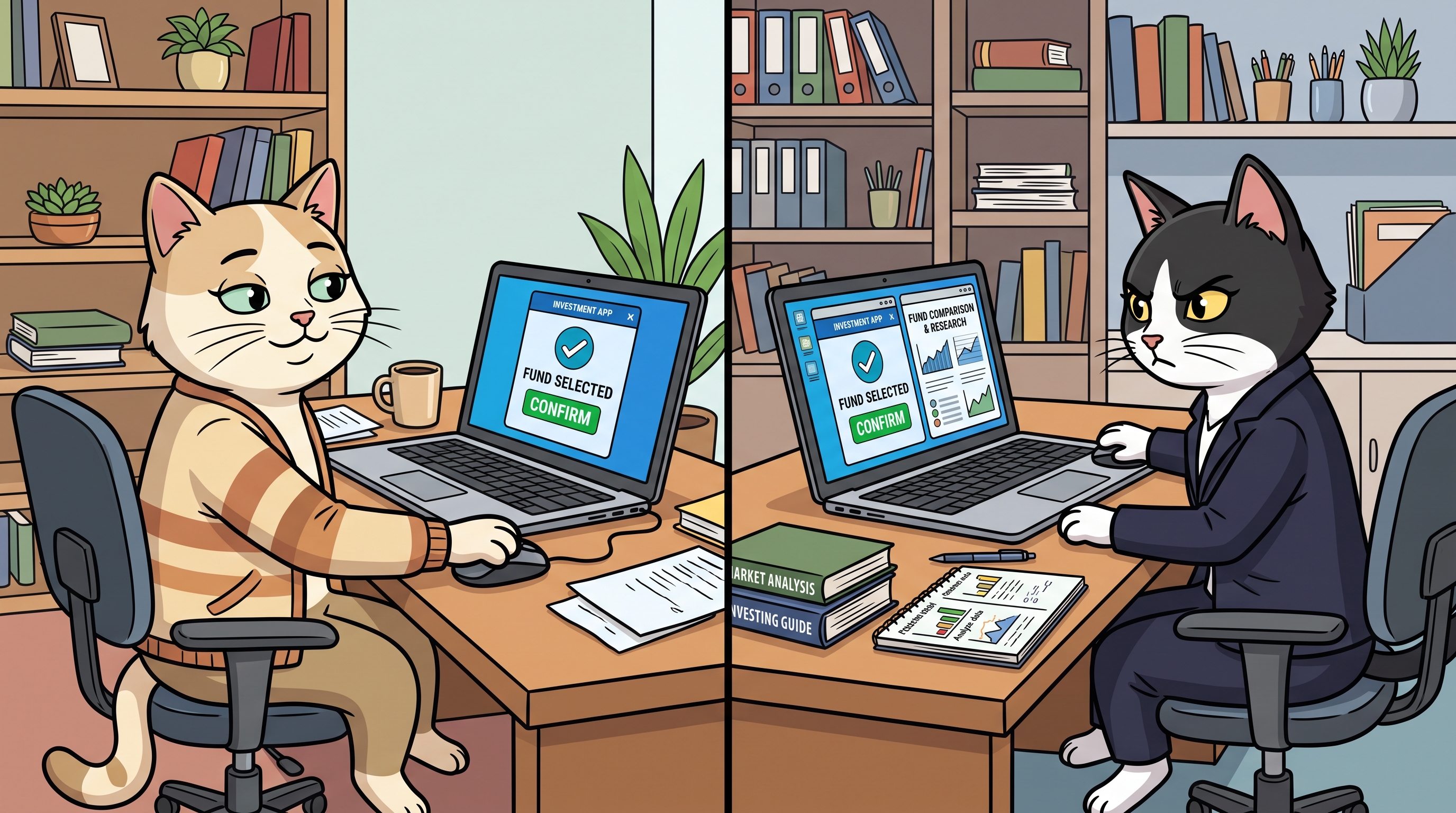
Picture two cats, each investing the same $10,000, in similar funds tracking similar markets. Same day. Same amount. The only difference is the fee.
Rachel picked a fund without checking the expense ratio. It charges 0.65% a year — right around the actual industry average for actively managed equity funds.
Sophia checked. She picked a low-cost index fund charging 0.04% — close to what many of the cheapest broad-market index funds actually charge today.
Assuming both funds earn the same 7% gross market return before fees — a common long-term benchmark, not a guarantee — here's where that 0.61% difference actually lands:
| Rachel (0.65% fee) | Sophia (0.04% fee) | Gap | |
|---|---|---|---|
| Year 10 | $18,511 | $19,594 | $1,083 |
| Year 20 | $34,260 | $38,390 | $4,130 |
| Year 30 | $63,410 | $75,240 | $11,830 |
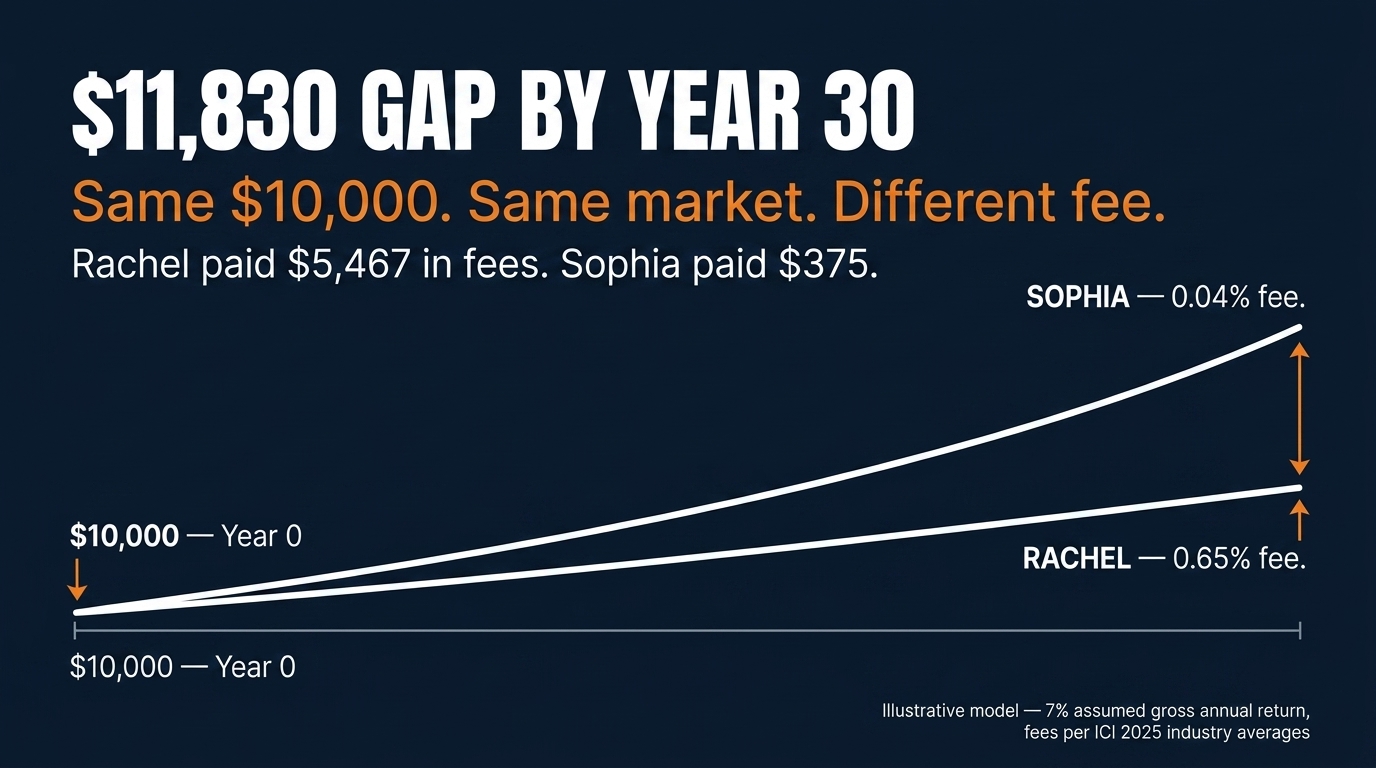
Neither cat did anything wrong with their investing strategy. Same market, same timeline, same starting amount. The entire $11,830 gap by year 30 came from one number neither of them ever saw charged.
But the ending balance only tells half the story. Here's what each of them actually paid in fees along the way — not lost opportunity, actual dollars deducted from the fund every single year:
| Rachel — Total Fees Paid | Sophia — Total Fees Paid | |
|---|---|---|
| By Year 10 | $871 | $55 |
| By Year 20 | $2,483 | $163 |
| By Year 30 | $5,467 | $375 |
By year 30, Rachel has paid more than half her original $10,000 investment in fees alone — without ever seeing a bill, an invoice, or a withdrawal notification. It just came out of her return, one year at a time, until it added up to real money.
Rachel's not bad at investing. She just never checked the paw-print on the fine print.
What's a "Good" Expense Ratio
This depends on what kind of fund you're looking at — an index fund and an actively managed fund aren't playing the same game.
For index funds and passive ETFs, anything under 0.20% is competitive, and many of the most popular broad-market options charge 0.10% or less. If your index fund is charging more than that for the same basic market exposure, you're paying for nothing extra.
For actively managed funds, anything under 0.50% is considered reasonable — though "reasonable" doesn't mean "worth it." The real question isn't just the fee, it's whether the fund is actually outperforming a comparable index by enough to justify paying more for it. Most, over long periods, don't.
Target-date funds — the default option in a lot of 401(k) plans — have gotten meaningfully cheaper too, often landing around 0.30% or below for a competitive option.
The One-Dollar Rule
A 0.10% expense ratio costs $1 a year for every $1,000 you have invested.
$50,000 sitting in a fund with a 0.65% expense ratio costs you $325 a year — money that leaves before your return ever reaches you, with no line item, no invoice, no notification.
Where to Actually Find This Number
This isn't buried. It's usually one search away.
If you have a brokerage account — Fidelity, Vanguard, Schwab, wherever — search the fund's ticker symbol directly, and the expense ratio is listed on the fund's summary page, usually labeled exactly that: "Expense Ratio" or "Net Expense Ratio."
If you're in a 401(k), your plan's fund lineup document (sometimes called a fee disclosure or fund fact sheet) lists this for every option you're allowed to choose from. It's required to be disclosed — it's just rarely highlighted.
Either way, this is a five-minute check, not a research project.
If you're shopping for a new index fund or ETF, check the expense ratio before you check anything else. Two funds tracking the same index will hand you close to the same return — the fee is very often the actual difference between them.
The Part Chuck Wants You To Actually Do
Go look up the expense ratio on one fund you already own — doesn't matter which one, just pick one. If it's an index fund charging under 0.20%, you're in good shape. If it's an actively managed fund charging over 1%, it's worth asking whether that fund has actually beaten a comparable index enough to earn that premium.

You don't need to overhaul your whole portfolio over this. You just need to know the number is there, know what it's costing you, and decide on purpose — not by accident.
Sources: