The Actual Mechanic: Deduct Now vs. Pay Later
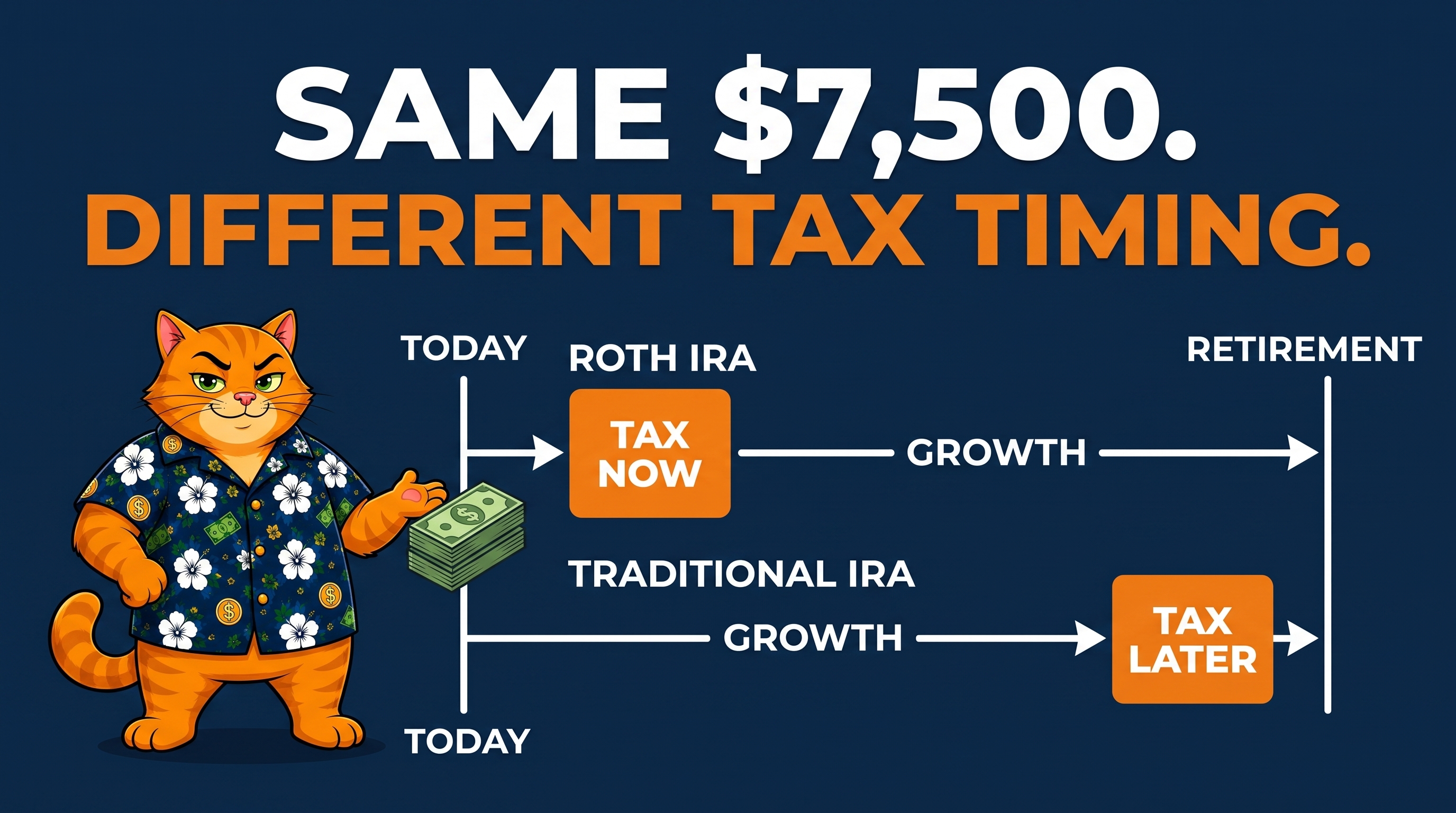
Strip away the marketing and an IRA — an Individual Retirement Account — is just a tax-advantaged account you open and fund yourself, outside of any employer plan. The government created it to give people a real tax benefit for saving toward retirement. There are two main versions, and they hand you that benefit at opposite ends of the timeline.
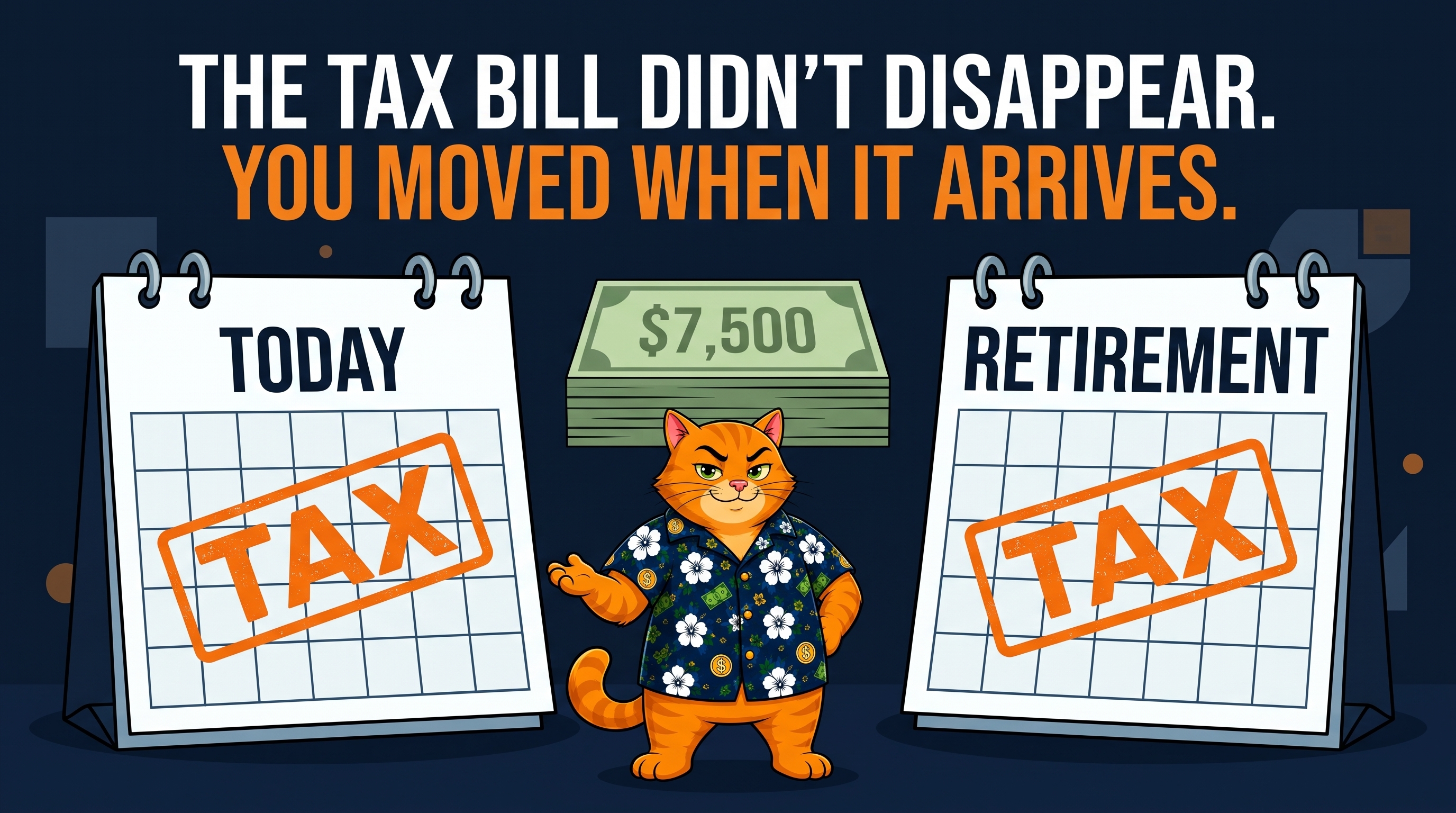
A Traditional IRA gives you a tax break the year you contribute — assuming your contribution is deductible, which isn't automatic (more on that below) — and you pay income tax on it later, when you withdraw. A Roth IRA runs in reverse: you pay the tax up front, and everything that money grows into after that is yours, tax-free, permanently. Same contribution limit for both — $7,500 for 2026, or $8,600 if you're 50 or older. Same basic account type. Completely different tax bill, just collected at different ends of the timeline.
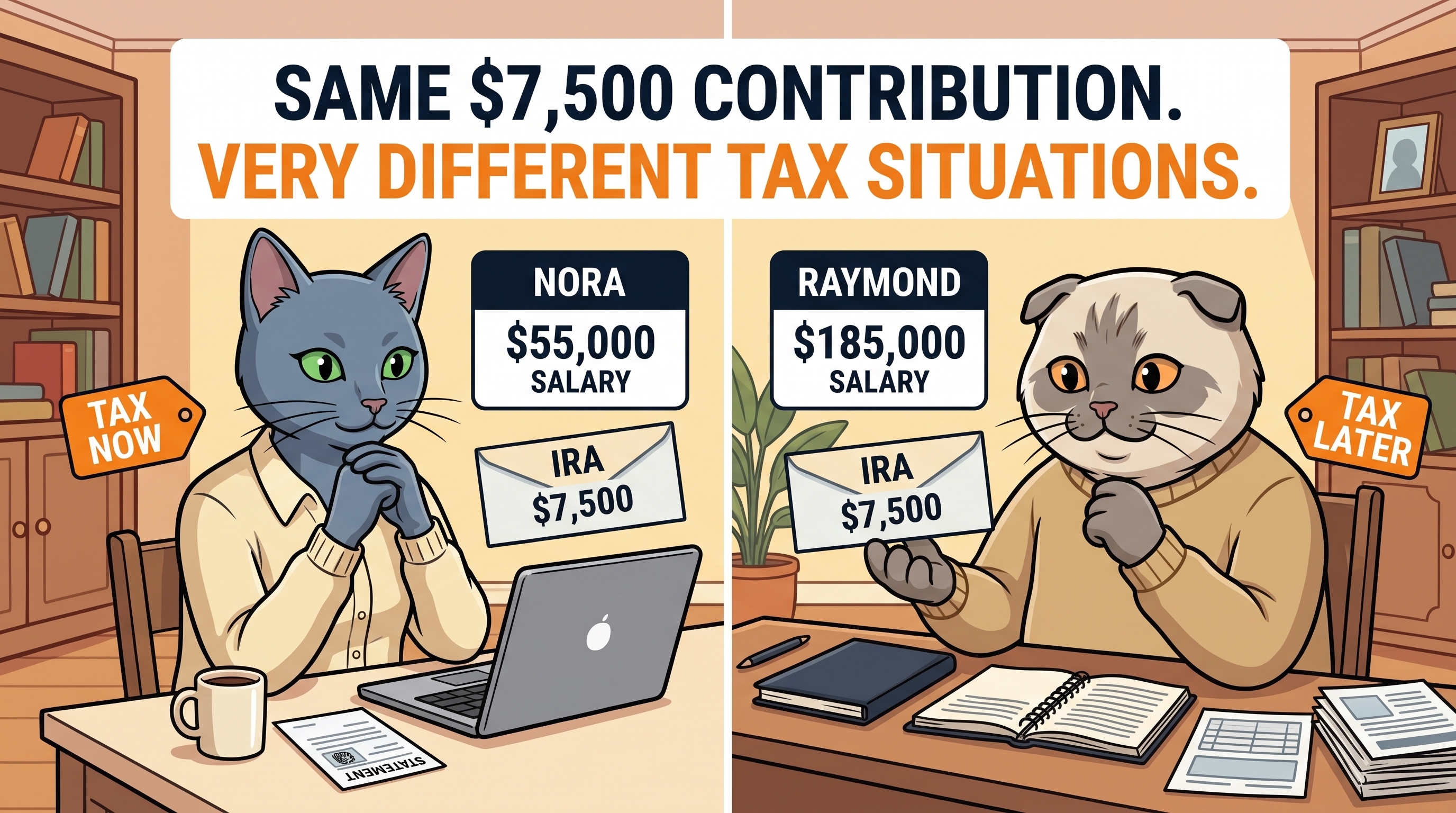
Nora picked Roth. She's early in her career, earning $55,000 a year, with plenty of room for her income to climb — paying tax now, while her paycheck is still relatively small, is a reasonable bet. Raymond picked Traditional. He's closer to his peak earnings as an engineering manager making $185,000 a year, and because his employer doesn't offer a retirement plan at all, his Traditional contribution is fully deductible with no phase-out to worry about. He gets the deduction now, while it's worth the most to him, and expects to withdraw the money later at a lower rate.
Here's the part Roth fans don't love hearing: if your tax rate is exactly the same today and in retirement, Roth doesn't automatically win. Compare the two accounts fairly — including what Raymond does with the tax savings his deduction hands him today — and the after-tax math can come out the same. Roth isn't magic. It's tax timing. The advantage only shows up when your tax rate actually changes between now and later.
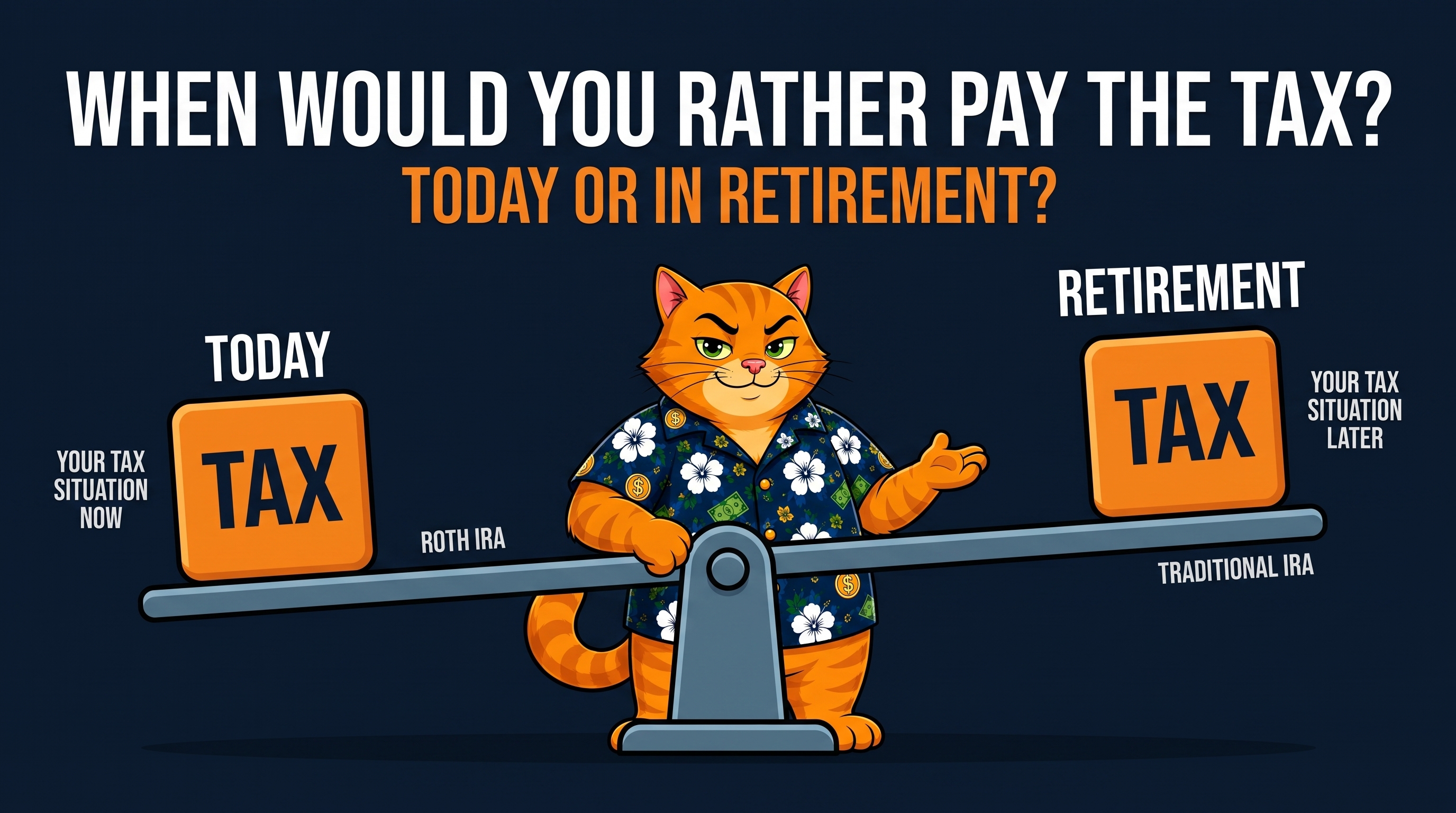
This is also why "which one is better" is the wrong question to ask a stranger on the internet. It's not a universal answer — it's a personal one, built from two things only you actually know: what you're earning today, and what your best guess is about what you'll be earning when you retire. Nora and Raymond aren't case studies in who's smarter with money. They're case studies in why the same $7,500 decision can be correct twice, in opposite directions, for two different people.
The Age Nobody's Thinking About
That's not the only thing separating Nora and Raymond. There's a number neither of them is thinking about yet: 73.
Under current law, Traditional IRA owners are forced to start withdrawing money at age 73 — or 75, depending on when they were born — whether they need it or not, and whether it pushes them into a higher tax bracket or not. These are called Required Minimum Distributions, or RMDs. Miss the deadline and the penalty is 25% of whatever you didn't take out, cut to 10% if you fix it fast (IRS, 2026). Once Raymond hits that age, he'll get a letter every year telling him the minimum amount he's required to pull out, whether he needs the cash that year or not.
Roth accounts don't have this problem. A Roth owner can let the account sit for the rest of their life and never be forced to touch a dollar.
RMDs exist because the government gave Traditional IRA owners a deal: skip the tax now, but the deferral isn't indefinite. Eventually the IRS wants its share, and it sets the schedule rather than leaving it up to you. Roth contributions were already taxed going in, so there's nothing left for the IRS to collect on a fixed timeline — which is the whole reason the RMD requirement doesn't apply to them.
Quick gut check: do you actually know whether your own account is a Roth or a Traditional? Not "pretty sure" — the real answer, off your last statement.
The Traditional IRA Deduction Isn't Automatic
Now for the part almost nobody tells you straight: putting money into a Traditional IRA does not automatically mean you get the deduction.
If you're single and covered by a retirement plan at work, the Traditional IRA deduction starts phasing out at $81,000 of income and disappears completely at $91,000. Married and filing jointly, when the spouse contributing is covered by a workplace plan, that phase-out runs from $129,000 to $149,000 (IRS, 2026). But if neither you nor your spouse is covered by a plan at work, none of those phase-outs apply — the deduction is yours regardless of income.
That's Raymond's situation exactly. No workplace plan means his $185,000 salary doesn't disqualify him from anything. Without that detail, his income alone would have priced him out of the deduction completely.
The Roth Income Limits — And the Backdoor Workaround
On the Roth side, the income limits work differently, and they hit everyone — plan or no plan. If you're single and earning more than $168,000, you're locked out of Roth contributions completely. Married and filing jointly, that number is $252,000. There's a phase-out zone before you hit the wall: room to contribute starts shrinking once you cross $153,000 single or $242,000 married, but past the ceiling, the door's shut (IRS, 2026).
Picture it as a dimmer switch, not a light switch. A single filer at $153,000 can still put in the full amount. Push into the middle of that range and the allowed contribution shrinks proportionally — maybe you're only cleared to put in half of it. Cross $168,000 and the switch is all the way off. Most people don't even know they're standing in that dimmer zone until tax season, when the contribution gets flagged as excess and they have to pull it back out.
Locked out of a direct Roth contribution doesn't mean locked out of Roth money, though. You can still put the cash into a Traditional IRA with no deduction, then convert it to Roth — a two-step move people call the backdoor Roth. It's legal, it's common, and the IRS has never closed it. There's one catch: if you already have pre-tax money sitting in a Traditional, SEP, or SIMPLE IRA, the pro-rata rule can make part of that conversion taxable. Backdoor Roth sounds simple. The tax form occasionally disagrees.
One more option worth five minutes of checking: a lot of workplace plans now include a Roth 401(k) alongside the traditional version — same paycheck deduction, same employer match rules, but Roth tax treatment, and it doesn't carry the income limits that block a Roth IRA. If you're already locked out of a direct Roth IRA contribution, check whether your plan offers a Roth 401(k) before you bother with the backdoor conversion.
Traditional also had a twenty-year head start on all of this. The Roth IRA wasn't created until 1997, and you couldn't actually open one until 1998 — Traditional IRAs had already been around for more than two decades by then. Traditional feels like the original because it is. Older doesn't mean better. It means older.
There's another difference worth knowing before it matters: a Roth lets you pull out whatever you originally contributed — not the growth, just your own contributions — at any age, for any reason, with no tax and no penalty, because you already paid the tax going in. Try that with a Traditional IRA before age 59½ and you're handing over income tax plus a 10% penalty on top. One of these accounts is far less forgiving if life happens before retirement does.
What the Average IRA Balance Actually Hides
Empower looked at IRA balances in its Personal Dashboard data as of March 2026. The average IRA balance was $281,280. The median — the point where half of savers have more and half have less — was $41,084 (Empower, March 2026).
The RMD Rule
Traditional IRA: forced withdrawals starting at age 73 (or 75). Roth IRA: no forced withdrawals, ever.
If you want to control when — or whether — you touch that money in retirement, Roth is the account that lets you. The government sets the withdrawal schedule on Traditional, not you.
That's not a small gap. The average is almost seven times higher than the median, because a relatively small number of very large accounts pull the average way up. So if you're closer to $41,000 than $281,000, you're a lot closer to the middle than the average makes it look. The account you choose from here matters more than the number you're starting with.
It's worth sitting with why that gap exists, because it changes how you should read every "average American has $X saved" headline you'll ever come across. A handful of accounts that have been compounding for decades — often Traditional accounts opened back when Roth didn't exist yet — can single-handedly drag a national average upward while doing nothing to represent what a typical saver actually has. The median is the more honest number for figuring out where you stand. The average is the more useful number for figuring out how far compounding can eventually take an account that started small.
The Part Chuck Wants You To Actually Do
Nora's version of this ends with her keeping every one of those dollars once RMD age hits. Raymond's doesn't — but Raymond made the right call for his situation anyway, because the deduction he took today was worth more to him than tax-free withdrawals decades out.
If you're early in your career, probably earning less now than you will later, Roth starts looking very hard to beat: you're paying tax on this year's smaller paycheck instead of some future, larger one, and once RMD age hits, there's no forced withdrawal schedule breathing down your neck. Traditional earns its spot when you're already in a high tax bracket right now, your contribution is deductible, and you expect a lower bracket in retirement — that's a real case, just a narrower one than most people assume when they default into it without thinking.
Most people fall into neither extreme. They're mid-career, earning more than they used to but nowhere near their ceiling, with no real idea whether their tax bracket in thirty years will be higher or lower than it is today. Nobody actually knows that answer with certainty. The real mistake isn't picking Roth or picking Traditional — it's paying tax at the expensive end of the timeline when you had a reasonable shot at paying the cheaper one. Guess wrong either way, and that's what it costs you.
If that's where you are, the simplest move is asking one honest question: is your income still climbing hard, or has it mostly leveled off? Still climbing — lean Roth. Already near your ceiling with retirement in sight — Traditional starts making real sense. And it's not all-or-nothing: you can hold both account types at once, and plenty of people do exactly that instead of betting everything on one guess about the future.
The uncomfortable part isn't the math — the math is simple once someone actually walks you through it. The uncomfortable part is realizing you've been contributing to one or the other for years without ever checking whether it matched your situation. That's fixable today. It's not fixable retroactively once you're already at RMD age and the IRS is sending the withdrawal notice.
If you're figuring out the 401(k) side of this same decision, Traditional 401(k) vs. Roth 401(k): What's the Difference? walks through the same timing logic applied to your workplace plan. And if you just want the raw numbers for both account types side by side, 2026 401(k) and IRA Contribution Limits, By Age, Explained Once has them.
Pick the account that matches where you actually are — not the one your coworker mentioned in the break room. Nora and Raymond didn't get lucky. They each did the math for the life they were actually living.
Sources cited in this post: