What Owning a Piece Actually Means
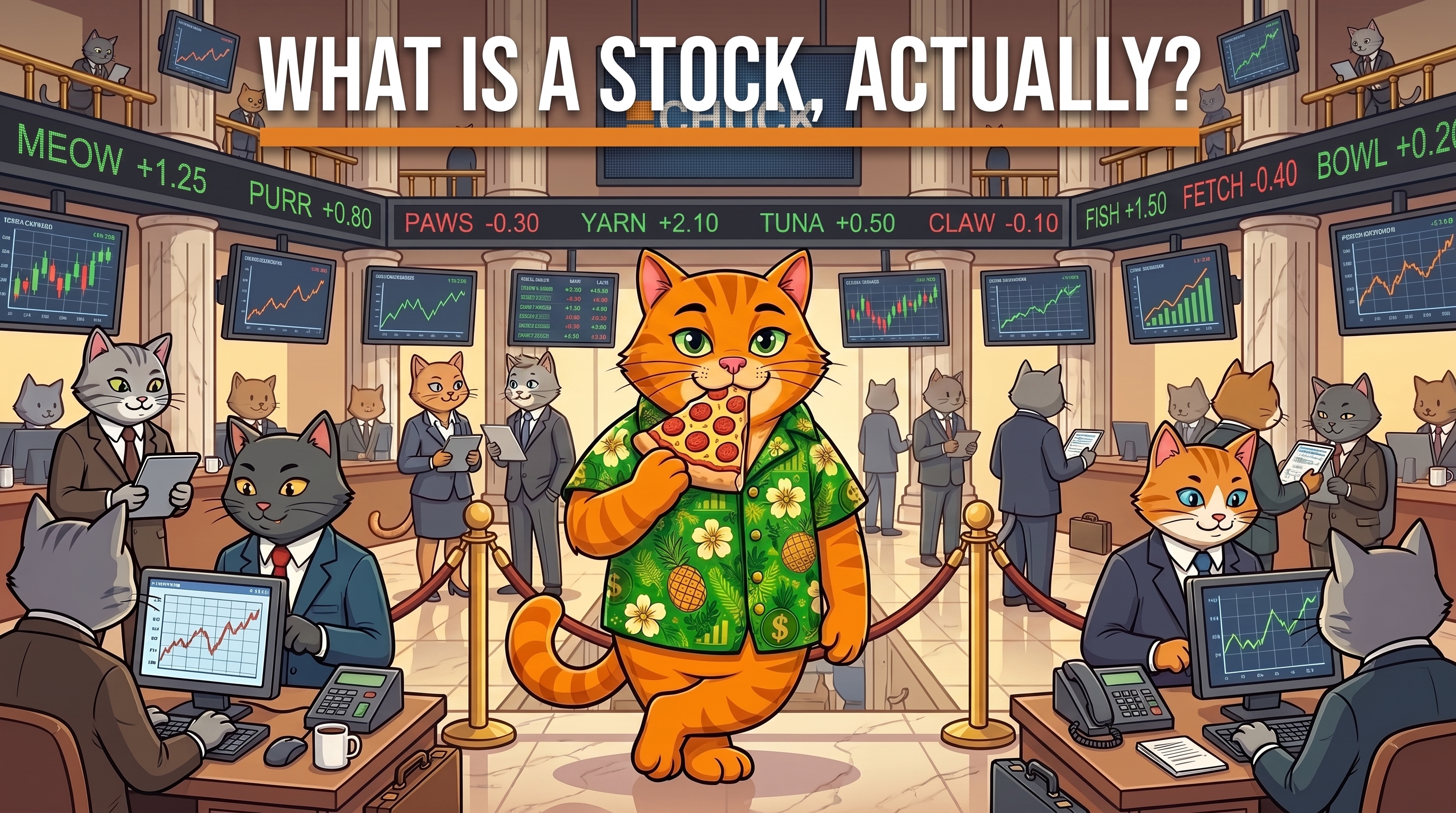
When you buy a stock, you own a tiny slice of that company — a real, legal claim on a piece of it, not a metaphor. Its value moves with how the company's doing and how the market feels about it. You don't get a vote on what happens in the break room, and you're not entitled to a say in daily decisions. What you own is a claim on the company's value, not a job title.
Companies You Already Know
This gets easier once you attach it to companies you already recognize. Apple makes iPhones. Amazon runs a huge share of e-commerce and a significant piece of the internet's cloud infrastructure behind the scenes. Nike makes shoes and sponsors half the athletes you watch on television. Starbucks sells coffee on what feels like every third corner in most American cities.
Every one of those is a company you can own a small piece of. Owning a share makes you a shareholder — a partial owner with a legal claim on that slice of the business, no matter how small the slice is. That claim doesn't change based on the company's size: a share of Apple works on the exact same mechanism as a share of a company nobody's heard of. Money in exchange for a legal claim on a piece of the business. The size of the company doesn't change what a share actually is.
Jamie's Five Years
Jamie doesn't carry much debt and had $5,000 sitting with nowhere assigned to go. Jamie put all of it into a company called Cat Tech, at $35 a share — about 143 shares. (Cat Tech isn't a real company — this whole example is illustrative, not investment advice about an actual stock.)

Two weeks in, Cat Tech dropped 5%, down to $33.25 a share. If Jamie had sold right there instead of holding, that original position would've shown a $250 loss — which could have offset other capital gains, or up to $3,000 of ordinary income for that tax year. That's a separate, long-standing IRS rule on capital losses, not tied to any particular year's figures.
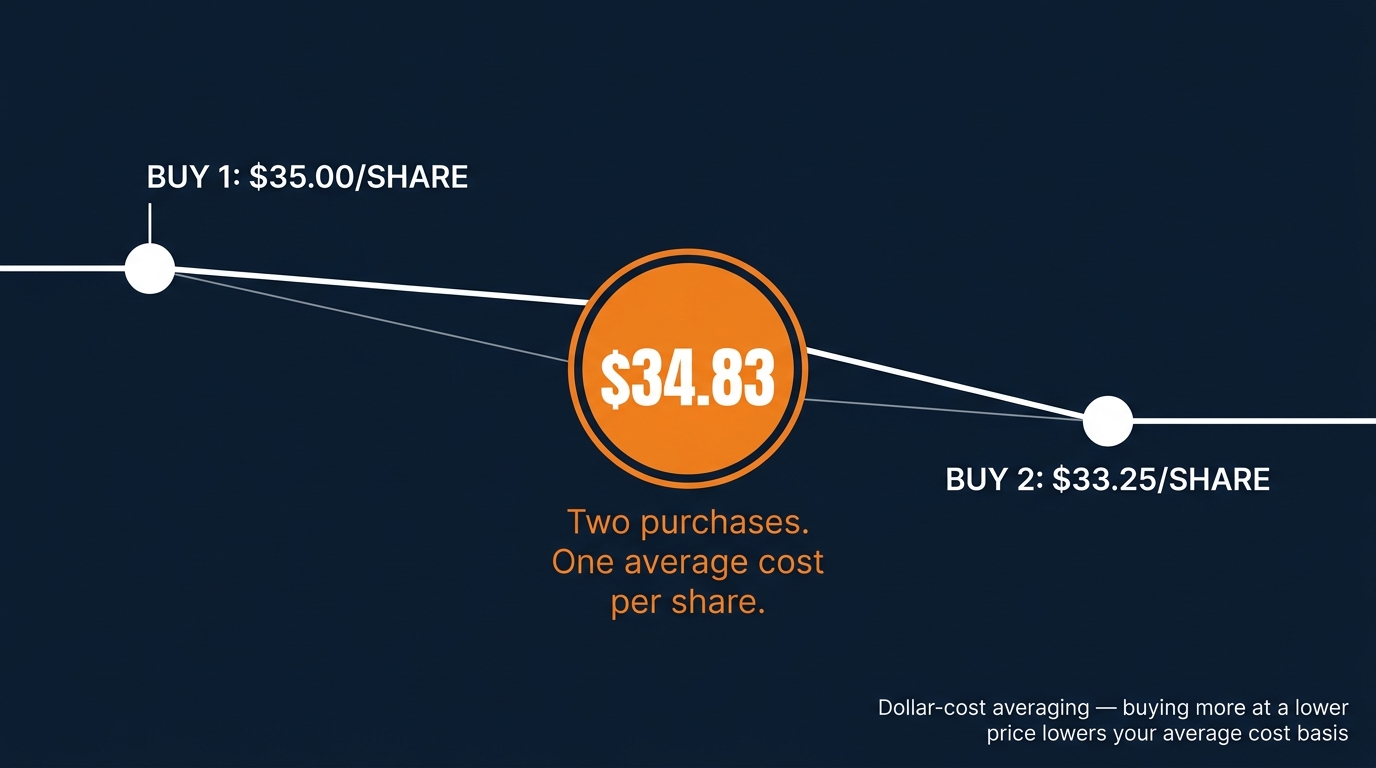
Jamie didn't sell. Instead, Jamie added another $500 at the lower price — about 15 more shares — buying more while the price was cheaper instead of panicking over a dip. That's dollar-cost averaging in practice: adding money on a schedule or in response to a lower price, not trying to guess the bottom. Jamie now owned roughly 158 shares, $5,500 invested total, at a blended average cost of about $34.83 a share — the two purchase prices combined into one number.
A few weeks after that, Cat Tech jumped 15% from that dip price, up to $38.24 a share. Jamie's position was suddenly worth about $6,040 — a gain of roughly $538 on paper. Selling right then would've felt great, until the tax bill: Jamie had held the stock less than a year at that point, so the gain would've been taxed as ordinary income. Assuming a 22% bracket for illustration, that's about $118 in tax on a $538 gain. So Jamie held.
Jamie kept holding. No drama, no daily checking, for five years. By year five, Cat Tech was up 287% from that original $35 share price — a final price of $135.45 a share. Jamie's roughly 158 shares were now worth about $21,390, on $5,500 invested. That's a gain of roughly $15,890.
When Jamie finally sold — to help fund a house down payment — the holding period was well past a year, so that entire $15,890 gain qualified for long-term capital gains treatment. Assuming a 15% long-term rate, Jamie owed about $2,384 in tax on that gain. Here's the number that actually matters: if that same $15,890 gain had been taxed at the short-term rate instead, it would've cost roughly $3,496 — meaning waiting past the one-year mark saved Jamie about $1,112, on the exact same dollar amount of profit.
The One-Year Line
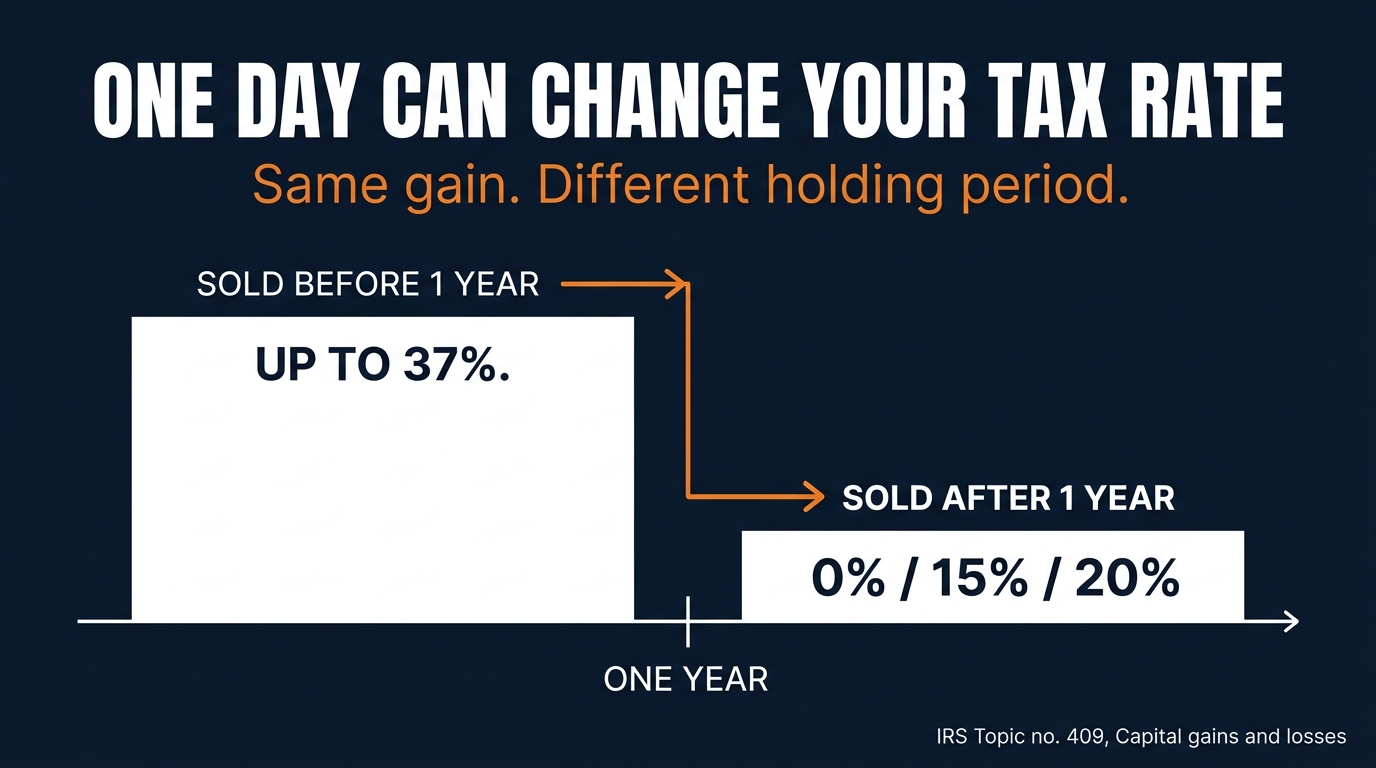
Sell before you've held a stock for one year, and any gain is taxed as ordinary income — up to 37%. Wait past that one-year mark, and the same gain qualifies for the long-term rate: 0%, 15%, or 20%.
On Jamie's roughly $15,890 gain, that's the difference between paying ordinary income tax rates and the much lower long-term rate — for holding the exact same stock, just past the one-year mark instead of before it.
What Jamie's Story Actually Teaches
Here's the vocabulary that story was actually teaching:
- Appreciation — Cat Tech's price going up over the five years Jamie held it
- A short-term dip — the 5% drop two weeks in, which didn't mean anything about the company's actual long-term value
- Dollar-cost averaging — buying more shares at the lower price instead of panic-selling
- Short- vs. long-term capital gains — selling before one year means ordinary income tax rates; selling after means the lower long-term rate

Stocks vs. the Things People Confuse Them With
A stock is ownership in one company. That's easy to mix up with two other things people hear about constantly.
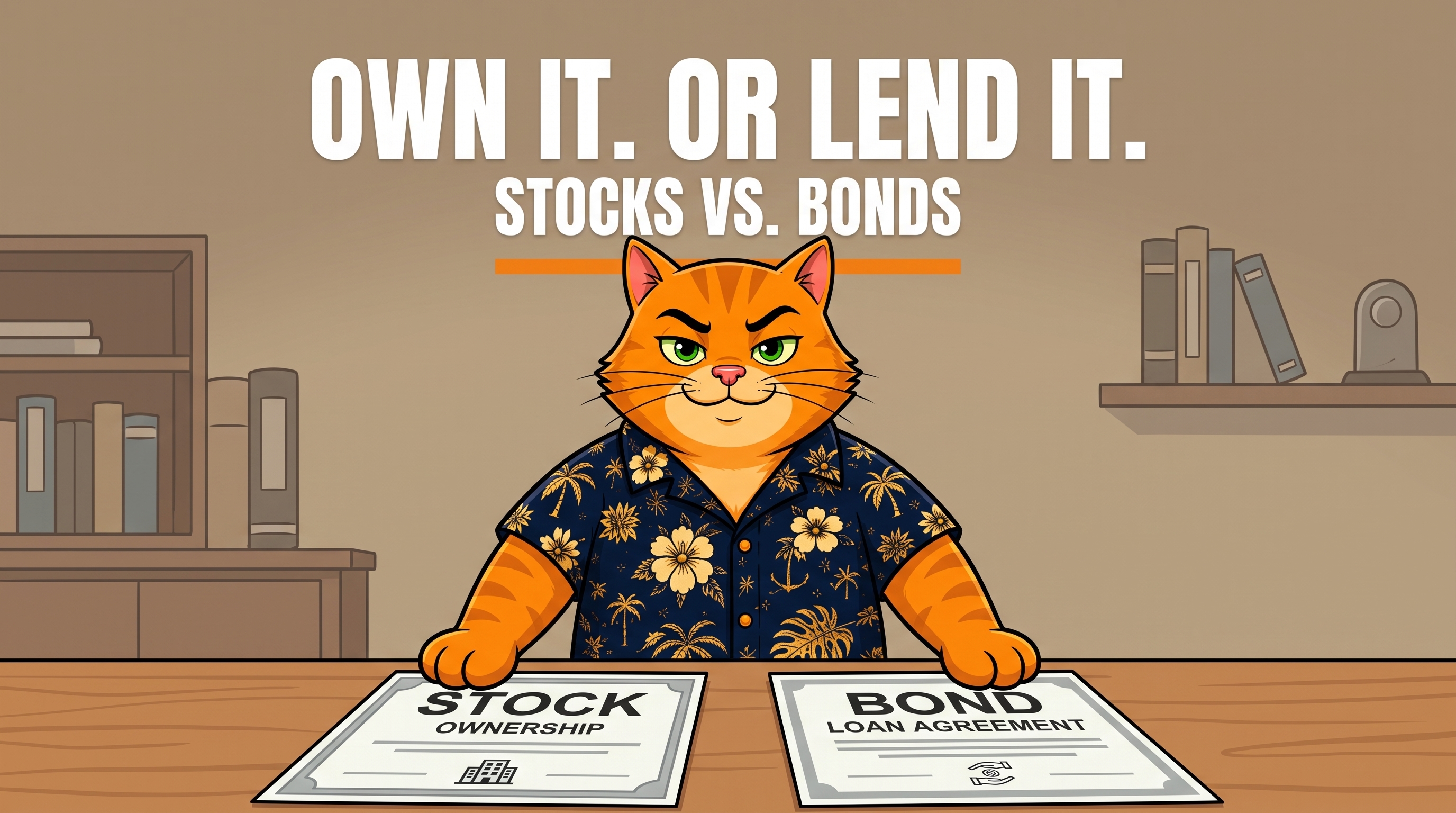
A bond is not ownership — it's a loan. When you buy a bond, you're lending money to a company or government, and they pay you back with interest over a set period. You're a creditor, not an owner. You don't get a slice of the company's future value the way a shareholder does, but you also don't take on the same risk — bondholders generally get paid before shareholders if a company runs into serious trouble.
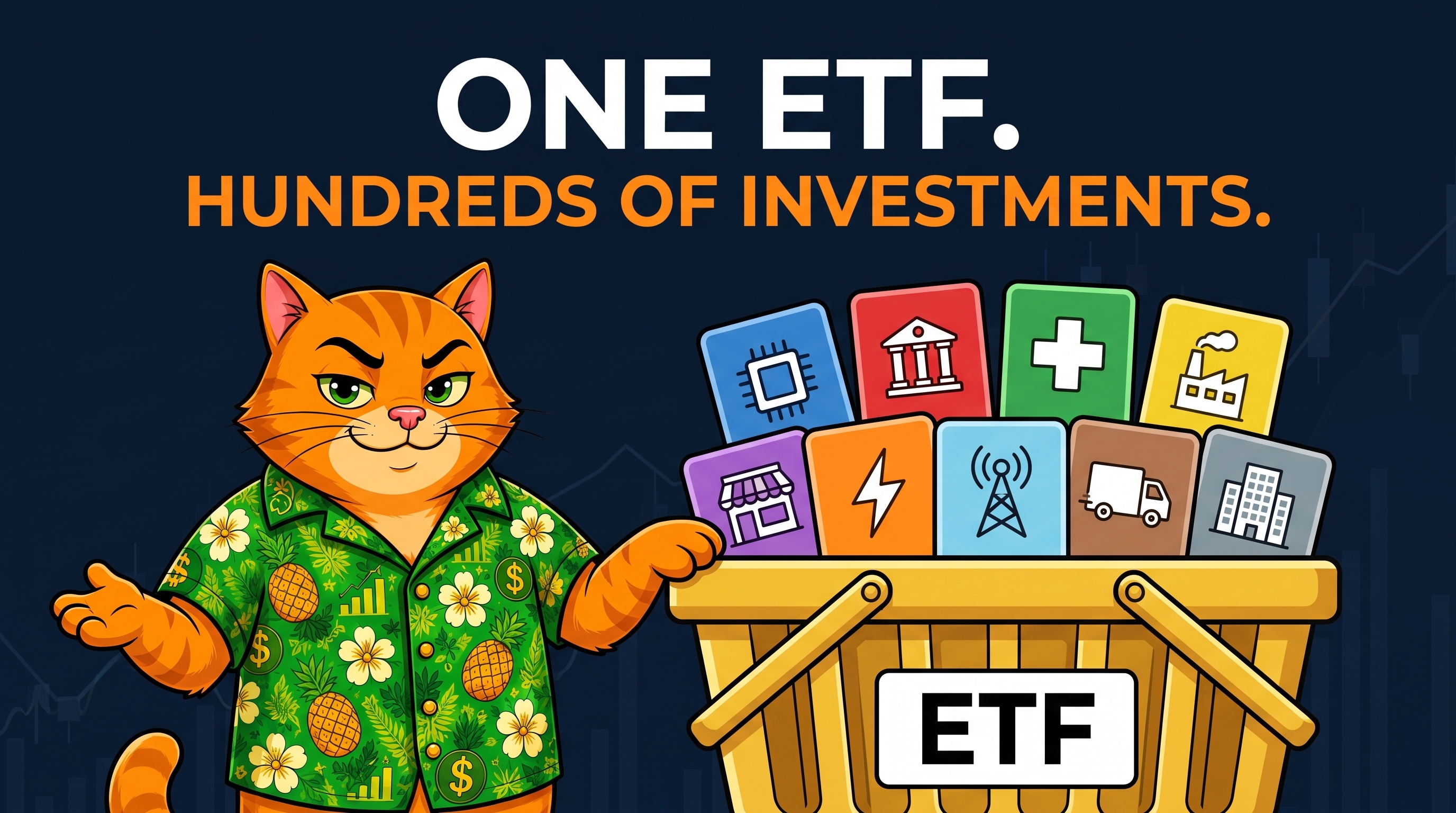
An index fund or ETF is neither a single stock nor a single loan — it's a basket holding many individual stocks bundled into one fund. Buying one share of an index fund means owning a tiny slice of every company inside that basket at once, instead of betting on one company the way Jamie did with Cat Tech. That's a meaningfully different bet, and it comes with its own fee structure worth understanding on its own.
Where This Actually Fits in Your Priority Order
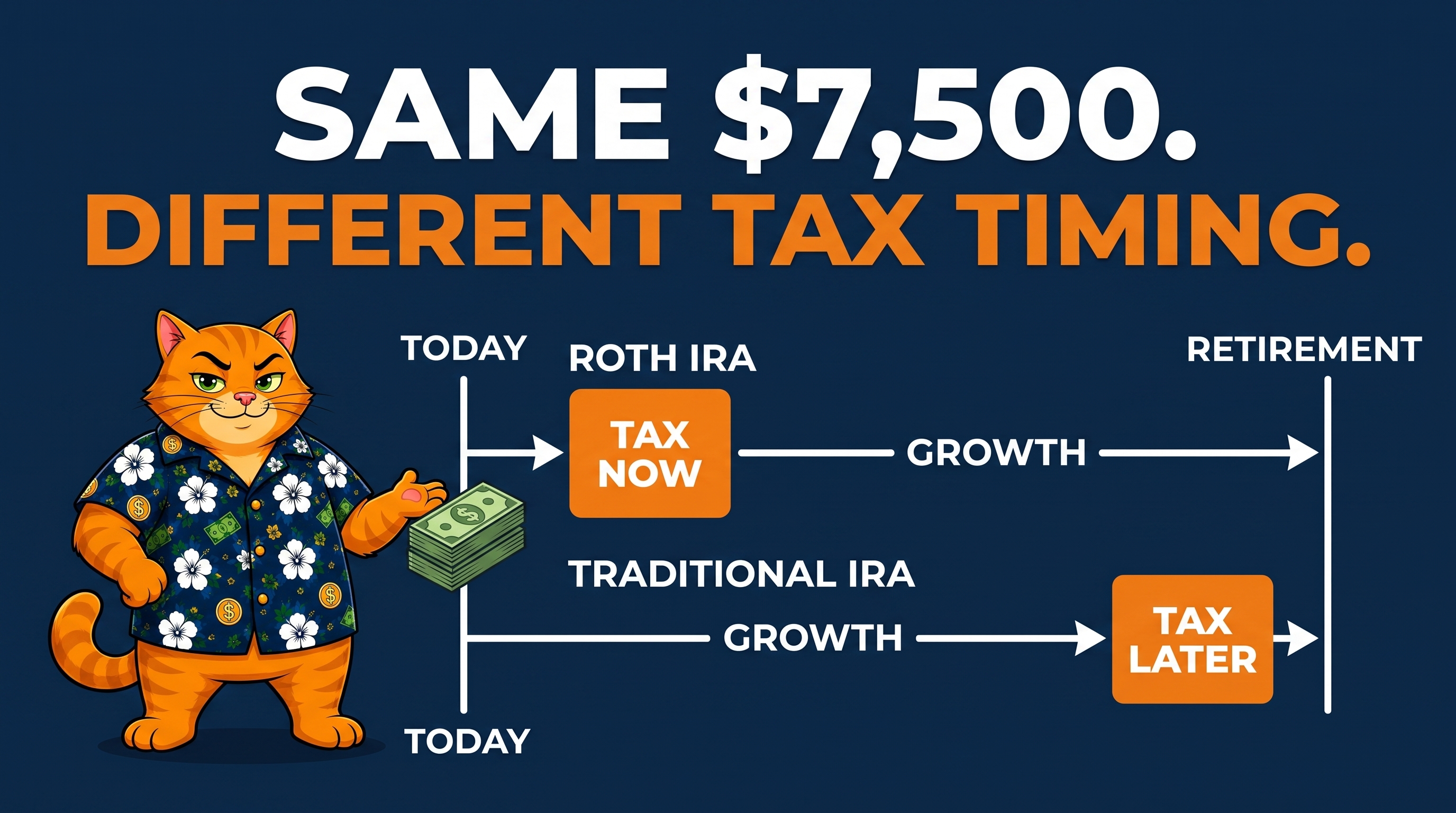
Before any of this — before Cat Tech, before Apple, before picking a single individual stock — a few things generally come first. Get the full employer match on your 401(k) if one's offered; turning down free money to go pick stocks instead doesn't make sense for almost anyone. Max out a Roth IRA if you're eligible — up to $7,500 for 2026, or $8,600 if you're 50 or older. Build an emergency fund that actually covers 6 months of real expenses, not a rough guess.
Individual stocks come after that, not before it. They're not the foundation — they're what you do with money you're willing to ride through the ups and downs of a single company for, once the foundation's already handled.
The Mistake Almost Every Beginner Makes
It's not picking the wrong stock. It's assuming you need to pick individual stocks at all in order to start investing. Most people are better served starting with a broad-market fund and treating individual stock ownership — if they ever do it, and only after the priority order above is handled — as something they add later, not something they need to figure out on day one.
Read This Next
If you haven't started investing at all yet, that's the actual first step — worth reading before you spend more time thinking about individual stocks like Jamie's.
Sources: