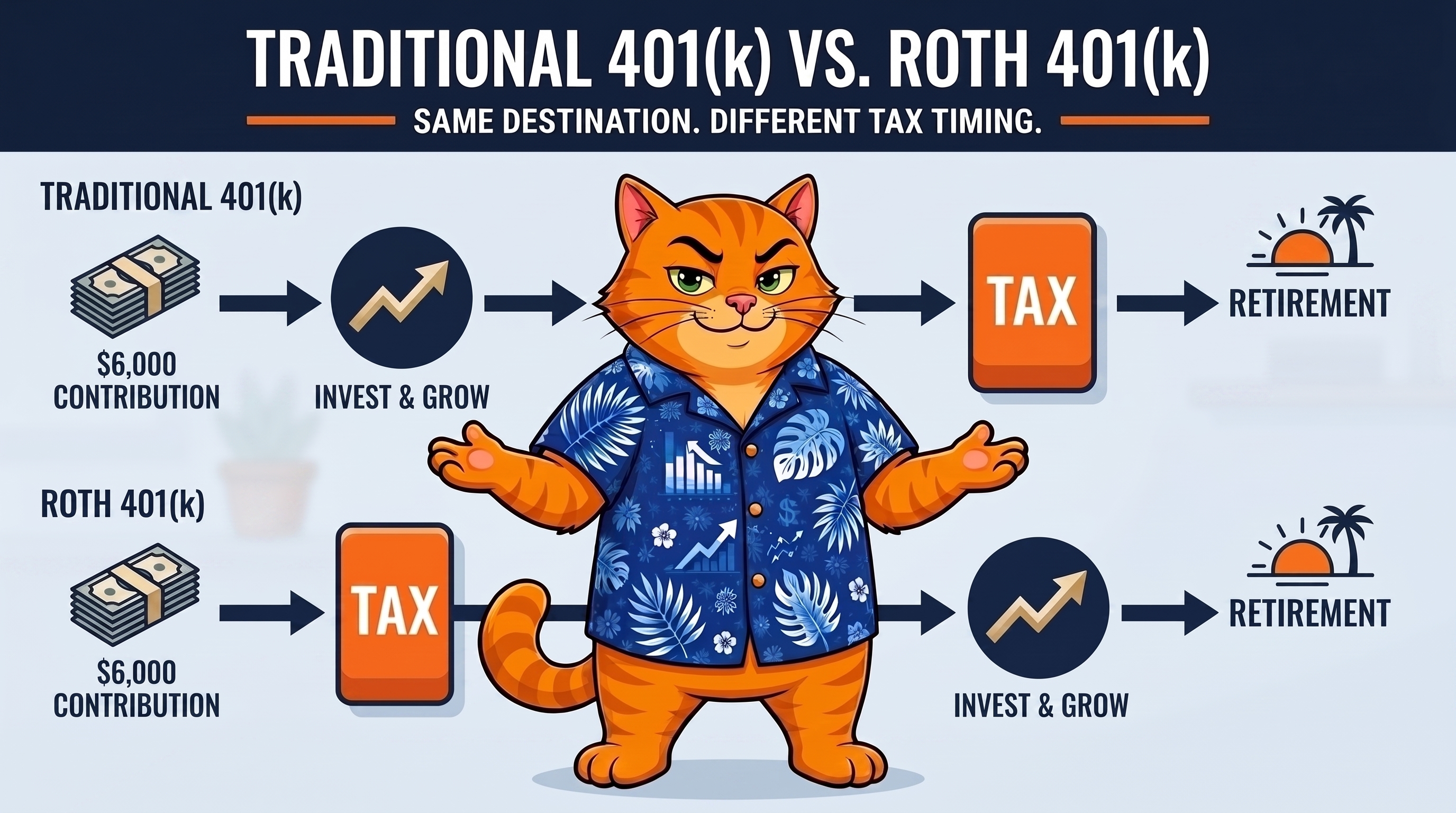
Pre-Tax Now vs. Taxed Later
Traditional 401(k) contributions come out of your paycheck before taxes are calculated — you get the tax break now, and you pay income tax on the money when you withdraw it in retirement. Roth 401(k) contributions come out after taxes are already taken — no break now, but qualified withdrawals in retirement are completely tax-free.
Same account type, same contribution limits, same investment options. The only thing that changes is which side of retirement the tax bill lands on.
Roth 401(k) vs. Roth IRA — Not the Same Bucket
Before going further, it's worth clearing up a common mix-up: a Roth 401(k) and a Roth IRA are not the same account. "Roth" describes a tax treatment — no break today, tax-free qualified withdrawals later — and both account types share that treatment. But they're two separate retirement buckets with their own rules.
A Roth 401(k) is offered through an employer, subject to standard 401(k) contribution limits, and has no income limit — anyone can contribute regardless of how much they earn, and as of 2024, Roth 401(k)s no longer require minimum distributions during the account owner's lifetime, per the IRS's own guidance.
A Roth IRA is opened individually, entirely outside any employer, comes with its own separate and much lower contribution limit, and phases out above certain income levels — high earners can lose eligibility to contribute directly. Like a Roth 401(k), it's also never subject to lifetime required distributions.
They're not the same bucket, and contributing to one doesn't use up room in the other. It's entirely possible — and common — to have both at once.
Spencer and Monique, Same Contribution
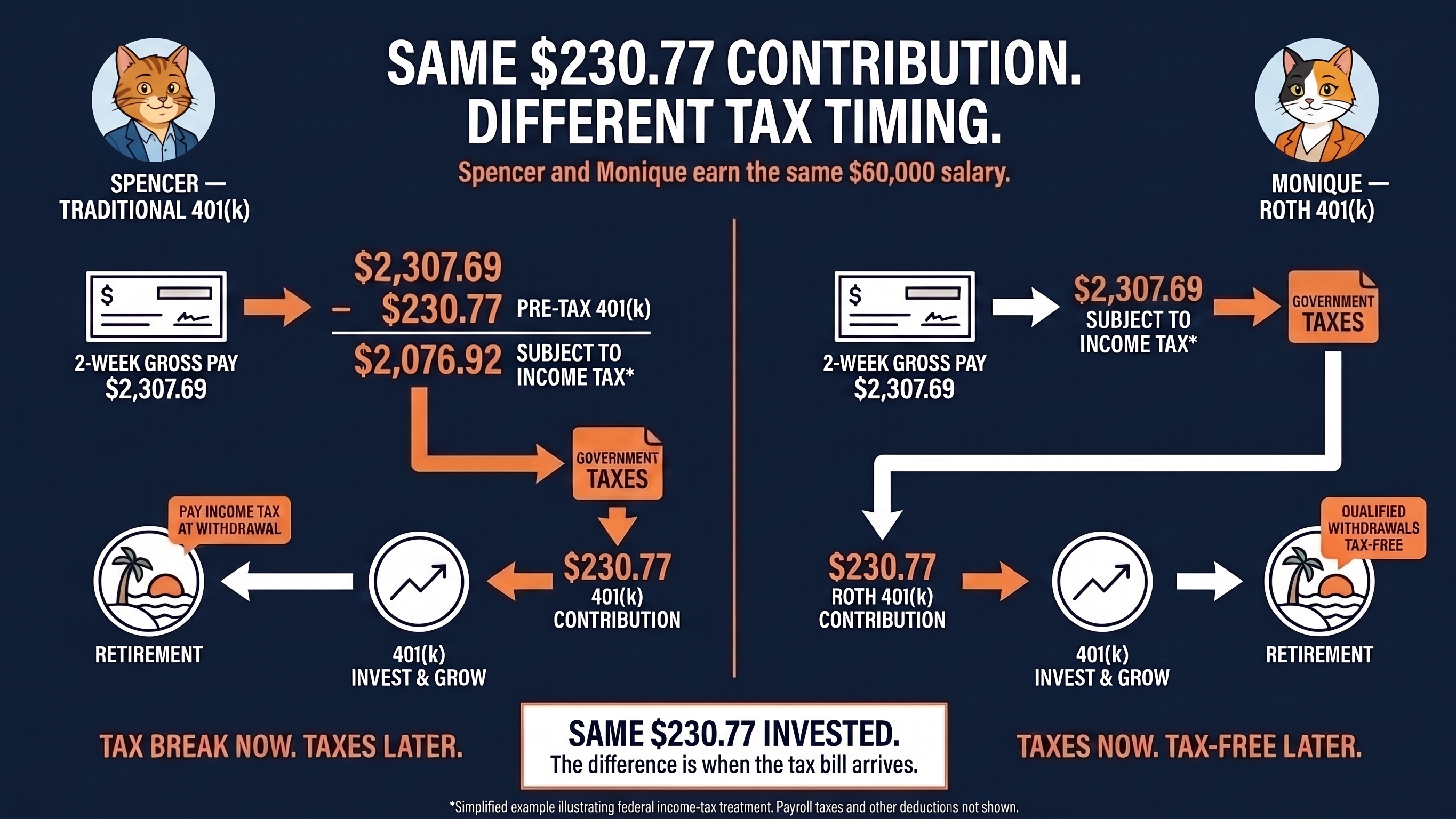
Spencer and Monique both earn $60,000 a year and both contribute $500 a month — $6,000 a year — to their 401(k). Spencer picked Traditional. Monique picked Roth.
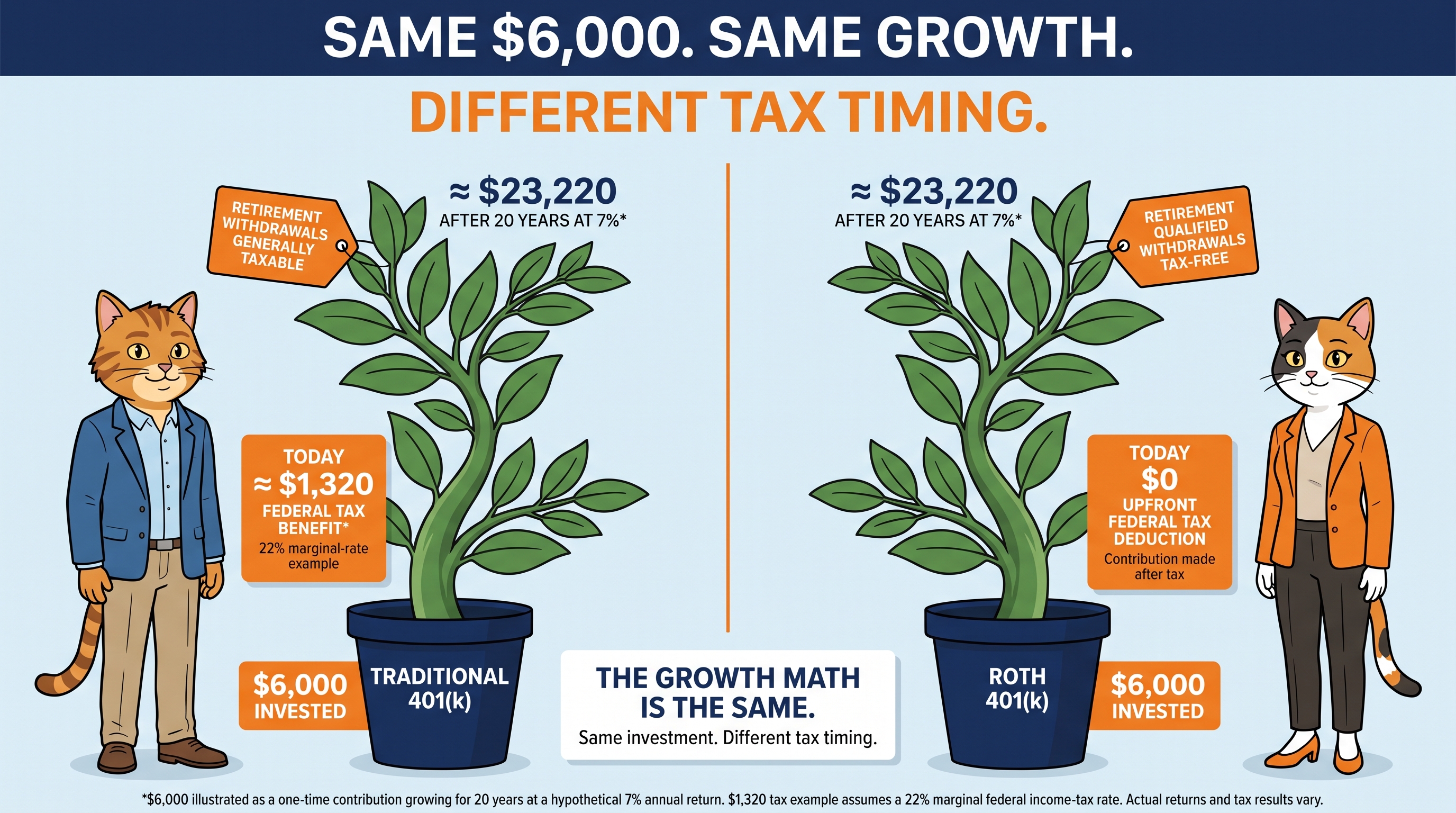
Assuming a 22% marginal tax bracket, here's what that $6,000 actually costs each of them out of their paycheck this year: Spencer's Traditional contribution reduces his taxable income by the full $6,000, saving him about $1,320 in taxes for the year. His paycheck only feels about $4,680 lighter to get that $6,000 invested. Monique's Roth contribution gets no such break — her paycheck feels the full $6,000 lighter, since she's contributing money that's already been taxed.
The Timing Difference
Same $6,000 contribution, same 22% bracket. Traditional: paycheck feels $4,680 lighter. Roth: paycheck feels the full $6,000 lighter.
That $1,320 gap is the entire value of the upfront tax break — not extra money, just tax paid later instead of now.
That same $6,000, growing at a 7% average annual return for 20 years, grows to roughly $23,220 — identical growth math for both of them, since the investments themselves don't know or care which account type they're sitting in. What differs is only what happens at withdrawal: Spencer's balance gets taxed as ordinary income when he takes it out. Monique's doesn't, assuming a qualified withdrawal.
Why This Matters More Than People Think
This decision compounds over decades, which is exactly why it's worth an active choice rather than a default. Not actively choosing isn't catastrophic — most employer plans default new employees into Traditional, and that's a perfectly reasonable outcome for a lot of people. But it's not nothing either. Thirty years of contributions sitting in the "wrong" tax treatment for your actual situation is a real, if quiet, cost.
A General Rule of Thumb
Traditional tends to favor people who expect to be in a lower tax bracket in retirement than they are right now — the tax break today is worth more than the tax bill later. Roth tends to favor people who expect to be in the same or a higher bracket in retirement — paying tax now, while the rate is known, avoids a potentially bigger bill later.
This is guidance, not gospel. Nobody can predict their exact tax bracket decades out, and tax law itself changes over time. Treat it as a reasonable starting point, not a guarantee.
If Your Employer Doesn't Offer Roth
Not every 401(k) plan offers both options. If yours only offers Traditional, that's not a mistake on your part — it's just what's available. A Roth IRA, opened separately outside your employer plan, is worth considering if Roth-style tax treatment fits your situation and your workplace plan doesn't offer it directly.
The Part Chuck Wants You To Actually Do
Log into your actual 401(k) plan portal this week and check which one you're contributing to right now — Traditional, Roth, or both, if your plan allows split contributions. A lot of people genuinely don't know, because it was set during onboarding and never looked at again.

For the exact 2026 contribution limits either account type is subject to, the full breakdown by age is here.