
What Actually Happens When You Leave
When you leave a job, your 401(k) account stays open, tied to your old employer's plan, exactly as it was on your last day. Nothing gets frozen, nothing gets seized, nothing evaporates. The investments inside it keep doing whatever they were doing — growing, dropping, tracking the market — completely independent of your employment status.
What stops is new money going in. No more paycheck contributions. No more employer match. The account keeps existing; it just stops receiving anything new, unless you decide otherwise.
There's one exception to "it just sits there as-is," and it involves small balances specifically — worth knowing about, covered further down.
Riley and Anthony, Same $20,000
Riley and Anthony both leave Job A on the same day, each with $20,000 sitting in a target-date index fund inside their 401(k).
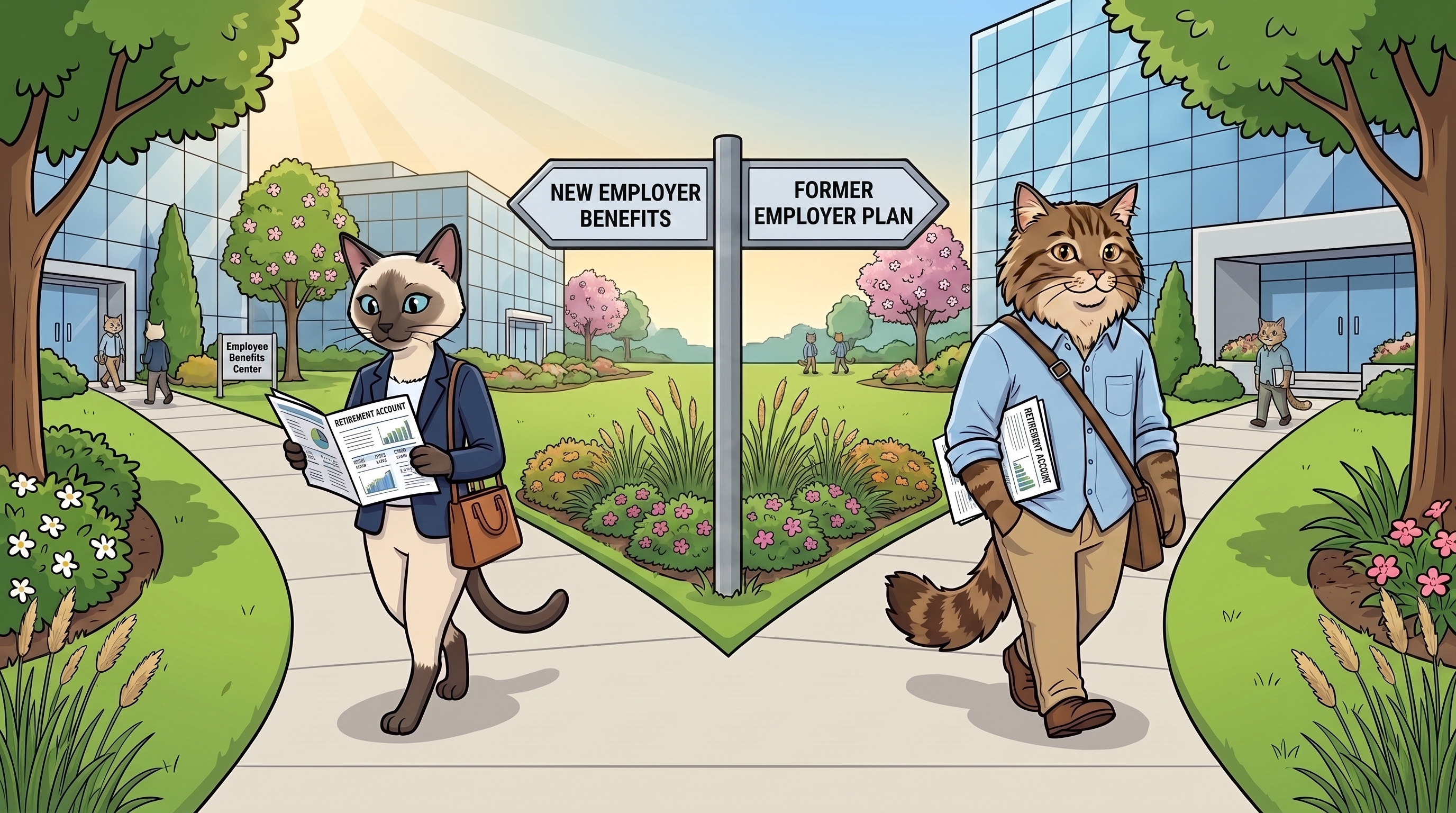
Riley starts Job B two weeks later. She does a direct rollover — moving the full $20,000 into Job B's 401(k) plan, into the same type of target-date fund. From her very first paycheck at the new job, she's contributing again, and Job B matches a portion of it. New money starts landing on top of that $20,000 immediately.
Anthony takes a different path — or more accurately, no path. He starts Job B too, but never gets around to dealing with the old account. His $20,000 stays exactly where it was, in the same target-date fund, at his old employer's plan. It's not frozen — it still grows with the market, same as Riley's. But no new paycheck money goes in. No match, ever again, on that account. Anthony contributes to Job B's own 401(k) separately, but the old $20,000 sits alone, growing only from market returns.
The Gap at Year 10
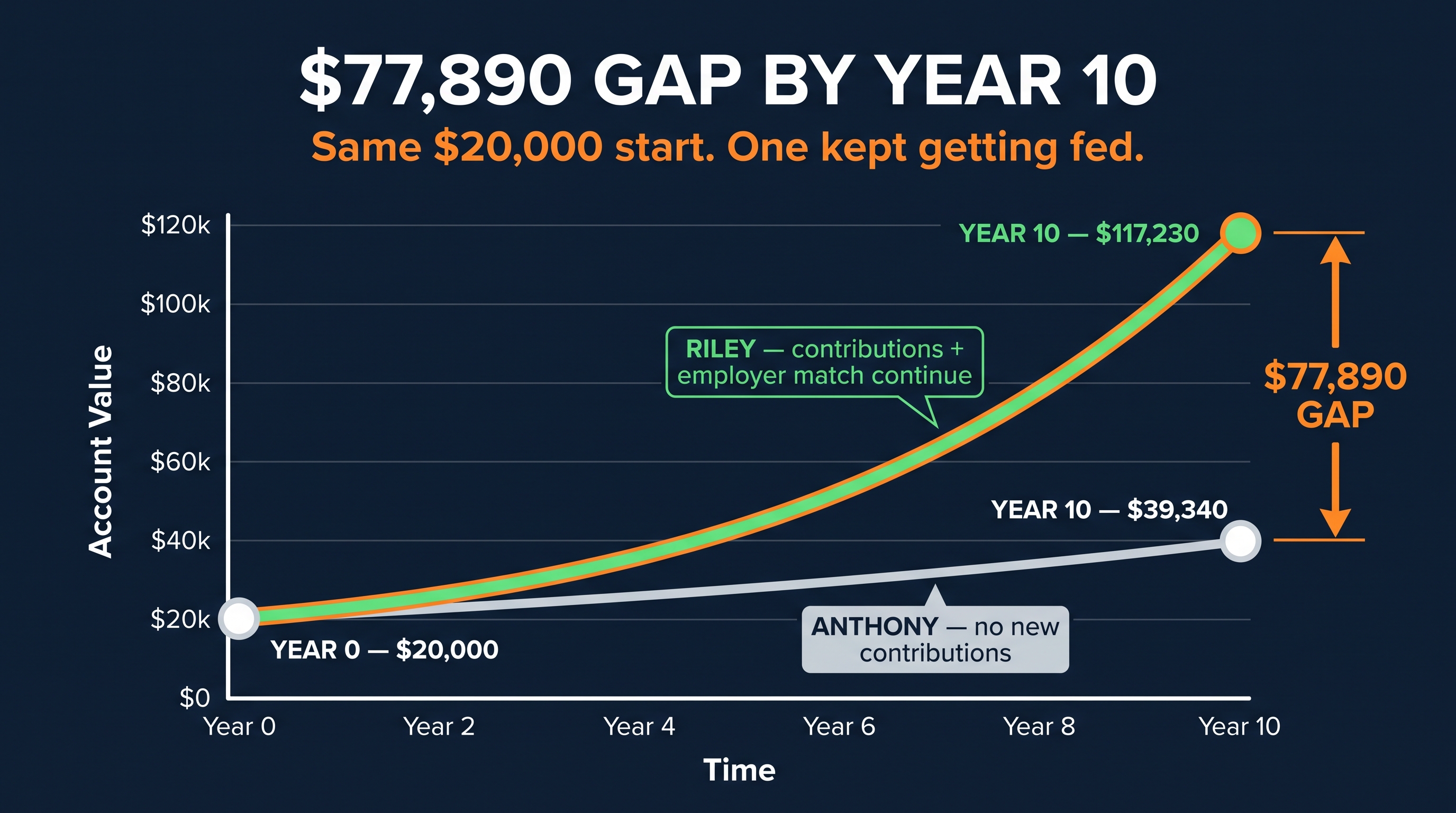
Here's the model, with assumptions stated plainly: both start at $20,000, both funds return an average 7% a year — a common long-term benchmark, not a guarantee. Riley earns $60,000 a year, contributes 6% of her salary, and Job B matches 50% up to that 6% — a realistic, common match structure. That's about $450 a month in combined new money landing on her account, on top of the original $20,000 compounding alongside it.
The Contribution Gap
Two identical $20,000 balances, same 7% average return, over the same 10 years. The only difference: one kept receiving new money, one didn't.
That single difference — whether new contributions and match kept landing on top of the original balance — is worth roughly $77,890 by year 10. The market didn't create that gap. New money did.
Ten years later: Anthony's untouched $20,000 has grown to roughly $39,340 — pure market growth, nothing added. Riley's account — the same starting $20,000, plus a decade of contributions and match — has grown to roughly $117,230.
The gap: about $77,890. Almost none of that came from the market treating one account better than the other. It came from new money landing on one account and not the other, every single month, for ten years.
What This Actually Teaches
The part people usually get wrong: Anthony's money didn't sit still. It didn't earn nothing. It grew right alongside Riley's original balance, same fund, same market. The real cost wasn't stagnation — it was everything that never got added on top: ten years of contributions, ten years of employer match, both permanently gone the moment Anthony stopped feeding that account.
There's a second, quieter cost too: the practical risk of losing track of an account entirely. An old 401(k) at a company you haven't worked for in years is exactly the kind of thing that gets forgotten — an address change, a plan administrator switch, a login you never updated. Riley's money is consolidated and visible. Anthony's is out there, technically fine, but easy to lose track of.
The Four Real Options
Whatever you decide, it's one of these four:
- Leave it where it is. Simplest option, no action required — but no new contributions ever land on it again, and it's one more account to keep track of.
- Roll it into your new employer's 401(k). What Riley did. Your money moves into whatever plan the new job offers, and your investment choices are limited to that plan's menu — but it's consolidated, and new contributions can build on the same balance.
- Roll it into an IRA. Your money moves into a self-directed account completely outside any employer. Far wider investment choice than a workplace plan menu — but it's fully self-managed. There's no employer-selected default fund guiding you if you don't actively choose something.
- Cash it out. Technically an option, rarely a good one — it typically triggers taxes and an early-withdrawal penalty if you're under 59½, on top of losing all future growth on that money.
The Exception Worth Knowing About
Small balances don't always get the luxury of sitting untouched indefinitely. Under the SECURE 2.0 Act, plans can force out small accounts without much say from the account holder: balances under $1,000 can be cashed out directly by the plan, and balances between $1,000 and $7,000 can be automatically rolled into an IRA the plan chooses — not one you picked — if you don't make an active election. Above $7,000, the plan needs your actual consent to move anything.
If your old balance is on the smaller side, this is worth knowing before it happens without you noticing.
The Part Chuck Wants You To Actually Do
Find your old 401(k)'s current balance this week. Log into the old plan, or check whatever statement you last got from it. Then pick one of the four options above — not "eventually," this week.
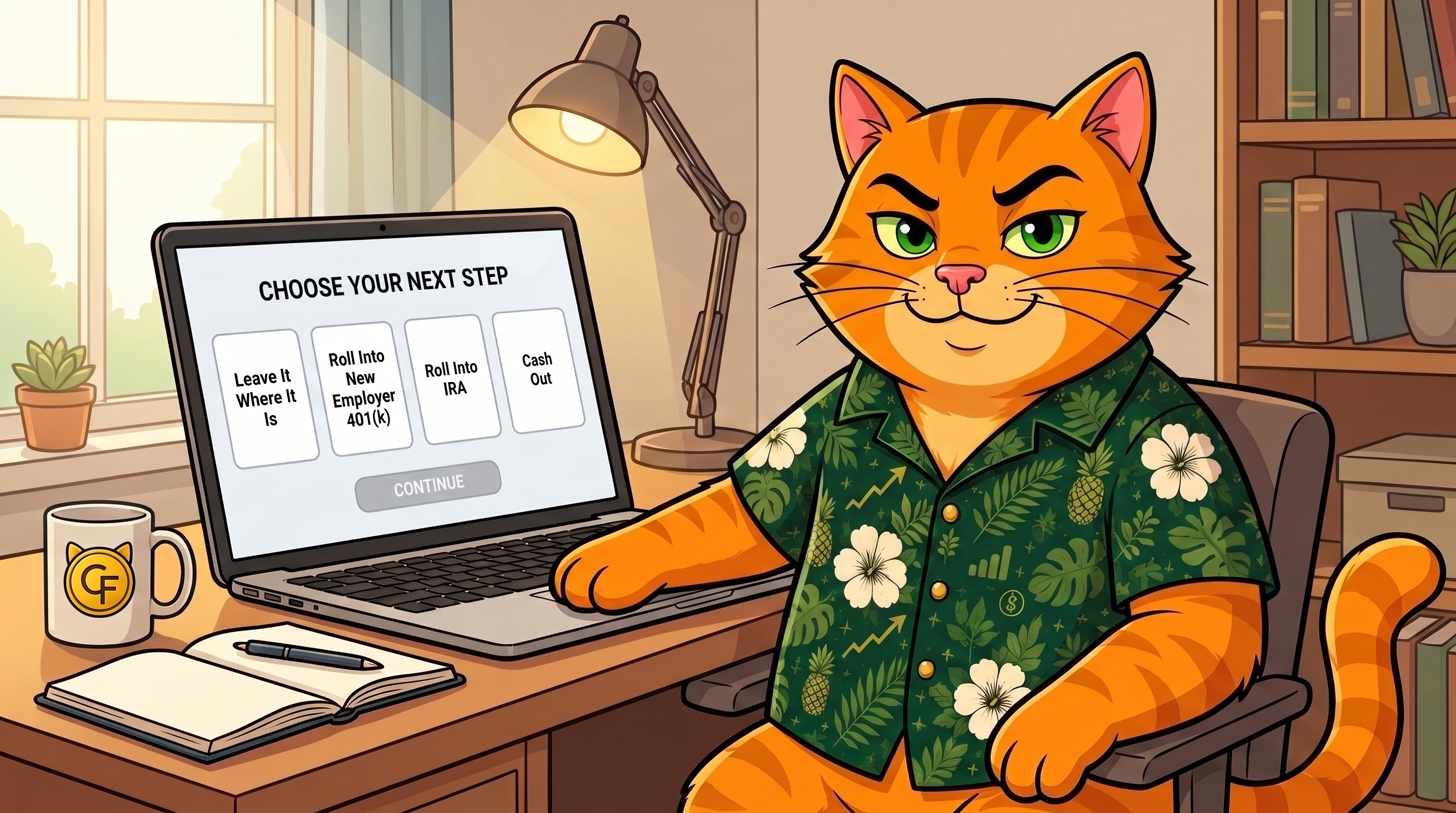
None of the four options is universally "correct." Doing nothing for years by accident is the only option that's actually a mistake.
Sources: