What a 401k Actually Is
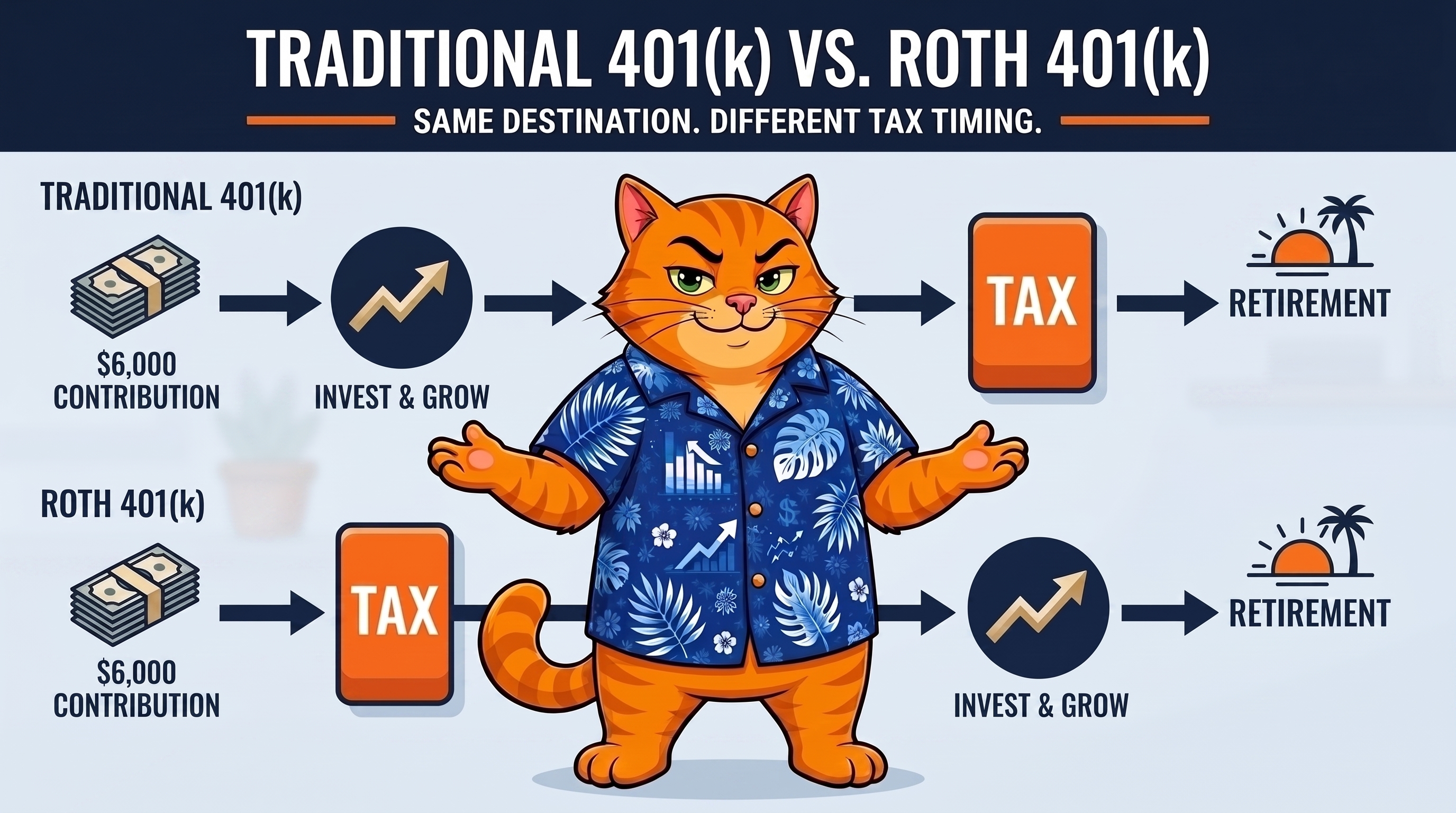
A 401k is a retirement savings account tied to your employer. You contribute a percentage of your paycheck before taxes, which lowers your taxable income for the year, and that money gets invested in a menu of funds your plan offers. It grows tax-deferred until retirement, meaning you don't pay taxes on the gains until you withdraw. Your employer often adds money on top of yours — the match — up to a percentage they set.
What most people don't realize is that the most important number in that account — how much of your paycheck actually goes in — was chosen for you before you ever logged in.
Why the Default Is 3%
When your employer set up automatic enrollment, somebody had to pick a default contribution rate — a number you'd start at unless you said otherwise. The logic wasn't "here's what you need to retire." The logic was "here's a number small enough that you won't opt out." Most plans landed on 3%. Painless, invisible, easy to say yes to by doing nothing at all.
And that's exactly what happened. A landmark study on automatic enrollment found that 61% of employees auto-enrolled into a 401k never changed a single thing — not the contribution rate, not the fund. More recent numbers say the same thing a different way: after two years on the job, 40% to 54% of participants are still sitting at whatever default they were handed on day one. Nearly four in ten never move off it at all.
You didn't fail some test here. Nobody sat you down and asked what number made sense for your actual retirement. A default got chosen for you, by someone optimizing for you not quitting the plan — not for you having enough money at 65.
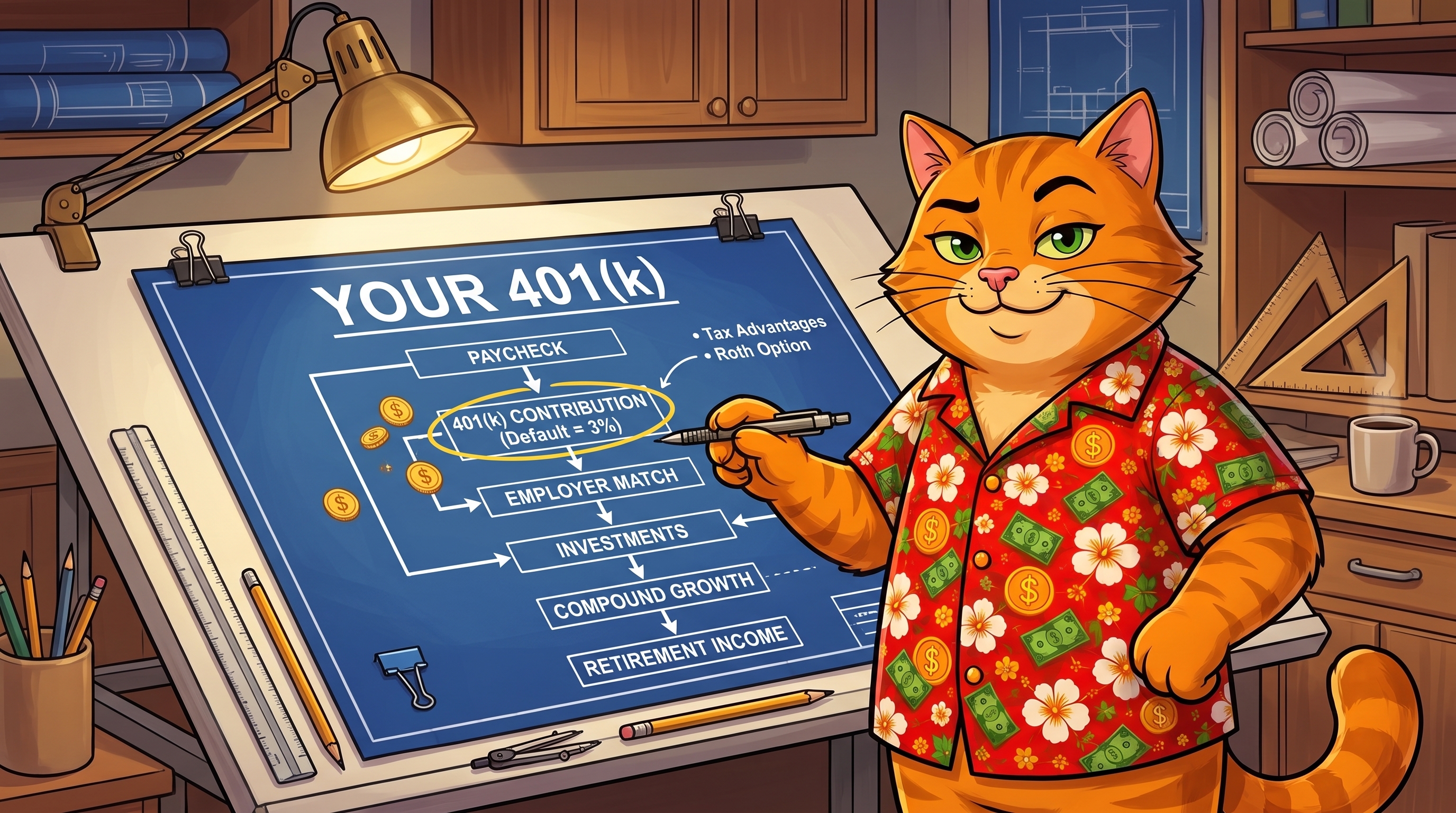
The Default Gap
Auto-enrollment default: 3%. Full employer match: usually 6%. That 3% gap is free money you're not collecting.
On a $65,000 salary, that's roughly $1,950 a year in employer match left unclaimed — before you even get to the $369,000 lifetime gap between staying at 3% and raising it.
Your Fund Defaults Too
The contribution rate isn't the only thing that defaults without your input — your money's actual home does too. Nearly 9 in 10 401k plans now use a target-date fund as their default investment. That's not necessarily bad; target-date funds are a genuinely reasonable choice for most people. But "reasonable choice for most people" and "the specific fund matched to your actual retirement year" are two different sentences, and most people have never checked which one they're holding.
A target-date fund is diversified by design — a mix of US stocks, international stocks, and bonds that automatically gets more conservative as you approach your target year. But "diversified" and "the only option on the menu" are different ideas.
What Else Is Actually on the Menu
Every 401k lineup typically includes a handful of other buckets. An S&P 500 or large-cap index fund — the 500 biggest US companies, no bonds, no international, full exposure. A total US stock market index fund — thousands of companies instead of 500, small and mid-cap included, which sounds different but behaves almost identically: over the last decade, the total market and the S&P 500 differed by well under a single percentage point a year. And a small-cap value fund — smaller, cheaper-relative-to-earnings companies that have, over the very long run, outrun the S&P 500: since 1927, small-cap value has compounded around 13% to 14% a year against roughly 10% for the broad market.
None of that means small-cap value is "better," or that the S&P 500 "beats" target-date funds in any permanent sense. It's cyclical, and it flips hard. Small-cap value crushed the S&P 500 by more than 13 points a year during the 2000s. Then the S&P 500 turned around and beat small-cap value by about 1.7 points a year, every year, since 2010. The same pattern shows up comparing target-date funds to the S&P 500 — over a 28-year stretch, a typical target-date fund trailed the S&P 500 by about 2.4 points annually, a gap explained almost entirely by the bonds and international stocks a target-date fund holds on purpose. That's exactly what makes it more stable when the market drops and you're five years from needing the money.
What is worth knowing: target-date funds have also gotten dramatically cheaper. The asset-weighted average fee across target-date funds fell to about 0.27% last year, roughly half of what it was a decade ago, and the big providers — Vanguard, Fidelity — are running theirs closer to 0.08% to 0.12%. The default isn't expensive anymore, if it ever really was.
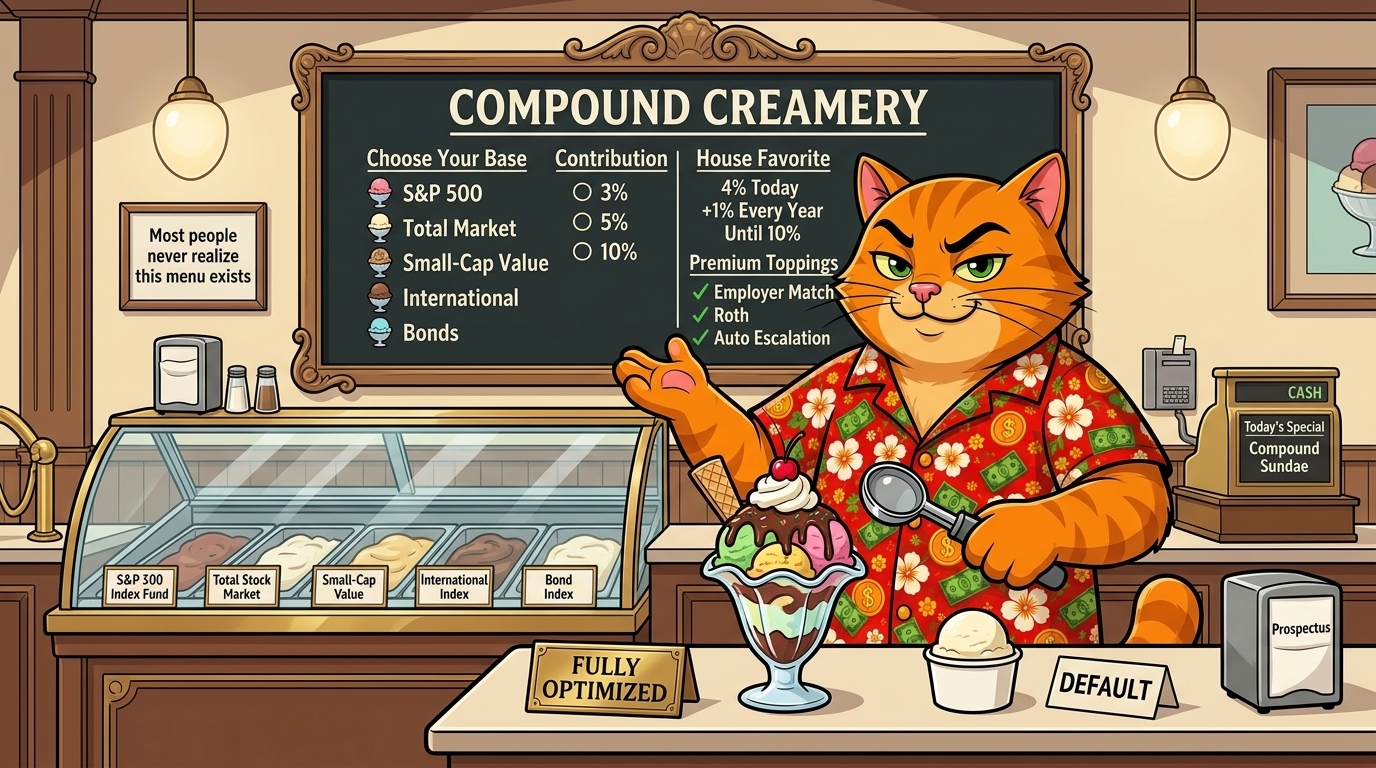
The Real Gap Between Recommended and Actual
A financial advisor may tell you 15% of your income is the number that actually gets you a real retirement — not comfortable, not padded, just real. And for the first time in a while, the country as a whole is getting close: combined employee and employer contributions hit roughly 14.3% recently. Except that number is stacking employer match on top of what people are actually choosing to defer themselves — and on their own, most workers are still only putting in 8% to 10%. Your number, alone, unassisted, is probably a lot closer to 3.
The Fix Some Plans Already Have
Some newer plans don't leave this to memory anymore. Under recent federal rules, plans created after the end of 2022 have to start new employees between 3% and 10%, and then auto-escalate them — usually 1% a year — up toward 10% to 15%. That's a real fix, if your plan has it and if the escalation feature is actually turned on. Plenty of plans have the feature sitting there, dormant, doing nothing, because turning it on requires the same thing skipping it did: somebody actually going in and touching a setting.
Three Numbers to Check This Week
Log into your plan portal — not the app icon, the actual number on the screen.
- Your contribution percentage. If it's below whatever percentage gets you the full employer match, fix that first — that's free money you're currently declining.
- Auto-escalation. Check if it exists as an option and whether it's on. If it's off, turn it on.
- Your fund. Confirm the target date actually matches when you're planning to retire, not some number a system assigned you in your first week at a job you don't even work anymore.
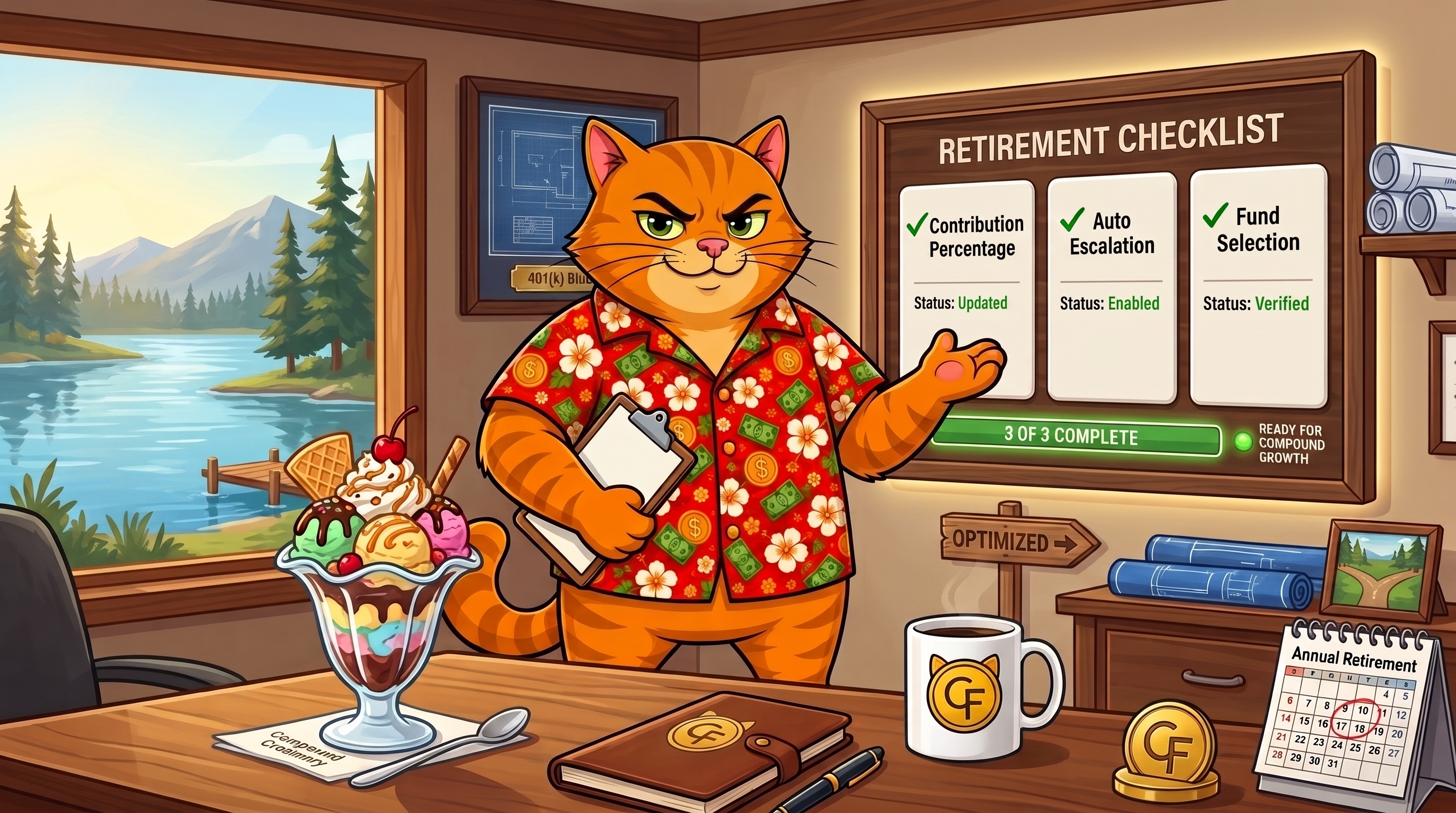
Celeste's version of those three checks was worth $369,000. Not because she got smarter or worked harder. Because she eventually looked at a number and changed it, and Dorian didn't.
The gap between $184,000 and $553,000 isn't a story about income. It's not a story about the market. It's a story about one setting, and whether you ever went back to look at it.
Sources:
- The 401(k) Mistake Costing Average Americans $200,000 at Retirement — 24/7 Wall St., March 2026
- The Impact of Default Contribution Rates on 401(k) Plans — Human Interest
- Percentage of plans with automatic enrollment by default contribution rate — Vanguard
- "The Power of Suggestion: Inertia in 401(k) Participation" — Madrian & Shea
- The Path of Least Resistance in 401(k) Plans — NBER
- 2026 Deep Dive: Target-Date Funds — 401kspecialistmag.com
- QDIA Update: Essential Insights and Emerging Trends — Fiducient
- Total Stock Market Index vs. S&P 500 Index — The Balance
- The Vanguard S&P 500 ETF Is Unstoppable — Motley Fool, 2026
- Small Caps Have Done Better Than You Think — IFA.com
- Is the Small Cap Premium Dead? — A Wealth of Common Sense
- Target-Date Funds vs S&P 500 Index Funds — ProjectFinance
- Investors have $4.8 trillion in target-date funds — CNBC, March 2026