Table of Contents
- Is It Too Late to Start Investing at 40? What Waiting Changed
- What Can Marco Build From Here?
- What If the Return Is Lower?
- What If Marco Changes the Monthly Contribution?
- What Marco Can Actually Control
- What This Model Cannot Answer
- What You Do With This Information
- Sources
Is It Too Late to Start Investing at 40? What Waiting Changed
Marco's first instinct is understandable: How much did waiting cost me?
We can model that.
Hold the monthly contribution constant at $400 and assume both cases stop adding money at 65. The age-25 case starts with $0. Marco starts at 40 with his existing $8,000. Both use the same hypothetical 7% model.
| Illustrative case | Monthly contribution | Years contributing | Starting balance | Projected balance at 65 |
|---|---|---|---|---|
| Start at 25 | $400 | 40 | $0 | $1,049,925 |
| Marco starts at 40 | $400 | 25 | $8,000 | $369,832 |
That's a projected difference of $680,093.
And this is exactly where a useful comparison can turn into a terrible conclusion.
Marco could look at that table and think: Great. I'm $680,000 behind.
Behind what?
We never established that $1,049,925 is Marco's retirement target. It is simply what a different starting point produces under the same hypothetical return and monthly contribution.
The age-25 case deposits $192,000 over 40 years. Marco makes $120,000 in new monthly deposits over 25 years and begins with $8,000 already invested, for $128,000 of total principal. The principal difference between the two cases is $64,000. The remaining approximately $616,093 of the projected balance difference is modeled growth created by the different amounts and timelines.
That teaches Marco something important: time matters enormously in compounding.
It does not teach him that he needs to recreate the age-25 result.
That's the trap. The comparison can show Marco the effect of starting earlier. It cannot set his retirement goal.
What Can Marco Build From Here?
Now we're asking the useful question.
Marco is 40. The $8,000 already in his account is real. The $400 he can invest each month is real. And he has 25 years until age 65.
Under our hypothetical 7% model, those two inputs work on the same timeline:
| Part of Marco's model | At age 65, illustrative 7% |
|---|---|
| Existing $8,000 | $45,803 |
| Future $400 monthly deposits | $324,029 |
| Total projected balance | $369,832 |
Marco contributes $128,000 of principal: the $8,000 already there plus $120,000 in new monthly deposits. The remaining approximately $241,832 is modeled growth.
That old $8,000 matters. Ignoring an old retirement account doesn't make the money disappear from the math.
But $369,832 isn't a retirement verdict. It's the answer to a much narrower question:
What could $8,000 plus $400 a month become over 25 years under this assumption?
Answer that question first. Then decide whether the result solves the problem you're actually trying to solve.
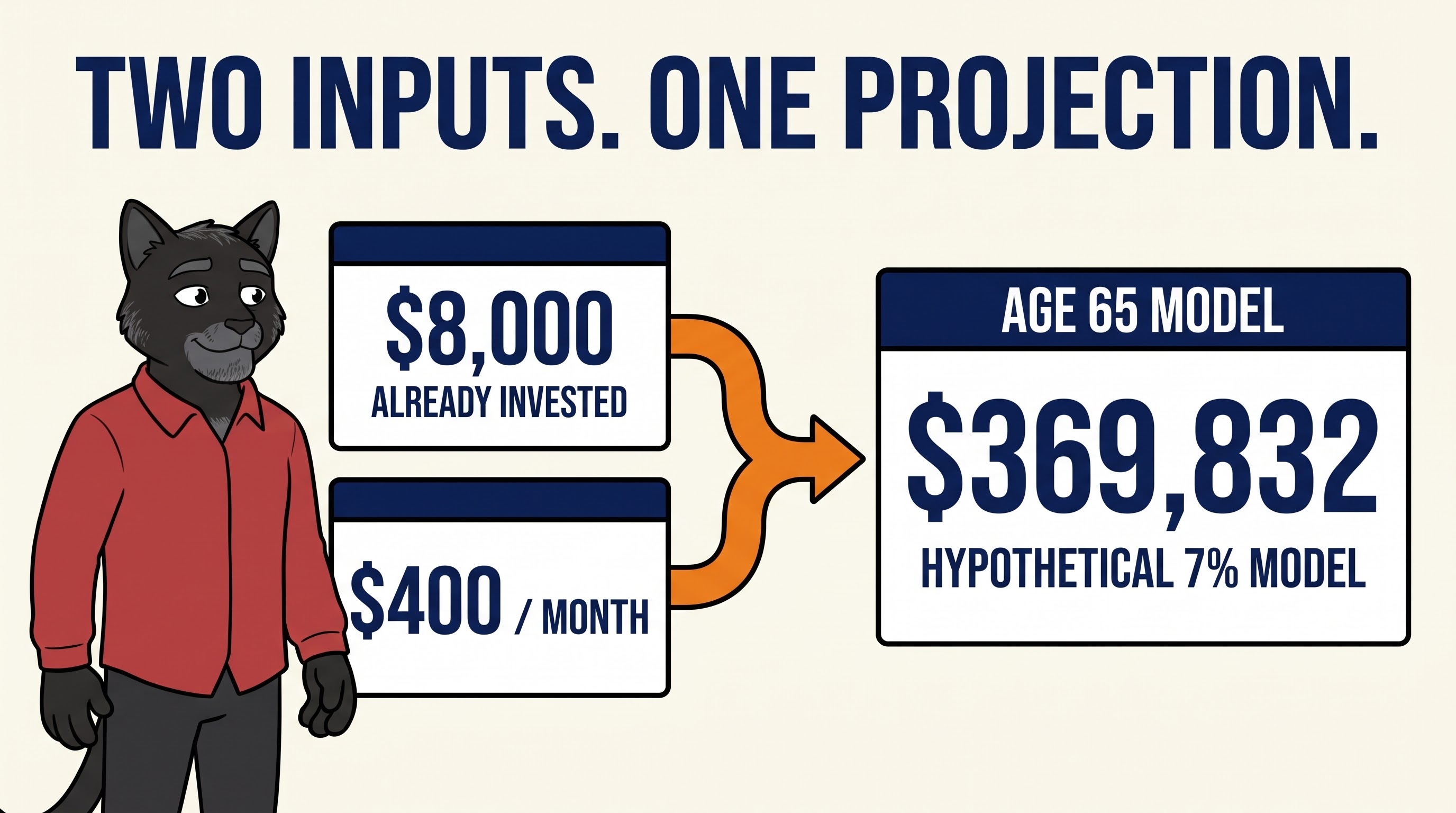
Marco's Age-40 Projection
$8,000 × (1 + r)^300 + monthly contribution × [((1 + r)^300 − 1) ÷ r]; r = illustrative annual return ÷ 12
At an illustrative 7% annual return compounded monthly, Marco's $8,000 plus $400 at each month-end projects to about $369,832 at 65.
What If the Return Is Lower?
Marco has another perfectly reasonable question: What if I don't get 7%?
Good. Change the assumption.
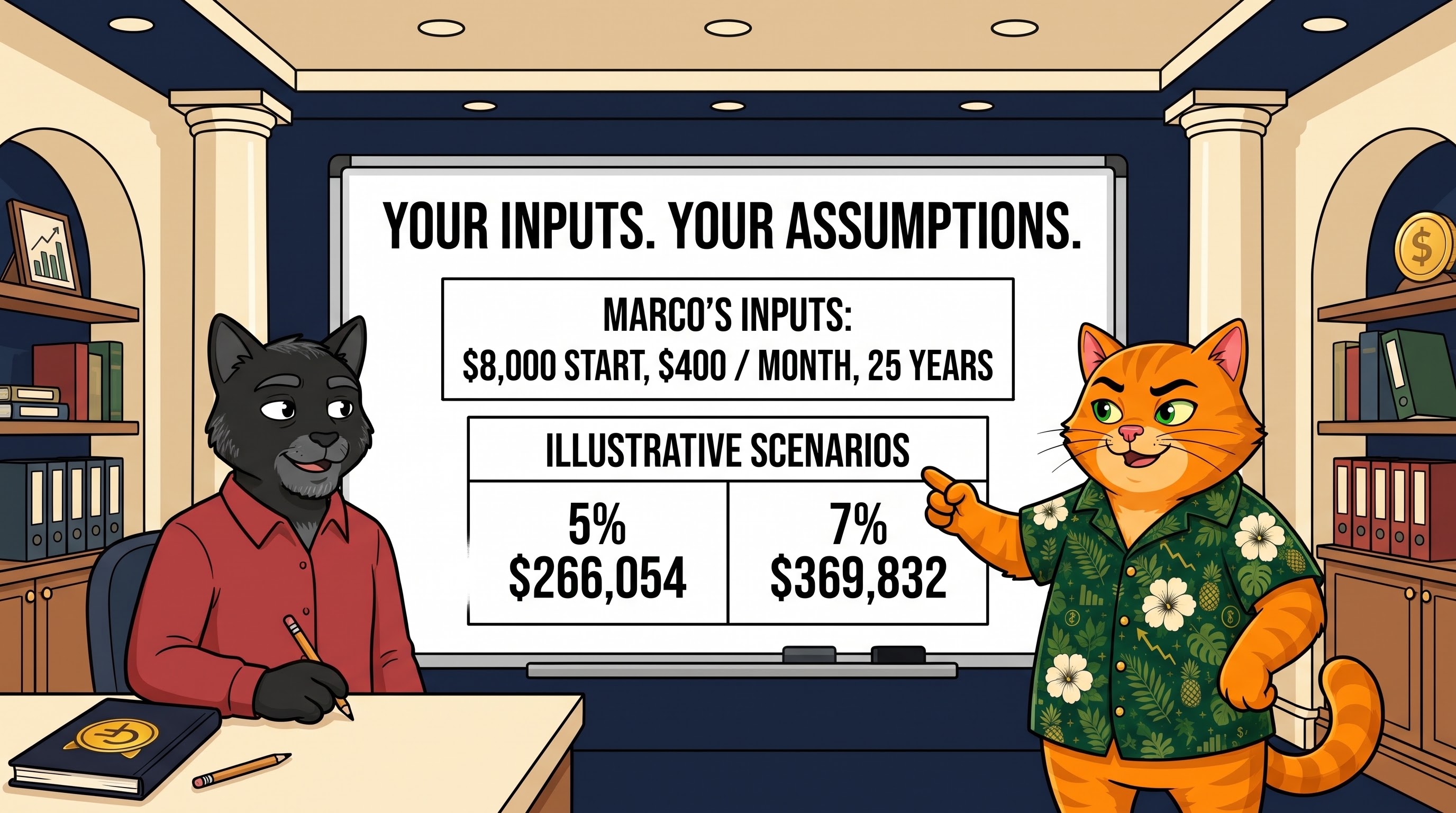
Leave his $8,000 starting balance, $400 monthly contribution, and 25-year timeline alone. Change only the hypothetical return.
| Illustrative annual return | Projected balance at 65 |
|---|---|
| 5% | $266,054 |
| 7% | $369,832 |
Same Marco. Same deposits. Same 25 years.
The projected difference is $103,778.
Neither row is a forecast. What matters is that changing one assumption by two percentage points materially changes the modeled outcome.
That's why I won't hand you one future-value number without telling you the rate behind it.
A projection is only as meaningful as the assumptions sitting underneath it. If one number makes your plan look comfortable and another makes it look tight, you just learned something useful: your plan may be sensitive to investment performance.
That's information you can work with. Pretending the higher number is guaranteed isn't.
What If Marco Changes the Monthly Contribution?
Now Marco can test the input he has the most direct control over.
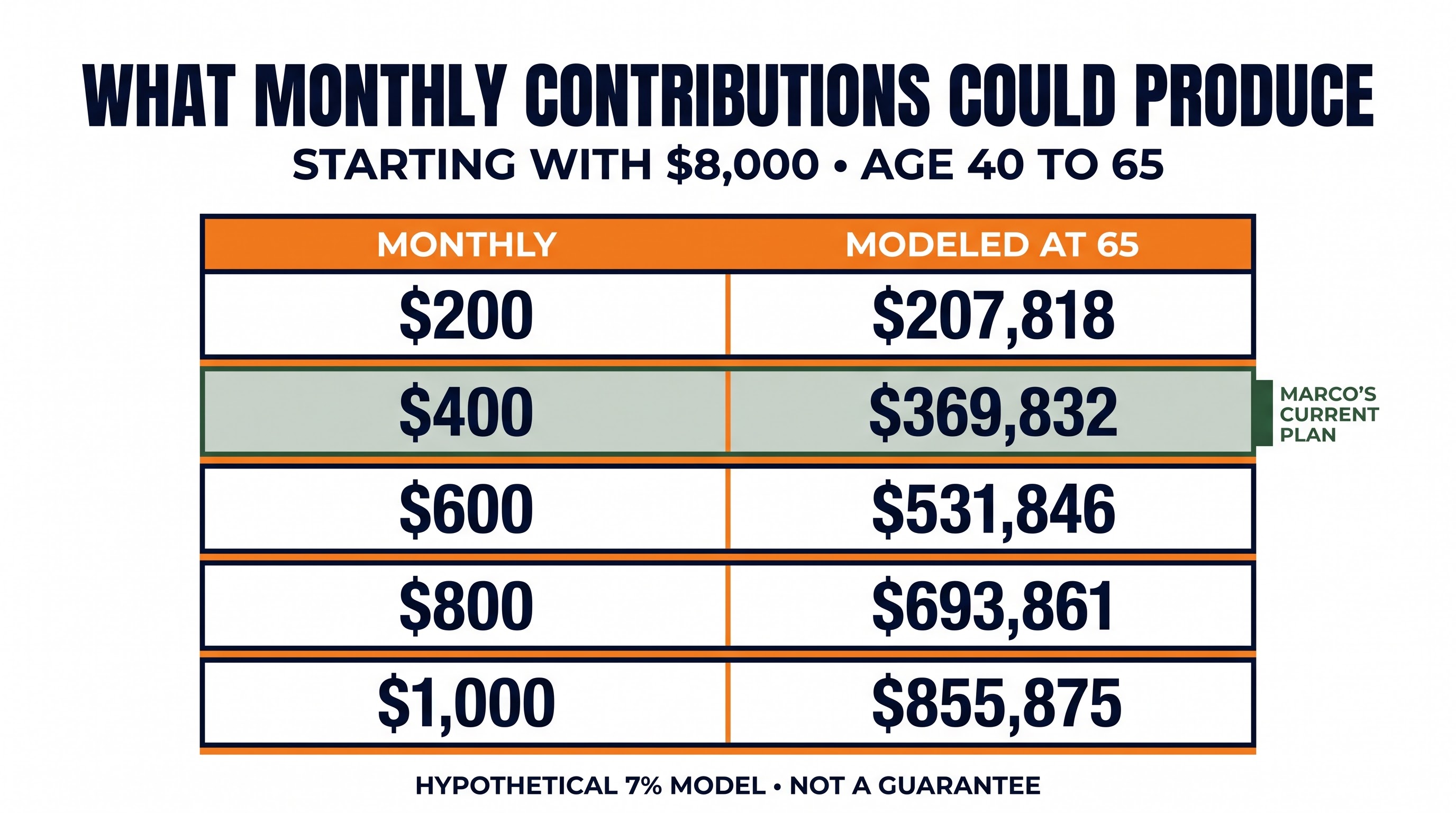
Keep the $8,000 starting balance, 25-year timeline, end-of-month deposits, and hypothetical 7% return. Change only the monthly contribution.
| Monthly contribution | Projected balance at 65 |
|---|---|
| $200 | $207,818 |
| $400 | $369,832 |
| $600 | $531,846 |
| $800 | $693,861 |
| $1,000 | $855,875 |
These aren't rungs on a ladder Marco is supposed to climb. They're choices with consequences.
Under these assumptions, every additional $100 per month adds approximately $81,007 to the modeled age-65 balance.
Now Marco has something more useful than "you should have started sooner." He can see what changing an input today does to the output later.
For comparison, matching the age-25 example's projected $1,049,925 from Marco's current starting point would require approximately $1,240 per month under this exact model.
Does that mean Marco should invest $1,240?
No.
We still haven't established that $1,049,925 is the amount Marco needs. Chasing somebody else's projected balance just because it appeared in the first table would turn a teaching example into an invented financial goal.
Marco's job is to find a contribution he can sustain, calculate what it could produce, and compare that result with the retirement he actually wants to fund.
What Marco Can Actually Control
Marco cannot buy back the 15 years between 25 and 40.
I'm not going to spend the rest of this article scolding Marco about the 15 years he can't get back.
He can control what happens next.
His contribution. Marco can decide how much of his current budget he can consistently invest. If $400 is sustainable today, that's a real input. If his income or expenses change later, he can run the model again. If you want a goal-based framework for choosing a monthly amount, see How Much Should I Invest Per Month?.
His investment approach. A diversified portfolio spreads exposure rather than concentrating everything in one investment, although diversification cannot eliminate market risk. What Marco owns matters because different investments carry different combinations of expected return and risk.
When he starts. Waiting another five years doesn't leave Marco in the same situation. It gives his money 20 years instead of 25.
Under the same hypothetical 7% model, if Marco invests the same $8,000 and $400 a month but waits until 45 to start, that projects to approximately $240,681 at 65.
Compare that with approximately $369,832 if he starts at 40.
That's not a scare tactic. It's the math Marco came here to see.
The past 15 years are unavailable. The next five aren't.
What This Model Cannot Answer
Now Marco knows what $400 a month could produce under stated assumptions.
He still doesn't know whether $369,832 is enough to retire at 65.
Those are different questions, and mixing them together is how a clean projection turns into bad financial planning.
To evaluate whether a projected balance is enough, Marco would need to estimate his retirement spending and account for other assets, taxes, inflation, and the timing and size of retirement income. Social Security may supplement portfolio withdrawals for an eligible reader. Market returns will also arrive unevenly, and poor returns near retirement can matter differently than poor returns decades earlier.
So don't ask a compound-interest calculator to answer a question it wasn't built to answer.
It can tell Marco what a set of inputs produces under a set of assumptions.
It cannot tell Marco what his life will cost.
If you want age-based benchmark context, see Retirement Savings by Age. If you want the mechanics behind the growth, see What Is Compound Interest? If you want to test when an existing balance might grow toward a target without further contributions, see What Is Coast FIRE?
Those are useful questions. They're just not this question.
What You Do With This Information
Marco has his answer.
Starting at 40 isn't "too late." But "not too late" isn't a retirement plan either.
His $8,000 plus $400 a month projects to about $369,832 at 65 under the 7% model and about $266,054 under the 5% model. Marco can sustainably invest $400 a month right now, so that's where he starts.
He does not make the age-25 example his personal scoreboard.
And he does not look at $369,832 and declare himself "on track."
His next job is to estimate what his retirement actually needs to cost and compare that need with what his current contribution could produce. If the numbers don't line up, then he has a useful decision to make: contribute more when his budget allows, adjust the timeline, revisit the retirement goal, or examine the other pieces of his retirement plan.
Do the same with your numbers.
Open Investor.gov's Compound Interest Calculator. Enter your actual starting balance, the monthly contribution you're considering, and the number of years you have. Run more than one return assumption. Write down the results.
Then ask the question that matters:
Does what I'm building match what I'm trying to fund?
Don't ask whether 40 is too late. That's not a useful financial question.
Ask what you have, what you can invest, what that could become, and whether the result fits the retirement you're trying to build. Those are questions you can actually do something about.
Sources
- Investor.gov — Compound Interest Calculator — calculator inputs and compounding settings.
- Investor.gov — Introduction to Investing — general investing education and investment-risk context.
- All balances, contribution comparisons, and differences in this article are independently calculated hypothetical future values, not statistics reported by those sources.
Chuck Finance is for entertainment and informational purposes only. Chuck is not a licensed financial advisor, and nothing in this post constitutes professional financial, investment, legal, or tax advice. Always consult a qualified professional before making financial decisions.