
What Coast FIRE Actually Is
Say you've been contributing to retirement for a decade. You've built up a real balance. A natural question starts to form: if you stopped adding new money today, could that balance still grow into what you'll eventually need, just by sitting invested? That's the question Coast FIRE answers.
The term comes from the financial independence community — it's short for "Coast to Financial Independence, Retire Early." You don't need any interest in retiring early for the underlying question to be useful. Strip away the early-retirement framing and what's left is a genuinely practical retirement-progress check: has what I've already saved crossed the point where compounding could carry it the rest of the way? Worth being precise about what this is: a planning framework used within a personal-finance community, not a formal financial standard or a number some institution certifies you against.
Where the Retirement Target Comes From
Before you can check whether your balance has crossed a threshold, you need to know what the threshold is aiming at — how much you'd actually need saved by retirement.
A common shortcut: take how much you expect to spend annually in retirement, in today's dollars, and multiply it by 25. Spend $55,000 a year, and the shortcut says you'd want roughly $1,375,000 saved.
That multiplier isn't arbitrary. It comes from research into how much a retiree could withdraw from a portfolio each year without running out of money — most notably a 1994 study by financial planner William Bengen, published in the Journal of Financial Planning, and a related 1998 analysis often called the Trinity Study. Both examined historical U.S. stock and bond returns across defined retirement periods. That body of historical research helped establish the roughly 4% starting-withdrawal framework as a common retirement-planning rule of thumb — and 25 is simply 1 divided by 4%.
This is historical evidence, not a promise. It's based on specific portfolio assumptions and tested time horizons. A retirement lasting meaningfully longer than 30 years may call for more conservative assumptions than the original research covered. Treat the 25x figure as a reasonable starting shortcut, not a guarantee stamped by decades of data.
The Assumption Nobody Can Actually Know
Here's the part that determines everything else: to figure out whether your current balance can grow into that target, you need to guess what rate it'll grow at between now and retirement. Nobody can know this in advance. The best anyone can do is pick an assumption and be honest that it's a guess.
One more piece worth being precise about: the growth rate that matters here is the return after subtracting inflation — called a real return, as opposed to a nominal return, which is the raw, unadjusted number. Using a real return keeps your retirement spending figure meaningful in today's dollars throughout the whole calculation, instead of needing to separately inflate the target too.
This post runs the numbers at three different real return assumptions — 5%, 6%, and 7% — to show how much the final answer moves. None of these is being presented as the expected return, a conservative estimate, or a historical average handed down as fact. They're three illustrative scenarios, chosen to show how much the answer can move when the return assumption changes. Real, historical stock market returns don't arrive smoothly either — some years are strongly positive, some are negative, and a real-world sequence of returns doesn't look like a steady annual number at all. That unevenness is exactly why the assumption matters so much: change the number, and the answer to "has my retirement crossed the threshold" can genuinely flip.
The Coast FIRE Threshold
Retirement Target ÷ (1 + real return)^years remaining
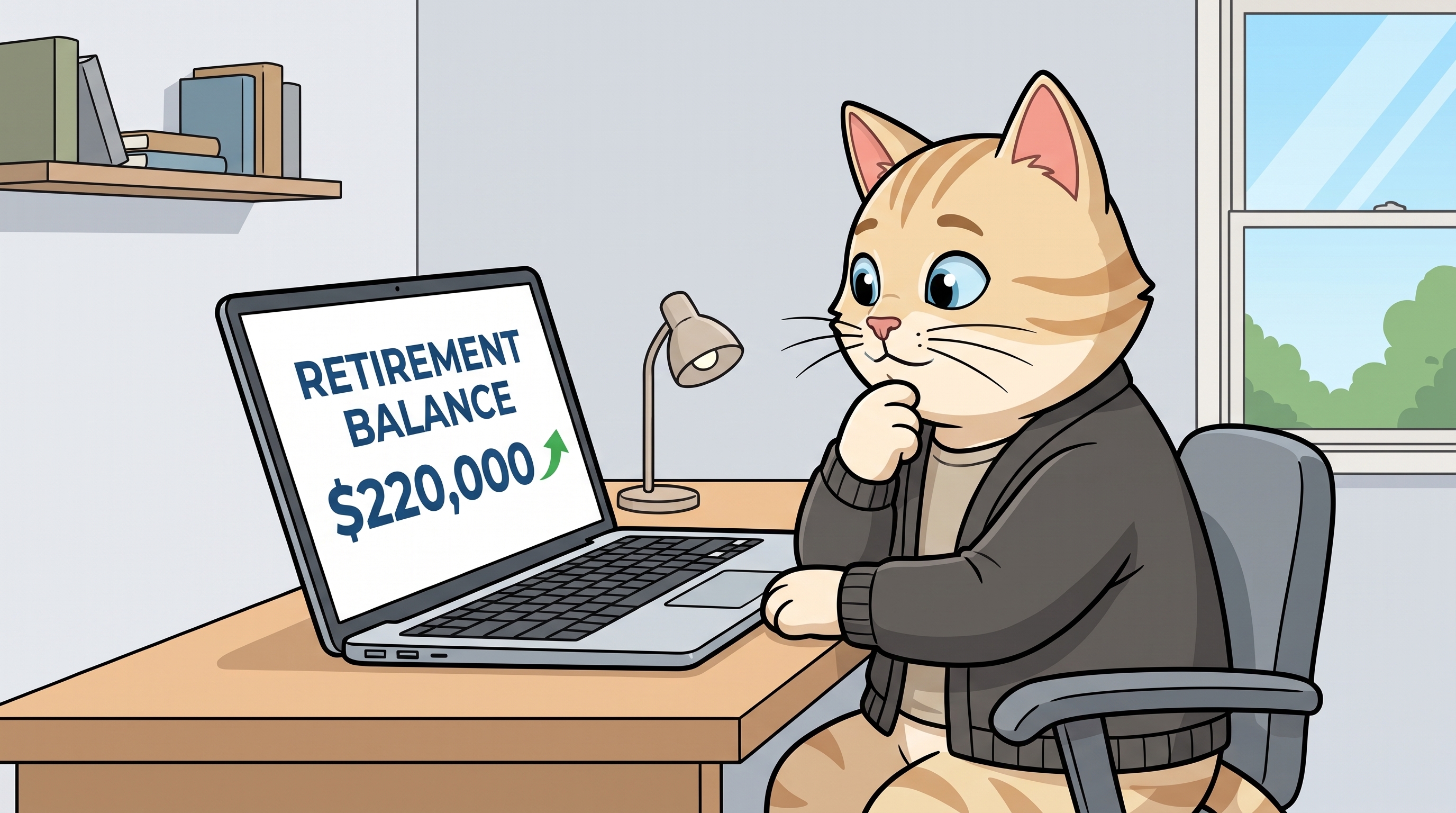
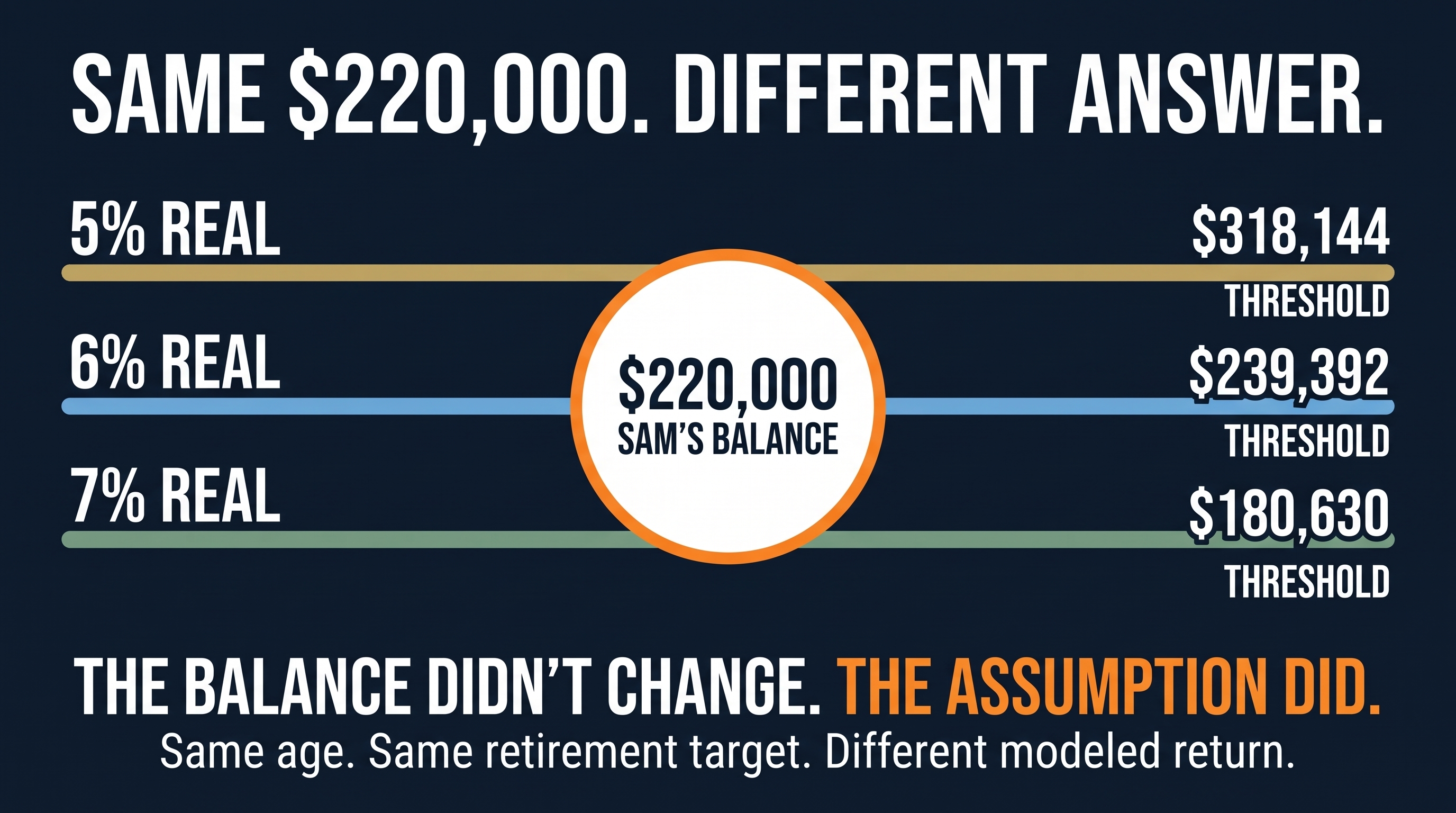
The same $220,000 balance sits above that threshold at one illustrative return assumption and below it at another. The number isn't wrong either time. It's just answering the question under a different guess about the future.
No algebra required to use this — just three inputs. You're asking: how big would my balance need to be right now for compounding, on its own, to carry it to my target by the time I retire? That "right now" number is the threshold. If your actual balance is above it, compounding alone could potentially get you there under that assumption. If it's below, that same assumption says you'd need additional contributions to reach the modeled target.
Sam's Question
Sam is 35, plans to retire at 65 — 30 years away — and expects to spend about $55,000 a year in retirement, in today's dollars. That puts Sam's retirement target at $1,375,000. Sam has been contributing for years, has a real balance of $220,000, and just started wondering: is this already on track to grow into that target on its own?
Run the formula at 7% real return, and the threshold comes out to $180,630. Sam's $220,000 is above that. At this assumption, Sam's balance has crossed the threshold — left alone, it could compound to roughly $1,674,700 by 65, more than the target.
Now change the one input nobody can actually know in advance. Run the same formula at 5% real return instead. The threshold jumps to $318,144. Sam's $220,000 is now well below it. At this assumption, that same balance would only reach roughly $950,800 by 65 — about $424,200 short of the target.
Same balance. Same age. Same target. One assumption changed, and the answer flipped from yes to no.
What This Actually Tells Sam
The honest answer to "has my retirement crossed the threshold" isn't yes or no. It's: yes, under one illustrative assumption; no, under another — and the gap between those two outcomes is enormous, not a rounding difference. That range is the actual answer, not an inconvenient asterisk on a cleaner one.
What makes this useful for Sam isn't picking whichever scenario sounds better. It's understanding that the entire question hinges on one number nobody can know in advance, and that a real balance can look perfectly on track under one illustrative scenario and meaningfully short under another.
This doesn't mean Sam should stop contributing, even in the scenario where the balance already clears the target. More contributions build a cushion against returns coming in below the 7% scenario, against retirement spending eventually landing above $55,000, and against other assumptions not working out exactly as modeled. Crossing a modeled threshold under one assumption means the model no longer requires additional contributions to reach that specific target — it doesn't remove the value of contributing anyway.
What Crossing the Threshold Doesn't Mean
Crossing the Coast FIRE threshold under some assumption does not mean retirement is guaranteed, that you should stop contributing, that you could retire today, or that real investment returns will actually match whatever rate you assumed. It also doesn't mean the calculation accounts for everything relevant to your retirement.
The more precise way to describe it: under the stated assumptions, the current balance could potentially grow to the modeled target without additional contributions — a conditional statement about a model, not a fact about your future.
What This Simple Model Leaves Out
This calculation is useful precisely because it's simple, but simple means it's leaving real things out:
Social Security, pensions, and other retirement income. The basic model only counts the investment balance itself. Income from these other sources can change the actual target meaningfully — leaving them out isn't automatically a conservative choice or an aggressive one, it's just an incomplete one that a fuller retirement plan should fill in.
Uneven investment returns. The formula assumes the same return every year, but markets don't work that way. Sam's actual balance will rise and fall along the way, and the return ultimately earned over those 30 years may be very different from the modeled rate. Once withdrawals begin in retirement, the order of good and bad years can matter too — that's known as sequence-of-returns risk.
Taxes and account type. The formula itself doesn't change depending on whether the balance sits in a Roth or a Traditional account — but what you actually get to spend from it, after taxes, can. That's a separate layer this simple version doesn't model.
Changing costs. Healthcare and other retirement expenses can shift the $55,000 spending estimate up over time, which raises both the target and the threshold.
Running Your Own Numbers
Three inputs: your expected annual retirement spending in today's dollars, your target retirement age, and your current retirement balance. Multiply the spending figure by 25 to get a rough target, then run the formula above at more than one real return assumption — try 5% and 7%, the same illustrative range used here. The SEC's Investor.gov compound interest calculator is a free, legitimate tool for checking how a balance grows forward under a given rate, if you want to sanity-check the compounding side of the math yourself.
Sam's $220,000 didn't produce one trustworthy yes-or-no answer. It produced a range: above the modeled threshold at 7%, below it at 5% and 6%. That's useful information. Sam now knows the balance is close enough for compounding to matter enormously — but not far enough ahead to make the return assumption irrelevant.
Your result deserves the same treatment. Don't collapse the range into the one number you want to trust. Compare the scenarios and pay attention to which assumptions are doing the work.

Chuck Finance is for entertainment and informational purposes only. Chuck is not a financial advisor, and nothing in this post constitutes professional financial advice. Coast FIRE is a personal-finance community planning framework, not a formal financial standard or a guarantee of any outcome. The 25x retirement-target shortcut is a historical planning guideline derived from research over specific, defined time horizons — it does not guarantee portfolio sustainability for every situation. All return assumptions used in this article are illustrative scenarios, not predictions; actual investment returns vary substantially and include negative years. Retirement outcomes depend on many factors, including actual returns, inflation, spending changes, taxes, healthcare costs, Social Security, and individual circumstances not modeled here. Consult a licensed financial professional for advice specific to your situation.
Sources
- William P. Bengen, "Determining Withdrawal Rates Using Historical Data," Journal of Financial Planning, October 1994 (foundational 4% research and portfolio assumptions)
- Philip L. Cooley, Carl M. Hubbard, and Daniel T. Walz, "Retirement Savings: Choosing a Withdrawal Rate That Is Sustainable" (Trinity Study), AAII Journal, 1998
- U.S. Securities and Exchange Commission, Investor.gov Compound Interest Calculator — investor.gov, confirmed current September 2026