The Container, Not the Investment
A Roth IRA is a type of individual retirement account funded with after-tax dollars. "After-tax" means the money going in has already had income tax paid on it. In exchange, the growth and qualified withdrawals generally aren't taxed again in retirement.
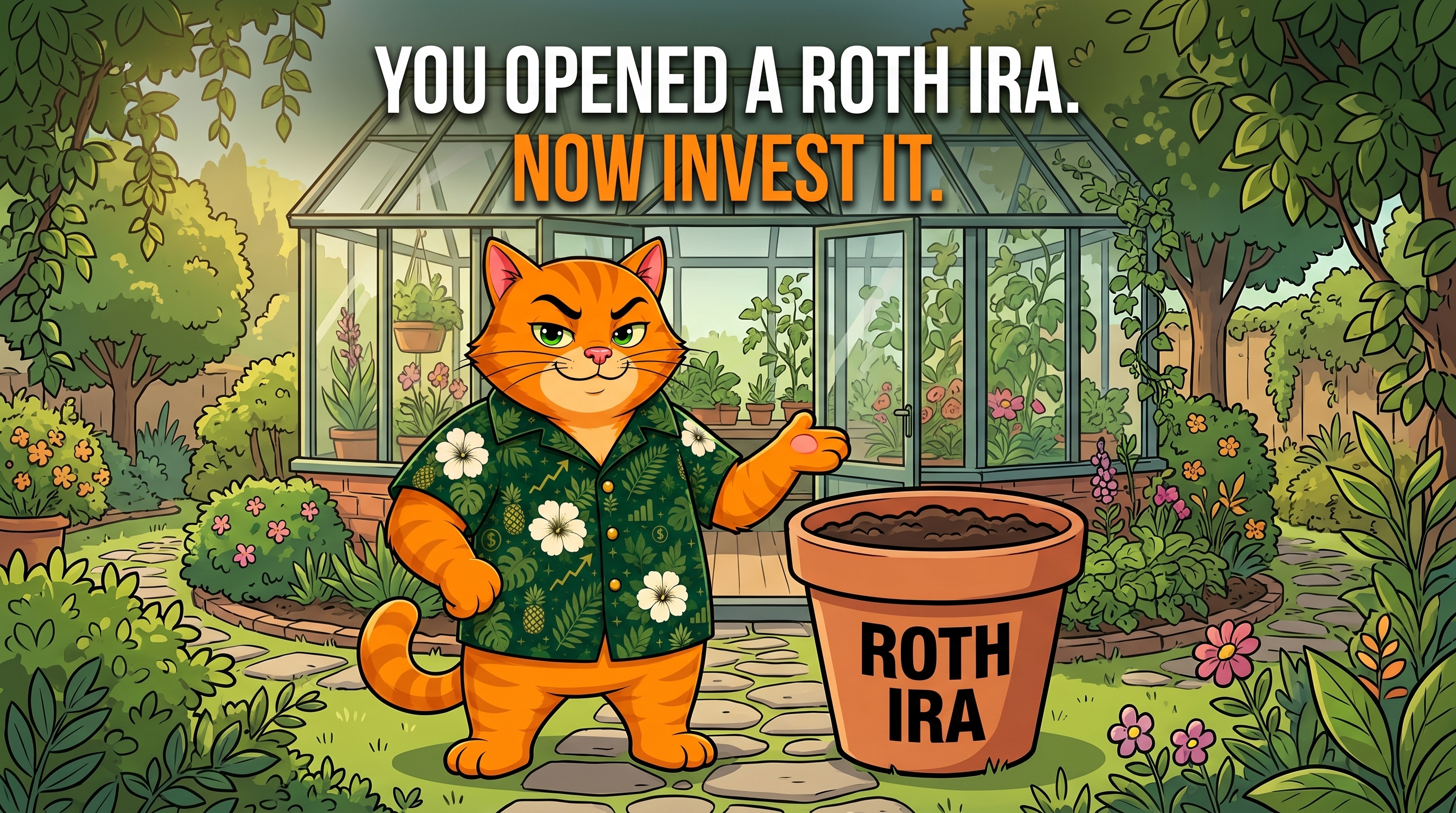
That's the account. It's a container — it holds whatever gets chosen to go inside it. The container itself doesn't grow anything. What's put inside it does.
The Container Rule
A Roth IRA is a container for after-tax money — not an investment itself.
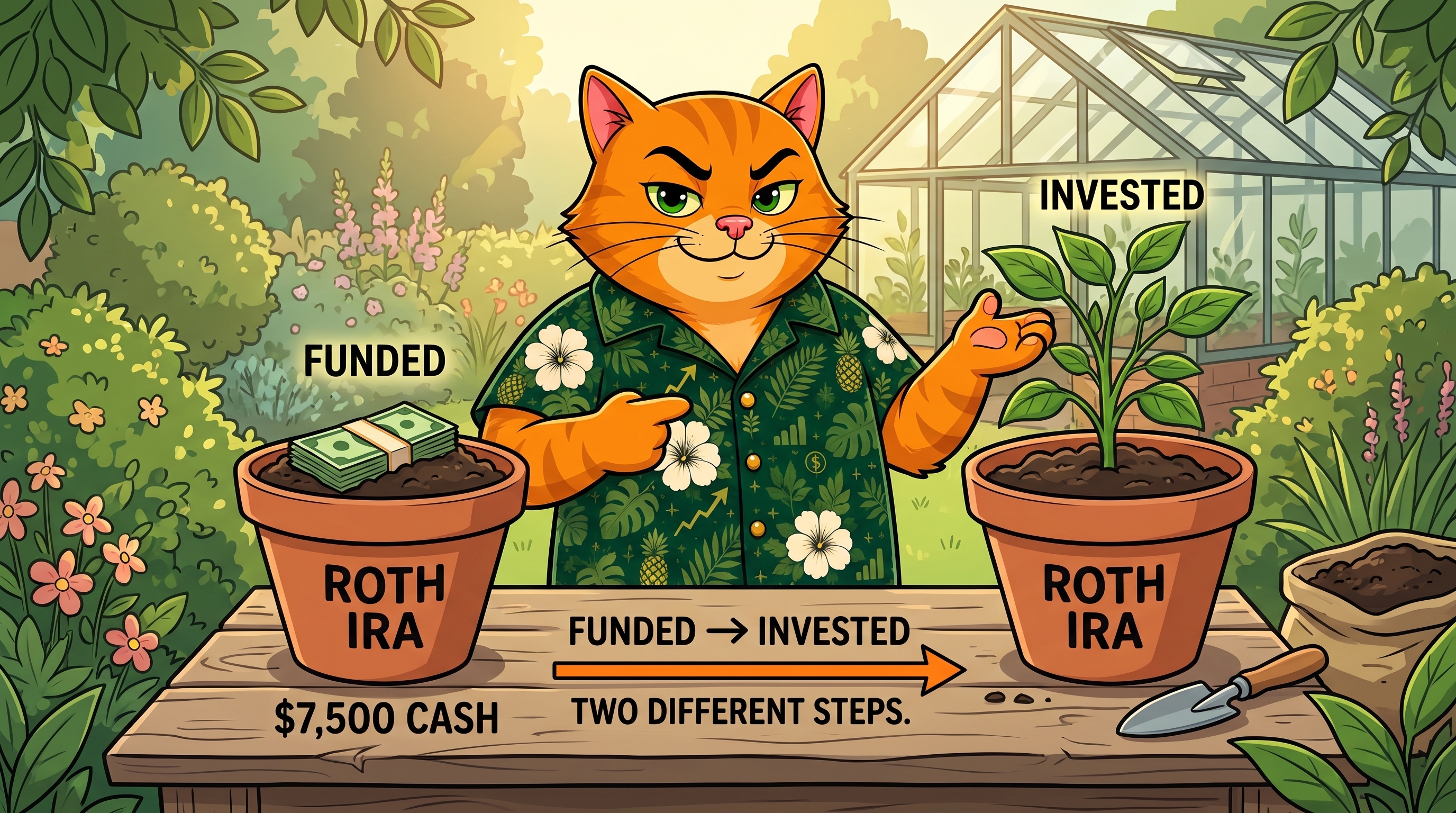
Opening the account and funding it is step one; choosing what to invest in is step two. The long-term growth you're trying to capture depends on what you do with the money inside it.
The Basics: 2026 Limits, Eligibility, and Rules
Reference numbers, verified directly against IRS.gov for 2026:
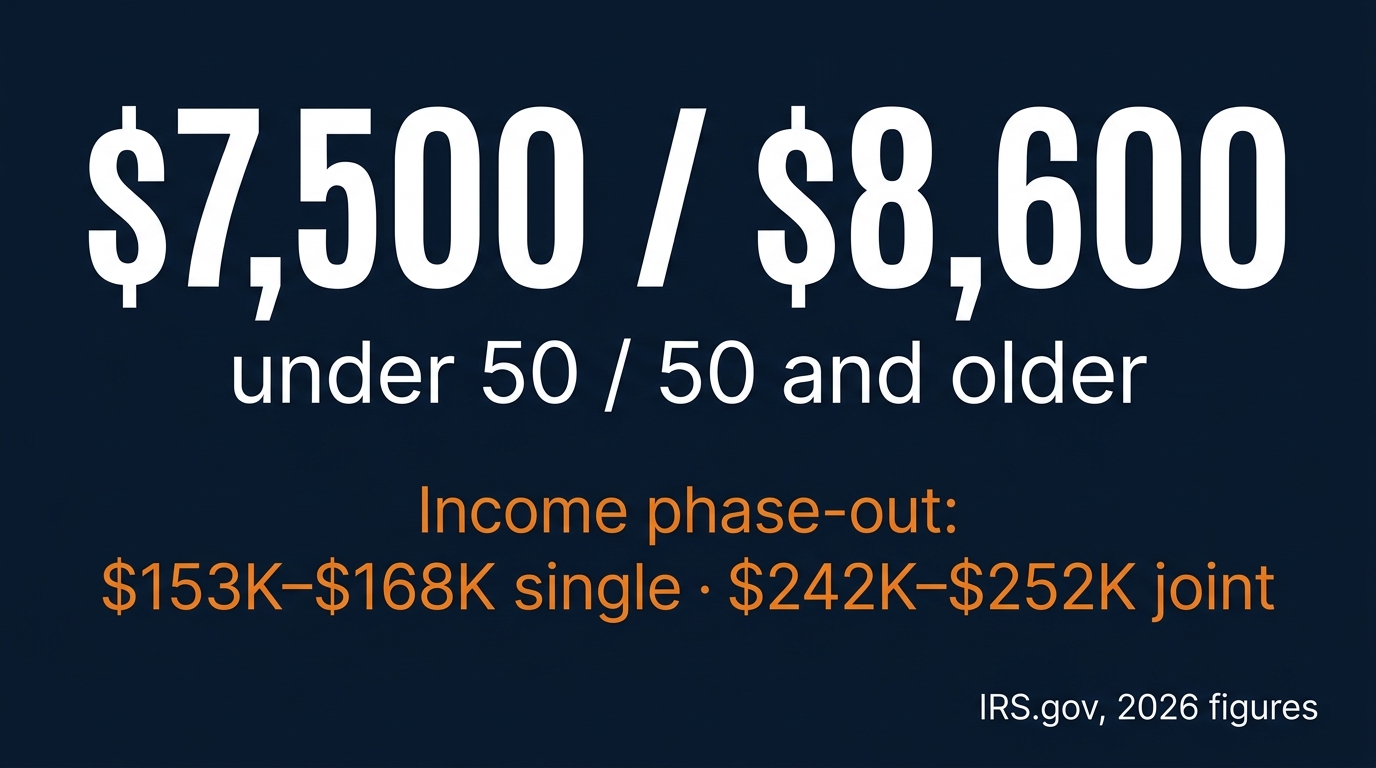
- Contribution limit: $7,500 for those under 50. $8,600 for those 50 and older (a $1,100 catch-up, per the SECURE 2.0 Act's inflation-indexing change starting in 2026 — up from a flat $1,000 in prior years).
- Income phase-out ranges (2026): Single or head of household, phase-out begins at $153,000 Modified Adjusted Gross Income (MAGI), eliminated at $168,000. Married filing jointly: $242,000 to $252,000. Married filing separately: $0 to $10,000 — this range is not adjusted for inflation.
- No age limit on contributions, as long as there's qualifying earned income. There's no cutoff age the way there once was for other account types.
- No required minimum distributions (RMDs) during the original account owner's lifetime — a real difference from most other retirement accounts.
Source: IRS.gov newsroom release IR-2025-111 (Nov. 13, 2025), covering 2026 cost-of-living adjustments.
What Happens Inside the Container
Here's the scenario: you open a Roth IRA. You transfer money in. You look at the account and see a balance sitting there. You assume your money is already invested and growing.
It might not be. Depending on the provider and how the account was set up, money that's transferred in can land in a default cash position — sometimes called a settlement fund or sweep account — where it stays uninvested until an investment is actively chosen. That cash position isn't the same thing as being invested for long-term growth, regardless of what it happens to earn while it sits there. The account being funded and the money being invested are two different steps, and the second one doesn't happen automatically just because the first one did.
The long-term value people usually open a Roth IRA to capture depends on what happens to the money inside it. If the money stays uninvested, years can pass before you realize the account wasn't doing what you thought it was doing. That's the reason this post exists: not to tell anyone what to buy, but to make sure the "did I actually invest it" question gets asked at all.
What Comes Out, and When
Two different sets of rules apply here, depending on what kind of money is coming out.
Regular contributions — the after-tax dollars put in directly — can generally be withdrawn at any time, at any age, without income tax or penalty. That's because the money was already taxed before it went in; the IRS isn't taxing it twice. In the IRS's ordering rules for a Roth IRA withdrawal, contributions come out first, ahead of any conversions or earnings.
Earnings — the growth generated inside the account — follow a separate set of rules. A qualified distribution from a Roth IRA is tax-free, but it requires two things at once: the account has been open at least 5 tax years, and the distribution is made after age 59½, because of disability or death, or for a qualifying first-time home purchase, up to the applicable $10,000 lifetime limit. A non-qualified distribution of earnings may be taxed and subject to a 10% additional tax — commonly called the early withdrawal penalty.
Worth being precise about the distinction: contributions being accessible is different from earnings being accessible, and neither is the same as a decision to treat retirement savings as a household emergency fund. Money being technically reachable in an emergency isn't the same as building a Roth IRA to be an emergency fund on purpose — that's a different job, with real costs to using it that way. Where an emergency fund actually belongs is its own question, already answered.
What a Roth IRA Is Not
- Not a bank account. It's an investment account wrapper — the tax treatment is the feature, not a savings-account-style interest rate.
- Not guaranteed to grow. Whatever's invested inside it can gain or lose value, same as any investment.
- Not an investment on its own. The account is the container, not the thing that grows. See above.
- Not the same as a Roth 401(k). Different account type, different contribution limits, different rules entirely — that's its own topic.

The Part Chuck Wants You To Actually Do
If you don't already have a Roth IRA and you're within the income limits, find out where you'd open one — but don't stop at opening it. Check what investment options are actually available inside the account, and confirm the money isn't just sitting in a default cash position sitting idle.
If you already understand what a Roth IRA is and the real question is Roth versus Traditional, that answer lives here: Roth IRA vs. Traditional IRA — Chuck Picks One covers exactly that comparison.
Chuck Finance is for entertainment and informational purposes only. Chuck is not a licensed financial advisor, and nothing in this post constitutes professional financial, investment, legal, or tax advice. IRA rules and contribution limits change annually — verify current figures at IRS.gov before making any contribution or withdrawal decisions, and consult a licensed professional for your specific situation.
Sources
- Internal Revenue Service, "401(k) limit increases to $24,500 for 2026, IRA limit increases to $7,500", IR-2025-111, November 13, 2025 (contribution limits, catch-up amount, income phase-out ranges)
- Internal Revenue Service, Instructions for Form 8606 (2025) (qualified distribution requirements: 5-year period, age 59½, disability, death, first-time home purchase)
- Internal Revenue Service, "Retirement plans FAQs regarding IRAs distributions (withdrawals)" (no RMDs required for Roth IRAs)