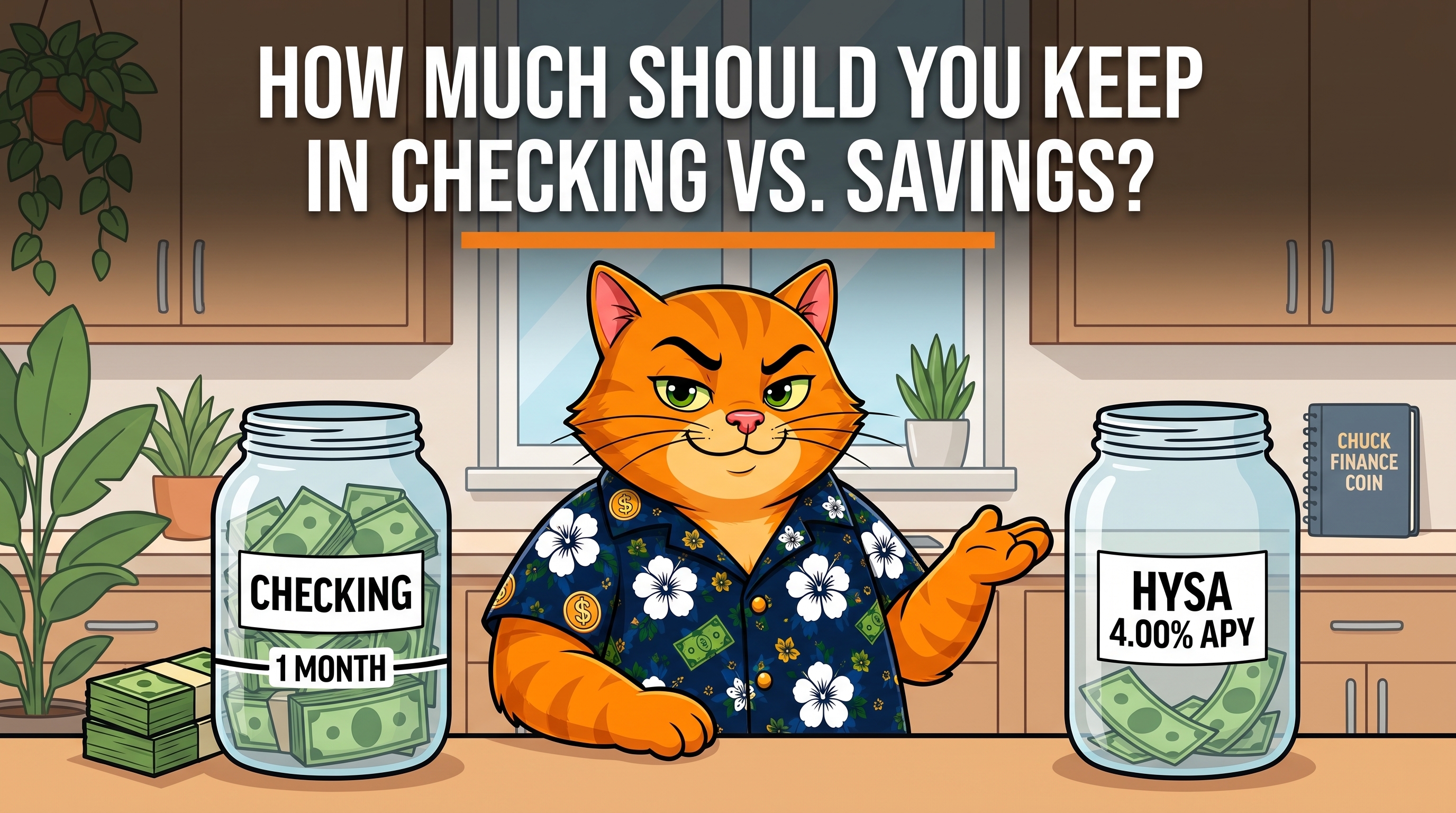


Wait, Didn't We Already Cover This?
If you read Why Your Savings Account Is Losing You Money, you already know the basic math: the national average savings account pays 0.38% APY, and high-yield savings accounts (HYSAs) pay meaningfully more — in the 2.50% to 4.21% range as of July 2026, with 3.5% APY a realistic, non-promotional rate to expect.
This post isn't a repeat of that math. It's the part that post promised: once your money is generally sitting in the right kind of account, is it sitting in the right account for what it's actually for — your emergency fund specifically? An emergency fund isn't just money. It's money with a job: it has to be there, in full, the moment you need it. That constraint changes what "the right account" means, and it's exactly the part most people get wrong.
Why Your Bank Is Counting On You Not Moving It
Here's the part your bank hopes you never think about: that 0.38% national average isn't a mistake, and it isn't because the bank doesn't have the money. It's one of the largest financial institutions on the planet. It's because your bank is counting on you not moving.
Your bank takes your deposit, lends it out or invests it at four, five, six percent, and pays you back a fraction of that. For most people, that bet pays off — not because the math is close, but because most people never run the math at all.
On $10,000, that's the difference between $38 a year and $350 a year. On the median American emergency fund — $5,000, according to Bankrate's 2026 Emergency Savings Report — it's $19 versus $175. Not a rounding error. The difference between forgettable and actually noticing.
This matters more than it looks like it should: nearly one in four Americans (24%) have zero emergency savings at all, and only 46% can cover three months of expenses if they needed to. Building the fund is already the hard part. The least it should do, once it exists, is keep pace with what it's worth.
The Real Reasons People Never Switch
If the math is this obvious, why doesn't everyone just move their emergency fund? Three reasons, and none of them hold up.
- "It's complicated." It isn't. Opening a HYSA takes about as long as ordering food delivery, and you don't have to close your old account first — you can run both while you make the switch.
- "My money is less safe somewhere new." It isn't, as long as the bank is FDIC-insured. Same $250,000-per-depositor protection, same federal backing, just a rate that isn't insulting.
- Nobody ever actually told them the gap was this big. There's no notification that pops up and says, "hey, you left three hundred dollars on the table this year." Banks don't advertise what they're not paying you. Silence is the entire business model.
The Liquidity Myth That Keeps People Stuck
There's a specific myth that keeps people from moving their emergency fund in particular, even after they've moved other savings — and it's worth killing directly.
People hear "higher rate" and assume it means locked up: a CD, a fixed term, a penalty for touching the money early. It doesn't. A HYSA is exactly as liquid as the savings account you already have. Same-day transfers, no lockup, no penalty. The only thing that changes is the number next to APY.

If something is asking you to lock up your emergency fund to get a better rate, that's not a HYSA — that's a different product, and it defeats the entire point of an emergency fund existing. The whole reason the fund exists is that you might need all of it, at once, without warning. Anything that adds friction to that access isn't an upgrade — it's a different tool for a different job.
This Isn't a Character Flaw
If you've been keeping your emergency fund in the same account you've had since your first job, that isn't a character flaw.
Nobody sat you down and explained that "savings account" doesn't mean one fixed rate — it means whatever your bank feels like paying that quarter, and that number can vary by ten times depending on where you look. You did the hard part. Building three, six, however many months of expenses is genuinely difficult. The system just never bothered to mention that where you put it matters almost as much as the fact that you did it at all.
Moving your emergency fund doesn't touch that habit. The saving, the discipline — all of that stays exactly as it is. You just move the money. Same amount, same purpose, sitting somewhere that actually respects the work you put into saving it.
What Actually Matters When You Move It
Once you've decided to move it, here's the checklist specific to an emergency fund — not just "any savings":
- Keep it liquid. No CDs, no lockups, nothing that penalizes you for needing it during an actual emergency. That defeats the purpose.
- Confirm FDIC insurance before you deposit a dollar. It takes thirty seconds to check.
- Ignore teaser rates that expire after three months. Look at what the account pays after the introductory period ends — that's the number that matters for the other eleven months of the year.
- Automate the transfer once you've made the switch, so this becomes a decision you make exactly one time, not a decision you have to keep making.
Don't chase the single highest number you can find online and forget about it. You don't need the absolute top rate on any given week — you need a real rate, confirmed safe, moved once.
The Real Difference
Denise still has her three months saved. So does Walter. Same effort. Same discipline. The only difference between two coffees a year and two months of groceries a year is one five-minute form.
That gap doesn't close on its own. It just quietly gets a little wider every year you don't move it.

If your emergency fund has been sitting in the same account for years, this is the week to check where it actually lives. Confirm the rate. Confirm the FDIC coverage. Move it once.
Sources: