One Number You Know, One Number You Hope For
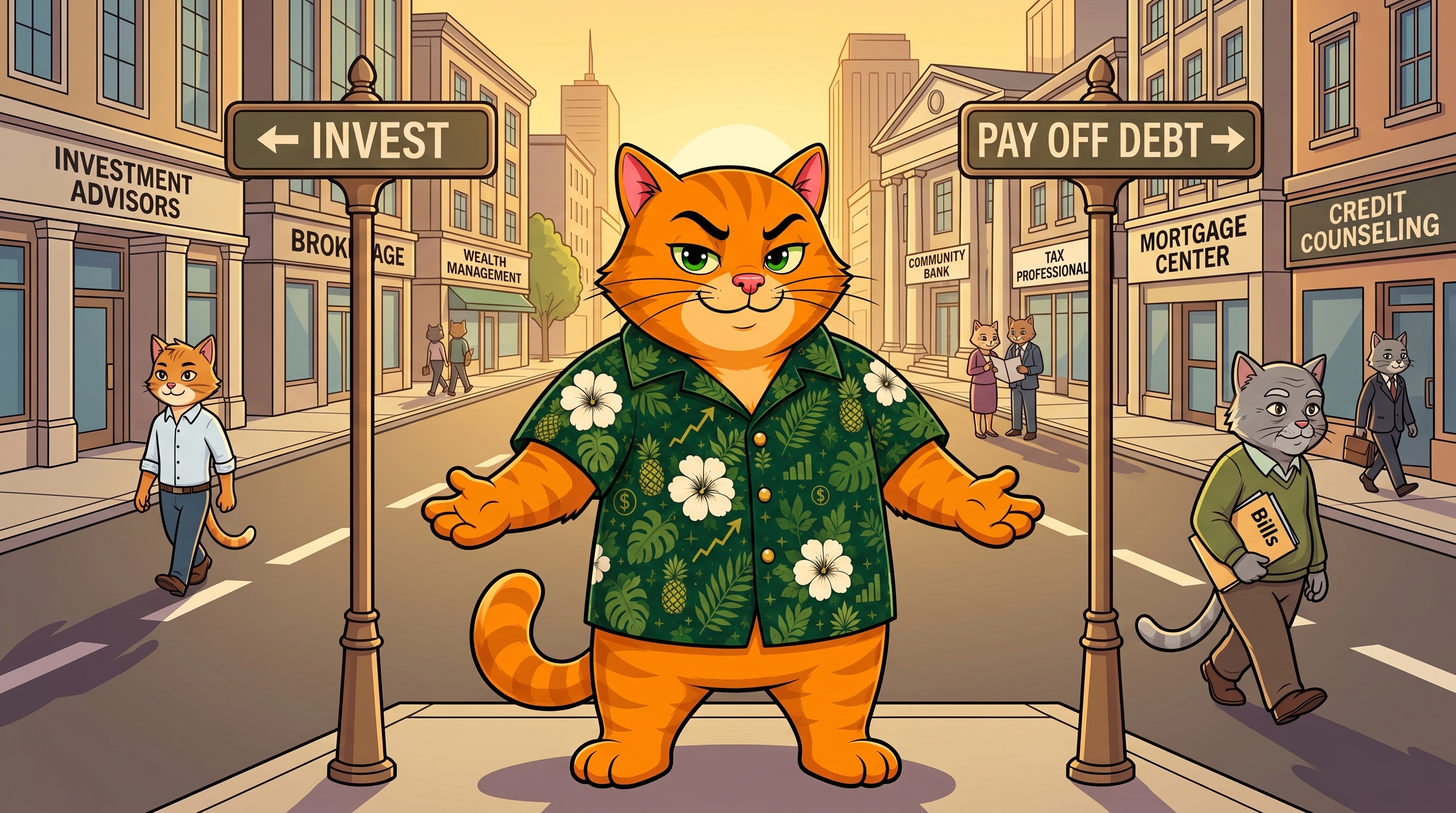
Here's the mechanic underneath this whole decision. Debt has a guaranteed cost — the interest rate on the balance, charged whether the market goes up or down that year. Investing has an expected return — historically strong, but never guaranteed in any single twelve-month stretch.
Comparing the two means comparing a number you know for certain against a number that's an average over decades. That's the entire decision. Most people never frame it that way. They feel guilty about the debt and guilty about not investing, at the same time, and never actually run the two numbers against each other.
The Credit Card Math Isn't Close
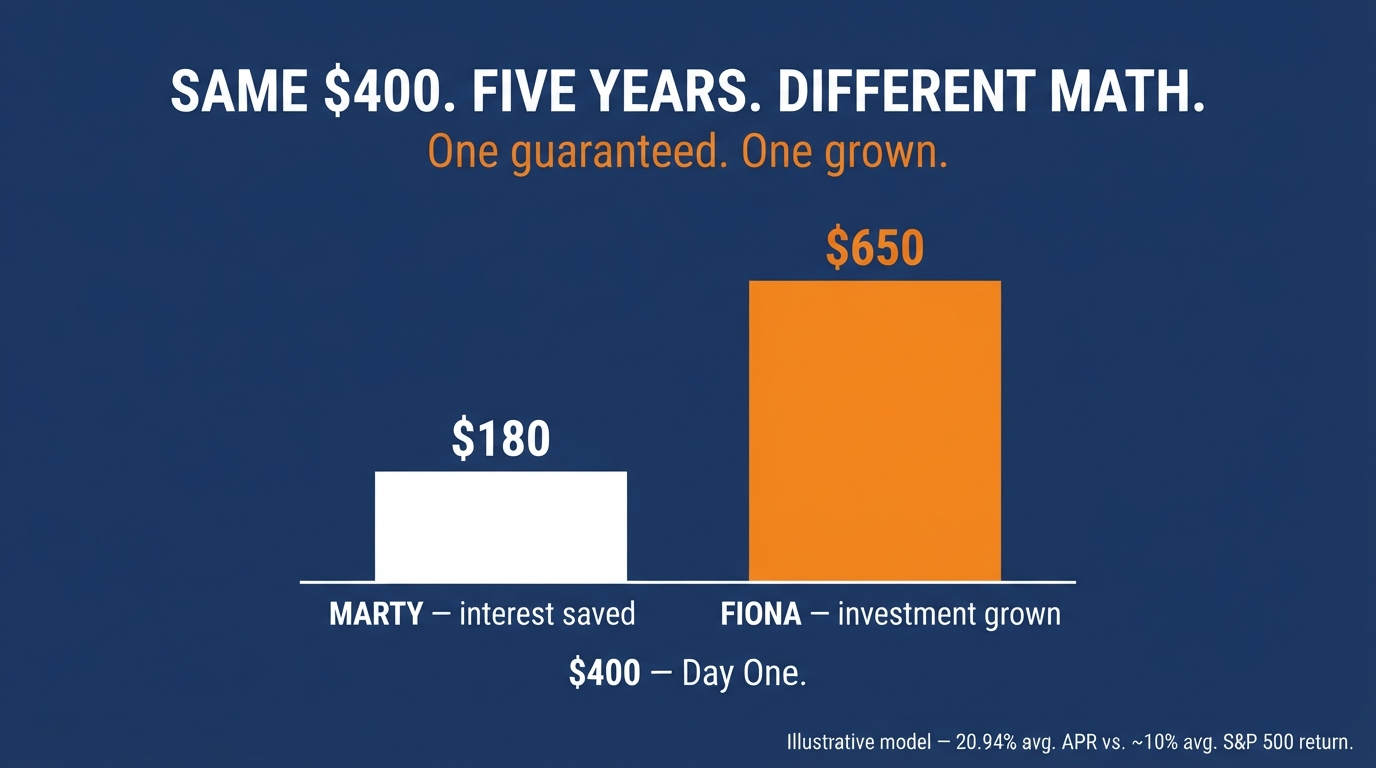
The average credit card sits at 20.94% APR right now, according to the Federal Reserve's own data from this year. Some cards run as low as 10%. Plenty run past 30%. Meanwhile, the S&P 500 has averaged close to 10% a year going back to 1928.
Put those two numbers next to each other and the math isn't close. A dollar that pays off a 20% card saves you 20% in guaranteed interest, the moment you send the payment. Nothing in the stock market guarantees you 20% — not this year, not most years.
If you're carrying a balance north of 15%, paying it down beats almost any investment you could make with that same dollar. That's arithmetic, and it doesn't care how you feel about either option.
What a $5,000 Balance Actually Costs
Run the numbers on a $5,000 balance at 22%. Left alone, making only minimum payments, that balance can take over a decade to clear — and cost you more in interest than the original amount you borrowed.
Redirect an extra $200 a month toward it instead, and it's gone in about two years, with a fraction of the interest paid. That's not a small optimization. That's the difference between debt that owns you for a decade and debt that's a temporary, closed chapter.
Why Smart People Get This Wrong
Debt feels like an emergency — something to be managed quietly and dealt with later. Investing feels like a bonus — something you do once the emergency is handled. So people default to whichever one feels more urgent in the moment, instead of whichever one the numbers actually favor.

Urgency and math are not the same thing. The gap between them is where most of this decision goes wrong.
Quick gut check: do you know your card's actual APR right now — not what you remember it being when you opened the account? It takes about ninety seconds to look up, and it's the single number this entire decision turns on.
Student Loans Are a Different Problem
Not all debt behaves like a credit card. Federal student loans this year run between 6.52% for undergraduate loans and 9.07% for Parent PLUS loans, depending on the loan type. That's real money, but it's a different category entirely from a 22% card.
Here's what that looks like with real numbers. A $30,000 student loan at 6.52% on a standard ten-year schedule costs about $338 a month, and roughly $10,560 in total interest if you only ever make the minimum. Take every dollar above that minimum and invest it monthly into a broad index fund instead, and — based on the S&P 500's roughly 10% historical average, which varies meaningfully decade to decade — the math tends to favor that split over aggressive early payoff. The gap between 6.52% and the historical return is wide enough that the market has room to do its work.
Push that loan to 9% or higher and the gap shrinks close to nothing. Push it past 10% and paying it down aggressively wins again. The specific rate is doing all the work in that decision. The word "debt" tells you almost nothing on its own.
A 24% credit card and a 6.5% student loan are not the same problem wearing different names. One is a fire. The other is a slow leak. You put out the fire first. You can manage the leak while you handle other things at the same time.
The Step Everyone Skips
Before either of those, there's a step that makes everything after it actually work: a small emergency cushion. Even just $1,000 to start.
Not because debt or investing don't matter — because without it, the next flat tire or broken phone goes straight back onto the same credit card you're trying to pay down, and you're right back where you started, except now you feel worse about it too.
This cushion isn't a full emergency fund. It's just enough distance between you and the next unplanned expense that a bad week doesn't turn into another year of debt.
Minimum Payments Are Working Exactly as Designed
47% of American cardholders are carrying a balance right now, and the average balance among people who actually revolve month to month is $10,870. Total credit card debt in this country sits at $1.25 trillion. Most of that is compounding against people, not for them.
Here's what card issuers don't advertise: minimum payments are calculated to keep the balance alive as long as possible while still technically being "in good standing." A minimum payment on a balance like that can be mostly interest, with only a sliver actually reducing what you owe. You can make that payment faithfully for years and watch the balance barely move.
That's not a failure on your part. That's the product working exactly as designed.
This Isn't a Discipline Problem
If you're staring at both a credit card balance and an empty retirement account, that isn't a discipline problem. Almost nobody sits down and calculates the exact interest rate math before they get into debt. You get into it during a job loss, a medical bill, a month where the numbers didn't work out.
The debt shows up first. The guilt about not investing shows up after. Neither one means you're bad with money. It means you were dealing with a real situation using the tools you had at the time.
You don't have to solve this perfectly. You have to solve it in order.
The 6%–10% Threshold
The math starts shifting somewhere between 6% and 10%. Below that range, investing tends to win over time. Above it, paying down the debt wins faster.
There's no single universal number that fits every person and every risk tolerance — most advisors land somewhere inside that band depending on how aggressively you invest. But there's a range, and it's not a mystery once you know where to look.
The 401k Match Outranks Everything
If your employer offers a 401k match, that sits in a category of its own. It is not debt payoff. It is not investing in the traditional sense. It is a guaranteed, immediate return on your contribution — often 50% to 100% — the moment your employer matches it.
Capture the full match before you redirect a single extra dollar anywhere else. Every time. Regardless of what your debt looks like.
The Order, Start to Finish
- Minimum payments on everything you owe. No exceptions, ever. Missing a minimum tanks your credit and adds fees on top of interest.
- Build the starter emergency cushion — even $1,000 — so one bad week doesn't undo the rest of this list.
- Grab the full employer match before you touch another dollar of debt. Skipping it is leaving money behind.
- Attack any debt above roughly 7%–8% interest with every extra dollar you can find, until it's gone.
- Then split: keep the lower-interest debt on schedule, as agreed, and start directing real money into an index fund at the same time.
Debt payoff and investing were never actually competing goals. Debt payoff is just the first phase of the same plan, running on a different timeline than the second phase. You're not choosing between them forever. You're choosing an order — and the order is the entire strategy.
The Boring Truth About How This Works
Marty didn't get out from under his card in a month, and Fiona didn't build real wealth in one either. The five-year gap between them wasn't one dramatic decision. It was which direction every extra dollar moved, month after month, for years in a row.
Neither of them won the lottery. Neither got a sudden raise that solved everything. Marty stopped feeding a 22% balance with more debt and started feeding it with actual payments. Fiona left her $400 alone and let market history do what it's done for a century. Small, boring, repeated decisions — that's the entire mechanism behind almost every real financial turnaround, whether the number involved is $400 or $40,000.
Sit down today and write down every debt you're carrying — the balance, the rate, the minimum payment. Put them in order by interest rate. That list is your plan. The math does the rest.
Sources:
- Average Credit Card Interest Rate — The Motley Fool, citing Federal Reserve G.19, 2026
- Macrotrends, S&P 500 Historical Annual Returns
- Federal Register, Annual Notice of Interest Rates for Fixed-Rate Federal Student Loans, 2026
- LendingTree, 2026 Credit Card Debt Statistics
- Federal Reserve Bank of New York, Household Debt and Credit Report, Q1 2026