
What APR Actually Means
Annual Percentage Rate (APR) is the yearly cost of carrying a balance, expressed as a percentage. The word "annual" is where the confusion starts — interest doesn't actually get charged once a year. It gets charged throughout the billing cycle, on whatever balance you're carrying at the time. The annual number is just the starting point issuers use to work backward to the shorter period that actually shows up on your bill.
Step 1 — Turning APR Into a Daily Rate
Card issuers convert your APR into a Daily Periodic Rate (DPR) — the slice of that annual number that applies to a single day you're carrying a balance. The most common method, confirmed by the Consumer Financial Protection Bureau (CFPB), divides the APR by 365:
20% ÷ 365 = 0.05479% per day (0.0005479 as a decimal)
That's the rate we'll use for Leslie's example. Some issuers divide by 360 instead, and the exact method can vary by card — your own cardholder agreement has the specifics for your account. This post uses 365, since that's the version CFPB and most issuers cite.
Step 2 — Average Daily Balance
Most issuers calculate interest using the average daily balance — each day's balance during the cycle gets tracked, added up, and divided by the number of days. For someone making payments or new charges throughout the month, that number moves around day to day.
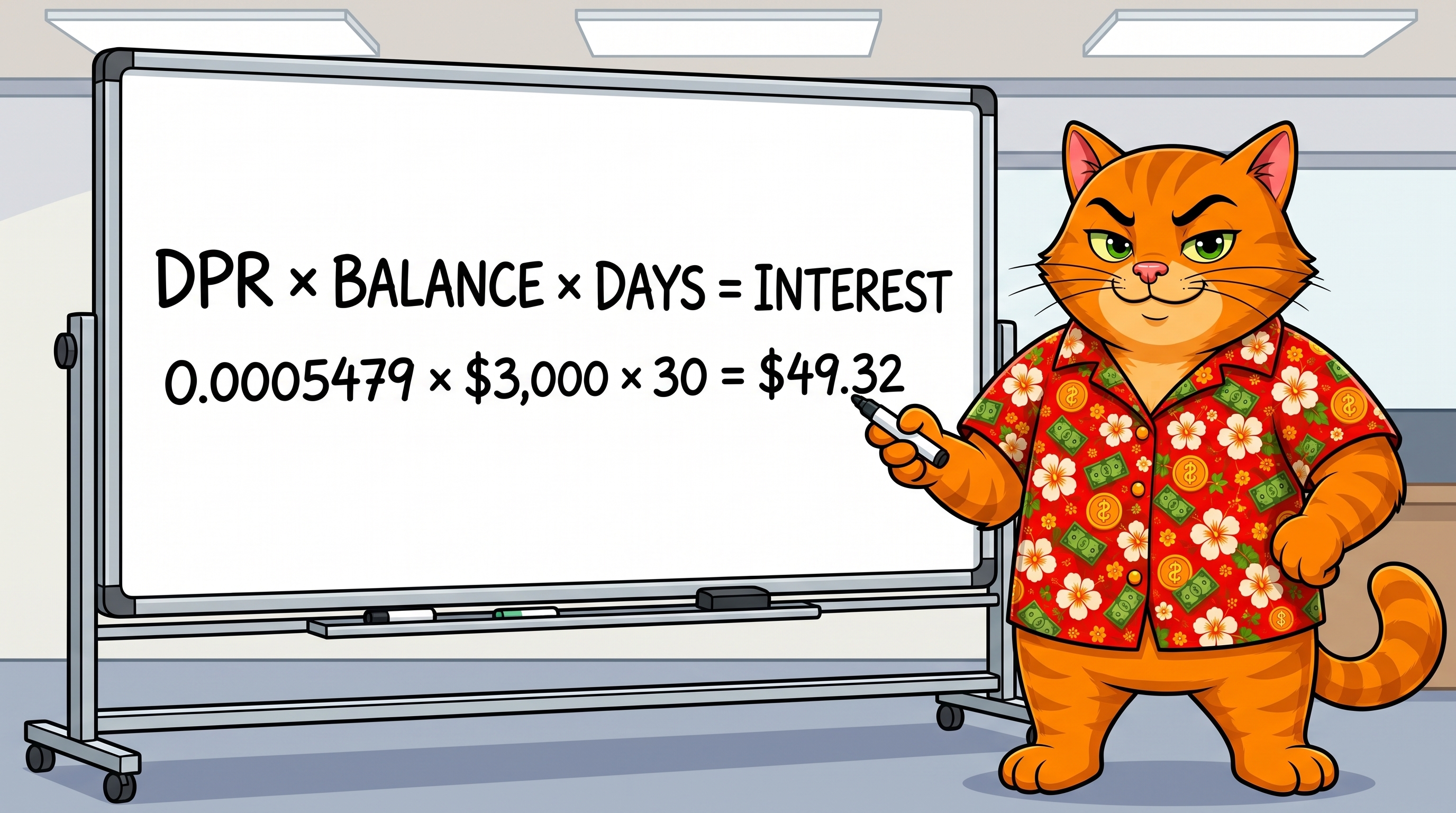
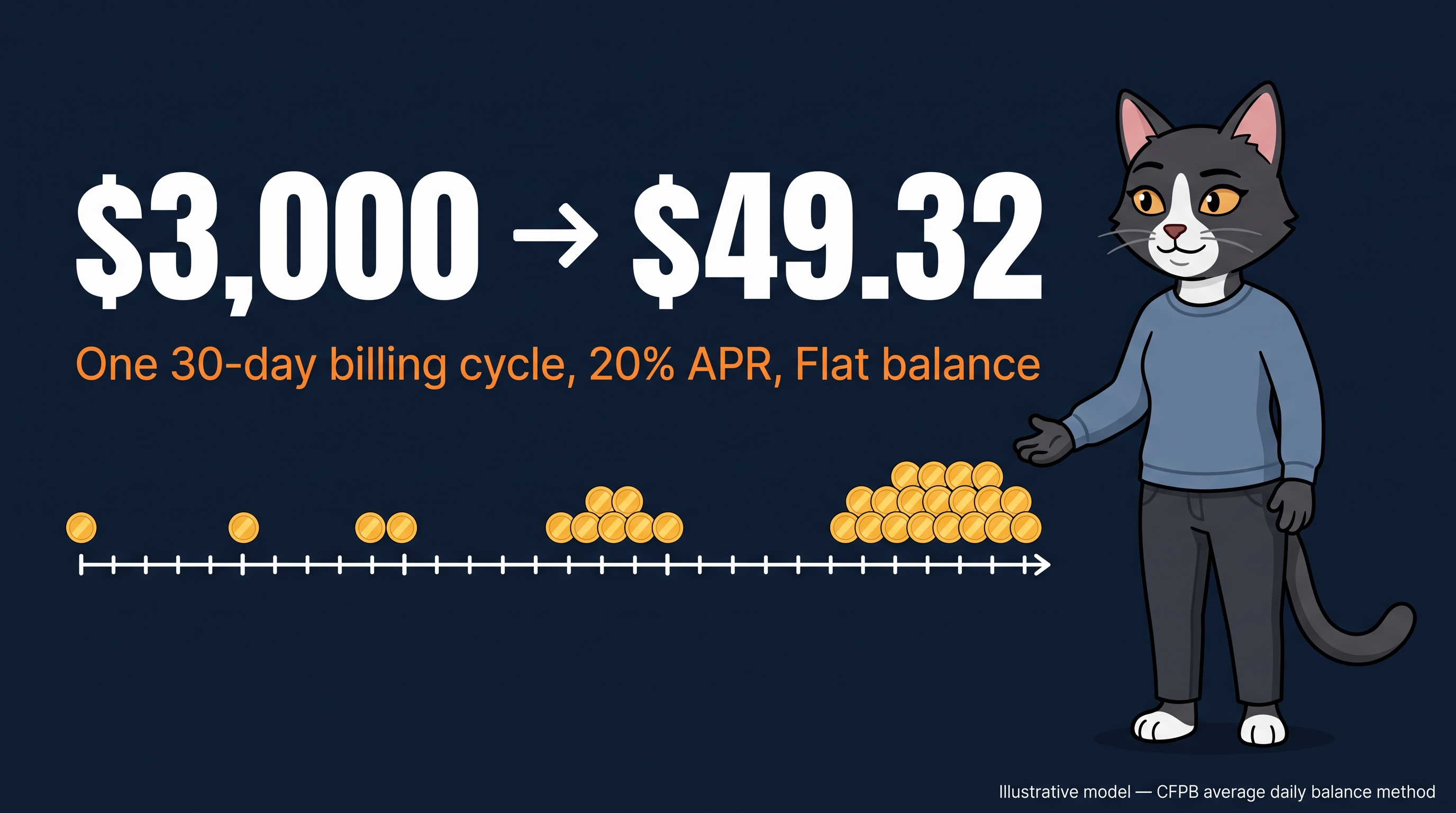
To actually see what the interest is doing, we're going to hold Leslie's balance still for one billing cycle. Her real balance won't stay frozen at $3,000 — payments, any new charges, and the interest itself will all move it over time. But for this one 30-day stretch, let's freeze it right where it started: $3,000. That makes her average daily balance for the cycle simply $3,000, and it lets us isolate exactly what the interest rate itself is doing, before anything else changes.
Chuck's not counting on nine lives to do this math — just a calculator and about five minutes.
The Reveal — Leslie's Actual Dollar Cost
Here's the math for that one frozen cycle:
- Daily rate × balance: 0.0005479 × $3,000 = $1.64 in interest per day
- Daily amount × 30 days: $1.64 × 30 = $49.32 for the cycle
Leslie's $3,000 vacation just cost her another $49.32 — not for spending more, not for missing a payment, just for carrying that balance through one billing cycle.
For perspective, not a prediction: if a $3,000 balance sat completely unchanged for a full year at 20% APR, the simple comparison is 20% × $3,000 = $600. That's not what Leslie's actual annual interest will add up to — her balance won't stay frozen, and whatever she pays down will chip away at it. It's just a clean way to see what the rate itself is worth over a full year, before real life changes the number.
This is a simplified model, not a replica of any one issuer's exact calculation. Some cards add unpaid interest into the balance before figuring the next day's charge; others don't. Whether interest applies to a given balance at all can also depend on your card's grace-period terms — that's between you and your cardholder agreement, and it's its own topic beyond this post.
Leslie's statement has one more number on it: a minimum payment, separate from the interest we just calculated. The minimum is the least her card agreement requires her to pay that cycle — it isn't the amount needed to clear the balance. If she pays only the minimum, whatever's left keeps sitting on the card, and next cycle's interest gets calculated on that remainder. The Minimum Payment Trap Nobody Warns You About walks through exactly what that path costs over time, if that's the road Leslie's headed down.
The APR-to-Dollars Formula
Daily Periodic Rate (APR ÷ 365) × Average Daily Balance × Days in Billing Cycle = Interest Charged
Freeze a $3,000 balance at 20% APR for one 30-day cycle and the interest alone is about $49 — roughly $600 for the year if that balance never moved, just as a point of comparison, not a forecast of anyone's actual bill.
What Moves the Number
Three variables change the size of this charge — no judgment on any of them, just what's actually doing the work:
Balance. A higher balance means a bigger interest charge at the same rate — if Leslie's vacation had run $4,000 instead of $3,000, the same math scales right along with it.
APR. This varies by card and by creditworthiness. Leslie's 20% is used here as a clean, round illustrative number, not a claim about any specific credit tier. For general context, the overall average credit card APR sits near 21% as of 2026, per Federal Reserve G.19 Consumer Credit data — though G.19 tracks the market as a whole and doesn't break results down by credit score.
Time. The longer a balance gets carried, the more billing cycles that charge accumulates across — this is the one variable entirely in the cardholder's control.
The Part Chuck Wants You To Actually Do
Pull up your own cardholder agreement or your most recent statement. Find your actual APR — not the rate on an ad you saw, the one printed on your account. Run Leslie's math with your own balance and your own APR. The amount of interest accumulating on your balance each day is yours to know, and now you know exactly how to find it.

Credit card interest calculation methods vary by issuer and by cardholder agreement. The figures in this post are an illustrative model, not a universal calculation — verify your own card's specific terms directly with your issuer.
Sources:
- Consumer Financial Protection Bureau, "Credit card contract definitions" (daily periodic rate and average daily balance definitions)
- Consumer Financial Protection Bureau, "What is a 'daily periodic rate' on a credit card?" (confirms 360- vs. 365-day divisor varies by issuer)
- Board of Governors of the Federal Reserve System, Consumer Credit — G.19 data, 2026 (overall average credit card APR; does not break down by credit score tier)