What the Minimum Payment Actually Is
Most issuers calculate your minimum payment as whichever is greater: 1% of your balance plus that month's interest charge, or a flat floor amount — usually around $25 to $35. That formula isn't random. It's built to cover the interest the issuer is owed, chip a token amount off the principal, and nothing more.
It's not designed to get you out of debt at any meaningful pace. It's designed to keep the account open, keep you in good standing, and keep the balance generating interest for as long as possible. Nothing about the minimum payment is a recommendation. It's a floor, not a target.
The 1% + Interest Rule
Minimum payment = 1% of your balance plus that month's interest, or $25 — whichever is greater.
On a $4,800 balance at today's average card rate, that minimum barely covers the interest — which is exactly why it can take 18+ years to pay off.
Karl's Statement, and What It Actually Costs
Karl collects trading cards. A passionate hobby plus his general lifestyle put a $4,800 balance on a credit card with a 22.15% APR (Annual Percentage Rate) — APR is the yearly cost of carrying a balance, expressed as a percentage — but it's charged monthly, not all at once. On Karl's $4,800, a 22.15% APR works out to roughly 1.85% added to his balance every single month he carries it, which is where $89 interest charge will come from.
Karl pays his minimum every month, on time, without missing a payment. His credit stays fine. His first minimum payment comes out to about $137 — roughly $48 (1% of the balance) plus about $89 in that month's interest. It'll drift down a little each month as the balance shrinks, but that's where it starts. Here's what that actually costs him, using the standard 1%-plus-interest minimum payment formula:
Paying only the minimum on $4,800:
- Payoff time: roughly 18 years, 8 months
- Total interest paid: about $7,658
- Total paid overall: about $12,458 — more than 2.5 times the original balance
That's an illustrative model, not Karl's literal future, and it assumes Karl doesn't put another purchase on the card the whole time — add even occasional new charges, and both numbers get worse. Actual timelines will also shift with your specific issuer's minimum payment formula and your own APR. But the shape of it is accurate to how the math works for anyone carrying a comparable balance at a comparable rate.
Why the Minimum Is Built This Way
Card issuers earn money on carried balances. Every month a balance survives, it generates interest. The minimum payment formula exists to extend that window as long as legally possible while still meeting the issuer's own risk requirements — not to help a cardholder pay the balance down.
This isn't a hidden conspiracy. It's disclosed, in writing, on every statement — U.S. issuers are required by the CARD Act (Credit Card Accountability Responsibility and Disclosure Act) of 2009 to show exactly this payoff timeline and total interest figure in a box on your bill. The information has been sitting there the whole time. Most people never open that part of the statement.
What Actually Changes the Math
The minimum isn't the only number available to you, and a modest amount above it moves the math more than it looks like it should. Take Karl's same $4,800 balance at 22.15% APR:
- Minimum only: ~18 years, 8 months — ~$7,658 in interest
- Minimum + $50/month: ~5 years, 4 months — ~$2,648 in interest
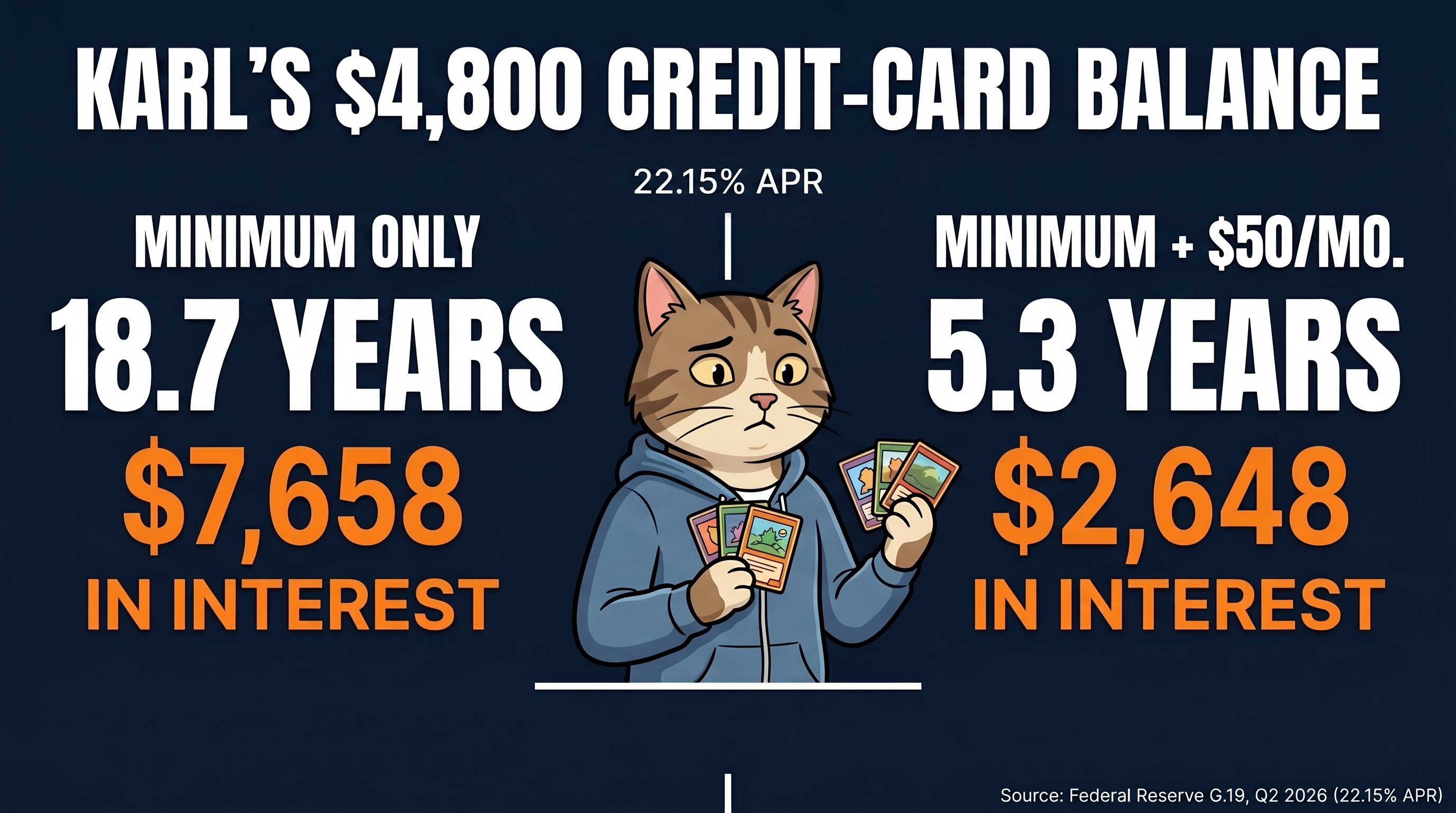
An extra $50 a month cuts more than 13 years off the payoff timeline and saves roughly $5,000 in interest. The minimum payment isn't a wall. It's a floor with a lot of room above it.
When Minimum-Only Is a Reasonable Move
None of this means paying the minimum is always a mistake. If you're in a genuine short-term cash crunch — a lost paycheck, a medical bill, a month where rent and groceries have to come first — paying the minimum to stay current while you get through it is a legitimate, sane choice. So is a 0% promotional balance where the minimum is keeping the account current at no interest cost.
The problem isn't paying the minimum once. It's treating it as a permanent plan instead of a temporary bridge.
Here's What Actually Fixes This
If you're carrying a balance and only paying the minimum, that's not a character flaw. Nobody sat you down and explained that the minimum payment box on your statement is legally required precisely because issuers profit from you not reading it. Now you know.

Go pull up your own most recent credit card statement. Every U.S. card statement has a "Minimum Payment Warning" box — it's required by law. It'll show your real payoff timeline and total interest at your actual balance and actual rate, not Karl's. Look at the minimum payment amount — and always pay a lot more than what the minimum payment is.
Should You Pay Off Debt or Invest First? The Math Decides is next. Read it here: https://chuckfinance.com/blog/chuck-20260715-v04-should-i-pay-off-debt-or-invest-first/
Sources:
- Federal Reserve Board — G.19 Consumer Credit report, Q2 2026 — average APR on credit card accounts assessed interest: 22.15%
- Consumer Financial Protection Bureau / Truth in Lending Act, Regulation Z, 12 CFR Appendix M1 to Part 1026 — required minimum payment repayment disclosure methodology (CARD Act of 2009)