What This Covers
This post covers federal student loans specifically — Direct Loans and Federal Family Education Loan (FFEL) Program loans. Federal Perkins Loans follow different default rules; if you have a Perkins Loan, contact your loan holder directly for the applicable timeline. Private student loans operate under entirely separate rules and aren't covered here at all — don't apply anything below to a private loan.
Delinquency vs. Default — Trevor's Clock Starts
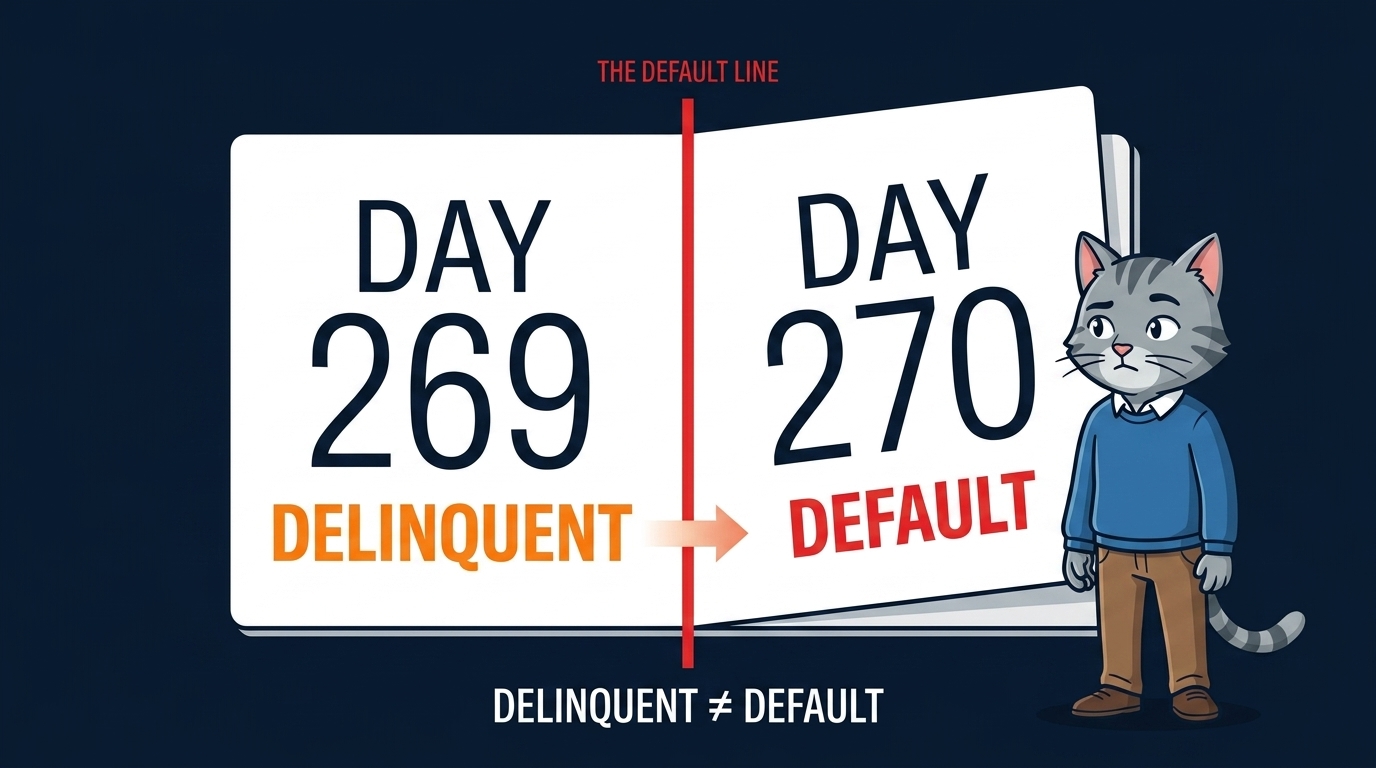
Trevor misses a payment on his federal student loan. His loan is now delinquent — behind, but not yet in default. That distinction matters, because the consequences and the options available change at each stage between here and default.
First missed payment. The clock starts. Trevor's options are still fully open — call the servicer, request forbearance or deferment, look into an income-driven repayment plan.
90+ days past due. The delinquency gets reported to the credit bureaus. Trevor's credit score takes a hit. He still has options. But now the move is a phone call, not another unopened notice.
Approaching 270 days. Trevor is close to the threshold. Servicer notices have gone out. He hasn't called. His options are narrowing, but they haven't closed yet.
270 days — default. For most federal student loans, this is the line: no payment in more than 270 days means the loan is in default. Trevor's loan transfers to the Department of Education's Default Resolution Group (Direct Loans) or a guaranty agency (FFEL loans).
What Default Actually Triggers
Crossing into default is a specific legal status change, not just a worse version of being late:
- The full remaining balance becomes due and payable
- The loan transfers out of ordinary servicing to the Default Resolution Group (Direct) or a guaranty agency (FFEL)
- Access to income-driven repayment, deferment, and forbearance is lost
- Eligibility for additional federal student aid is suspended until default is resolved
- Credit damage deepens well beyond what delinquency alone caused
Federal student loans are also generally not dischargeable in bankruptcy — the "undue hardship" standard courts apply is difficult to meet. This isn't the main story here, but it's worth knowing before assuming bankruptcy is a clean exit.
What the Government Can Do
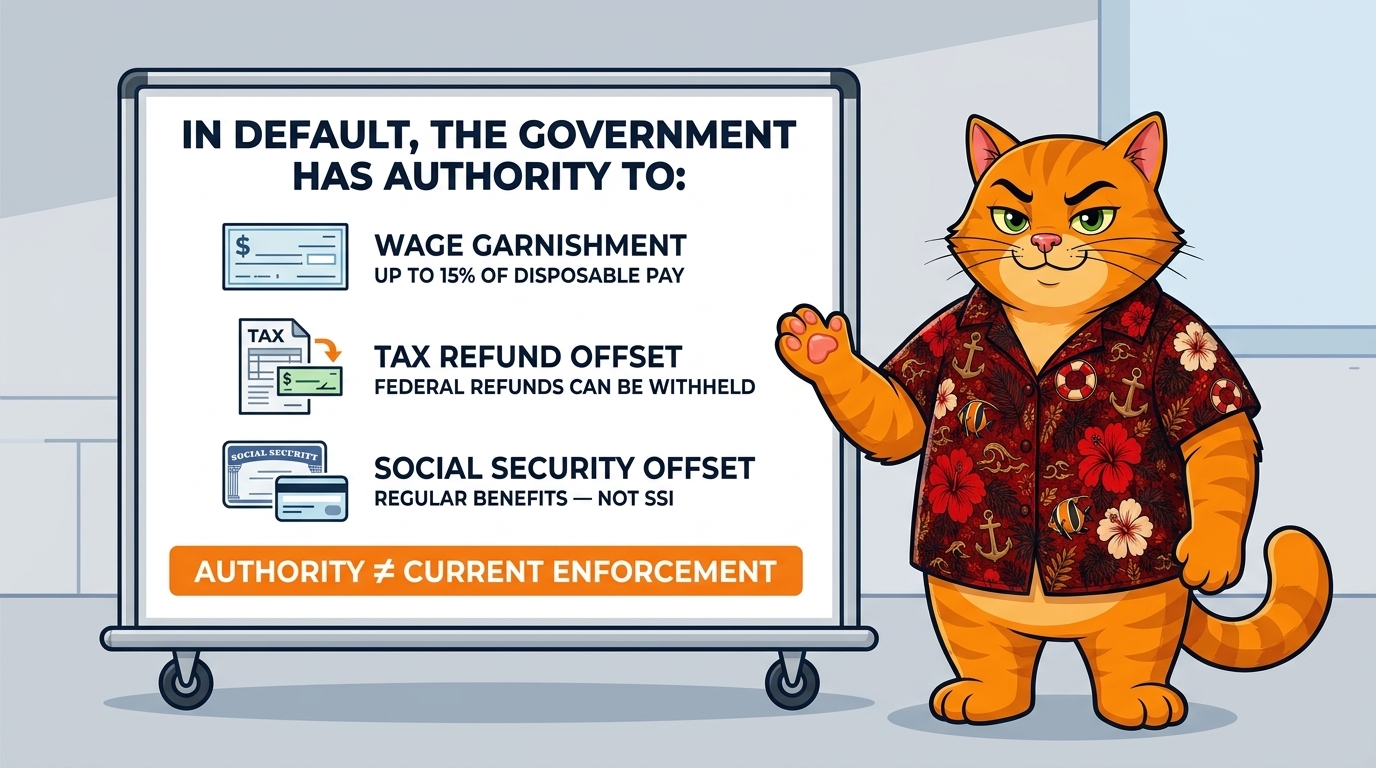
This is where federal student loan default is genuinely different from an ordinary consumer debt like a credit card balance. Three authorities apply specifically because the lender is the federal government — and all three exist independent of whether they're actively being used right now. That distinction runs through this whole section: has authority to, not is currently doing.
Administrative Wage Garnishment. The Department of Education has authority to direct an employer to withhold up to 15% of a borrower's disposable pay — without a court order. Borrowers receive at least 30 days' written notice before garnishment can begin and can request a hearing. By law, garnishment also can't drop weekly pay below 30 times the federal minimum wage, whichever protection leaves more of the paycheck intact.
Treasury Offset Program — tax refunds and federal payments. The government has authority to withhold federal tax refunds and certain other federal payments through the Treasury Offset Program (TOP) to collect on defaulted federal student loan debt. Borrowers receive written notice before a TOP referral.
Treasury Offset Program — Social Security. The government has authority to offset regular Social Security benefits — not Supplemental Security Income (SSI), which is fully protected — by the lesser of 15% of the monthly benefit or the amount by which the benefit exceeds $750 a month. That $750 floor was set in 1996 and has never been adjusted for inflation, per the Consumer Financial Protection Bureau's (CFPB's) own analysis.
What's Actually Happening Right Now
Current as of September 2026 — verify at studentaid.gov before relying on this section, since this is the layer that changes.
The Department of Education paused Administrative Wage Garnishment and the Treasury Offset Program on January 16, 2026, to allow time for broader repayment-system reforms. As of ED's most recent posted review of that announcement (August 27, 2026), no restart date has been announced, and involuntary collection under either program remains paused. The Department continues to report defaults to credit bureaus during this pause — that consequence hasn't stopped.
A pause is not a repeal. The authorities described above remain fully intact in law; the Department has simply chosen not to exercise them right now. That can change without much advance public notice, which is exactly why this section is dated and the section above it isn't.
Authority vs. Enforcement
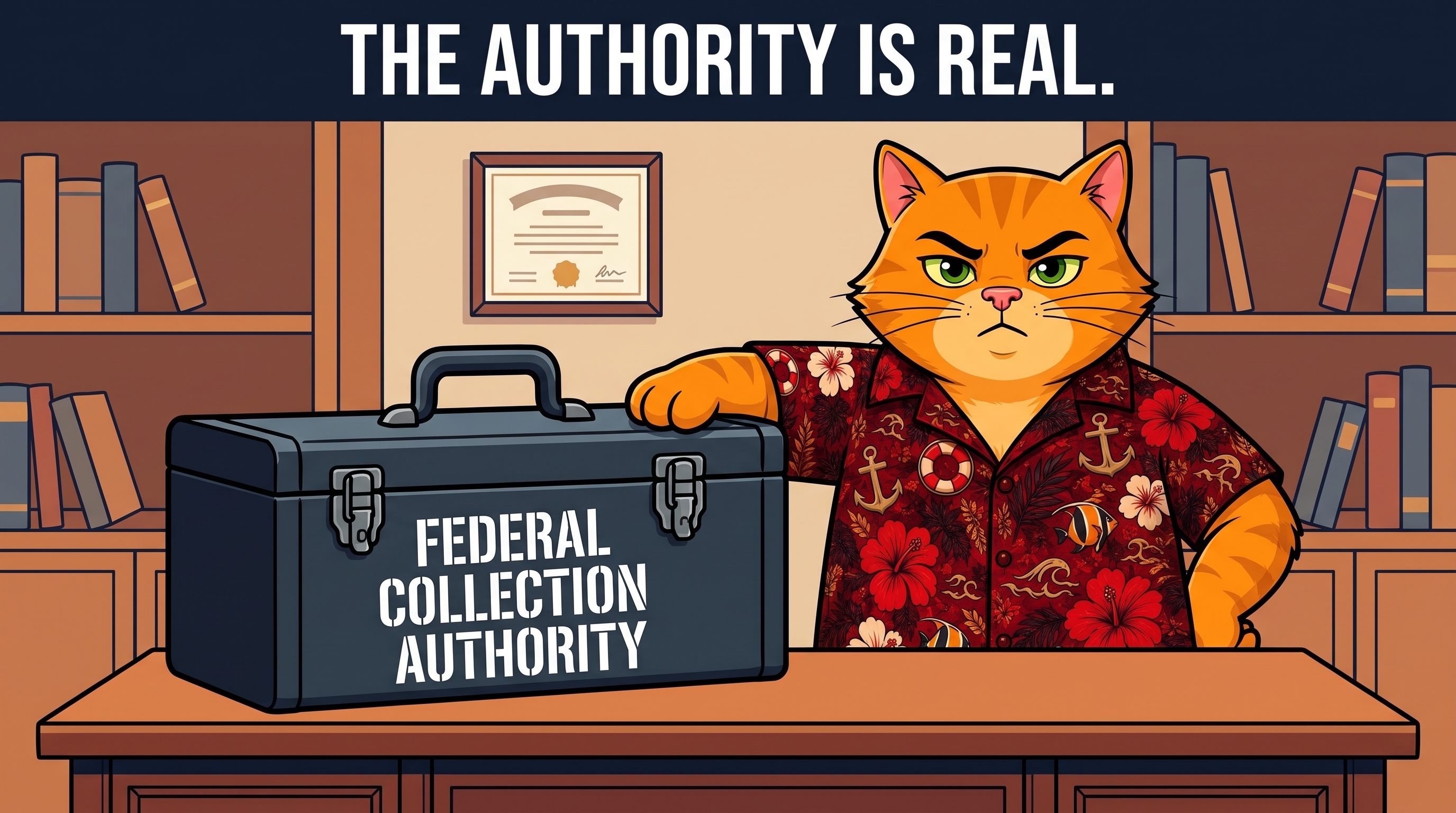
The government has collection authorities ordinary creditors don't — without a court order.
As of September 2026, those tools remain paused with no announced restart date — but the underlying authority never went away, and a pause is not a repeal.
Before Default: The Off-Ramp
If you're behind but haven't hit 270 days yet, the door is still open:
- Contact your loan servicer now, not after the next notice arrives
- Before default, options such as deferment, forbearance, and income-driven repayment may still be available through ordinary loan servicing. Default changes that menu substantially and moves you into default-resolution territory instead.
- Current plan options change; check studentaid.gov directly rather than relying on what a plan was called last year.
After Default: Three Ways Out
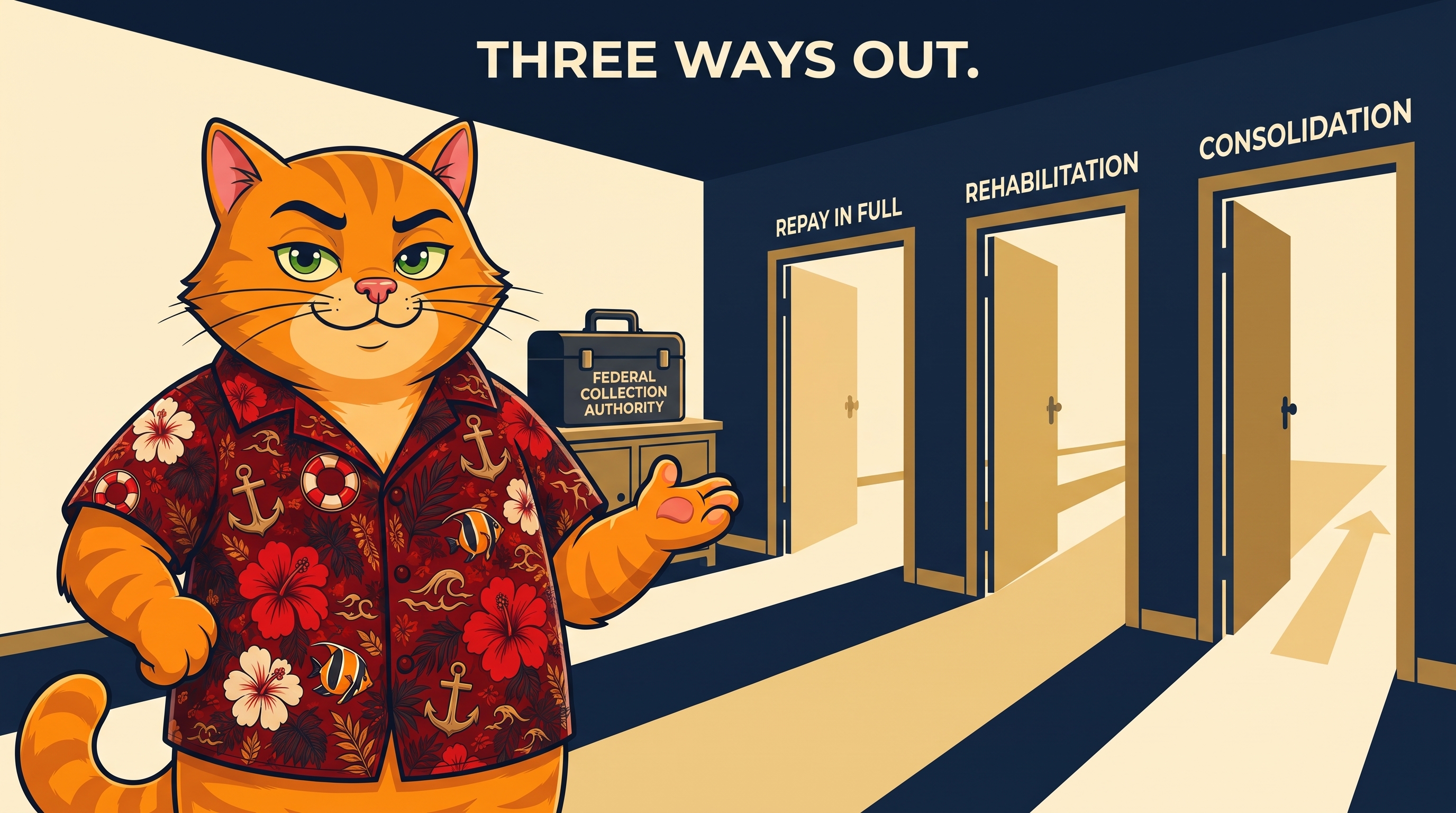
If you're already past 270 days, there are three established paths back:
- Repay in full.
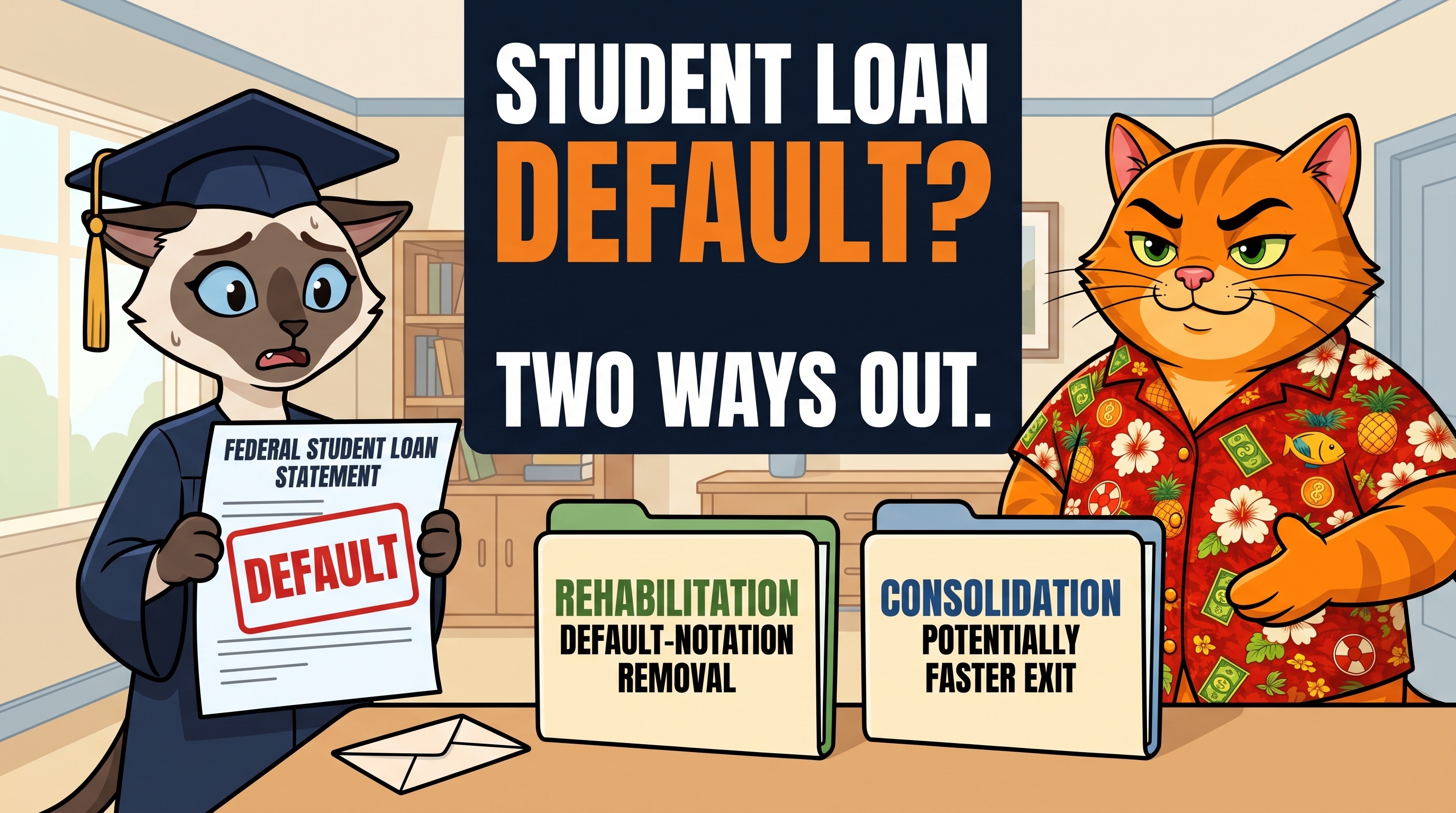
- Loan rehabilitation — nine consecutive voluntary, on-time payments over 10 months. Once complete, the default notation is removed from your credit report (Direct and FFEL loans) — but the late payments reported before the loan went into default remain on your credit history. Rehabilitation clears the default record, not the payment history that led to it.
- Consolidation — combine defaulted loans into a new Direct Consolidation Loan, generally after committing to an income-driven repayment plan or making three voluntary payments first.
Contact the Department's Default Resolution Group directly at 1-800-621-3115 (Monday–Friday 8 a.m.–10 p.m. ET, Saturday 8 a.m.–6 p.m. ET) or start at studentaid.gov.
If you're already in default, the point of knowing all this isn't to scare you. It's to show you that default is a status with resolution paths — not the end of the road.
The Part Chuck Wants You To Actually Do
If you have federal student loans and you're behind, log into studentaid.gov right now. Check your actual loan status, confirm your servicer, and make contact before the timeline runs further. This isn't about which of the three resolution paths is right for you — that depends on your situation. It's about not letting the 270-day clock run out simply because nobody made the call.
Chuck Finance is for entertainment and informational purposes only. Chuck is not a financial advisor or attorney, and nothing in this post constitutes professional financial, legal, or tax advice. Federal student loan policy is subject to change — verify current rules and enforcement status at studentaid.gov before acting on anything above. Rules differ significantly for private student loans, which are not covered in this article. If you have a defaulted loan, consider consulting a nonprofit student loan counselor or an attorney for your specific situation.
Sources
- Consumer Financial Protection Bureau, "What happens if I default on a federal student loan?" (270-day default definition)
- Federal Student Aid, "Student Loan Default and Collections: FAQs" (default timeline, transfer to Default Resolution Group)
- U.S. Department of Education, "U.S. Department of Education Delays Involuntary Collections Amid Ongoing Student Loan Repayment Improvements", January 16, 2026, page last reviewed August 27, 2026 (current-policy pause status)
- Consumer Financial Protection Bureau, "Issue Spotlight: Social Security Offsets and Defaulted Student Loans" — Social Security offset formula and the unindexed $750 floor
- Federal Reserve Bank of New York, Liberty Street Economics, "Federal Student Loan Defaults Return After Pandemic Pause" (default volume and borrower age statistics)
- Federal Student Aid, Service Centers for Students (Default Resolution Group contact information)