Before the Math, Check Your Contract
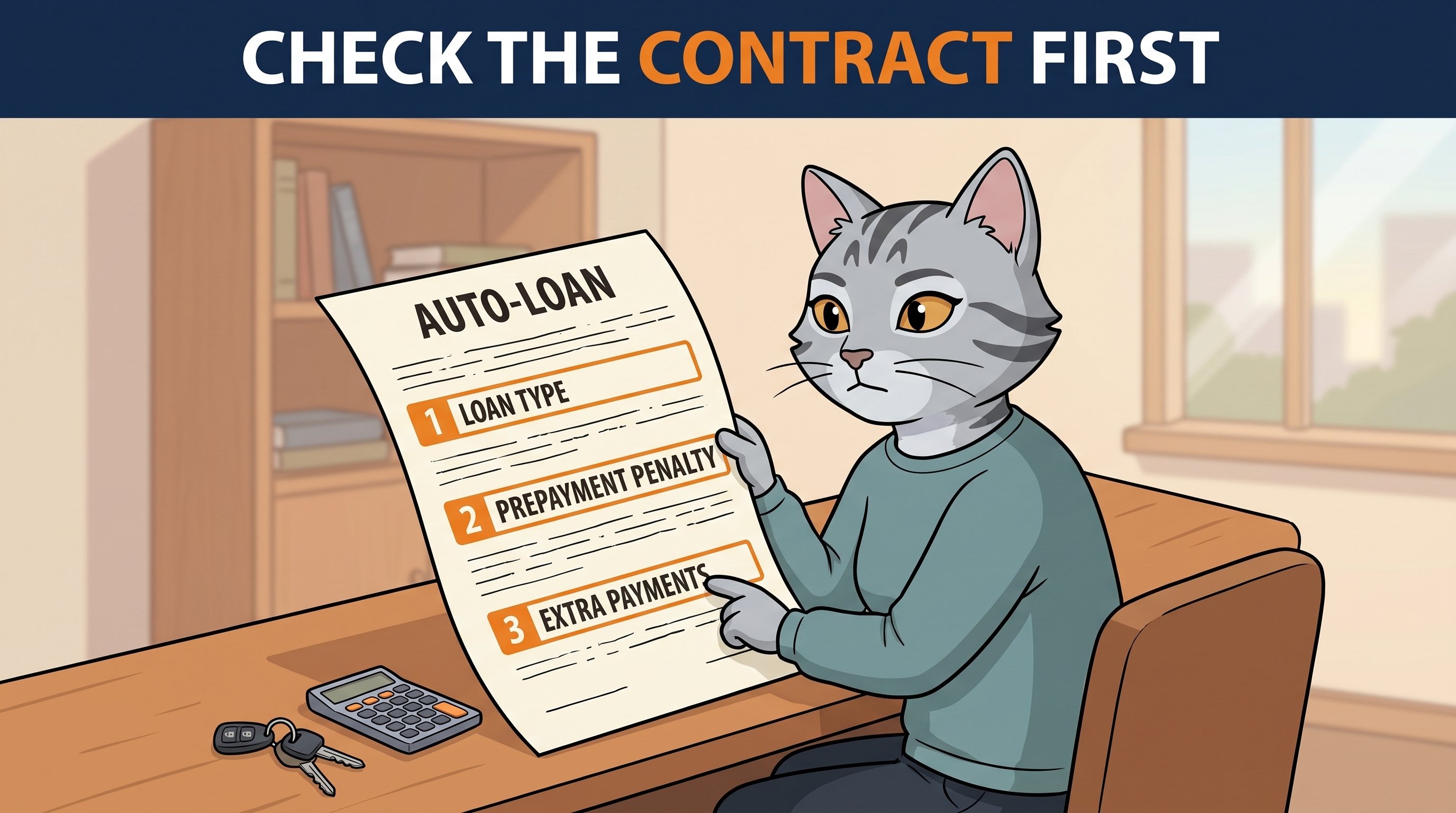
Before you calculate anything, find out what kind of loan you're actually dealing with.
The Consumer Financial Protection Bureau (CFPB) distinguishes between simple-interest and precomputed-interest auto loans.
With simple interest, interest is calculated from the outstanding balance. CFPB says that calculation may happen daily or monthly depending on the loan. Reducing principal sooner can therefore reduce the interest that accrues afterward.
Precomputed interest works differently. The interest is calculated at the beginning of the loan and built into the payment schedule. CFPB says making extra payments under this structure does not reduce principal or interest owed in the same way, although some unearned interest may be refundable in an early payoff.
So your first question is not:
How much extra should I send?
It's:
What does my contract say?
Then check one more thing: a prepayment penalty.
CFPB specifically tells borrowers who already have an auto loan and want to pay it off early to check the contract for a prepayment-penalty clause. State law can matter too. Regulation Z also requires applicable closed-end credit disclosures to state whether a charge may be imposed for paying principal before it's due.
No need to guess whether your lender "probably" has one.
Read the contract.
If the language isn't clear, ask the lender or servicer what would happen if you paid the loan in full today.
Make Sure Extra Money Actually Reaches Principal
On an auto loan, CFPB says a payment generally goes in this order:
Fees due → interest due → principal
That matters because the principal is the balance future simple interest is calculated against.
CFPB also says you may be able to request that your lender or servicer apply more of a payment toward principal, and it specifically recommends checking your loan documents first.
So if you're sending extra money, don't build your plan around an assumption about how the servicer handles it.
Ask.
Then check the statement afterward and make sure the payment was applied the way you expected.
That's less exciting than a payoff calculator.
It's also the part that makes the calculator relevant.
Rachel's Car Loan
Now we can run Rachel's numbers.
This is an illustrative model, not a real borrower's loan.
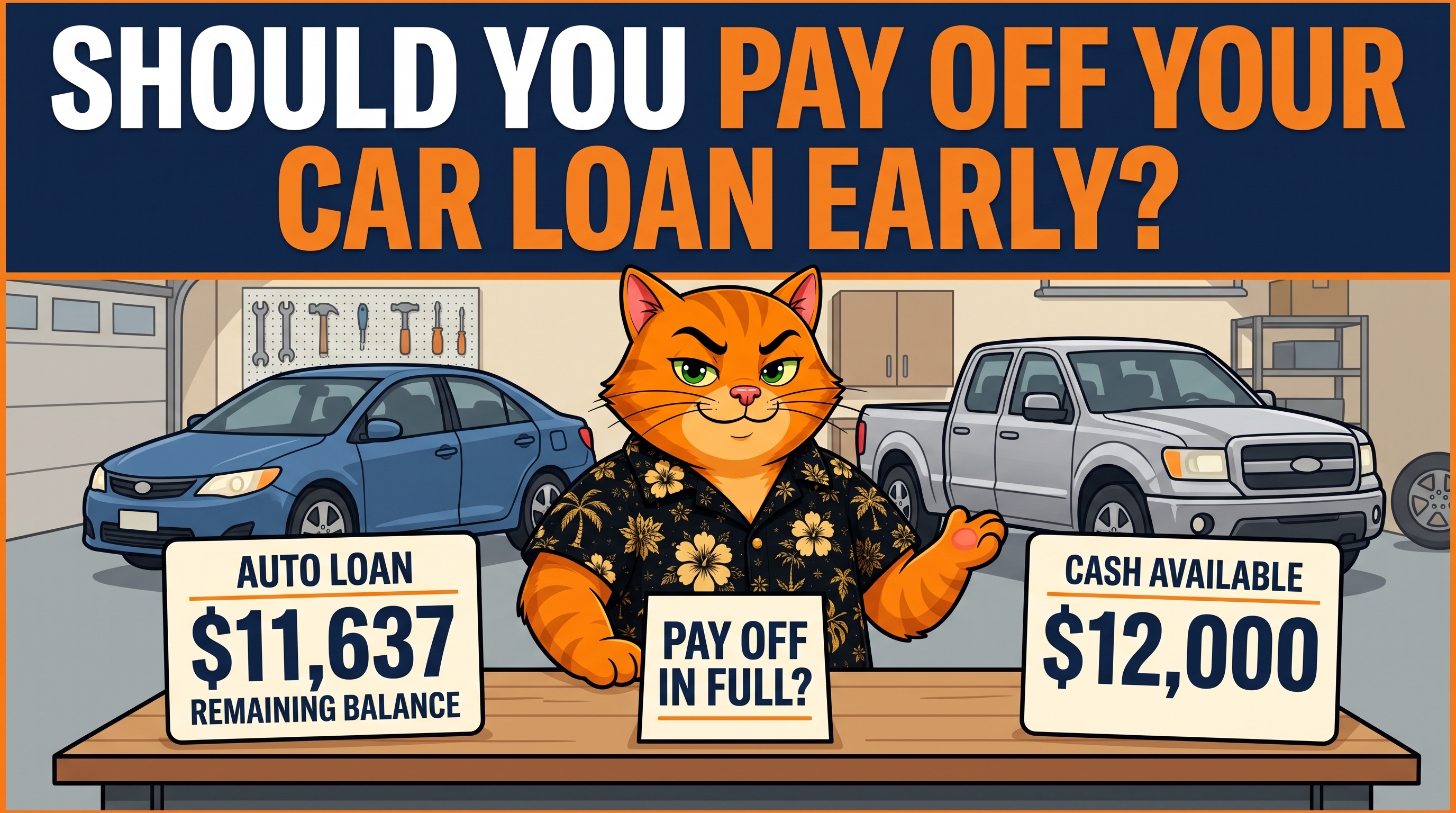
Rachel originally borrowed $18,000 for 60 months at a 7.9% contractual annual interest rate.
That's intentionally an interest rate — not an annual percentage rate (APR). APR is a separate disclosure measure and may incorporate costs beyond the periodic interest rate. If you need the foundational auto-loan mechanics behind that distinction, that's covered separately in How Do Auto Loans Work?
For this illustration, I'm using a standard fixed-payment amortization model with a monthly periodic rate of:
7.9% ÷ 12 = 0.6583% per month
Real simple-interest auto loans may accrue interest daily, so this model is not pretending to reconstruct Rachel's actual lender statement.
Under those assumptions:
| Rachel's modeled loan | Amount |
|---|---|
| Original loan | $18,000.00 |
| Contractual annual interest rate | 7.9% |
| Original term | 60 months |
| Monthly payment | $364.11 |
| Payments completed | 24 |
| Modeled balance after payment 24 | $11,636.67 |
| Scheduled months remaining | 36 |
| Modeled scheduled interest remaining | $1,471.45 |
| Savings | $12,000.00 |
One more distinction matters before Rachel sends $11,636.67 anywhere.
That modeled balance is not a payoff quote.
An actual auto-loan payoff amount can differ from the balance shown on a statement because of how interest is calculated, outstanding charges, or other contract terms. Rachel needs the exact payoff amount from her lender or servicer for the date she intends to pay.
For our comparison, we'll use the modeled balance immediately after payment 24 so every scenario starts from the same controlled point.
The Apparent Answer: Pay It Off
Now the decision looks easy.
If Rachel eliminates the modeled balance at that point, she avoids approximately:
$1,471.45 in scheduled future interest.
She also eliminates 36 remaining scheduled payments.
That's the largest interest saving available in our three scenarios.
So there we go.
Pay it off.
Except Rachel started with $12,000.
After using $11,636.67 to eliminate the modeled balance, she'd have:
$363.33 left.
And her actual lender payoff quote could move that number slightly.
Rachel just traded nearly all of her liquid savings for a paid-off car.
The loan math didn't make a mistake. It answered exactly the question we asked:
How much scheduled interest can Rachel avoid?
It did not answer the second question:
What does Rachel give up by using almost all of her available cash to do it?
That's the constraint.
Rachel's Payoff Tradeoff
$11,636.67 modeled balance → $1,471.45 scheduled interest remaining → compare the interest saved with the cash left afterward
Rachel can eliminate the modeled loan balance and save about $1,471 in scheduled interest, but doing so would reduce $12,000 of savings to about $363 before adjusting for her lender's actual payoff quote.
Three Ways Rachel Could Use the Money
Let's compare three choices using the same illustrative monthly model.
Option A: Pay Off the Modeled Balance
Rachel uses approximately $11,636.67 of her $12,000 to eliminate the modeled balance.
Modeled result:
- Scheduled interest avoided: $1,471.45
- Scheduled time eliminated: 36 months
- Savings remaining: about $363.33
This wins on interest saved.
It loses almost all of Rachel's liquidity.
Option B: Pay an Extra $200 Per Month
Instead of touching the $12,000, Rachel keeps making the regular $364.11 payment and adds $200 per month from ongoing cash flow.
Her modeled payment becomes $564.11 until the final smaller payment.
Modeled result:
- Payoff: 23 months
- Time saved: 13 months
- Remaining modeled interest: $911.32
- Modeled interest saved: $560.13
- Original $12,000 savings: kept intact
This option saves less interest than full payoff, but Rachel keeps the entire savings balance available.
That only works if the extra $200 fits her ongoing monthly cash flow. Moving the same $200 out of savings every month would be a different comparison.
Option C: Put $3,000 Toward Principal
Rachel sends $3,000 toward principal, assuming her contract and servicer process the extra payment that way, and keeps making her regular scheduled payment.
Her modeled principal falls from $11,636.67 to $8,636.67.
She keeps $9,000 in savings.
Modeled result:
- Payoff: 26 months
- Time saved: 10 months
- Remaining modeled interest: $784.94
- Modeled interest saved: $686.51
- Savings remaining: $9,000
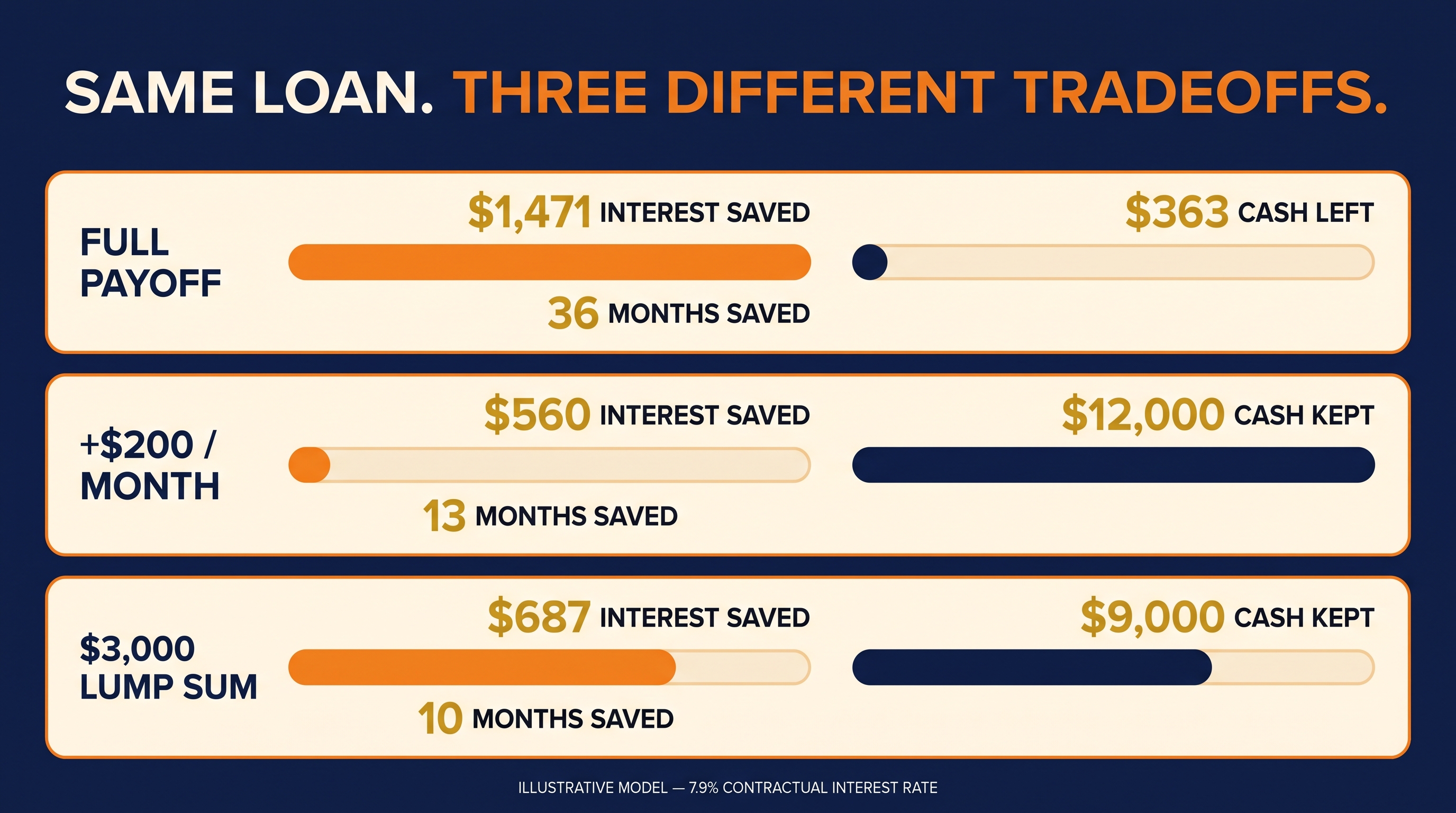
Now put the tradeoffs next to each other:
| Scheduled | Full payoff | +$200/month | $3,000 lump sum | |
|---|---|---|---|---|
| Months remaining | 36 | 0 | 23 | 26 |
| Modeled interest remaining | $1,471.45 | $0.00* | $911.32 | $784.94 |
| Modeled interest saved | — | $1,471.45* | $560.13 | $686.51 |
| Savings remaining | $12,000.00 | ≈$363.33* | $12,000.00 | $9,000.00 |
| Time saved | — | 36 months | 13 months | 10 months |
*The full-payoff column uses the controlled monthly model at the decision point. Rachel's actual payoff quote and actual interest saved depend on her lender's payoff amount and payoff date.
And now we have a much better decision than:
7.9% loan = pay it off.
Full payoff saves the most modeled interest.
The $3,000 lump sum saves about $687 while preserving $9,000.
The extra-$200 strategy saves about $560 while leaving the $12,000 untouched, assuming Rachel can fund the extra payment from ongoing cash flow.
None of those facts chooses the winner for her.
They show her what each choice buys — and what it gives up.
What Changes the Decision
This is where Rachel's financial life matters more than the amortization table.
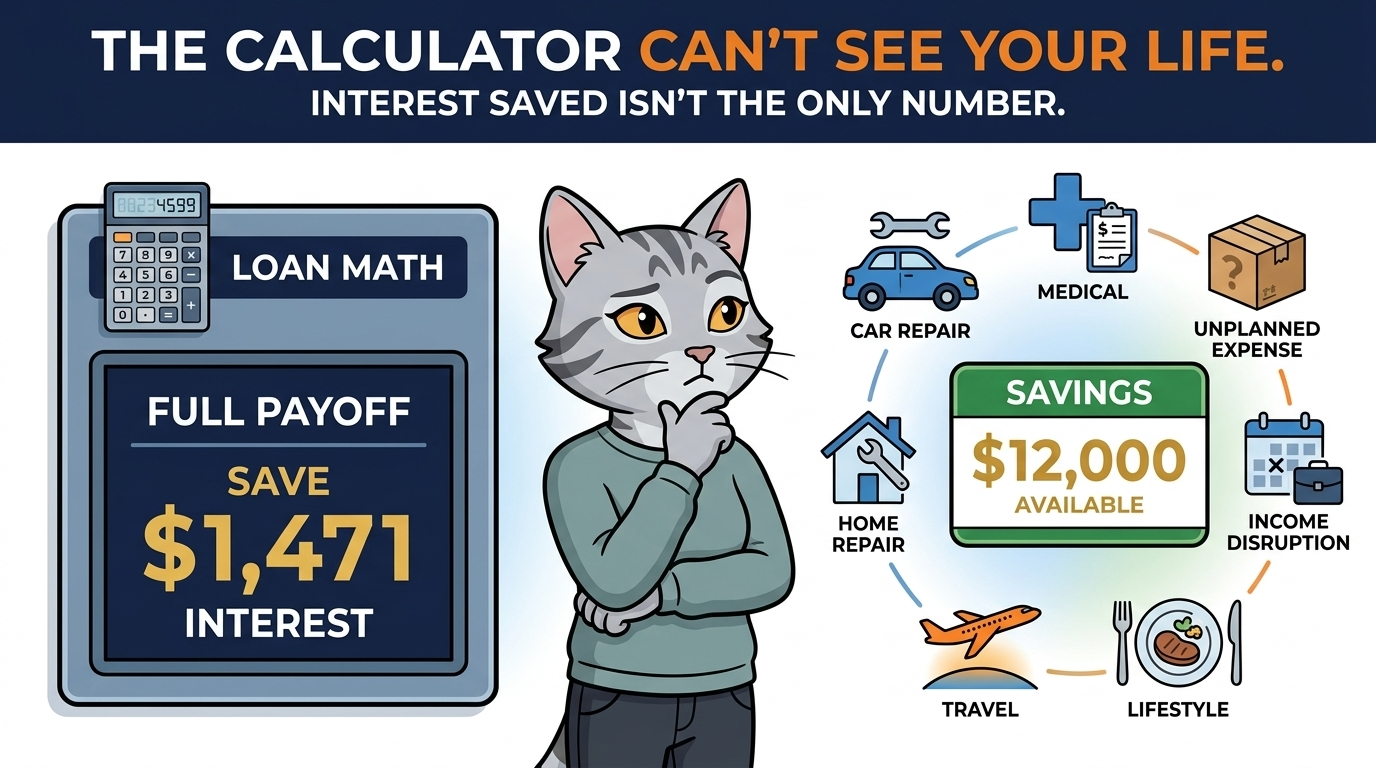
How much cash would be left?
If Rachel has another large emergency reserve somewhere else, spending most of this $12,000 may look very different.
She doesn't.
This is her primary liquid savings.
So full payoff doesn't merely remove a car payment. It also removes almost all of the money she can reach if the transmission fails, she gets a surprise medical bill, or her income gets interrupted.
That's a real cost even though it never appears in the loan's interest column.
If you're trying to figure out how much of your own cash should remain available, Where to Put Your Emergency Fund covers the emergency-fund side separately.
Is there more expensive debt?
Rachel doesn't have higher-rate debt.
If she did, the comparison could change.
A dollar sent toward one debt is a dollar that cannot simultaneously reduce another balance. So before attacking the car loan, compare the actual costs of the debts you're carrying rather than treating "debt" as one category.
That's as far as we need to take that here.
The broader pay debt versus invest decision is a different problem, and this article isn't going to quietly become that article halfway through.
Does Rachel need the cash soon?
Liquidity becomes more valuable when you already know a large expense may be coming.
A move.
A medical procedure.
A period of reduced income.
A major home repair.
A family obligation.
The loan calculator has no field labeled "I might need this $9,000 six months from now."
That doesn't make the need imaginary.
It means the amortization model isn't designed to answer that part of the decision.
Has she verified the contract?
Before any of this matters, Rachel still needs to know:
- Is this a simple-interest or precomputed-interest loan?
- Is there a prepayment penalty?
- How will an extra payment be applied?
- What is the exact payoff quote if she wants to eliminate the loan?
Those are contract questions.
Answer them before turning a hypothetical calculation into a real payment.
What about investing the money instead?
Yes, opportunity cost exists.
Rachel could compare the guaranteed interest avoided by reducing the loan with other possible uses for the cash, including investing.
But expected investment returns are uncertain. The auto-loan obligation isn't.
And more importantly, turning this entire decision into 7.9% versus an expected investment return skips the liquidity question that makes Rachel's situation useful in the first place.
That comparison deserves its own analysis.
It doesn't replace this one.
What About Her Credit Score?
One small credit-score wrinkle is worth knowing.
FICO says paying off the last active installment loan can result in a loss of points. Its scoring models consider installment-loan balances relative to their original amounts, and a consumer with no active installment loans can score differently from one actively paying down an installment loan.
That does not mean Rachel should pay interest just to keep an auto loan open.
FICO also says very high scores are possible without active installment-loan activity and that a score decline after payoff should not be viewed as permanent.
If Rachel expects a major credit application in the near future, knowing that a payoff can change her score is useful context.
It is not a reason by itself to keep paying unnecessary interest.
What You Do With This Information
Rachel can afford to pay off the modeled loan balance.
That's not the same as saying she can comfortably afford to give up the cash.
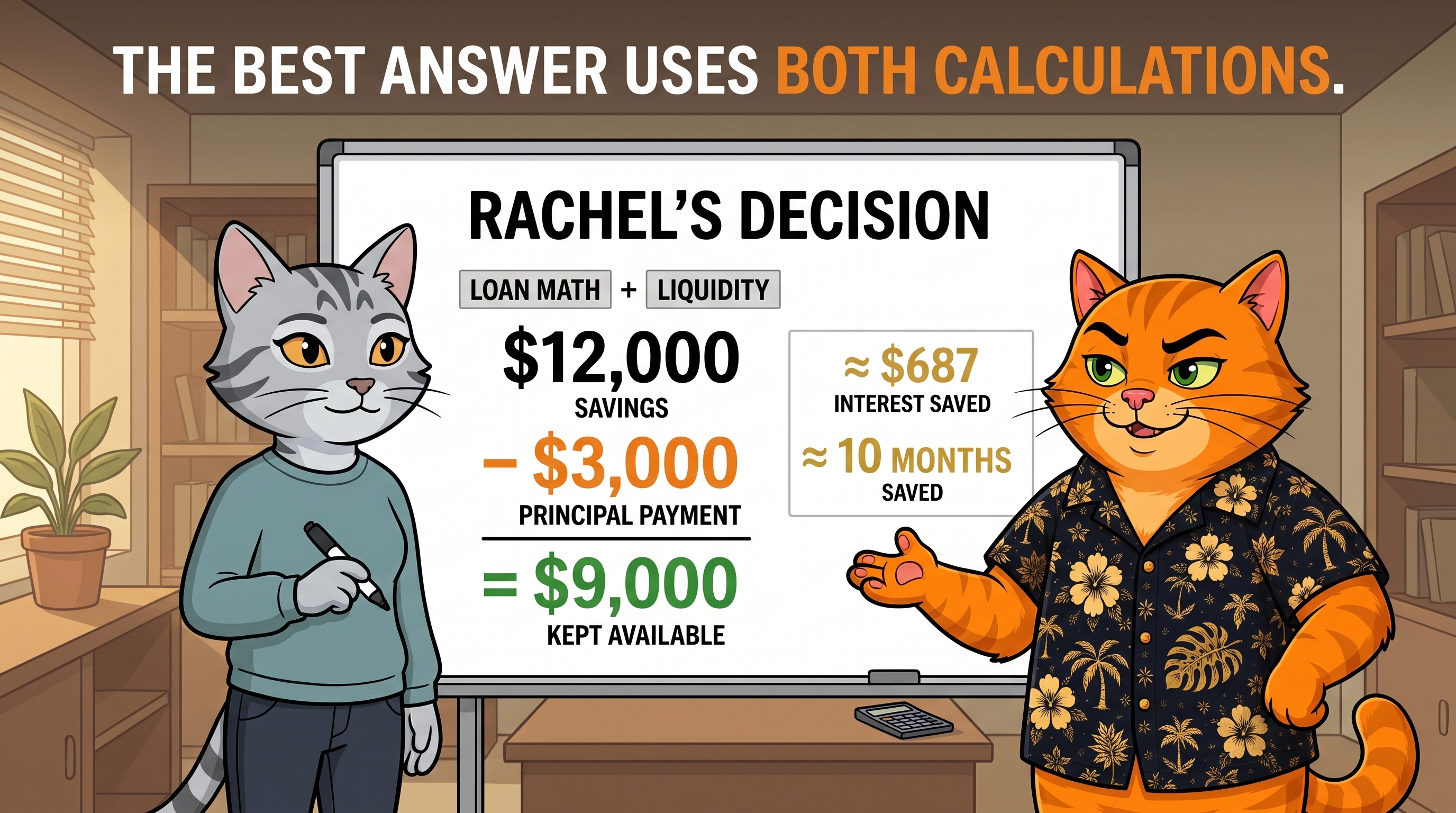
Her $12,000 is her primary emergency savings. She has no higher-rate debt competing for the money. Full payoff gives her the largest modeled interest saving — about $1,471 — but reduces that $12,000 to roughly $363 before accounting for the exact lender payoff quote.
That's too much liquidity for Rachel to give up for this particular tradeoff.
So she chooses the $3,000 principal payment.
Under our illustrative model, she keeps $9,000 liquid, cuts about 10 months from the remaining schedule, and saves approximately $686.51 of the modeled remaining interest.
Could another borrower rationally choose the full payoff?
Absolutely.
Could another keep all $12,000 and add $200 per month?
Yes.
That's why the diagnosis matters.
The math tells you what paying off early saves. It doesn't automatically tell you whether that is the best use of your cash.
Rachel didn't need a universal rule.
She needed the cost of each choice made visible.
The math was the starting point.
The rest of her financial picture determined the answer.
Before You Leave
Pull out your auto-loan contract.
Before calculating an early payoff, confirm two things:
1. Is the loan simple interest or precomputed interest?
2. Does the contract allow a prepayment charge?
Then contact your lender or servicer and ask how an extra payment will be applied. If you're considering full payoff, request the lender's actual payoff amount for the date you intend to pay.
Once you have those answers, run your own numbers.
Don't ask only:
How much interest would I save?
Ask:
How much cash would I have left after saving it?
That's the second number that makes this decision useful.
Chuck Finance is for entertainment and informational purposes only. Chuck is not a licensed financial advisor, and nothing in this post constitutes professional financial, investment, legal, or tax advice. Always consult a qualified professional before making financial decisions.
Sources
- Consumer Financial Protection Bureau — What's the difference between a simple interest rate and precomputed interest on an auto loan?
- Consumer Financial Protection Bureau — Is it better to pay off the interest or principal on my auto loan?
- Consumer Financial Protection Bureau — Can I prepay my loan at any time without penalty?
- Consumer Financial Protection Bureau — Regulation Z §1026.18, Content of Disclosures
- Consumer Financial Protection Bureau — Should I trade in my car if it's not paid off?
- Consumer Financial Protection Bureau — What is amortization and how could it affect my auto loan?
- myFICO — Can Paying Off Installment Loans Cause a FICO Score to Drop?
- myFICO — Why Did My FICO Score Drop After Paying Off a Loan?
- Experian — Average Car Loan Interest Rates by Credit Score, Q2 2026