What This Covers
This post covers auto loans — buying a vehicle with borrowed money you pay back over time. It doesn't cover leasing, which works differently and has its own separate math.
Five Numbers Worth Reading Together
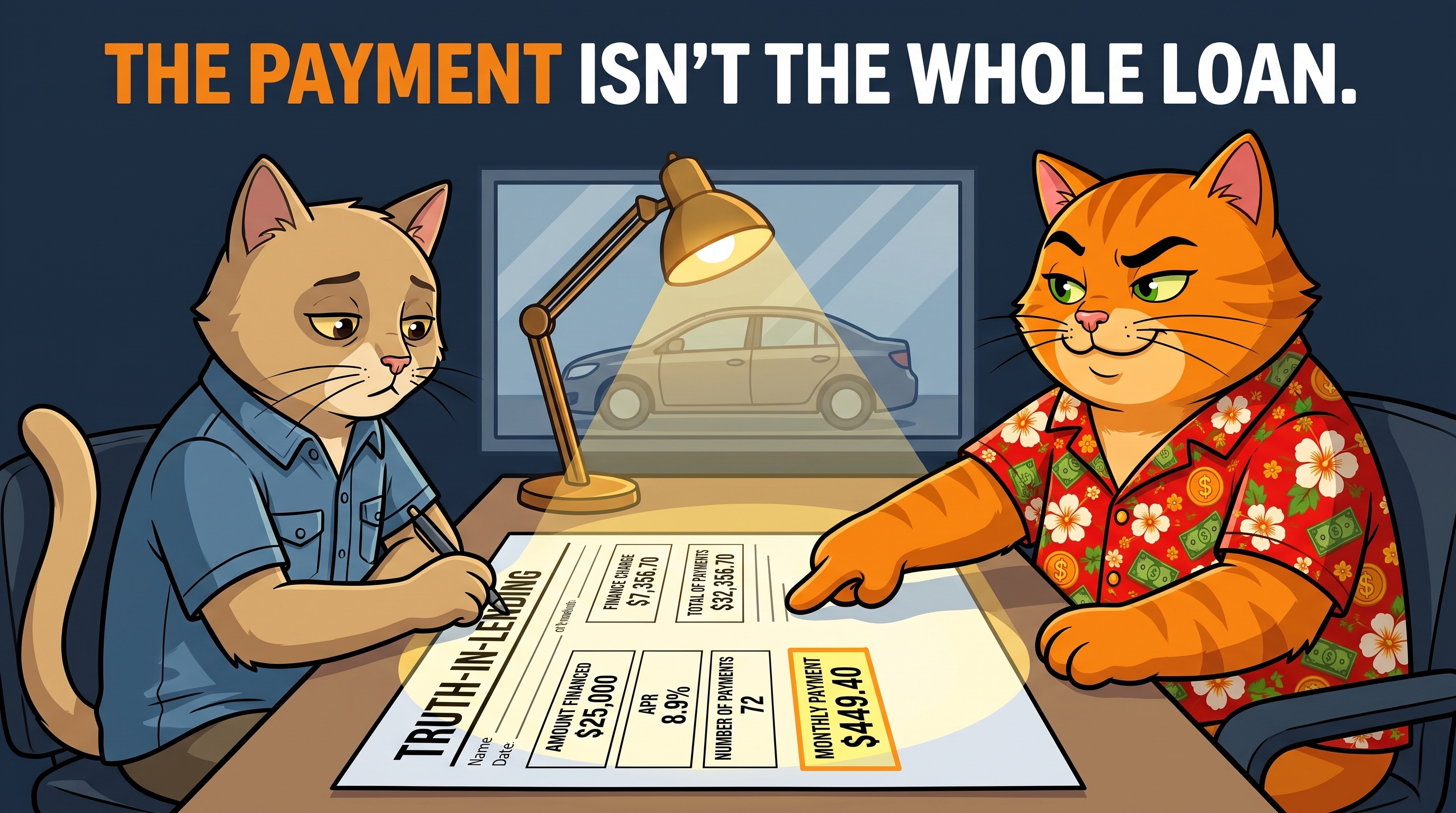
Before you sign, the Truth-in-Lending disclosure puts the numbers that define the loan in one place. Five are especially useful for comparing offers:
- Amount financed — how much you're actually borrowing (the vehicle price, plus anything else rolled in, minus your down payment or trade-in)
- APR — the yearly cost of the credit, including the interest rate and certain required fees. That's why APR and the loan's interest rate aren't always the same number.
- Number of payments — how many months you'll be paying
- Finance charge — the total dollar cost of borrowing, including interest and certain fees, if you make the payments as scheduled
- Total of payments — everything you'll have paid, principal and interest combined, once it's done
Each one answers a different question. The monthly payment isn't hidden — it's just the number that tends to get the most attention on the sales floor. Reading the rest alongside it is how you actually understand what you're agreeing to.
The Five Numbers Worth Reading Together
Amount financed, APR, number of payments, finance charge, and total of payments.
In one comparison, the cheaper-per-month offer cost $3,676.85 more over the life of the loan. Both numbers were sitting on the same disclosure — nothing was hidden, it just wasn't the number anyone pointed at.
How the Math Actually Works Inside the Loan
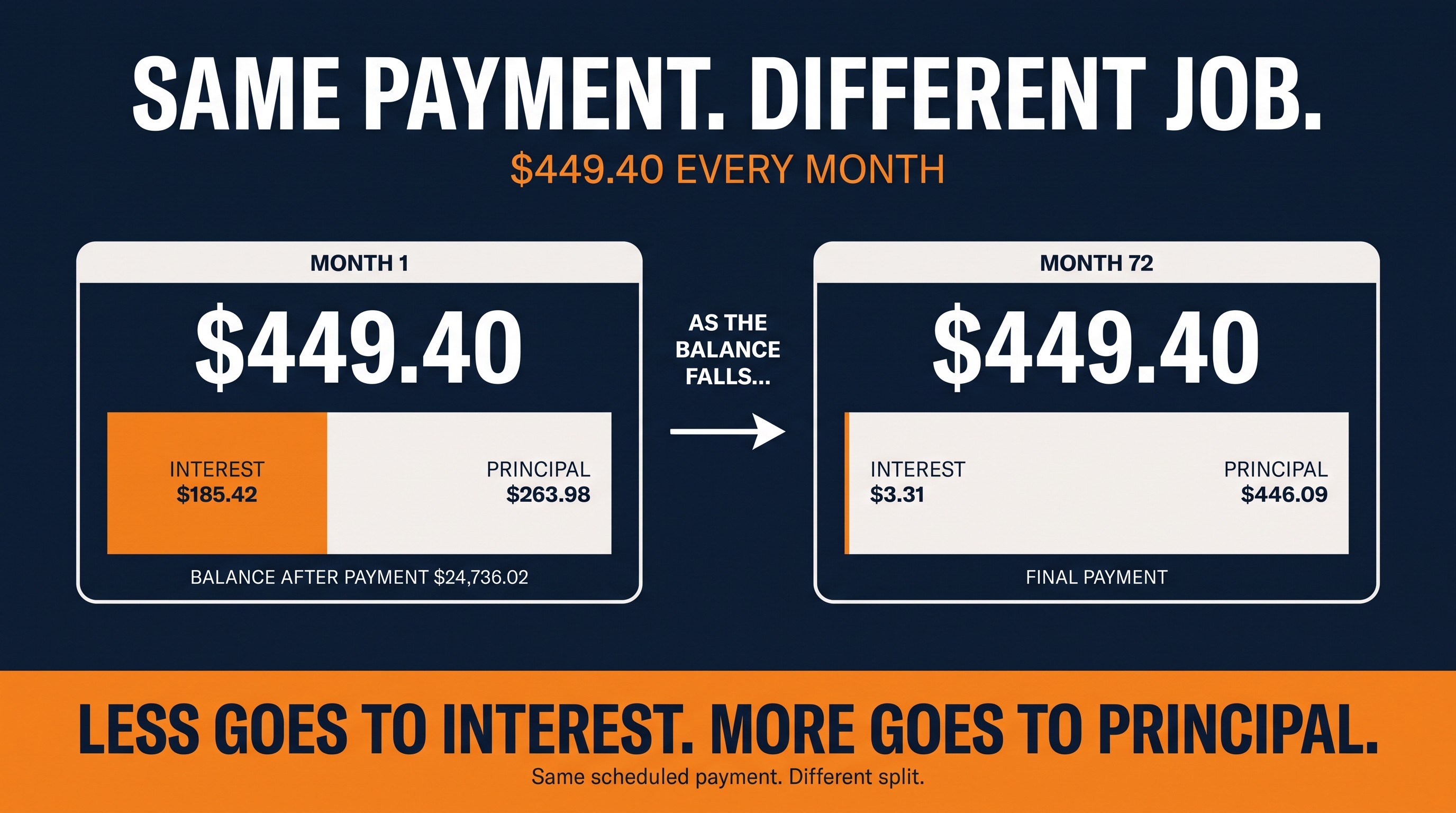
A car loan is repaid in equal monthly payments, but what each payment is actually doing changes over time. Every payment covers some interest and some principal. Early on, more of it goes to interest, because interest is calculated on however much you still owe — and you owe the most at the very beginning. As the balance shrinks, the interest portion of each payment shrinks with it, and more of the same payment starts going toward principal instead.
Here's what that looks like in the first six months of one of Jordan's illustrative offers, a $25,000 loan at 8.9% over 72 months:
| Month | Payment | To Interest | To Principal | Remaining Balance |
|---|---|---|---|---|
| 1 | $449.40 | $185.42 | $263.98 | $24,736.02 |
| 2 | $449.40 | $183.46 | $265.94 | $24,470.08 |
| 3 | $449.40 | $181.49 | $267.91 | $24,202.17 |
| 4 | $449.40 | $179.50 | $269.90 | $23,932.27 |
| 5 | $449.40 | $177.50 | $271.90 | $23,660.37 |
| 6 | $449.40 | $175.48 | $273.92 | $23,386.45 |
By the last payment, month 72, the split looks completely different: $3.31 to interest, $446.09 to principal. Same payment amount the whole time — just a different split every single month.
Jordan's Two Offers
Jordan is financing $25,000 for the vehicle after a $3,000 down payment, and has two offers on the table:
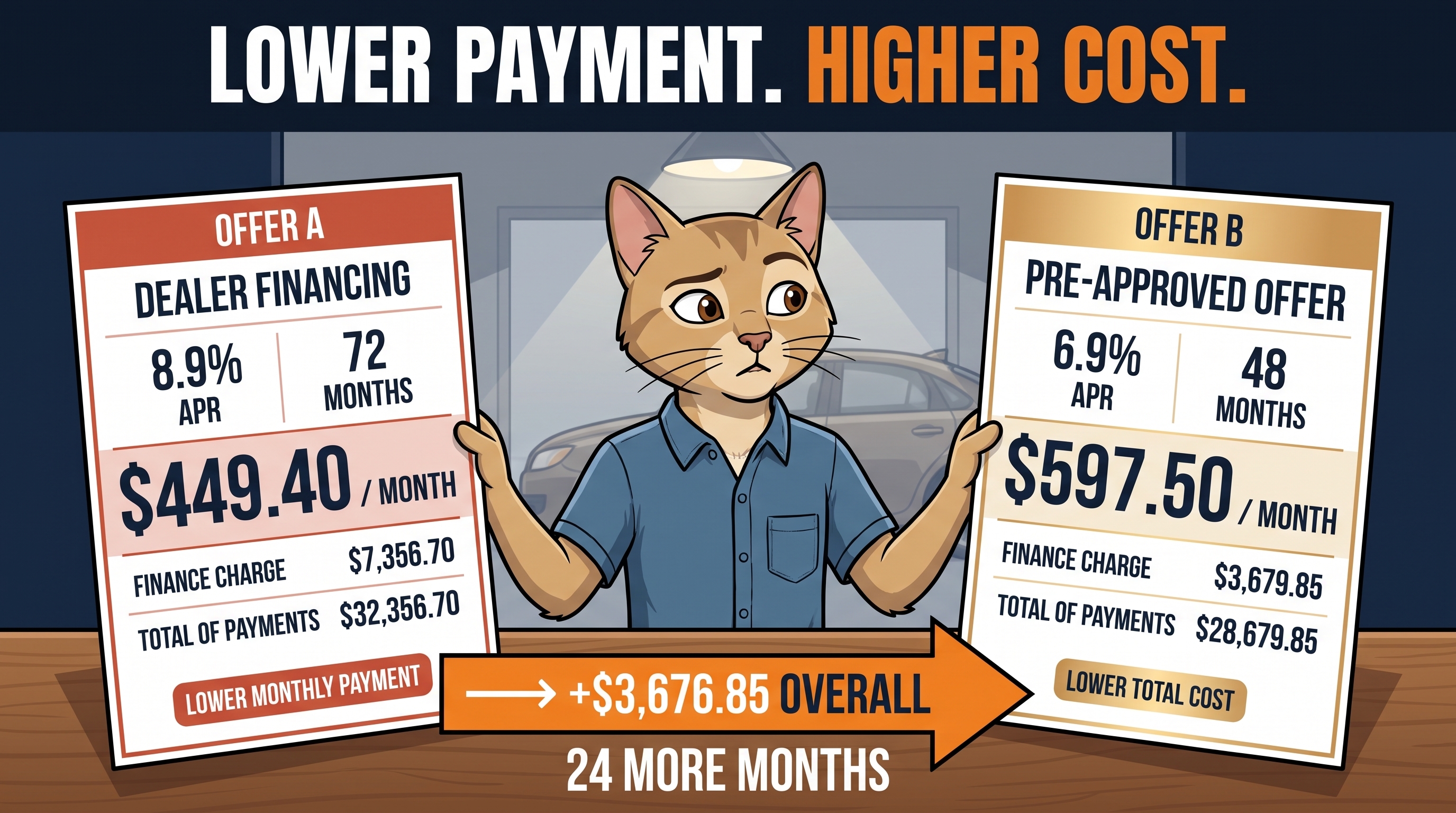
Offer A — dealer financing: 8.9% APR, 72 months. Offer B — pre-approved through a credit union: 6.9% APR, 48 months.
Here's what the Truth-in-Lending disclosure shows for both, side by side:
| Offer A | Offer B | |
|---|---|---|
| Amount financed | $25,000 | $25,000 |
| APR | 8.9% | 6.9% |
| Monthly payment | $449.40 | $597.50 |
| Finance charge | $7,356.70 | $3,679.85 |
| Total of payments | $32,356.70 | $28,679.85 |
Offer A costs $148.10 less every month. Offer B costs $3,676.85 less overall, and finishes 24 months sooner. Neither number is hidden. Both are sitting right there on the same required paperwork — it's just that only one of them usually gets said out loud on the sales floor.
What This Actually Means for Jordan
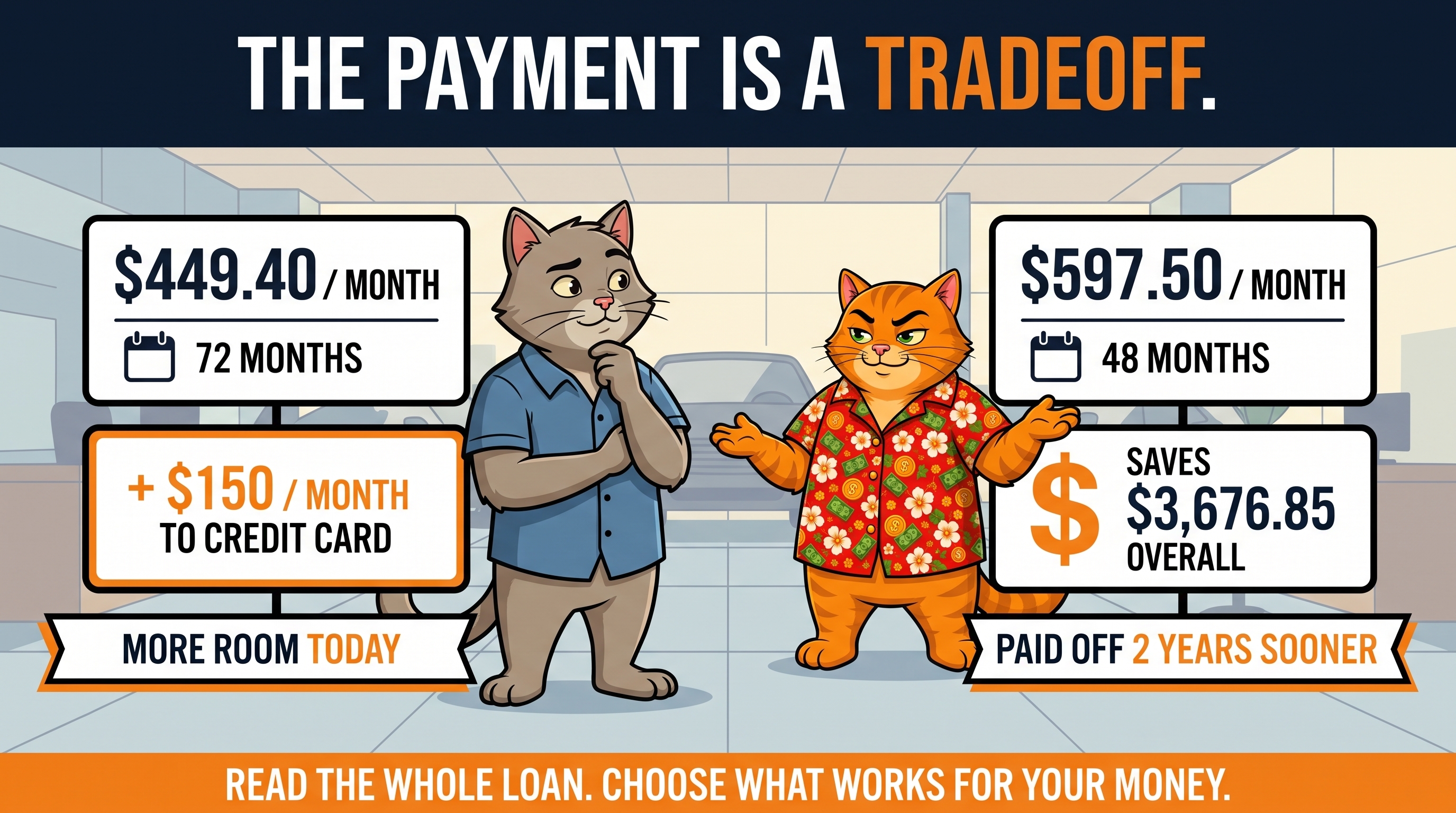
Jordan isn't choosing based on which offer sounds better in the abstract — there's a real budget to work with. Right now, Jordan is also putting $150 a month toward paying down a credit card balance, and doesn't want to stop that progress just to finance a car. Offer A's $449.40 payment fits Jordan's budget with the $150 debt payment left intact. Offer B's $597.50 would mean either pausing that debt payoff or stretching the budget somewhere else.
So the honest picture is this: Offer A fits what Jordan is actually trying to do right now. That's a legitimate reason to choose it. But it's worth being clear-eyed about the price of that choice — $3,676.85 more, spread out over two extra years, in exchange for keeping the debt payoff on track today. That's not a bad decision. It's a decision made with the real cost in view, which is the entire point of reading the whole disclosure instead of just the monthly payment.
If Jordan's other debt were already paid off, or the budget had more room, Offer B would be the harder one to walk away from — a straightforwardly lower total cost with a faster finish. The math doesn't change. What changes is which number matters most for the person doing the deciding.
Dealer Financing vs. Going Straight to a Lender
A lot of auto financing happens through the dealership rather than a bank or credit union directly. In dealer financing, the dealer connects you with a third-party lender, and the rate you're quoted can include some room built in above what that lender would have charged the dealer directly — this is a normal, legal part of how dealer financing is compensated, not a hidden scam. It just means the rate you're offered at the dealership isn't necessarily the best rate available for your credit profile.
Getting pre-approved by a bank or credit union before you go car shopping gives you a real benchmark. If the dealer can beat it, great — take the better offer. If they can't, you already have a good one lined up. Without a pre-approval in hand, you have no way to know which one you're getting.
Two Things Worth Watching
What's rolled into the loan. Extended warranties, GAP insurance, and other add-ons can get folded into the amount financed — which means you're paying interest on them too, for the life of the loan. Check what's actually included in that number before you sign.
Negative equity. Longer loan terms and smaller down payments can leave you owing more than the car is worth, especially early on when the vehicle may be losing value faster than you're paying down the loan. It's worth knowing this risk exists — a deeper look at it is its own future topic.
One More Thing, and It's Temporary
This one is temporary, so check the current rules before you build it into your decision.
A temporary federal tax provision, created by the One Big Beautiful Bill Act (IRC Section 163(h)(4)) and in effect for tax years 2025 through 2028, allows a deduction of up to $10,000 per year in interest paid on a qualifying new-vehicle loan. Among other requirements, the loan must have originated after December 31, 2024, the vehicle must be new, have its final assembly in the United States, be for personal use, and be secured by the loan itself. The deduction is available whether or not you itemize, and it phases out at higher incomes — starting at $100,000 in Modified Adjusted Gross Income (MAGI) for single filers and $200,000 for married couples filing jointly, phased out completely by $150,000 and $250,000 respectively.
One distinction worth being precise about: this is a deduction, not a refund. It reduces the income you're taxed on — it doesn't hand you $10,000 back. The actual dollar value depends on your tax bracket, and it's meaningfully smaller than the deduction amount itself. This provision is set to expire after 2028 and could change before then — verify current status before counting on it.
Before You Sign Anything
Ask for the disclosure with the full picture — amount financed, APR, number of payments, finance charge, and total of payments — before you sign anything. If you've got a pre-approved offer from somewhere else, compare the finance charge and total of payments between the two, not just the monthly payment. That comparison is the one that actually tells you which offer is cheaper.
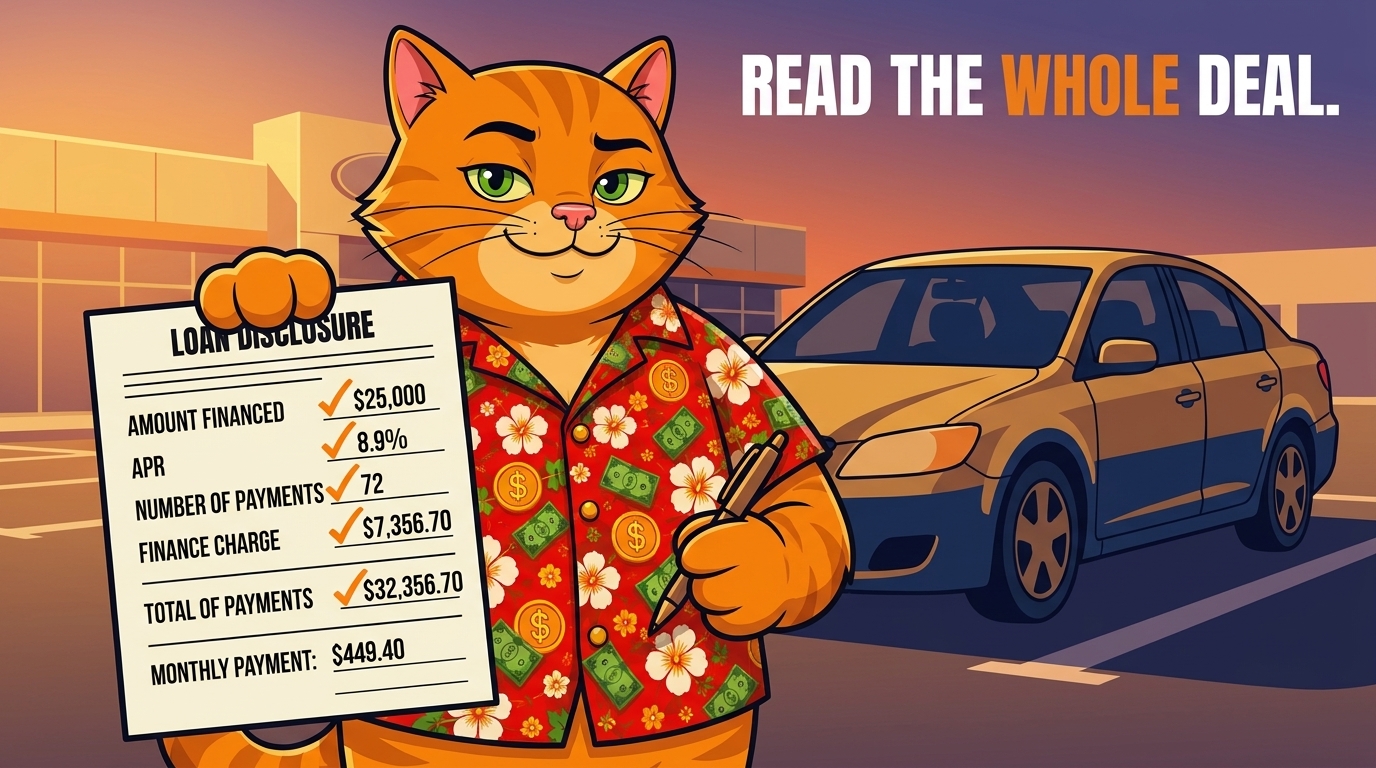
Jordan walked into the dealership asking one question: What am I paying in exchange for that monthly payment? The $449.40 offer lets him keep putting $150 a month toward his credit card without stretching his budget. The $597.50 offer costs more each month, but saves him $3,676.85 overall and gets the car paid off two years sooner. Neither choice makes the other number disappear. Jordan just has to decide whether that extra breathing room today is worth the higher cost and longer loan. Read the whole loan, understand the tradeoff, and make the decision that works for your money.
Chuck Finance is for entertainment and informational purposes only. Chuck is not a financial advisor, and nothing in this post constitutes professional financial or tax advice. All figures in this post are illustrative — not a representation of any real borrower's situation or a guarantee of loan terms. Actual rates, terms, and eligibility for any tax provisions mentioned depend on your credit, lender, vehicle, and current law at the time. Verify current rates and tax rules before making any financing decision, and consult a licensed professional for advice specific to your situation.
Sources
- Consumer Financial Protection Bureau, "Take Control of Your Auto Loan" — consumerfinance.gov, March 2024
- Truth in Lending Act (TILA) / Regulation Z, 12 CFR Part 1026 — required disclosure figures
- Bankrate, auto loan rate survey — bankrate.com, updated September 9, 2026 (6.90% average, 60-month new car loan)
- Experian, State of the Automotive Finance Market, Q2 2026, via U.S. News, September 2026 (credit-tier rate ranges)
- Federal Register, "Car Loan Interest Deduction" (proposed regulations, REG-113515-25) — December 31, 2025; enacted under Section 70203 of Public Law 119-21 (July 4, 2025), IRC Section 163(h)(4)