Table of Contents
- You Already Know You're in Default. Now What?
- Rehabilitation: The Longer Route With a Credit-Report Benefit
- Consolidation: Potentially Faster, but a Different Tradeoff
- The Difference That Actually Matters
- Julie Has 14 Months. What Does That Change?
- Change the Goal and the Answer Can Change
- The Three-Piece Audit
- What About the Current Collections Pause?
- What You Do With This Information
- Sources
You Already Know You're in Default. Now What?
If you need the full walkthrough of what federal student loan default means — including the 270-day timeline, possible collection actions, and what's currently paused — start here: what happens if you default on a student loan.
This article starts one step later.
Your loans are already in default.
Now what?
First, this isn't some obscure situation that only happens to a handful of borrowers. In May 2026, the New York Fed reported that approximately 2.6 million federal student loan borrowers who were more than 120 days past due had their loans transferred to the Department of Education's Default Resolution Group during the first quarter of 2026.
That's a lot of people dealing with some version of this problem.
But knowing you're not alone doesn't get the loan out of default.
You still need a plan.
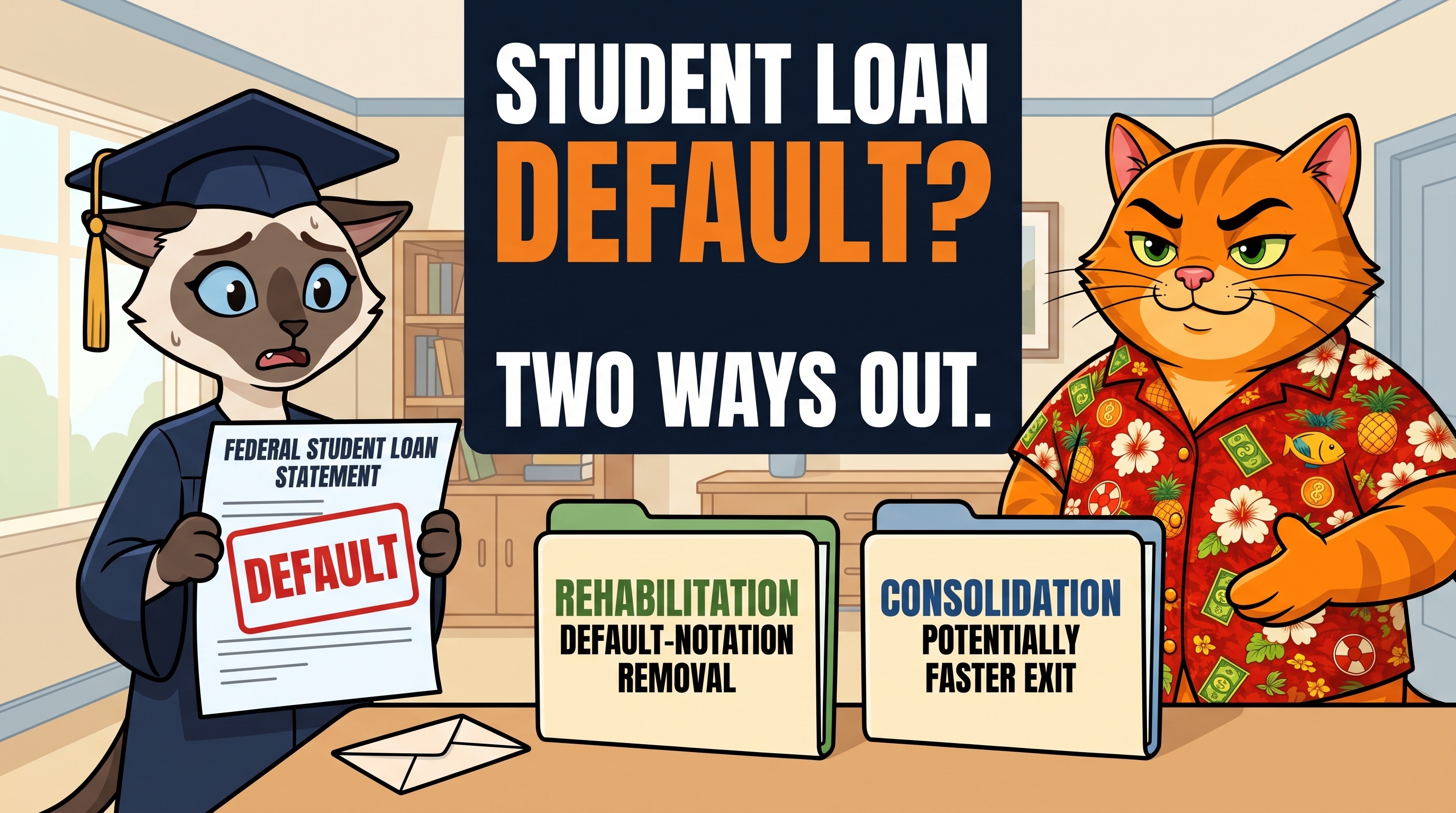
Federal Student Aid lists several ways borrowers may respond to default and collections, including payment in full, repayment agreements, rehabilitation, and consolidation. Those options don't all accomplish the same thing.
A repayment agreement, for example, may address collections or help restore federal student aid eligibility under certain circumstances, but simply entering one does not itself remove the loan from default. Paying the debt in full would resolve it, but that obviously isn't realistic for every borrower.
For the decision we're making here, I want to focus on the two major paths borrowers commonly need to compare:
Rehabilitation and consolidation.
And before you choose either one, you need to understand what you're actually choosing between.
Rehabilitation: The Longer Route With a Credit-Report Benefit
For most defaulted Direct and Federal Family Education Loan (FFEL) loans, rehabilitation requires you to make nine qualifying payments during 10 consecutive months under a rehabilitation agreement.
That means you can miss one payment within that 10-month window and still complete rehabilitation, as long as you make all nine qualifying payments. A qualifying payment generally must be received within 20 days of its due date.
Defaulted Perkins Loans follow a different rule and require nine consecutive payments.
The payment amount is generally based on your income rather than simply on how much you owe.
And this part matters if you're already thinking, "Great, another payment I can't afford."
Don't guess what your rehabilitation payment will be.
Get the actual number.
If the standard rehabilitation payment is more than you can reasonably afford, you may be able to request an alternative payment amount based on your actual income and expenses.
Start with your loan holder. Get the payment amount, required documentation, and submission instructions directly from them and preferably in writing. Federal Student Aid's current rehabilitation guidance still describes mail or fax for some Default Resolution Group documentation, so don't assume every loan holder uses the exact same process.
Now here's the reason rehabilitation deserves special attention:
After successful rehabilitation, the holder requests removal of the default notation from your credit history.
That's a meaningful benefit.
But don't turn that sentence into something it doesn't promise.
Rehabilitation does not erase the late payments that were reported before the loan went into default. And your ninth payment is not a guaranteed date when every credit report suddenly updates.
Rehabilitation removes the default notation after successful completion. It doesn't erase the entire history that led to the default.
Once rehabilitation is complete, you also need to confirm your new servicer, available repayment plan, new payment amount, and first due date.
The payment you made during rehabilitation is not necessarily the payment you'll make afterward.
That's rehabilitation in plain English:
More time. A series of qualifying payments. And a credit-report benefit that consolidation does not provide.
Consolidation: Potentially Faster, but a Different Tradeoff
Consolidation works differently.
Instead of rehabilitating the existing defaulted loan, eligible loans are replaced with a new Direct Consolidation Loan.
That can get you out of default faster than completing nine rehabilitation payments.
But "faster" does not mean "instant."
Submitting an online consolidation application does not immediately end the default. Eligibility and processing still matter.
Accrued interest and applicable collection costs can also become part of the new balance, so get the actual figures before you decide what you're agreeing to.
For a defaulted loan, you generally must do one of two things before or as part of consolidation:
- Make three consecutive, voluntary, on-time, full monthly payments, or
- Agree to repay the new Direct Consolidation Loan under an eligible income-driven repayment plan.
Federal Student Aid currently identifies the Repayment Assistance Plan, or RAP, as a route for eligible borrowers. Parent PLUS borrowers should not assume RAP is available to them.
Other circumstances can complicate consolidation too, including certain existing consolidation loans, judgments, or active wage-garnishment orders.
That's why I don't want you reading one paragraph on the internet and assuming you qualify.
Check your actual loan type and your actual eligibility.
But there's one tradeoff you should understand before doing any of that:
Consolidation does not remove the earlier default notation from your credit history.
Federal Student Aid says the default and earlier late-payment history may remain for up to 10 years. That is published federal guidance — not a promise that every borrower's credit report follows a brand-new 10-year clock after consolidation.
So consolidation may get you out of default sooner.
It does not give you rehabilitation's default-removal benefit.
The Difference That Actually Matters
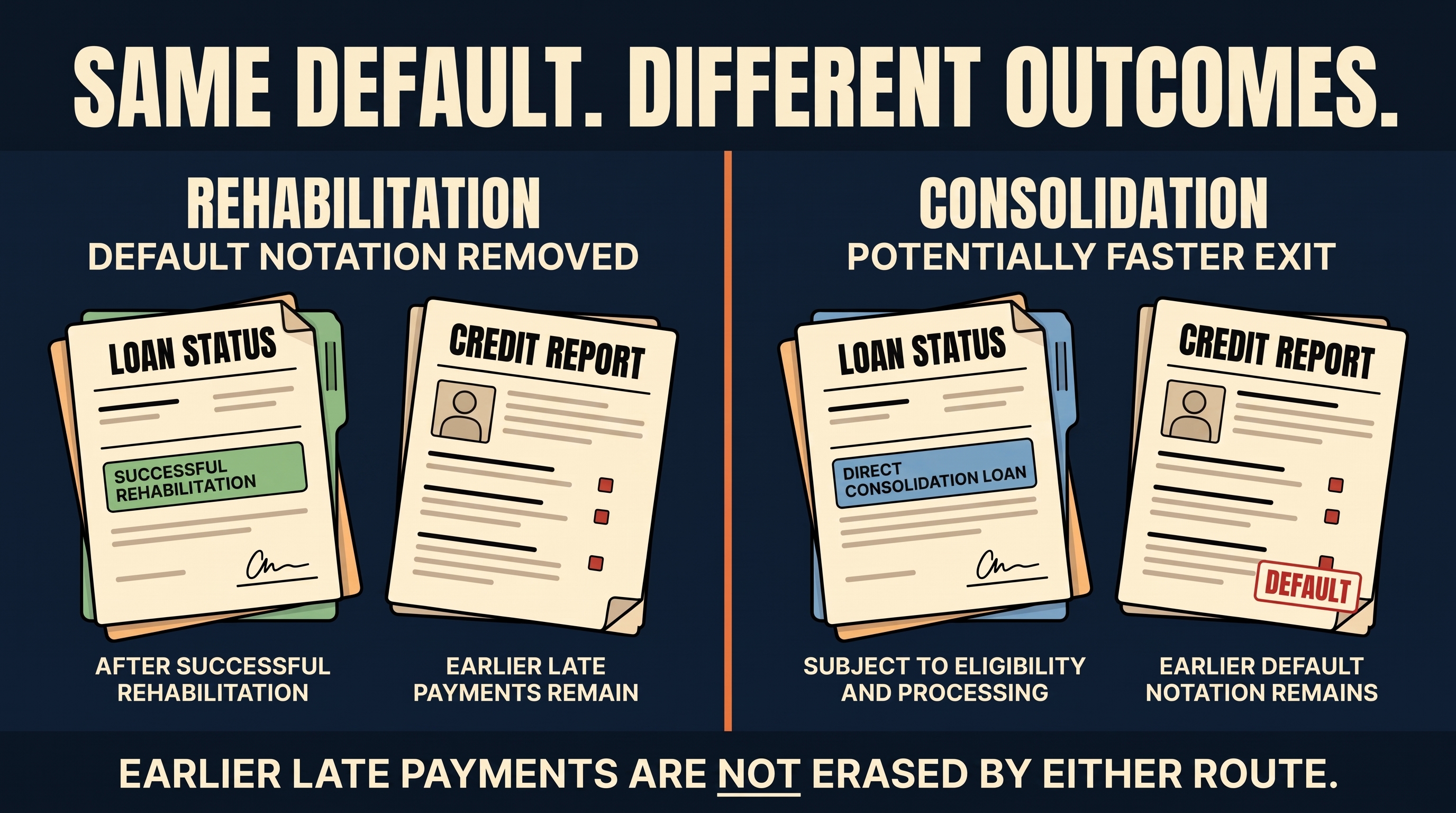
Put the two options next to each other and the decision gets much easier to understand.
| Rehabilitation | Consolidation | |
|---|---|---|
| Timing | Direct/FFEL: nine qualifying payments in 10 months, plus setup and processing | Can be faster; eligibility and processing still matter |
| Payment | Written rehabilitation payment agreement; alternative amount may be available based on income and expenses | Depends on the new loan and eligible repayment plan |
| Default notation | Removal requested after successful rehabilitation | Earlier default notation is not removed |
| Earlier late payments | Not erased | Not erased |
| Getting started | Contact your loan holder and follow its documentation instructions | Check eligibility and apply through StudentAid.gov |
That's why asking, "Which one is better?" doesn't get you very far.
Better for what?
If you need the default notation addressed because a credit check is coming, rehabilitation has a benefit consolidation doesn't.
If your priority is getting the loan out of default as quickly as possible, consolidation may deserve more attention.
These are different processes solving overlapping — but not identical — problems.
And there are edge cases.
For example, confirm whether you've previously rehabilitated the same loan before starting. Repeat-rehabilitation eligibility is date-sensitive. For Direct Loans, the second rehabilitation opportunity created by the newer rule begins July 1, 2027 — not July 2026.
But for most readers, the first decision isn't buried in the exceptions.
It's this:
What are you actually trying to accomplish?
Now let's go back to Julie.
Julie Has 14 Months. What Does That Change?
Julie owes about $38,000 in federal student loans.
Her lease ends in 14 months.
But that's not actually her deadline.
If she needs to apply for another apartment before the lease ends, the relevant date is when the landlord or property manager checks her credit.
That could be earlier.
And Julie's goal isn't simply:
"Get my student loans handled."
That's too vague to make a decision with.
Her actual goal is:
Address the default notation before the credit check for her next apartment, if her timeline and eligibility make that possible.
Now we have something useful.
Let's test rehabilitation against it.
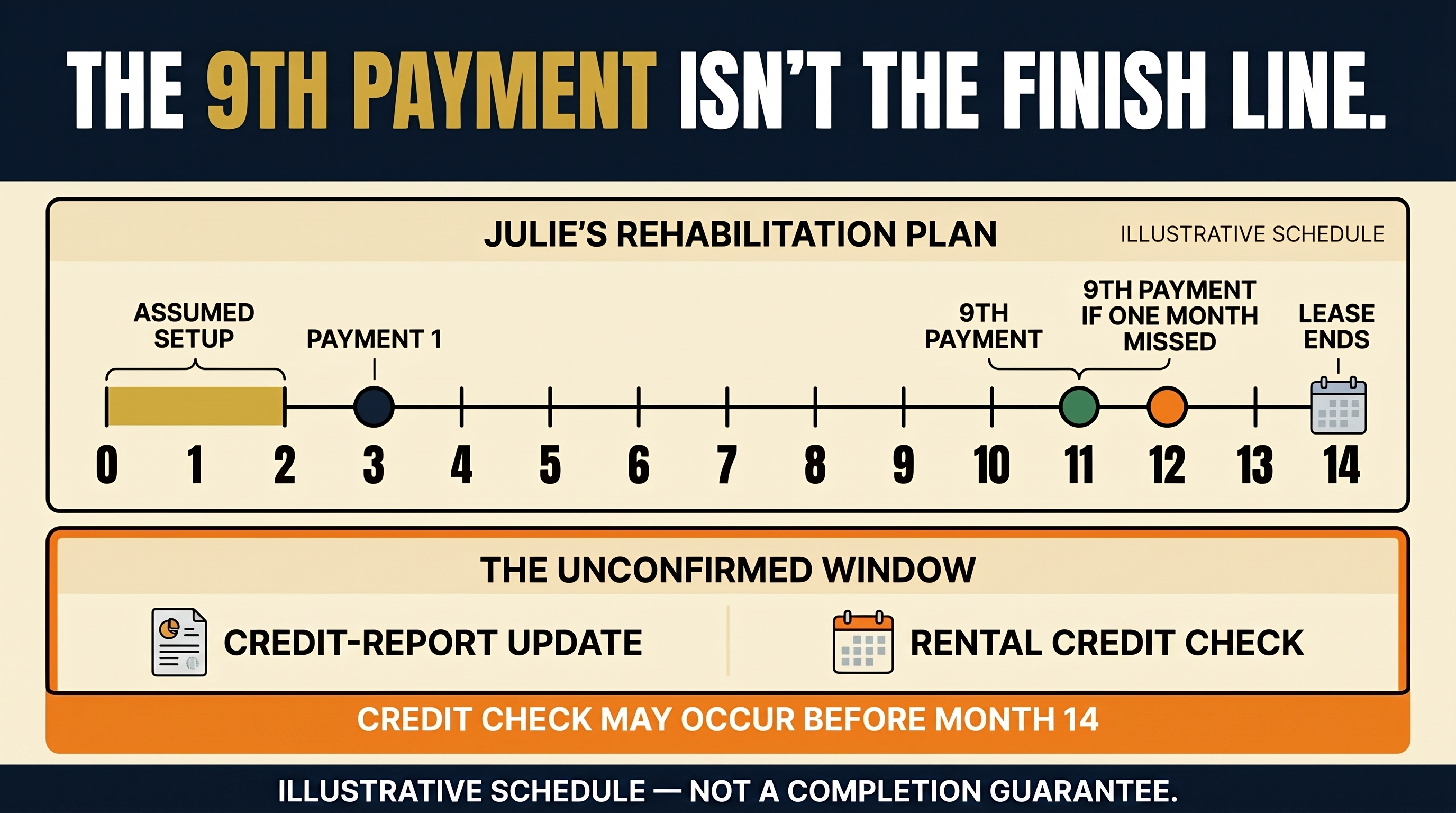
Suppose getting the rehabilitation agreement established takes roughly the first two months in our illustrative planning example, and Julie's first qualifying payment falls in month three.
If she then makes all nine qualifying payments on time, her ninth payment would fall around month 11.
If she misses one payment but still makes nine qualifying payments within the required 10 consecutive months, the ninth could fall around month 12.
Her lease ends at month 14.
At first glance, that looks promising.
But I'm not putting a green check mark next to it.
Why?
Because nine payments are not the entire timeline.
Julie still has to account for setup, processing, the date her credit is actually checked, and the time it takes for the credit-report update to appear after successful rehabilitation.
So month 11 is not "problem solved."
It's a planning estimate.
Julie needs the real timeline from her loan holder, and she needs to leave room between successful rehabilitation and the credit check she actually cares about.
Now compare that with consolidation.
Consolidation may get Julie's loans out of default sooner.
But Julie's specific problem isn't merely the status of the loan.
She wants the default notation addressed before someone checks her credit.
Consolidation does not remove that notation.
That means rehabilitation is the more relevant path for Julie to investigate if she qualifies, the payment is manageable, and the timing works.
Not because rehabilitation wins some universal contest.
Because its defining benefit matches Julie's goal.
And even then, rehabilitation does not erase her earlier late payments or guarantee that a landlord will approve her application.
That's the difference between making a financial decision and chasing a label like "best."
Change the Goal and the Answer Can Change
Now let's change one thing about Julie's situation.
Forget the apartment.
Suppose Julie wants to return to school, and her immediate priority is restoring access to federal student aid as quickly as possible.
Now the decision changes.
The default notation on her credit report may no longer be the thing driving the deadline.
Speed is.
That makes consolidation more important to investigate, subject to Julie's eligibility and the actual processing timeline.
She should also ask her school and loan holder about the separate route that may allow a borrower to regain federal student aid eligibility after six consecutive, full, voluntary, on-time payments under satisfactory repayment arrangements.
That route can restore aid eligibility while the loan itself remains in default.
Notice what just happened.
Same borrower.
Same loans.
Different goal.
Different deadline.
Different tradeoff.
That's why your deadline doesn't automatically hand you an answer.
It tells you which tradeoff deserves your attention.
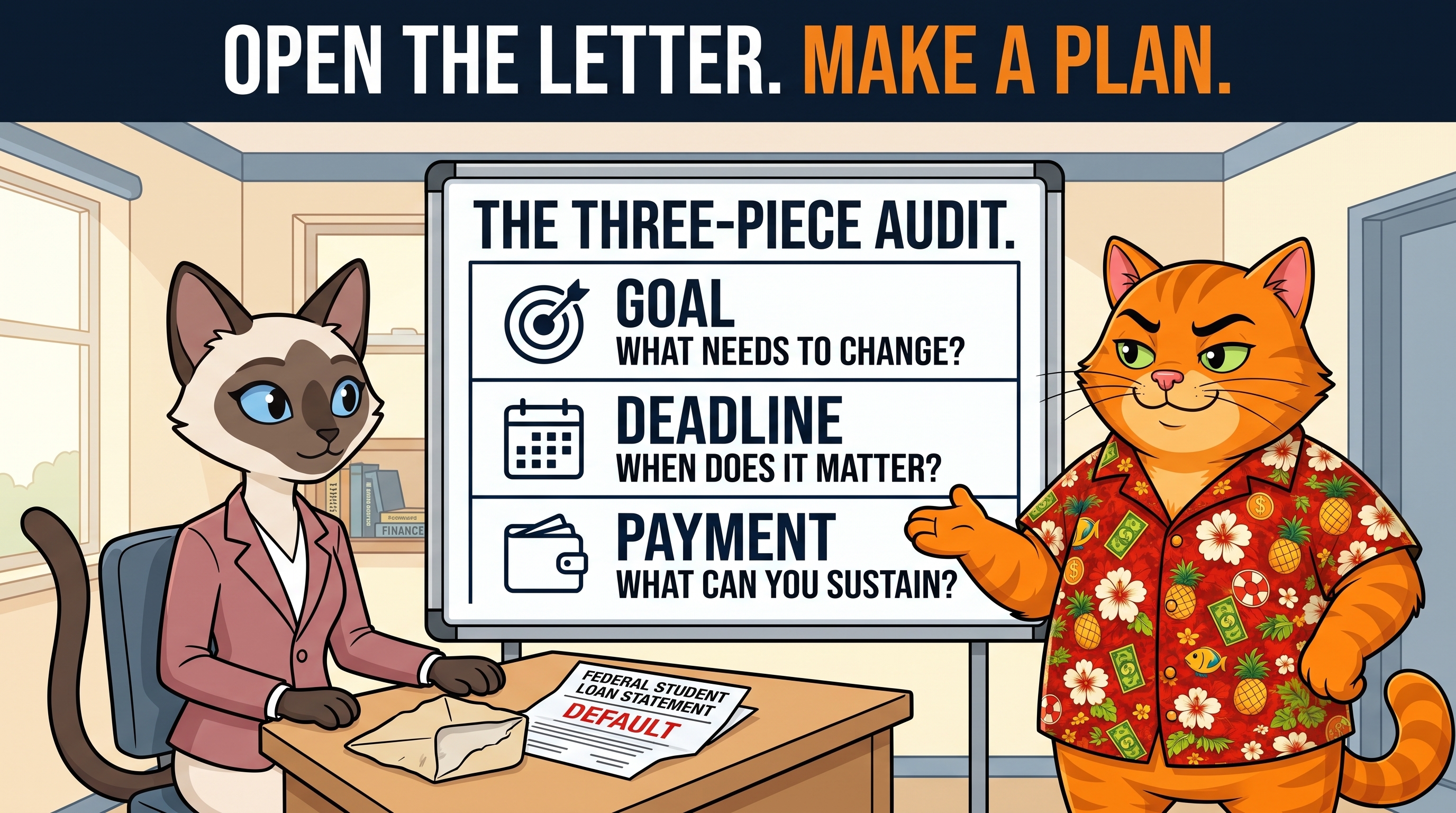
The Three-Piece Audit
This is the framework I want you to take from this article.
Before choosing a path out of default, check three things:
1. Goal
What are you actually trying to fix?
"Get out of default" may be part of the answer, but dig one level deeper.
Are you worried about an upcoming apartment application?
Trying to restore federal student aid eligibility?
Trying to resolve the default as quickly as possible?
Trying to deal with collections?
Your goal determines which differences between rehabilitation and consolidation actually matter.
2. Deadline
When does that goal need to be accomplished?
Don't use the date that feels obvious.
Julie doesn't really have 14 months just because her lease ends in 14 months. Her meaningful deadline may be the day her next landlord checks her credit.
The same applies to you.
Count the entire process — setup, qualifying payments, application processing, loan transfer, and any credit-report update you are relying on.
A deadline a few weeks away is not proof that consolidation will finish in time.
It's a reason to verify the processing timeline immediately.
3. Payment
What can you actually sustain?
This part is easy to overlook when you're focused on escaping default.
Don't.
A recovery plan that collapses because the payment doesn't fit your budget isn't much of a recovery plan.
For rehabilitation, get your actual payment amount from the loan holder. If that amount is unaffordable, ask whether you qualify for the alternative payment calculation based on your income and expenses.
For consolidation, confirm which repayment plans are actually available for your loan type and what the resulting payment would be.
The Three-Piece Audit
Goal + Deadline + Payment
Julie's modeled schedule may fit a 14-month horizon, but eligibility, affordable payments, processing, and the actual credit-check date still need confirmation. A shorter deadline makes consolidation worth investigating — not guaranteed to finish in time.
Goal. Deadline. Payment.
All three have to work.
What About the Current Collections Pause?
There's one current-policy wrinkle worth understanding.
Policy check: September 25, 2026.
The Department of Education announced on January 16, 2026, that it was delaying Administrative Wage Garnishment and the Treasury Offset Program while repayment changes were underway. That announcement did not provide a restart date, and this review found no later official announcement establishing one.
But don't mistake a delay in those collection actions for the default disappearing.
The underlying collection authority remains. Wage garnishment can reach up to 15% of disposable pay, and Treasury offset can reach tax refunds and certain federal benefits.
And defaults continue to be reported to the credit bureaus.
So if your strategy is:
"Collections are paused. I'll just wait."
You're building a plan around a restart date nobody has given you while leaving the default itself unresolved.
A pause is not a resolution.
Confirm current collection status with your loan holder before making decisions because this policy can change.
What You Do With This Information
Julie finally opens the letter.
That's not the dramatic ending.
It's the useful one.
She now knows that her apartment goal makes the credit-report difference between rehabilitation and consolidation important. But she still doesn't know whether rehabilitation actually works for her.
So her next move is not to declare rehabilitation the winner.
It's to get the missing information.
She contacts her loan holder and asks for:
- Her rehabilitation eligibility
- Her actual rehabilitation payment
- Any alternative-payment calculation available to her
- The setup and processing steps
- The expected timeline after successful completion
- Confirmation of what happens to the default notation
Then she compares those answers with the date she expects her apartment credit check to happen.
Now she's making a decision with her own numbers and her own deadline.
Do the same thing with your loans.
Start by logging in to StudentAid.gov and checking the status and holder of each federal student loan.
For Department-held defaulted loans, use MyEdDebt or contact the Default Resolution Group at 1-800-621-3115.
For a commercially held FFEL loan, contact the guaranty agency shown for the loan.
For a Perkins Loan, contact the school or holder.
If you're investigating consolidation, start the Direct Consolidation Loan application through StudentAid.gov. Don't treat MyEdDebt as the application portal for both routes.
And remember: the Default Resolution Group does not charge you for its services.
If a company wants an enrollment fee, subscription, or "maintenance" fee to help you get out of default, stop and verify who you're dealing with.
Fresh Start was a legitimate temporary federal program, but it ended in October 2024. Anyone advertising Fresh Start as an available federal option today isn't describing the current program.
That doesn't mean "no fee" automatically makes a caller legitimate either.
Use official federal websites and verified contact information.
If your loans aren't in default yet, don't wait for an article about getting out of default to become relevant. Contact your servicer now and ask about the repayment and relief options available to you: what happens if you default on a student loan.
And if student loans are only one part of a larger debt problem: debt snowball vs. debt avalanche, or what is debt consolidation.
Julie spent eleven months avoiding a letter because the whole problem felt bigger than the next decision.
Once she opened it, the question got smaller.
She didn't need to solve her entire financial life that afternoon.
She needed to figure out what she was trying to accomplish, when she needed it accomplished, and what payment she could actually sustain.
That's where I'd start too.
Default is a status, not a verdict. Open the letter. Check the goal, deadline, and payment. Then deal with the problem that's actually in front of you.
Chuck Finance is for entertainment and informational purposes only. Chuck is not a licensed financial advisor, and nothing in this post constitutes professional financial, investment, legal, or tax advice. Always consult a qualified professional before making financial decisions.
Federal student loan rules and enforcement policies can change. Verify current requirements and collection status through StudentAid.gov and your loan holder before acting. This article covers federal student loans; private student loans follow different rules.
Sources
- Federal Student Aid — Getting Out of Default
- Federal Student Aid — Loan Rehabilitation
- Federal Student Aid — Loan Consolidation
- Federal Student Aid — Credit Reporting and Default
- U.S. Department of Education — January 16, 2026 announcement delaying involuntary collections
- Federal Reserve Bank of New York — May 12, 2026 student-loan delinquency/default analysis
- 34 CFR 685.211(f)(12)
Policy note: Policy reviewed September 25, 2026; the eCFR pages displayed Title 34 as current through September 23, 2026. The New York Fed figure describes Q1 2026 transfers to the Default Resolution Group, not the current total default population. Recheck collections status, repayment-plan availability, rehabilitation requirements, and application guidance before publication.