Table of Contents
- What Is a Personal Loan?
- The Interest Rate Is Not the Price of the Loan
- Toby Needs $9,000. The Loan Doesn't Give Him $9,000
- How Much Does Toby's Personal Loan Actually Cost?
- Personal Loan vs. Credit Card: Compare the Same Payment
- A Personal Loan Can Fit Your Budget and Still Be a Bad Offer
- What the Math Can't Decide for You
- What Happens If You Can't Make the Payments?
- What About a Personal Loan for Debt Consolidation?
- What You Do With This Information
- Before You Sign
- Sources
What Is a Personal Loan?
A personal loan is usually a form of closed-end installment credit. You borrow a specific amount, receive the proceeds upfront, and repay what you owe through scheduled installments over a defined term.
That is different from revolving credit, such as a credit card. A credit card gives you a credit line you can borrow against, repay, and potentially borrow against again. A personal loan is built around one loan with a repayment schedule and an end date.
One detail gets flattened too often: personal loans do not universally have fixed interest rates. The Consumer Financial Protection Bureau (CFPB) says a personal installment loan may have a fixed or adjustable rate. Many personal loans are unsecured, meaning they do not require collateral, but secured personal loans also exist. If collateral is involved, the risk changes because an asset may be tied to repayment.
For Toby, the product itself isn't the hard part. He needs one specific amount for one necessary repair. The harder question is whether the offer in front of him is actually a good way to get that money.
The Interest Rate Is Not the Price of the Loan
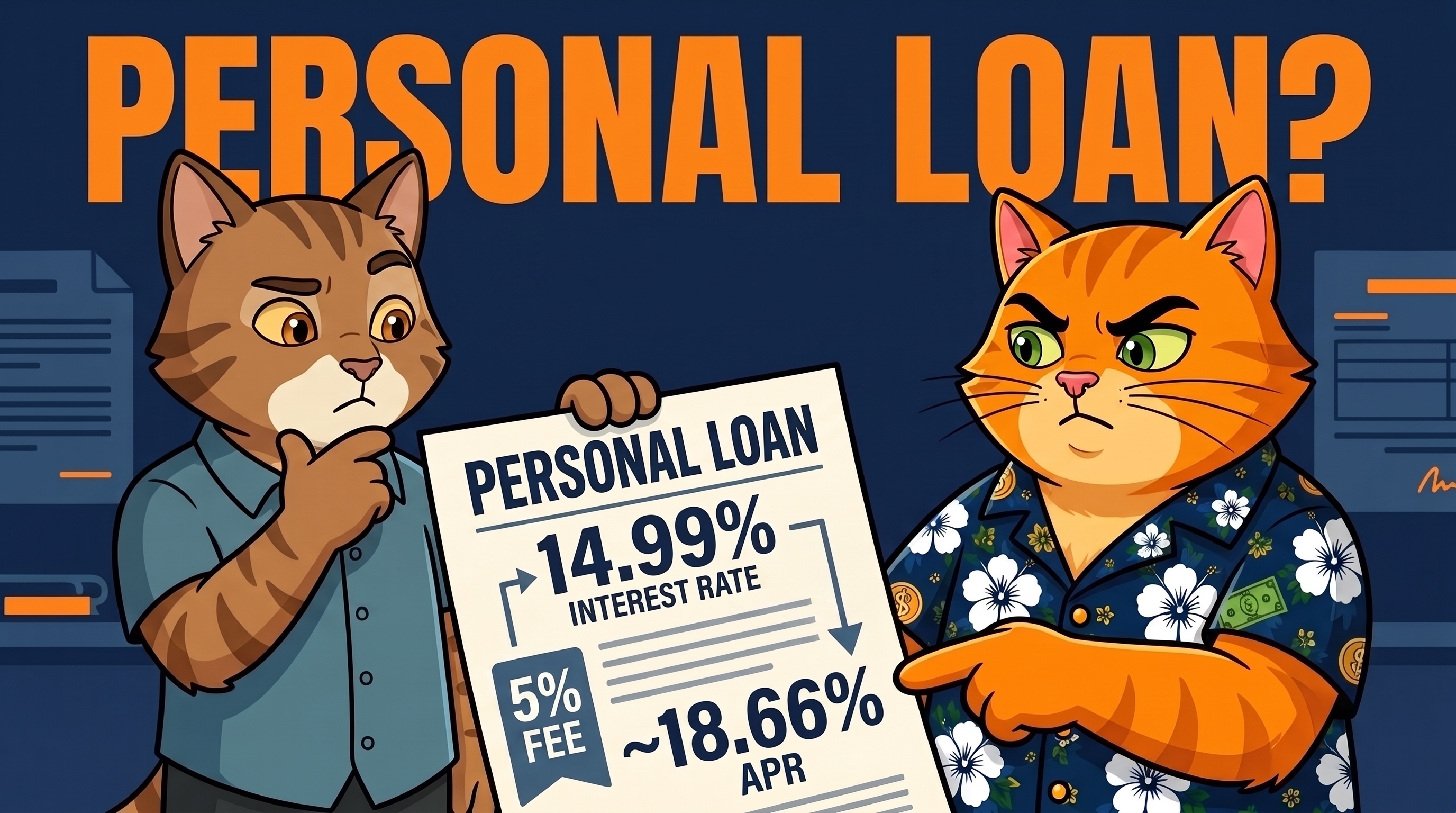
Toby sees 14.99% interest and naturally focuses on it.
I don't.
I want at least these numbers from the loan disclosure:
| Number | What it tells you |
|---|---|
| Amount financed | The amount of credit provided to you or on your behalf after applicable prepaid finance charges are accounted for |
| Finance charge | The dollar cost of consumer credit disclosed under Regulation Z |
| APR | The annualized cost of credit expressed as a percentage under the applicable disclosure rules |
| Total of payments | What you will have paid after making all scheduled payments |
| Payment schedule | How many payments you owe, how much they are, and when they are due |
The contractual interest rate still matters. It just doesn't get to work alone.
The Four Numbers That Price the Loan
Amount financed + finance charge + APR + total payments
If Toby needs $9,000 in his account, a 14.99% rate alone cannot tell him what the loan costs—or even whether $9,000 is what he will receive.
An origination fee is a perfect example. A lender may charge a fee for making the loan. If that fee is withheld from the proceeds, the number written on the loan can be larger than the cash that lands in your account.
That is exactly what happens to Toby.
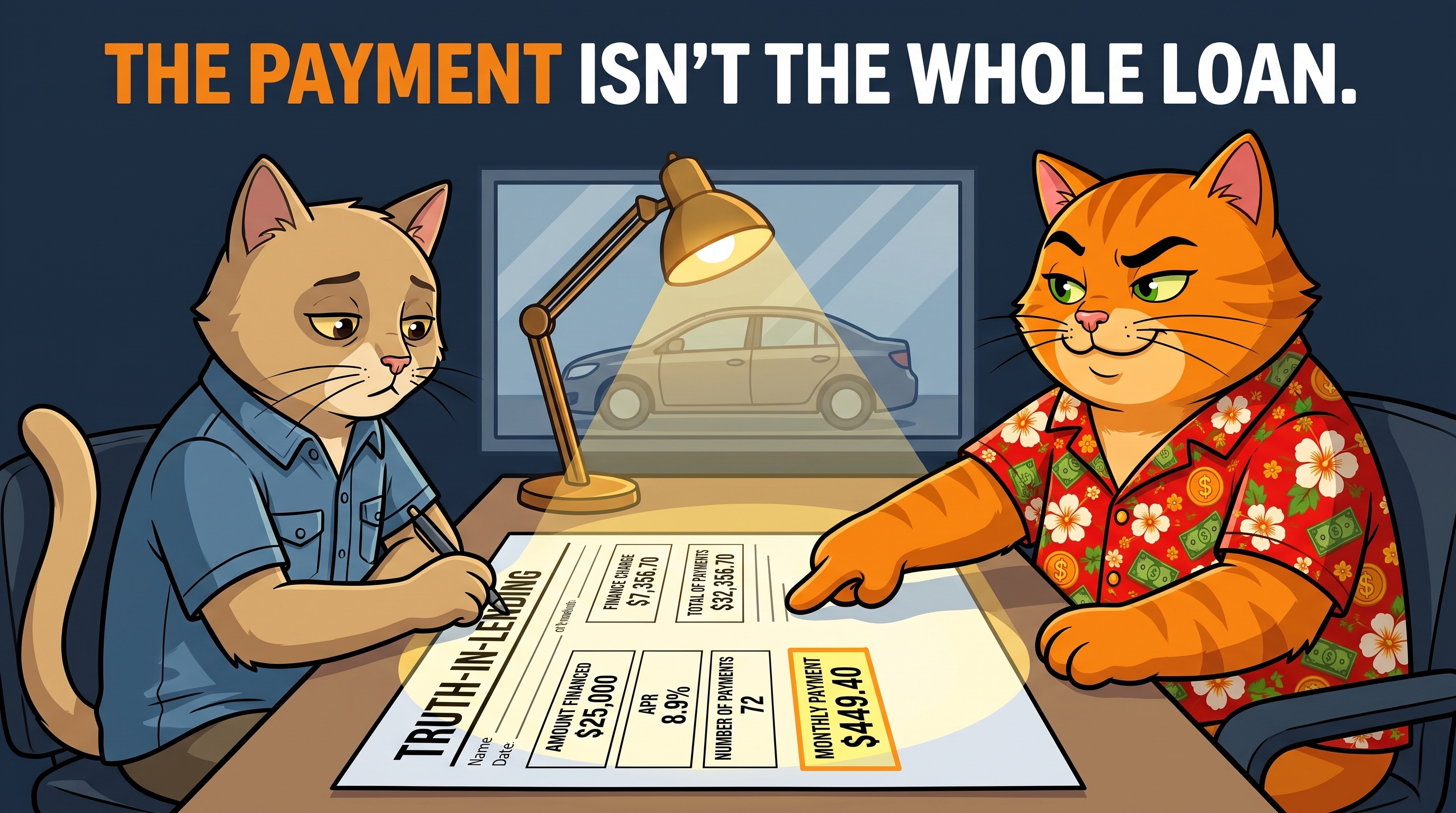
This same habit—reading the full disclosure instead of staring at the monthly payment—is useful when evaluating other installment debt too. See how I use the disclosure numbers when breaking down an auto loan.
Toby Needs $9,000. The Loan Doesn't Give Him $9,000
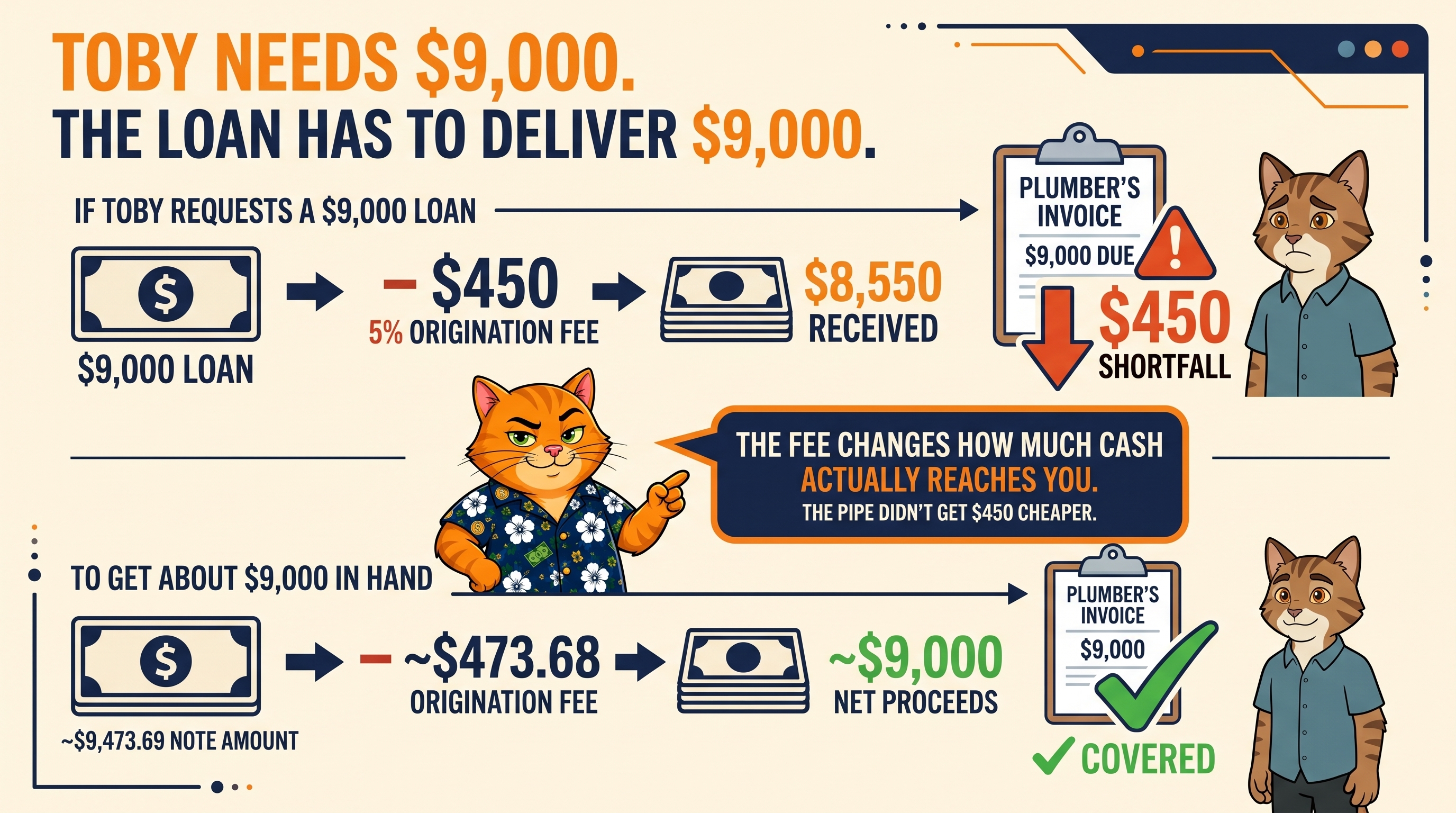
Toby's plumber needs $9,000.
The offer has:
- 14.99% contractual interest rate
- 5% origination fee withheld from the proceeds
- 36-month term
If Toby simply requests a $9,000 loan, the lender withholds 5%, or $450.
Toby receives:
$9,000 - $450 = $8,550
The pipe did not become $450 cheaper because the loan had a fee.
So if Toby needs $9,000 in hand, the note has to be grossed up. In this illustration, that puts the note at approximately $9,473.69, with an origination fee of about $473.68, leaving Toby approximately $9,000 in net proceeds.
That distinction is not paperwork trivia. It's the difference between the amount you think you're borrowing and the amount available to solve the problem.
There is no prize for landing on your feet if the loan disclosure moved the floor.
How Much Does Toby's Personal Loan Actually Cost?
Now we can price the actual offer.
For the 36-month loan at a 14.99% contractual interest rate with the 5% fee withheld:
| Toby's offer | Amount |
|---|---|
| Note amount | ~$9,473.69 |
| Origination fee | ~$473.68 |
| Net proceeds | ~$9,000 |
| Monthly payment | ~$328.36 |
| Total of scheduled payments | ~$11,820.96 |
| Finance charge | ~$2,820.95 |
| APR | ~18.66% |
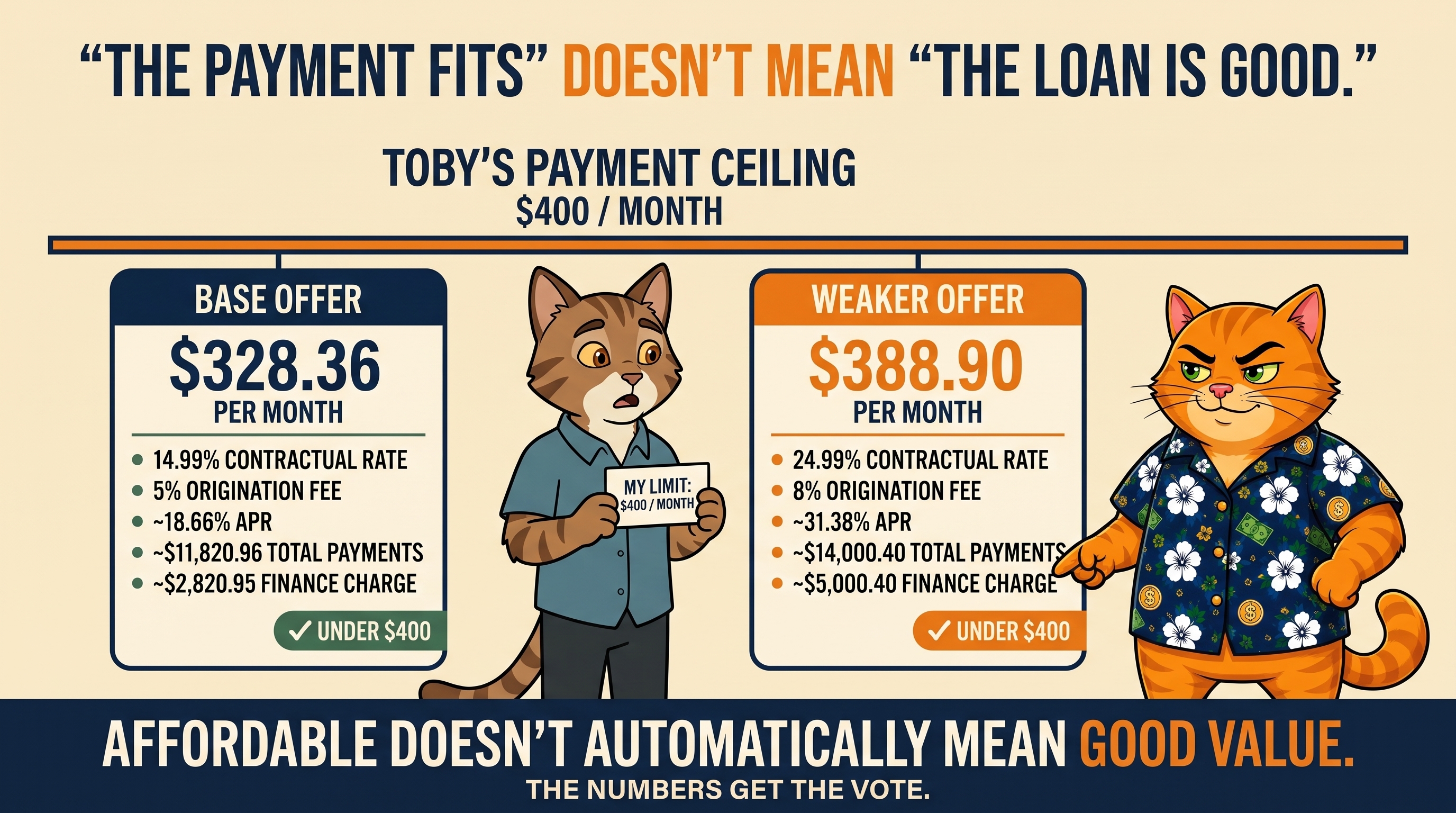
Toby can budget up to $400 per month, so the $328.36 payment fits his stated limit.
But "the payment fits" is not the same sentence as "the loan is good."
The 14.99% rate also isn't Toby's 18.66% APR. The fee pushes the disclosed cost higher. In the first month, approximately $118.34 of Toby's payment goes to interest and $210.02 reduces principal.
By the end of the scheduled loan, he has paid about $2,820.95 in finance charges to get the $9,000 he needed today.
That's the price worth judging.
My take: A manageable payment answers an affordability question. It does not answer a value question.
The fee changes more than the cash Toby receives
Hold the 14.99% contractual rate and 36-month term constant and change only the origination fee in this illustrative model:
| Origination fee | Approx. APR |
|---|---|
| 0% | 14.99% |
| 3% | 17.16% |
| 5% | 18.66% |
| 8% | 21.00% |
| 10% | 22.62% |
Same advertised interest rate. Very different borrowing cost.
This is why I don't let the biggest percentage in an ad do all the thinking.
Personal Loan vs. Credit Card: Compare the Same Payment
Toby has another option: put the $9,000 repair on a credit card.
For context, the Federal Reserve reported an average rate of 22.15% for credit card accounts assessed interest in Q2 2026. That is market context, not Toby's personal credit-card rate.
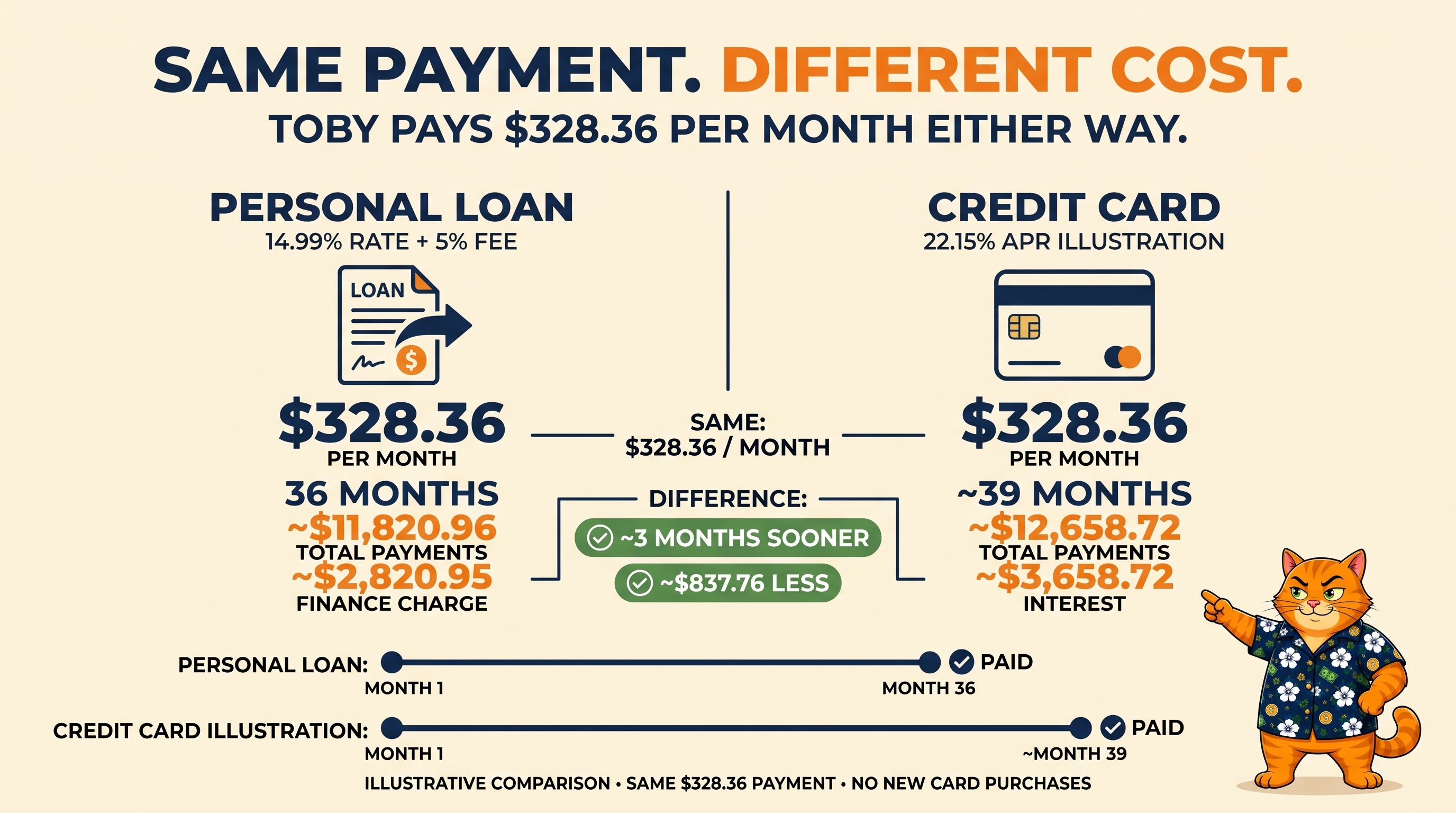
So let's use 22.15% as an illustration and force the comparison to use the same $328.36 monthly payment as Toby's personal loan.
Under a monthly-compounding approximation, with no new purchases:
| Option | Monthly payment | Approx. payoff | Approx. total cost | Approx. borrowing cost |
|---|---|---|---|---|
| Personal loan: 14.99% + 5% fee | $328.36 | 36 months | $11,820.96 | $2,820.95 finance charge |
| Credit card: 22.15% APR | $328.36 | 39 months | $12,658.72 | $3,658.72 interest |
In that comparison, the personal loan costs about $837.76 less and finishes about three months sooner.
Now lower the card APR to 19.99% while keeping the same payment. The card takes about 37 months, with approximately $3,121.81 in interest and $12,121.81 in total payments.
The personal loan still wins—but now by only about $300.85.
That's important. "Personal loans are cheaper than credit cards" is lazy advice. Sometimes the personal loan wins. Sometimes it doesn't. The actual rates, fees, payment, and repayment period decide.
Credit cards also do not promise that you will keep paying Toby's fixed $328.36 every month. This comparison imposes that constant payment so we can compare the two paths. Real credit-card interest is generally calculated using balance methods defined by the card agreement, and new purchases or smaller payments would change the result.
If you want the mechanics behind revolving-card interest, read my credit-card interest breakdown.
A Personal Loan Can Fit Your Budget and Still Be a Bad Offer
Let's make Toby's loan worse.
Suppose another lender offers him:
- 24.99% contractual interest rate
- 8% origination fee
- 36 months
- approximately $9,000 in net proceeds
The note rises to about $9,782.61. The payment becomes approximately $388.90.
Remember Toby's constraint: $400 per month.
So this loan still fits.
That's precisely why this comparison matters.
The total of scheduled payments is approximately $14,000.40. The finance charge is about $5,000.40, and the modeled APR is approximately 31.38%.
Now compare that with putting $9,000 on a card at 22.15% while paying the same $388.90 per month. Under the same monthly-compounding approximation, the card is paid off in about 31 months, costs approximately $2,847.74 in interest, and requires approximately $11,847.74 in total payments.
The "personal loan" label didn't save Toby.
The weaker loan costs roughly $2,152.66 more and runs about five months longer than the card comparison—even though the monthly loan payment fits his budget.
That kills two shortcuts at once:
Lower monthly payment does not mean lower cost.
And:
Personal loan does not mean cheaper debt.
The numbers get the vote.
What the Math Can't Decide for You
At this point, Toby can compare the dollars. He still has to answer questions a spreadsheet cannot.
Is this a one-time problem?
Toby has a failed plumbing line. The repair is a defined expense. Once it is fixed, he does not expect another $9,000 plumbing charge next month.
That's different from borrowing because normal monthly expenses repeatedly exceed income. A loan can finance a one-time expense. It cannot permanently repair a recurring cash-flow deficit.
If you borrow $9,000 to close a monthly budget gap and the gap is still there after the money arrives, you haven't solved the underlying problem. You've added a loan payment to it.
Does the payment fit without breaking something else?
Toby set his ceiling at $400 before choosing the loan. That matters.
A lender approving a payment does not make that payment comfortable inside your budget. You still need room for housing, food, utilities, insurance, existing debt, and the annoying expenses that refuse to ask permission.
What alternatives exist?
The comparison should not be "this loan or nothing" unless those are actually the choices.
Cash available above a necessary emergency reserve, a payment arrangement with the service provider, a different lender, a credit-union offer, or another financing option may change the decision. The point isn't that one alternative always wins. The point is that the first approval on your screen has not earned your signature just by existing.
Does the loan solve the problem—or move it?
This is my favorite test because it is difficult to hide from.
Toby's loan would pay for a completed repair and create a fixed repayment schedule. There is a clear use for the money and a clear endpoint for the debt.
If the loan merely creates room to borrow somewhere else again, that's a different problem.
What Happens If You Can't Make the Payments?
A personal loan is still debt.
If you miss payments, you may face late fees or other consequences under the agreement, and missed payments can lead to collection activity and credit-reporting consequences. If the loan is secured, collateral can add another layer of risk.
Don't wait until several missed payments have stacked up before looking at the contract or contacting the lender. CFPB guidance recommends contacting the lender as soon as possible if you think you may have trouble making payments.
Also check the disclosure and contract for late-payment terms and any prepayment provision that applies. Regulation Z requires certain closed-end credit disclosures, but the actual contract still matters. Don't assume a fee will be waived, refunded, or treated a particular way unless your agreement says so.
What About a Personal Loan for Debt Consolidation?
Yes, personal loans are sometimes used for debt consolidation.
But that's a strategy question, not the definition of the product.
Once you're using a new loan to replace multiple existing debts, you have to compare the new fee, rate, term, total cost, payment, and what happens to the old accounts. That's enough moving pieces to deserve its own analysis, so I'm not going to smuggle a second article into this one.
Read my full debt-consolidation breakdown.
The boundary is simple: a personal loan is a financial product. Debt consolidation is one possible use for borrowed money.
What You Do With This Information
Toby doesn't need a verdict on whether personal loans are "good" or "bad." He needs a verdict on this offer for this problem.
His base offer passes the first test: the approximately $328.36 payment fits below his $400 ceiling.
It also gives him the $9,000 he actually needs once the withheld fee is accounted for.
Against the 22.15% card illustration at the same payment, the base personal loan comes out ahead by about $837.76 and three months. Against the 19.99% card illustration, the advantage shrinks to about $300.85.
And the weaker personal-loan offer flips the result entirely.
So Toby's decision is not "personal loan versus credit card" in the abstract. It's verified offer versus verified alternative.
That's the decision Toby has to make.
Before You Sign
Take the disclosure and find these numbers:
- How much money will you actually receive?
- What is the amount financed?
- What is the finance charge?
- What is the APR?
- What is the total of payments?
- What is the monthly payment and repayment term?
- What fees or other contract terms could affect the cost?
Then compare at least one other real offer or realistic alternative.
A 14.99% interest rate can become an approximately 18.66% APR in Toby's illustrated loan. A payment under $400 can belong to the better offer or the worse one.
The loan's job is to give you money now.
Your job is to find out exactly what you're giving back.
Chuck Finance is for entertainment and informational purposes only. Chuck is not a licensed financial advisor, and nothing in this post constitutes professional financial, investment, legal, or tax advice. Always consult a qualified professional before making financial decisions.
All Toby loan and credit-card figures are illustrative. Rates, fees, repayment terms, lender practices, and individual offers vary. Credit-card comparisons use a simplified monthly-compounding model, a constant payment, and no new card purchases.
Sources
- Consumer Financial Protection Bureau — What is a personal installment loan?
- Consumer Financial Protection Bureau — Do personal installment loans have fees?
- Consumer Financial Protection Bureau — What is the difference between a loan interest rate and the APR?
- Consumer Financial Protection Bureau — 12 CFR Part 1026, Regulation Z
- Consumer Financial Protection Bureau — 12 CFR § 1026.18, content of disclosures
- Federal Reserve Board — Consumer Credit, G.19