What Debt Consolidation Actually Means
Debt consolidation means combining several debts you owe into one. Instead of juggling three credit card bills, you'd have one payment to keep track of. That's the whole idea at its simplest.
Here's the part worth saying plainly: consolidation doesn't erase any debt. It restructures it. The money you owe doesn't disappear — it just moves into a different shape. Whether that new shape is actually better than what you had depends entirely on the details, which this post walks through.
The Ways People Consolidate
There are a few different ways to do this, and they're not all the same kind of risk:
A new loan. You borrow a lump sum from a bank, credit union, or online lender, and use it to pay off your other debts. Now you owe one lender instead of several.
A balance transfer. You move credit card balances onto a new card that offers a low or 0% promotional rate for a limited time. This can genuinely help if you can pay off the balance before that promotional period ends. If you can't, whatever's left becomes subject to the card's regular rate under its normal terms — which can be steep.
A nonprofit-managed repayment plan. A nonprofit credit counseling agency negotiates with your creditors on your behalf and sets up one monthly payment that gets distributed to them. Important distinction: this isn't a new loan — your original debts don't get paid off, they just get managed differently, often at reduced interest. More on this below.
Borrowing against your home. Using your home's value to get a loan you then use to pay off other debt. This one deserves its own warning, which comes later in this post.
Four Things a Consolidation Offer Can Change
Before looking at any real numbers, it helps to know that a consolidation offer can change four different things — and improving one doesn't mean it improved the others:
- Your interest rate — is the new rate actually lower than what you're paying now?
- Your monthly payment — is the required payment smaller?
- Your total cost — will you pay less money overall, from now until it's fully paid off?
- How long it takes — will you be done sooner or later?
A lower monthly payment sounds like an improvement. It isn't automatically one. Here's why that matters.
Diana's Situation — A Real Comparison
Diana has three credit cards:
| Debt | Balance | Interest Rate | Minimum Payment |
|---|---|---|---|
| Credit Card A | $4,200 | 23.99% | $105 |
| Credit Card B | $3,100 | 19.99% | $78 |
| Credit Card C | $2,400 | 26.99% | $60 |
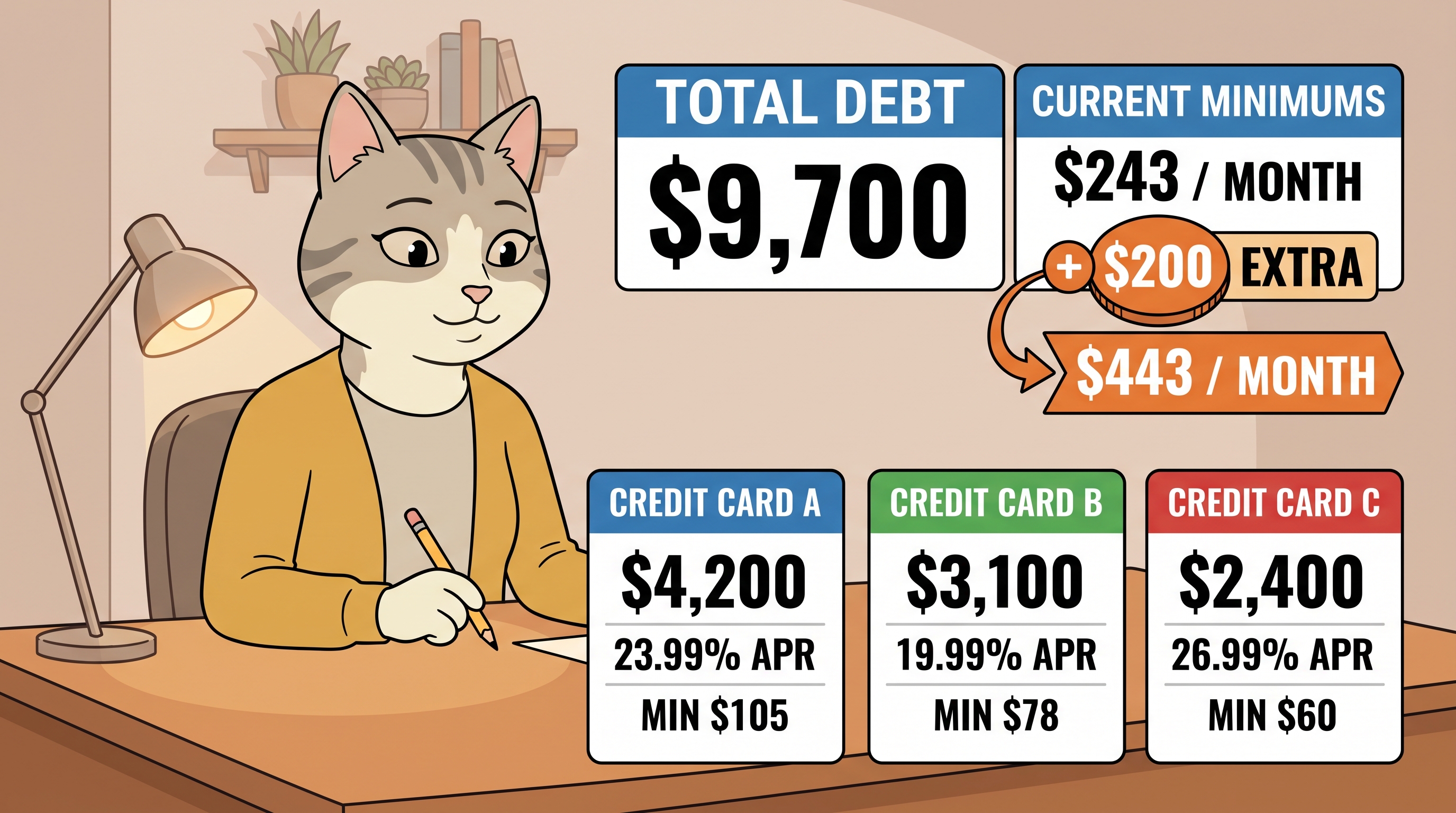
She owes $9,700 total, and her minimum payments add up to $243 a month. She also has an extra $200 a month available beyond that — so $443 a month total, if she puts all of it toward her debt.
If Diana keeps her cards and pays $443 a month — putting the extra $200 toward whichever card has the highest interest rate first, then rolling that payment to the next one once it's paid off — she'd be debt-free in 29 months, paying $2,913.84 in interest along the way.
Now say Diana gets two consolidation loan offers. Both loans charge a $291 fee for making the new loan — lenders call this an origination fee. In this example, that fee is added to what Diana borrows, so she pays interest on it along with the rest.
Offer 1: 13.99% interest, paid over 3 years. Required payment: $341.42 a month. That's about $100 less than what she's paying now.
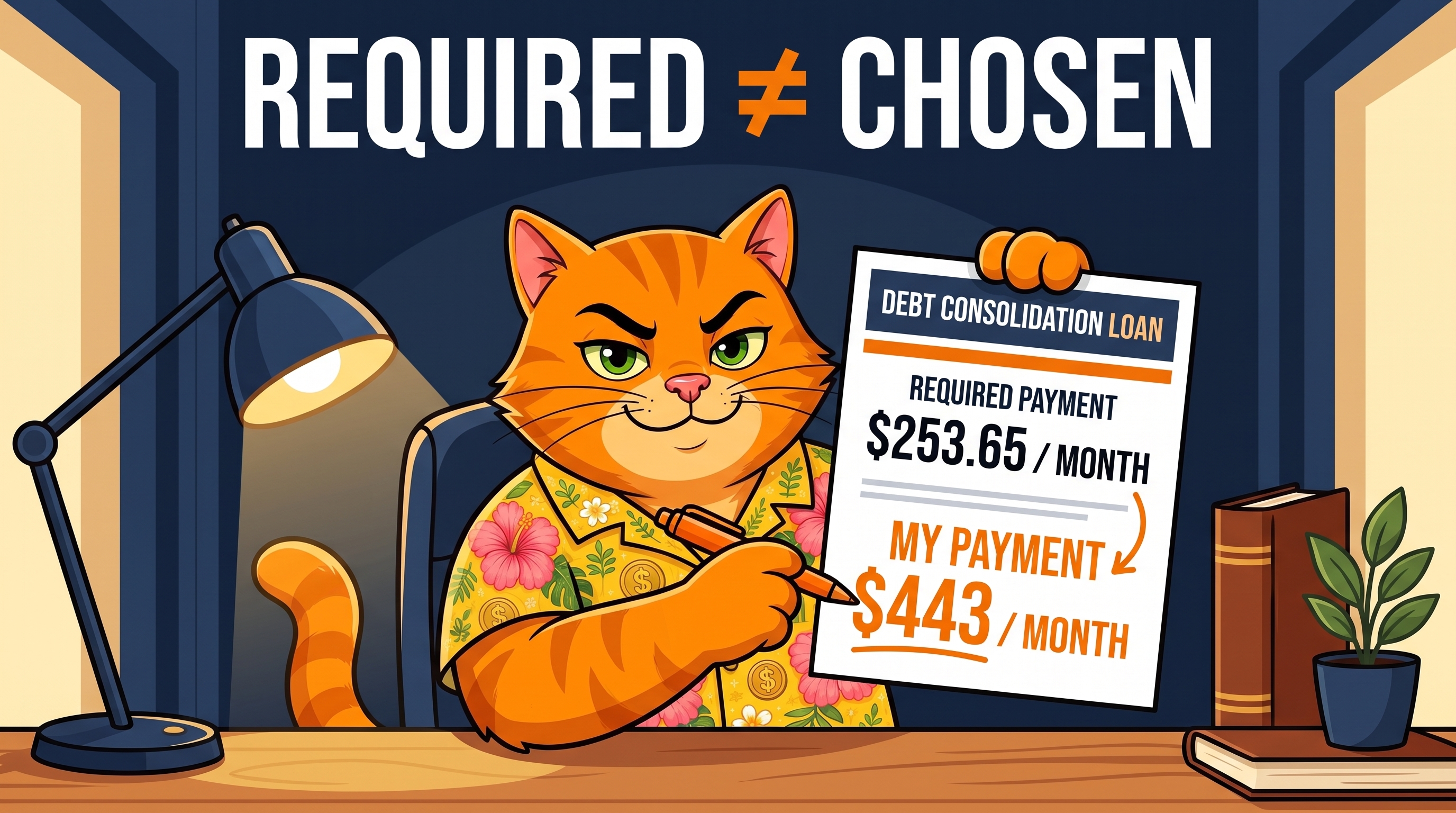
Offer 2: 17.99% interest, paid over 5 years. Required payment: $253.65 a month. That's about $190 less than what she's paying now.
What the Math Actually Shows
Here's what happens if Diana simply pays each offer's required monthly payment:
| Keep paying $443/mo herself | Offer 1 (required payment) | Offer 2 (required payment) | |
|---|---|---|---|
| Monthly payment | $443 | $341.42 | $253.65 |
| Time to pay off | 29 months | 36 months | 60 months |
| Total cost | $12,613.84 | $12,291.13 | $15,219.08 |
Offer 1 is a real improvement — it costs about $323 less overall, even though it takes 7 months longer. That's a genuine, if modest, win.
Offer 2 looks even better every month — a payment nearly $190 lower. But it takes an extra two and a half years and ends up costing Diana over $2,600 more than if she'd just kept paying $443 a month herself. The smallest payment turned out to be the most expensive option on the table.
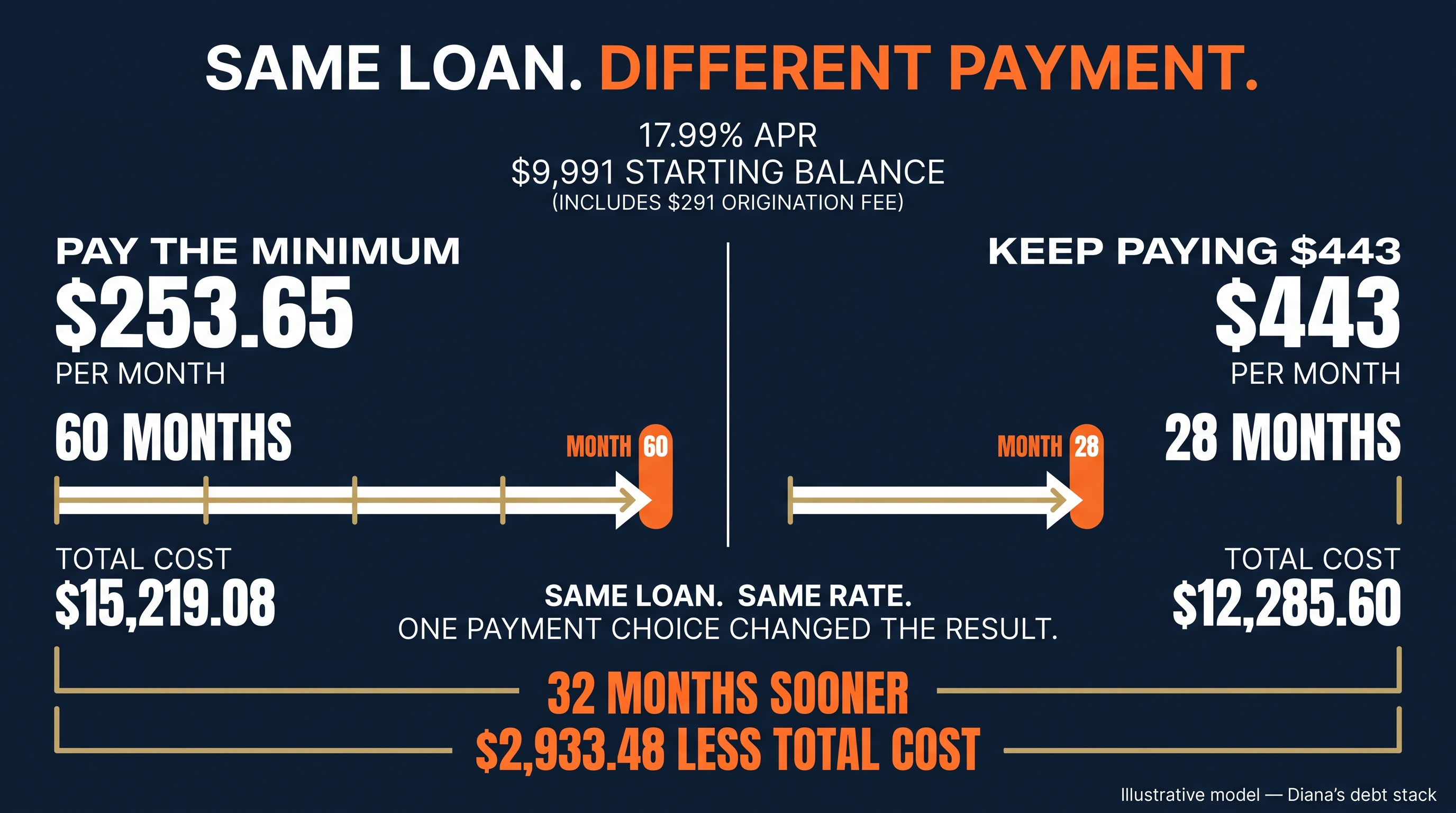
Here's the twist almost no one points out: nothing requires Diana to make only the required payment. If she takes Offer 2 but keeps paying the same $443 a month she already had available — instead of dropping down to the new $253.65 minimum — the picture flips completely:
| Offer 2, paying only the required $253.65 | Offer 2, but Diana keeps paying $443 | |
|---|---|---|
| Time to pay off | 60 months | 28 months |
| Total cost | $15,219.08 | $12,285.60 |
The Payment You're Required to Make vs. the Payment You Choose to Make
A consolidation loan sets a required minimum. Nothing stops you from paying more.
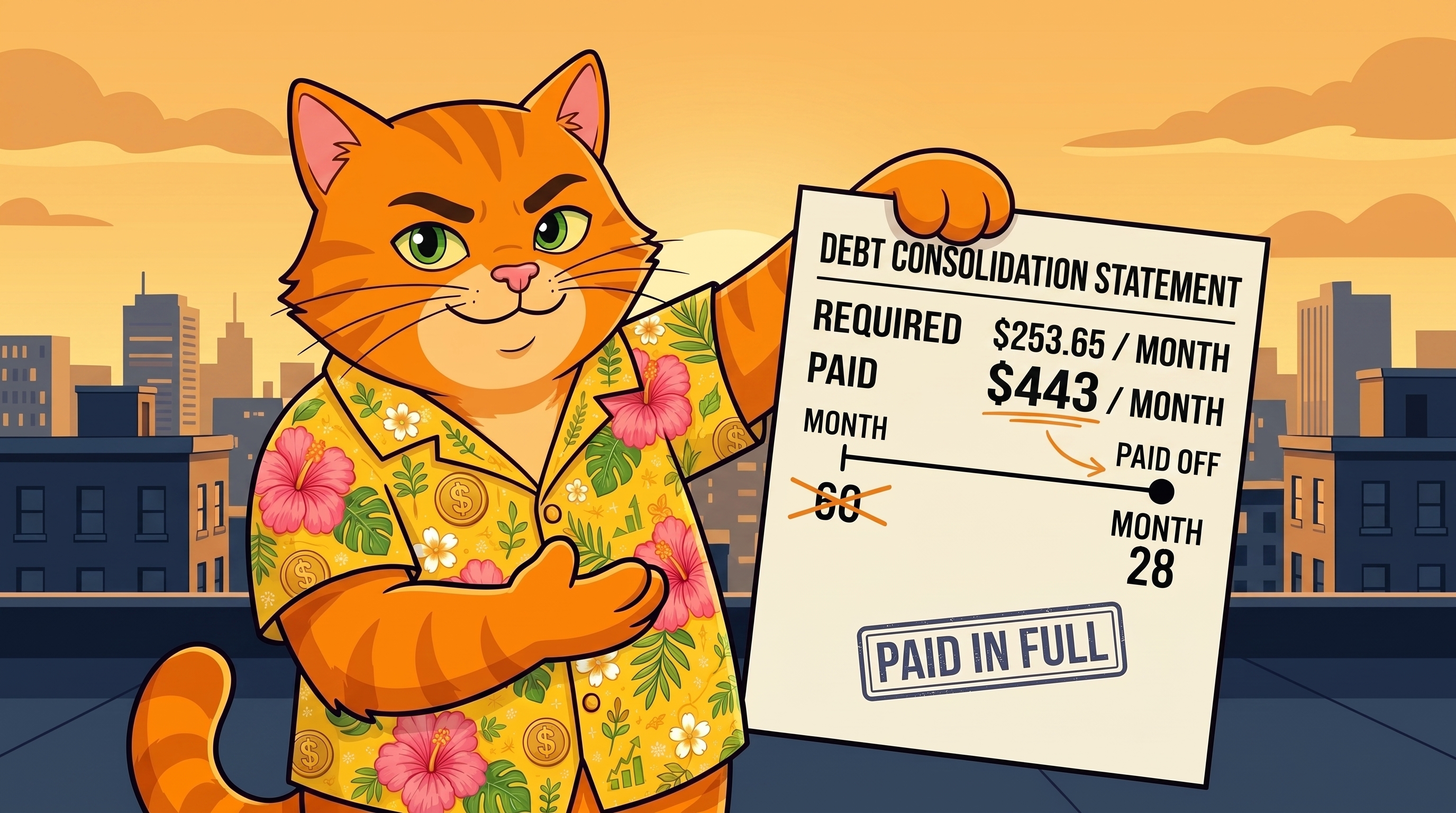
In one comparison, a "worse" consolidation offer became faster and cheaper than keeping the existing cards — simply because the borrower kept paying what she was already paying, instead of dropping to the new lower minimum.
Same loan. Same interest rate. The only thing that changed is whether Diana treated the new lower number as a payment she had to make, or a payment she chose to make instead of what she could actually afford. Paid at $443 a month, that "worse" offer becomes faster and cheaper than keeping her existing cards and continuing the same $443 payoff plan.
The required payment on a consolidation loan and the payment you actually choose to make are not the same number — and mixing them up is exactly where consolidation goes wrong for people. This isn't a rule that a lower payment always means more risk. In Diana's case, Offer 2 specifically only became expensive when she followed its lower minimum for the full five years. The loan itself didn't change. What she chose to pay against it did.
All figures above are an illustrative model — Diana isn't a real borrower, and monthly compounding, fixed payment assumptions, and no missed payments are built into the math. Real offers, real minimums, and your own numbers will differ.
Two Questions Before You Sign Anything
You don't need to be good at math to check whether a consolidation offer actually helps. Just ask two questions:
Would you pay less overall — after every fee — than if you kept paying what you already have? Not "is the monthly payment lower." The total amount, start to finish.
How long will you actually be paying? A lower monthly number that stretches out for years can cost more than a higher payment that finishes sooner. Look at both numbers side by side before deciding.
Does This Actually Fix the Problem?
One more question worth asking honestly, and it's not about your credit score or your math — it's about why the balances got this high in the first place.
Consolidation restructures debt you already have. It doesn't change whatever caused it to build up. If that cause was a one-time thing — a medical bill, a stretch of reduced income that's now over — consolidating can be a clean, sensible move. If the underlying situation hasn't changed — spending that's still outpacing income, an ongoing shortfall — there's a real risk of new balances building on the cards while you're still paying off the consolidation loan. That's not a character flaw. It's just something worth being honest with yourself about before you sign anything.
One small, real cost worth knowing: applying for a new loan involves a credit check that can cause a temporary, usually small dip in your credit score. It's normally not something to build a decision around, but it's a real part of the process.
A Word About Using Your Home
One consolidation option is a loan or line of credit borrowed against your home's value, used to pay off other debt. Be careful with this one.
Ordinary credit card debt isn't tied to anything specific you own — missing a payment doesn't put a particular possession on the line, though it can still lead to real consequences like collections or, eventually, a lawsuit. A loan borrowed against your home works differently: your home itself becomes the collateral. Miss payments on that loan, and foreclosure becomes a direct possibility in a way it simply isn't with an unpaid credit card. A lower interest rate doesn't change that trade — you'd be swapping one kind of risk for a more serious one.
If a Loan Isn't the Right Fit
If you can't qualify for a consolidation loan at a rate that would actually help, a nonprofit debt management plan is worth knowing about. A nonprofit credit counseling agency — the National Foundation for Credit Counseling is a legitimate one to start with — can negotiate directly with your creditors, often reducing your interest rate without you taking out any new loan. Fees vary by agency and state, so check the full cost before enrolling. It's a different tool than a loan, not a lesser one.
What To Do Before You Say Yes
Before accepting any consolidation offer, write down two numbers: what you'd pay in total if you kept doing what you're doing now, and what you'd pay in total under the new offer — including every fee. Compare those two numbers, not the monthly payments. Then decide what you're actually going to pay each month, separate from whatever the offer requires as a minimum.
If you decide to keep your debts as they are instead of consolidating, the next question is which one to attack first — Debt Snowball vs. Debt Avalanche walks through exactly that decision.
Chuck Finance is for entertainment and informational purposes only. Chuck is not a financial advisor, and nothing in this post constitutes professional financial advice. All figures in this post are illustrative — not a real borrower's situation or a guarantee of results. Consolidation products vary by lender; compare actual offers and verify terms before signing anything. Consult a licensed financial professional or a nonprofit credit counselor for advice specific to your situation.
Sources
- Consumer Financial Protection Bureau, "What do I need to know about consolidating my credit card debt?" — consumerfinance.gov, updated September 2, 2026
- Consumer Financial Protection Bureau, "What is the difference between credit counseling and debt settlement, debt consolidation, or credit repair?" — consumerfinance.gov, updated January 29, 2025
- National Foundation for Credit Counseling — nfcc.org, verified current as of publication
- myFICO, "Do Credit Inquiries Lower Your FICO Scores?" — myfico.com
- Board of Governors of the Federal Reserve System, Consumer Credit — G.19 release, May 12, 2026