Who This Is For
Both methods below assume you can currently make the minimum payment on every debt you owe, and you have some amount above those minimums to put toward faster payoff. If that's not your situation — if minimums themselves aren't currently doable — you're facing a different problem than this post solves, and a debt-ordering strategy isn't the fix for it. The National Foundation for Credit Counseling is a legitimate nonprofit that offers free, no-pressure budget reviews and can talk through real options — that's the right next call, not this article.
This post also assumes you've already decided debt payoff is where your extra money is going. If you're still weighing whether that money should go toward debt at all versus investing it instead, check out Should I Pay Off Debt or Invest First? — it covers that decision directly.
How Each Method Works
Both methods share one non-negotiable rule: minimum payments on every debt, every month. That part is identical. Where they diverge is what happens to whatever's left over.
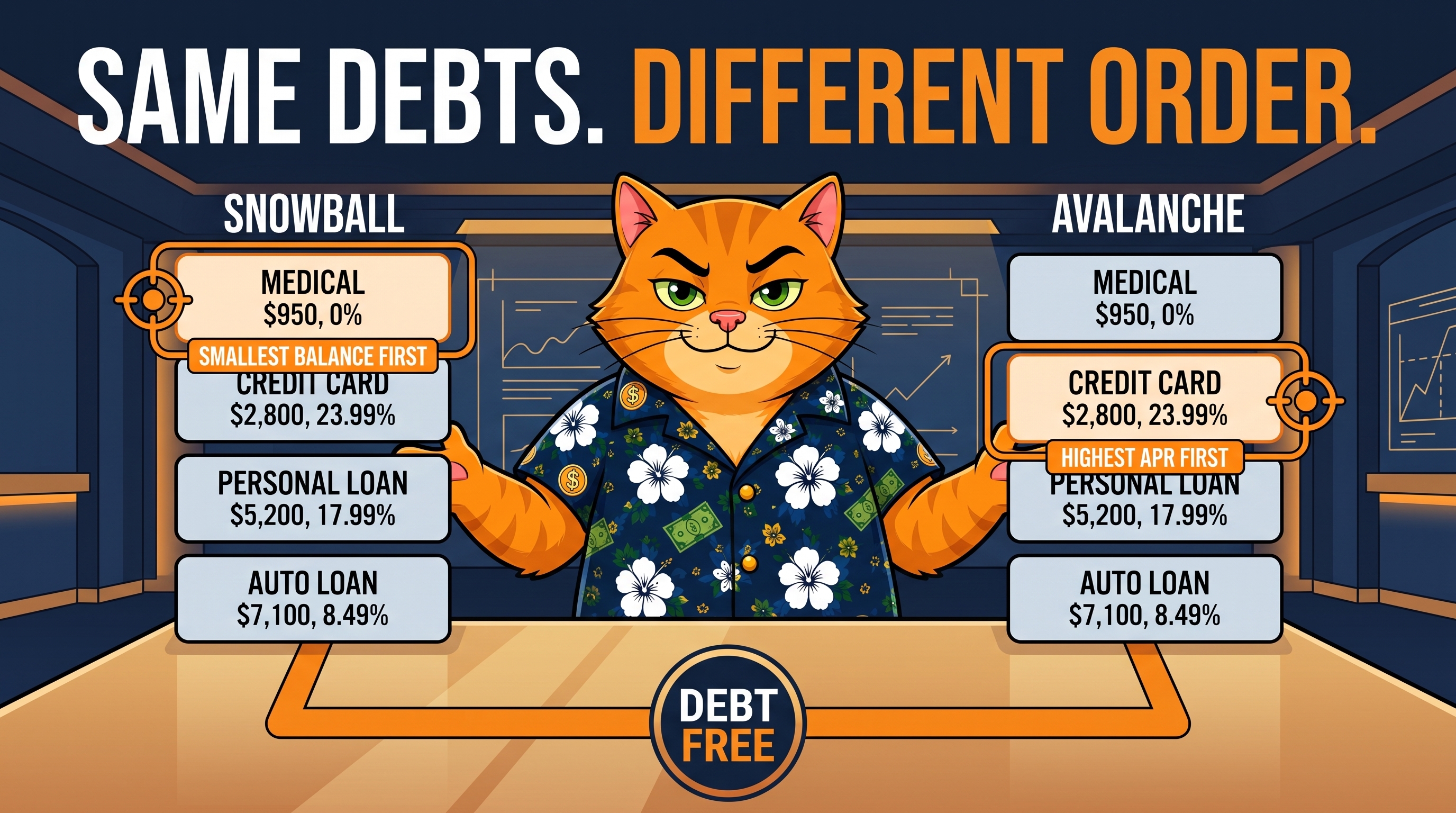
Debt snowball: List every debt from smallest balance to largest, ignoring interest rate entirely. Put every extra dollar toward the smallest one until it's gone. Roll its freed-up payment into the next-smallest. Repeat.
Debt avalanche: List every debt from highest interest rate to lowest, ignoring balance size entirely. Put every extra dollar toward the highest-rate debt until it's gone. Roll its freed-up payment into the next-highest rate. Repeat.
One wrinkle worth knowing: if your smallest balance also happens to carry your highest rate, both methods start in the exact same place. That doesn't mean they stay identical — once that first debt is gone, snowball keeps ordering by balance and avalanche keeps ordering by rate, and the remaining stack can diverge from there. Only if every debt happens to rank the same way by both balance and rate do the two methods stay identical all the way through.
What Each Method Actually Optimizes
Avalanche optimizes the cost. Under consistent execution — same balances, same minimums, same extra payment every month, no interruptions, no new debt, no rate changes — it minimizes total interest paid, because it attacks the most expensive balance first. The size of that advantage depends on your balances, rates, minimum payments, and how long higher-rate debt would otherwise stay outstanding. Wider rate differences can make the avalanche advantage larger, but the rest of the debt stack matters too.
Snowball optimizes the feedback loop. By targeting the smallest balance first, it's designed to put an account at zero early — giving you a concrete, visible win instead of optimizing purely for interest cost. In Marcus's scenario below, that means his first account closes in Month 5 under snowball versus Month 12 under avalanche.
Neither of these is "better" in general, because they're not measuring the same thing.
Marcus's Debt Stack — The Controlled Comparison
Here's how that plays out with real numbers. Marcus has four debts. Everything about his situation is identical in both scenarios below — same balances, same Annual Percentage Rates (APRs), same minimums, same $200 extra a month. The only thing that changes is which debt gets that extra $200 first.
| Debt | Balance | APR | Min. Payment |
|---|---|---|---|
| Medical Bill | $950 | 0.00% | $30 |
| Credit Card A | $2,800 | 23.99% | $70 |
| Personal Loan | $5,200 | 17.99% | $140 |
| Auto Loan | $7,100 | 8.49% | $195 |
Total debt: $16,050. Total minimum payments: $435/month. Extra payment: $200/month. Total monthly payment: $635.
Snowball order (smallest balance first): Medical Bill → Credit Card A → Personal Loan → Auto Loan Avalanche order (highest rate first): Credit Card A → Personal Loan → Auto Loan → Medical Bill
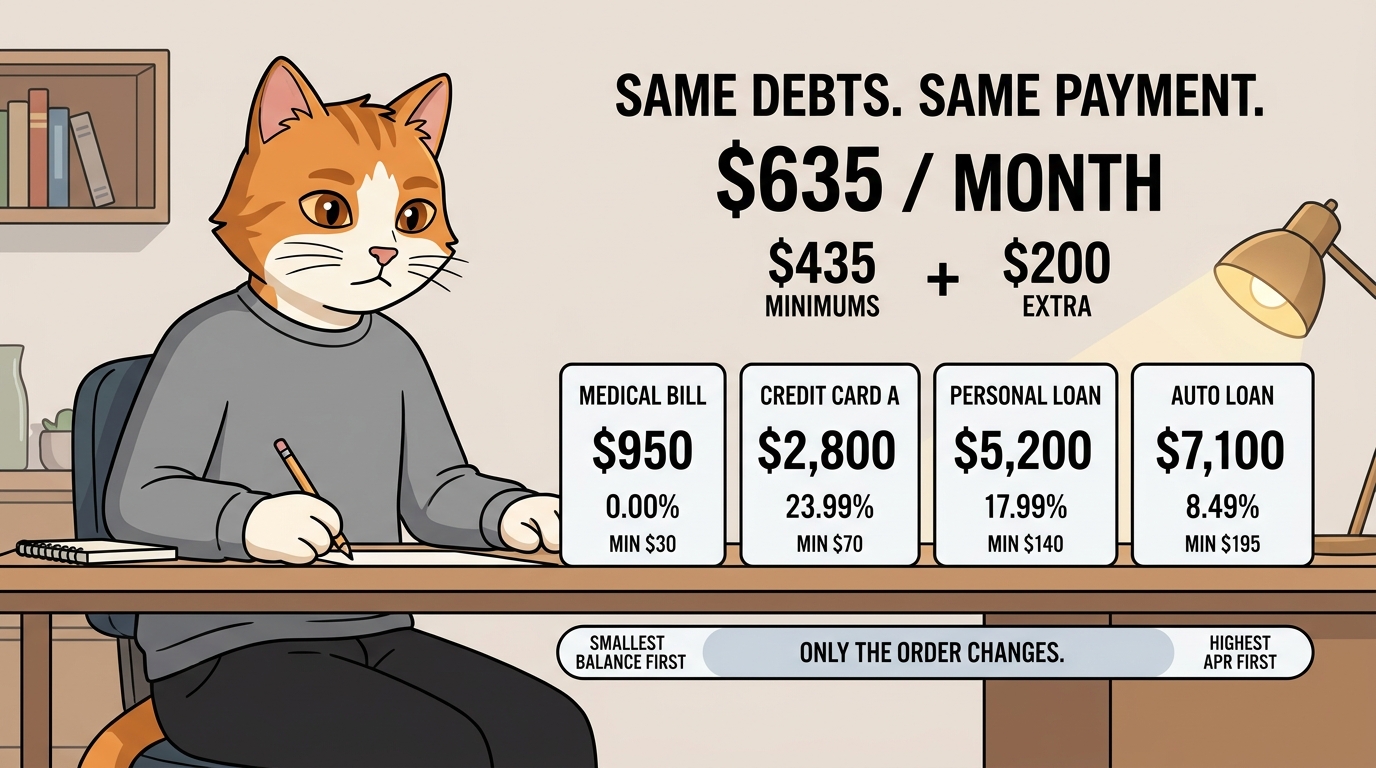
This is a controlled illustrative model, not a real borrower — built with monthly compounding, interest accruing before each month's payment, fixed scheduled minimums that don't get recalculated as balances shrink, and every freed-up minimum rolling forward into the extra-payment pool the moment a debt hits zero. It assumes the same starting balances, the same $635 total monthly payment throughout, no new debt, and no rate changes of any kind for the life of the payoff. Real lenders may recalculate minimums as balances decline, which would change these exact numbers — this shows the mechanism, not a prediction for your own accounts.
Results:
| Snowball | Avalanche | |
|---|---|---|
| First debt eliminated | Month 5 (Medical Bill) | Month 12 (Credit Card A) |
| Total payoff time | 30 months | 30 months |
| Total interest paid | $2,931.99 | $2,637.37 |
What the Math Is Telling You
Both methods get Marcus out of debt in exactly the same 30 months. That's not a typo — in this particular stack, the ordering doesn't change how long the whole thing takes. What it changes is two other things: which account closes first, and how much interest gets paid along the way.
Snowball gets Marcus his first closed account at Month 5. Avalanche doesn't deliver that first win until Month 12 — seven months later. In exchange for that seven-month wait, avalanche saves $294.62 in interest over the full 30 months.
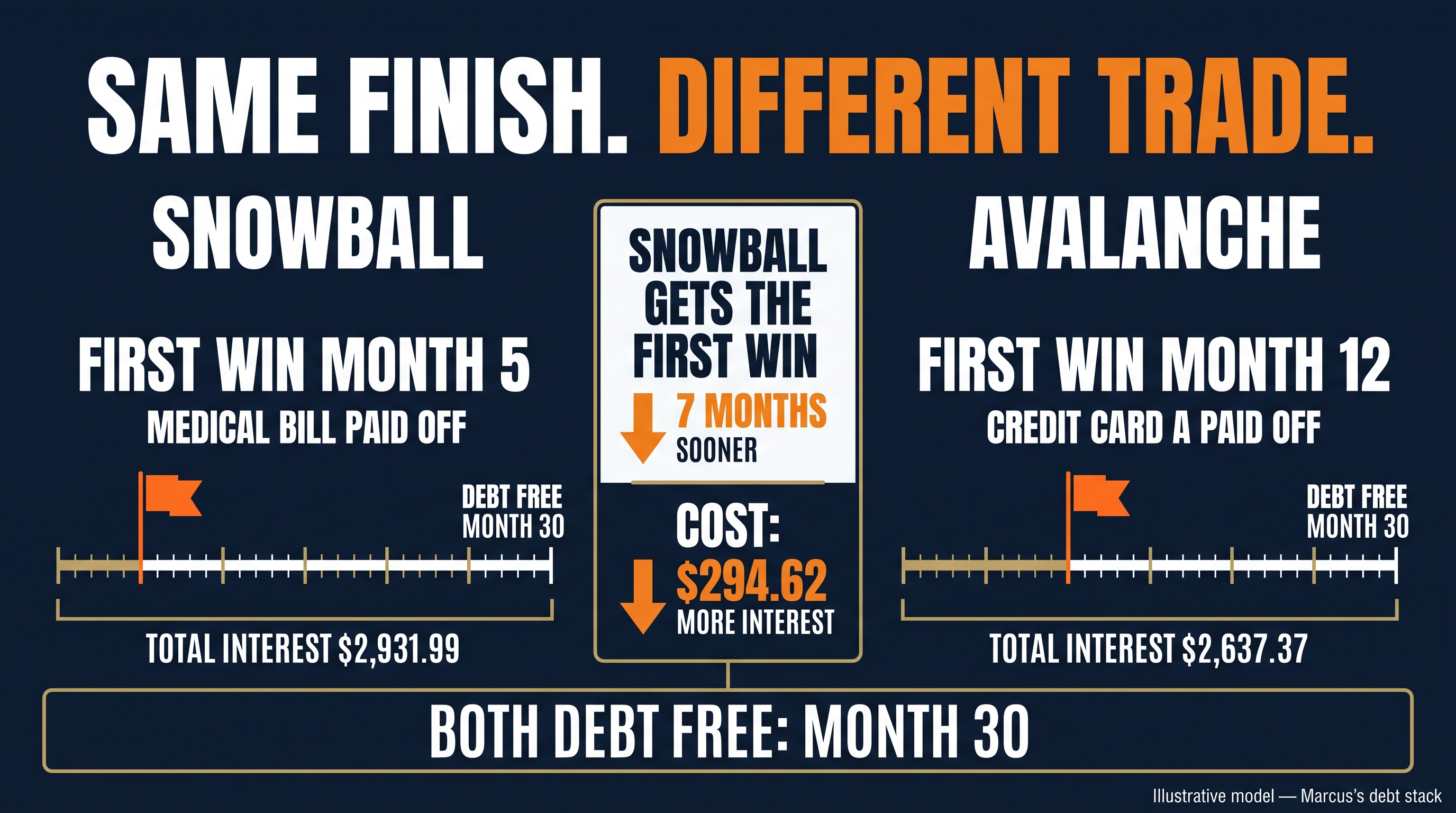
Flip it around: snowball's earlier win costs $294.62. Not free, not "basically free" — a real, calculable $294.62, priced directly against getting an account closed seven months sooner. Whether that's worth it is Marcus's call, not a math problem with one correct answer.
What Each Method Optimizes
Avalanche optimizes cost. Snowball optimizes the feedback loop.
In one controlled comparison, avalanche saved $294.62 in interest. Snowball closed the first account seven months sooner. Both finished in the same 30 months. Neither number makes the other one disappear.
The size of that cost isn't fixed — it's proportional to the interest rate on the debt snowball skips past in favor of the smaller balance. Marcus's smallest debt happens to be sitting at 0% APR, so targeting it first doesn't waste money on interest by itself — the cost comes entirely from delaying attacks on the 23.99% card for those first several months. If Marcus's smallest balance had carried a high rate instead of 0%, the price of that early win would be considerably steeper.
What the Research Actually Supports
The most direct answer comes from Ben Hamilton's 2023 paper in the Southern Economic Journal, and it's a stronger source than the behavioral research usually cited on this topic, so it leads here. Hamilton used the Federal Reserve's 2016 Survey of Consumer Finances — a large, real-world dataset of American households — to measure what snowball-consistent repayment behavior (allocating extra payments toward lower-balance debts instead of higher-rate ones) actually costs. Hamilton's finding, in the paper's own terms: the average household pays an additional 1.8% to 4.3% in interest under this pattern. Hamilton's own estimate of the aggregate cost puts this at $46.2 to $53.9 billion transferred from borrowers to lenders nationally, beyond what would occur under interest-minimizing repayment. What this study does not establish: it doesn't measure whether snowball behavior makes people more or less likely to actually finish paying off their debt, and it's observational survey data, not a controlled experiment tracking the same household under both strategies. It answers "what does this cost," not "does this work better."
On the motivation side, David Gal and Blakeley McShane's often-cited 2012 Journal of Marketing Research study is usually summarized as proof that the snowball helps people finish paying off debt. Having read the original paper directly rather than relying on summaries of it, that's not quite what it found. The data came from roughly 6,000 clients of a debt settlement firm, and the account-closing decisions in that dataset were made by the settlement firm itself — not by the individual consumers choosing a snowball or avalanche strategy for their own repayment. What the study actually found is that the fraction of accounts closed predicted a client's likelihood of eventually eliminating their debt better than the dollar amount paid down did. That's a real, useful finding about the psychology of closing accounts — but it's not a study of consumers picking snowball over avalanche, and it doesn't measure that comparison at all.
One real limitation worth stating plainly: both snowball and avalanche concentrate extra payments on a single account at a time. So even where account-concentration is shown to help, that finding supports either method over spreading payments thin across everything — it doesn't specifically favor snowball over avalanche.
On the "why concentration might feel motivating" question, a 2016 experimental study by Kettle, Trudel, Blanchard, and Häubl in the Journal of Consumer Research found that concentrating payments on one account — and visibly wiping out a larger proportion of that specific balance — creates a stronger sense of progress and motivation than the same dollar amount spread across a larger balance. This is genuine experimental evidence for the psychological mechanism behind the snowball's appeal. It measured perceived progress and motivation in controlled conditions, not real-world completion rates.
Put together: there's a real, quantified cost to snowball-consistent behavior (Hamilton), and there's a real psychological mechanism behind why people find concentrated repayment motivating (Kettle et al.). What's still genuinely unmeasured is whether that motivational benefit is large enough, for a given person, to outweigh the quantified cost. Nobody has run that experiment. Chuck isn't going to pretend otherwise.
Chuck's Decision Framework
Choose avalanche when: your extra monthly payment is enough to make meaningful progress on your highest-rate debt in a reasonable time, and you're confident you'll stick with the plan without needing an early visible win to stay motivated.
Choose snowball when: you've got a small balance — especially one at a low or 0% rate, where the cost of targeting it first is lower — and/or you've started a payoff plan before and didn't finish it.
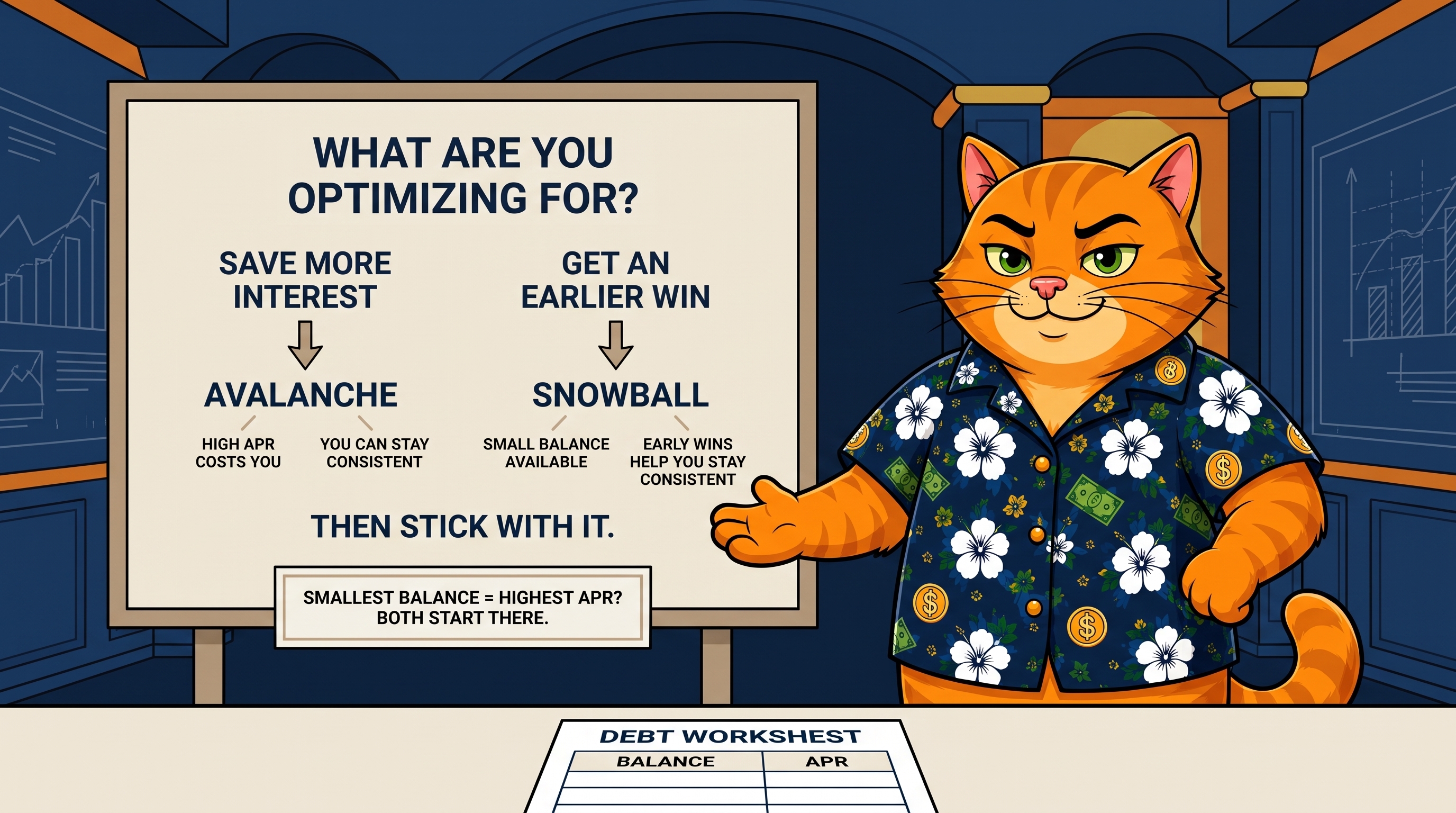
If your smallest balance and your highest rate are the same debt: both methods agree on where to start. Compare the rest of your stack — if the balance order and the rate order match all the way down, the methods are identical for you. If they diverge anywhere, use the framework above for what's left.
On a related but separate decision: these methods answer what order to attack debts you already have — whether to restructure those debts first through consolidation is a different, earlier question, and a future post's territory.
The Part Chuck Wants You To Actually Do
List every debt you have right now — balance and interest rate, side by side. Check whether your smallest balance is also your highest rate. If it is, both methods start in the same place; compare the rest of the stack to see where they'd diverge. If it isn't, look at the gap between your smallest balance's rate and your highest-rate debt's rate. That gap gives you one clue about how much the choice matters — but your balances, minimum payments, and payoff timeline matter too.
Chuck Finance is for entertainment and informational purposes only. Chuck is not a financial advisor, and nothing in this post constitutes professional financial or investment advice. All figures in this post are illustrative calculations using a hypothetical debt scenario — not a representation of any real borrower's situation or a prediction of your results. Real payoff timelines and interest costs depend on your actual balances, rates, payment amounts, and consistency, and may differ from this model if your lenders recalculate minimum payments as balances decline. Consult a licensed financial professional or a nonprofit credit counselor for advice specific to your situation.
Sources
- Board of Governors of the Federal Reserve System, Consumer Credit — G.19 release, May 12, 2026 (credit card APR context, 21.52% Q1 2026 average)
- Hamilton, B. (2023). "Two Steps Forward, One Step Back? Quantifying the Pecuniary Costs of Debt Account Aversion and the Debt Snowball." Southern Economic Journal, 89(3), 830–859. (2016 Survey of Consumer Finances; real-world interest cost of snowball-consistent behavior)
- Gal, D., & McShane, B. B. (2012). "Can Small Victories Help Win the War? Evidence from Consumer Debt Management." Journal of Marketing Research, 49, 487–501. (Read directly, not via secondary summary)
- Kettle, K. L., Trudel, R., Blanchard, S. J., & Häubl, G. (2016). "Repayment Concentration and Consumer Motivation to Get Out of Debt." Journal of Consumer Research, 43(3), 460–477.
- National Foundation for Credit Counseling — nfcc.org, verified current as of publication