Table of Contents
- What a Credit Score Actually Is
- The Credit Score Chain: Report → Model → Score
- Why Do I Have 3 Different Credit Scores?
- FICO vs. VantageScore
- What Actually Affects Your Credit Score
- Credit Utilization Is Not a 30% Cliff
- What Your Credit Score Doesn't Measure
- Checking Your Credit Before Applying
- How Sebastian's Auto Lender Uses His Score
- What Do Sebastian's 3 Credit Scores Mean?
- What You Do With This Information
- Sources
What a Credit Score Actually Is
A credit score is a numerical prediction of credit risk.
A scoring company uses information in your credit report to estimate how likely you are to repay borrowed money as agreed.
The result is a three-digit number.
That's it.
Your credit score isn't a personal-finance report card. Nobody is sitting in an office deciding whether you're responsible enough to deserve a 720.
It's a calculation.
And that distinction matters.
A credit score doesn't tell a lender how much money you have in savings. It doesn't reveal whether you're good at budgeting. It doesn't measure your financial intelligence.
It estimates credit risk using the information and rules built into a particular scoring model.
For Sebastian, that number matters because lenders can use it when evaluating his car-loan application and determining what terms to offer.
But before he can understand why his dealership shows 688 instead of 712, he needs to understand where those numbers come from.
The Credit Score Chain: Report → Model → Score
Here's the framework I want you to remember:
CREDIT REPORT → SCORING MODEL → CREDIT SCORE
Three pieces. Three different jobs.
1. Your credit report is the underlying record.
Credit reports contain information about your credit accounts, payment history, outstanding balances, account statuses, and other reported credit activity.
In the United States, three nationwide credit bureaus maintain separate credit files:
- Equifax
- Experian
- TransUnion
Not every creditor reports to every bureau. Information can also arrive at different times.
That means your three reports may not contain identical information on the same day.
2. A scoring model reads that information.
Companies such as FICO (Fair Isaac Corporation) and VantageScore develop mathematical models that evaluate credit-report data.
Different models can weigh information differently.
3. The model produces a credit score.
That's the number Sebastian sees.
Think of the credit report as the ingredients, the scoring model as the recipe, and the credit score as what comes out of the oven.
Change the ingredients or the recipe, and the result can change.
Sebastian's bank app and the dealership don't necessarily use the same ingredients or recipe.
And that brings us to his three numbers.
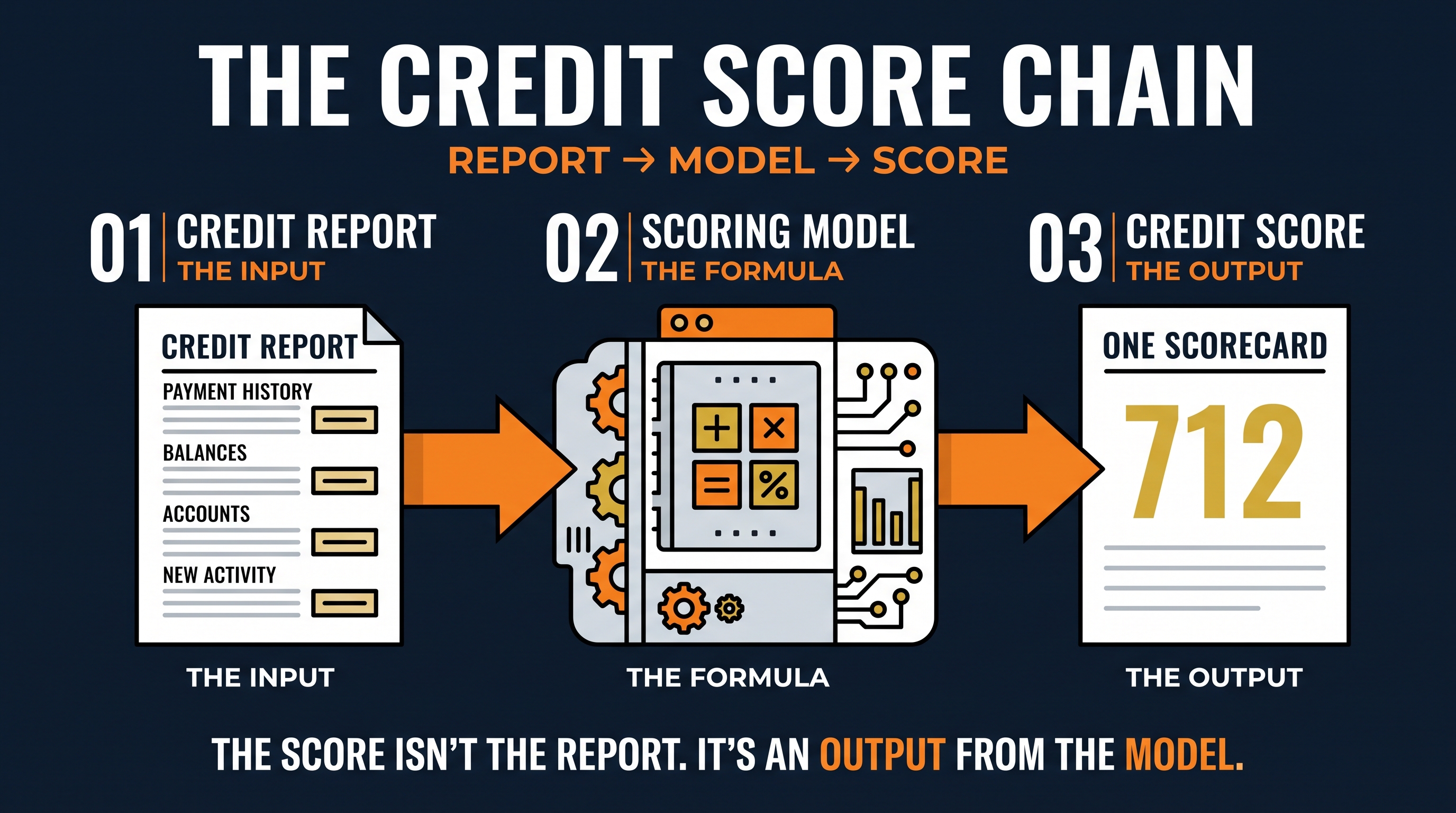
The Credit Score Chain
Credit report → scoring model → credit score
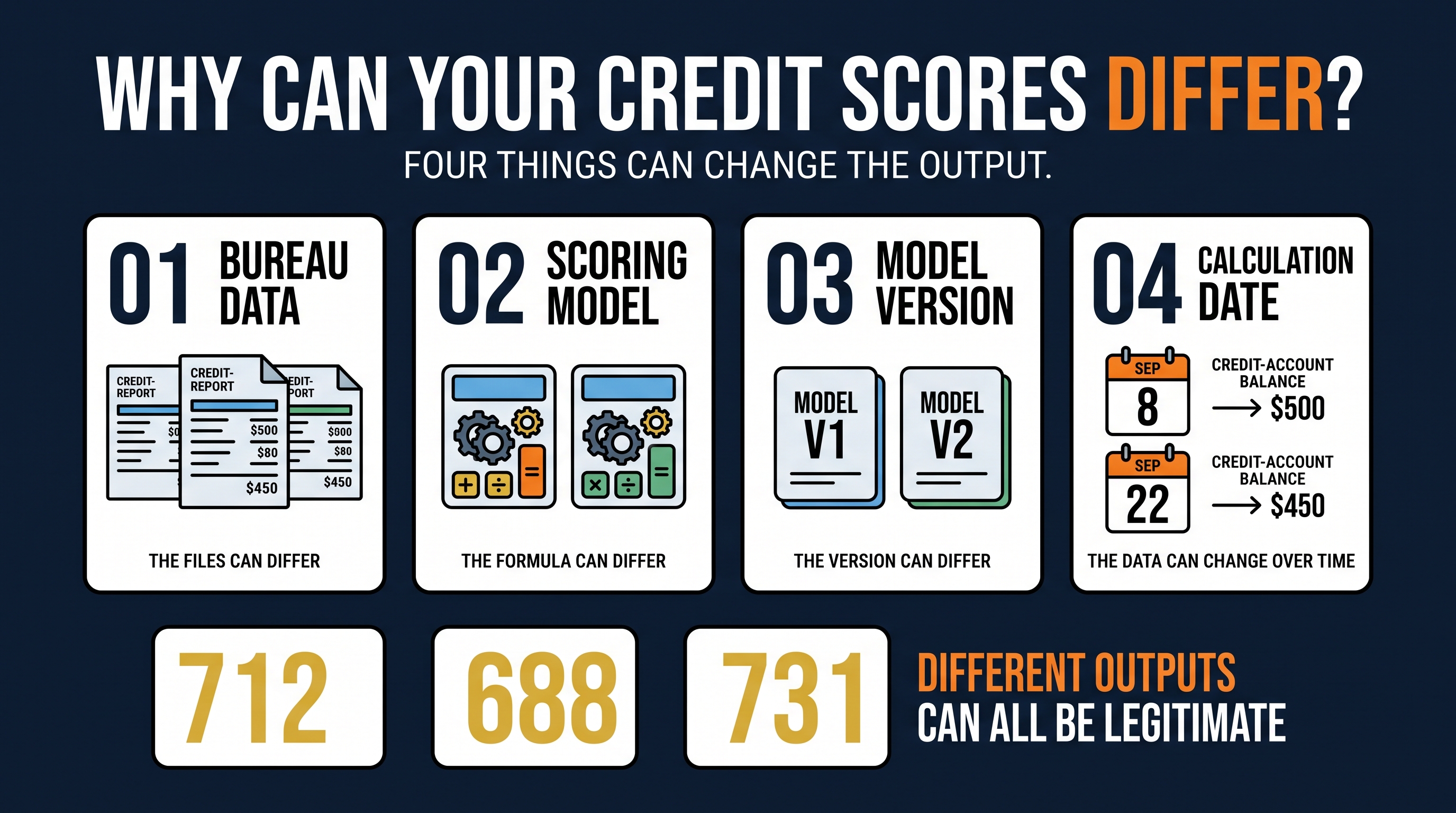
Sebastian's 712, 688, and 731 can all be legitimate because the report data, scoring model, version, or calculation date may differ.
Why Do I Have 3 Different Credit Scores?
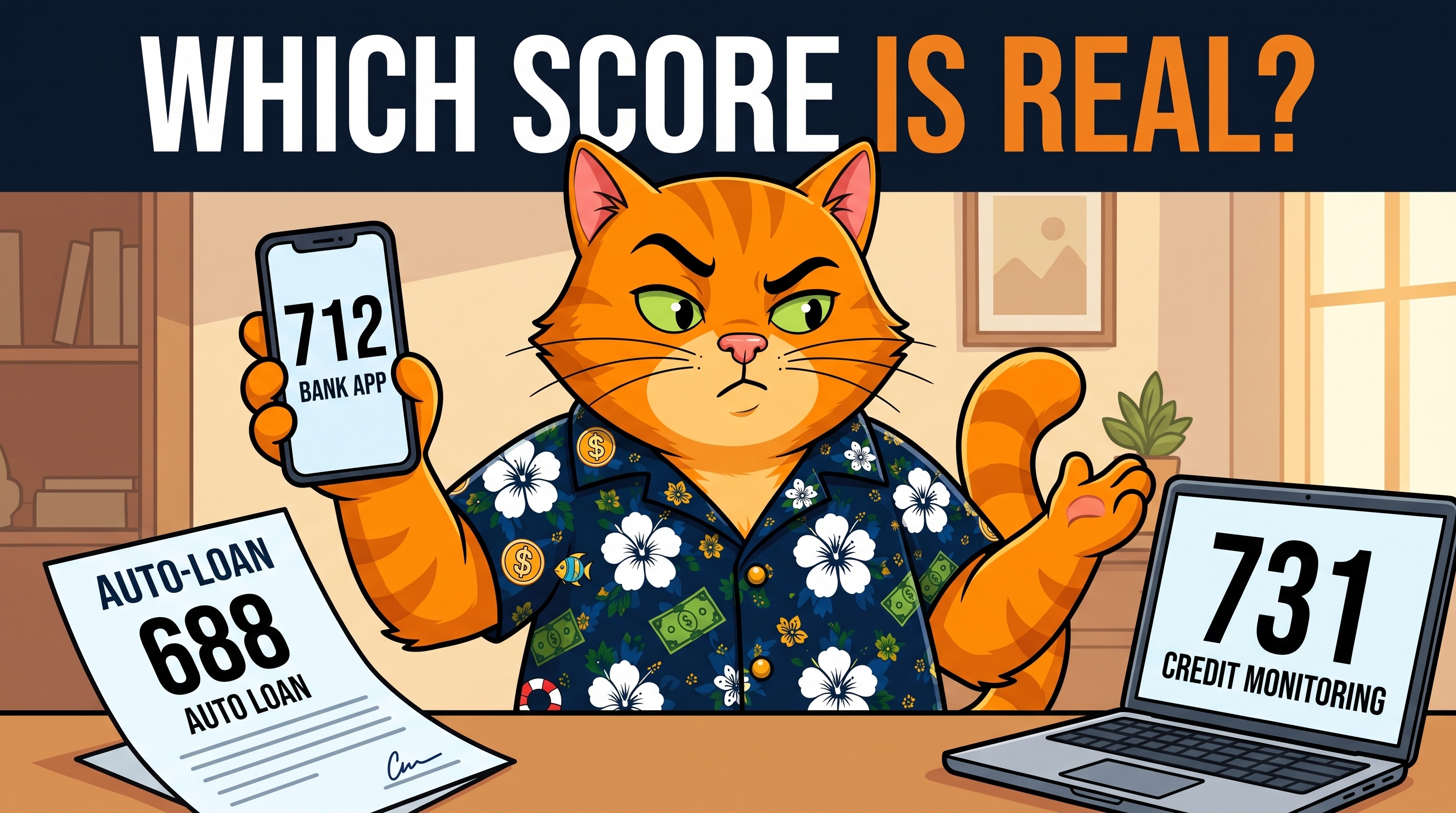
Sebastian has:
- 712 from his banking app.
- 688 from the auto dealership.
- 731 from a credit-monitoring service.
Which one is his real score?
Potentially all three.
The Consumer Financial Protection Bureau explains that consumers can have multiple credit scores.
There are four major reasons.
1. Different credit bureaus
Sebastian's bank app might use information from TransUnion.
His auto lender might use Experian.
His monitoring service might use Equifax.
Those files may contain slightly different balances, accounts, or reporting updates.
Different inputs can produce different scores.
2. Different scoring models
One service might use a FICO Score.
Another might use VantageScore.
Both are legitimate scoring systems, but they don't use identical formulas.
3. Different model versions
There isn't just one FICO model.
FICO has general-purpose scoring models and specialized versions designed for particular types of lending, including auto loans.
VantageScore also has multiple model generations.
Sebastian's dealership could be using a FICO Auto Score while his banking app displays a general-purpose score.
That doesn't mean the dealership is manipulating the number.
It means the lender may be asking a different model to evaluate his credit history.
4. Different calculation dates
Credit reports change.
Creditors report payments, balances, and account updates throughout the month.
If Sebastian's credit card balance was updated between two score calculations, the underlying information could be different.
Even the same scoring model using the same bureau can produce a different number when the report changes.
Different scores do not automatically mean something is wrong.
And without knowing the bureau, model, version, and calculation date for Sebastian's three scores, we shouldn't pretend to know exactly why they differ.
The useful question is no longer, "Which number is real?"
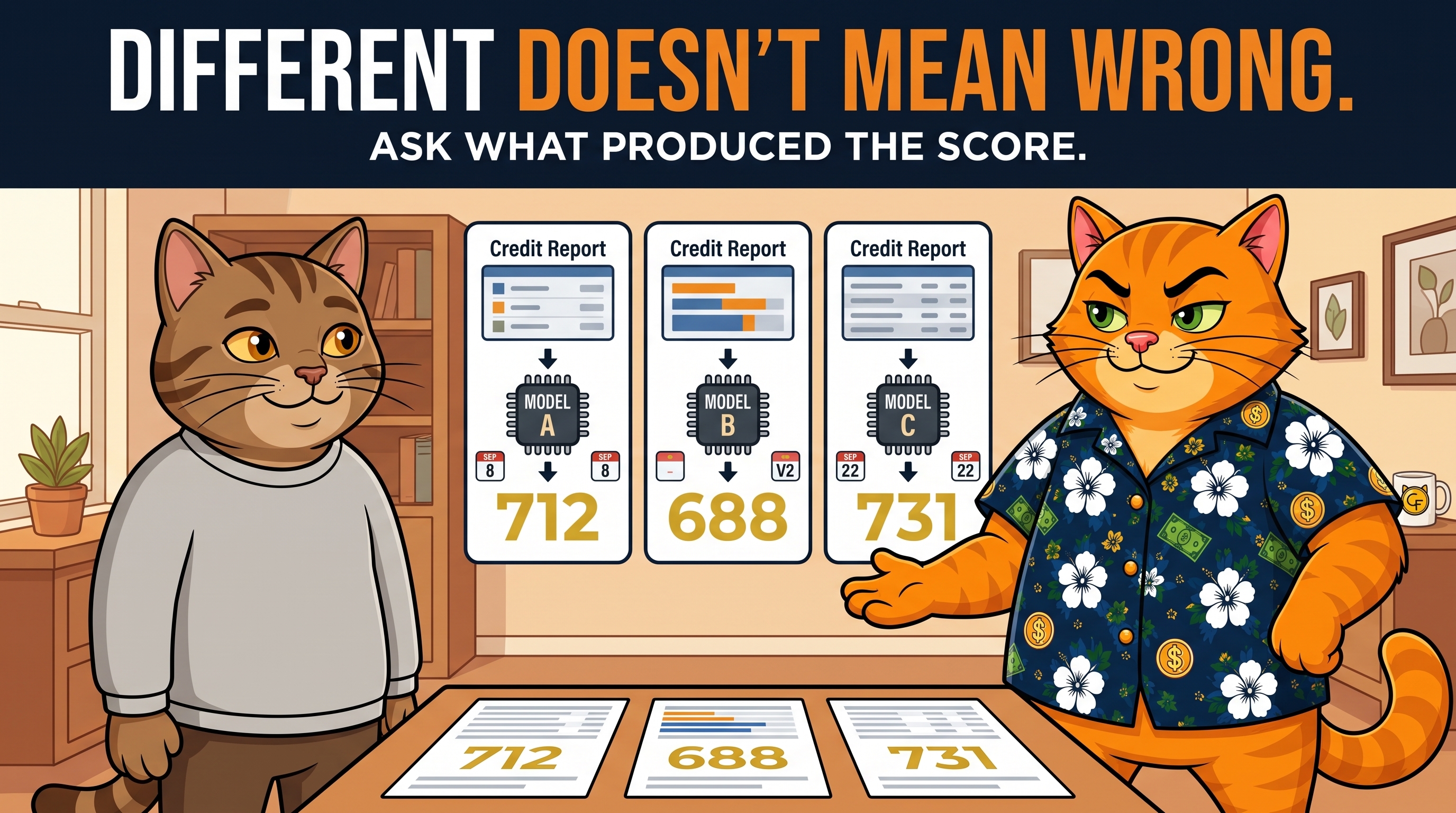
It's, "Which number am I looking at, and what produced it?"
FICO vs. VantageScore
You've probably heard of FICO.
You may have also seen VantageScore mentioned in a credit-monitoring app.
Both are credit-scoring systems.
FICO develops scoring models used by lenders across different types of credit products. Its general-purpose scores typically range from 300 to 850. Certain industry-specific models use different ranges.
VantageScore was established by the three nationwide credit bureaus and develops its own scoring models. Its widely used modern models also use a 300-to-850 range.
The important difference isn't which name sounds more official.
It's which model the lender actually uses.
A free app might display a VantageScore, while the lender evaluating Sebastian's auto application uses a FICO Auto Score.
Neither number is automatically fake.
But the free score may not match the one the lender uses.
That's why comparing a 712 FICO Score with a 731 VantageScore isn't necessarily an apples-to-apples comparison.
You can't reliably translate one into the other by adding or subtracting a fixed number of points.
For Sebastian, the dealership's 688 deserves attention because it may be relevant to his loan application.
But it doesn't erase the legitimacy of the other two scores.
The score you're monitoring and the score a lender uses can be different.
What Actually Affects Your Credit Score
Now that Sebastian understands why his numbers differ, he wants to know something more useful:
What can he actually do about his credit?
FICO publishes five major categories used in its general-purpose scoring framework.
| Category | Published FICO weighting | What it generally measures |
|---|---|---|
| Payment history | 35% | Whether credit obligations have been paid as agreed |
| Amounts owed | 30% | Outstanding debt and revolving credit usage |
| Length of credit history | 15% | How long credit accounts have been established |
| New credit | 10% | Recent credit applications and new accounts |
| Credit mix | 10% | Experience with different types of credit |
These percentages are useful for understanding the model.
They are not a point calculator.
FICO explains that the importance of individual categories can vary depending on a person's overall credit profile.
So don't assume paying off $1,000 of debt will automatically raise your score by a particular number.
Nobody can responsibly promise that.
Payment history
Payment history is the largest category in FICO's published framework.
If Sebastian has a history of paying his accounts as agreed, that's generally favorable.
Late payments and other negative payment information can hurt his score.
And there's an important difference between paying only the required minimum and missing a payment.
Paying the minimum on time generally satisfies that month's payment obligation, although carrying a balance can create interest costs and affect credit utilization.
Paying late is a separate credit-reporting and payment-history problem.
Those aren't interchangeable mistakes.
Amounts owed
This category considers several aspects of debt, including revolving credit utilization.
If Sebastian has high reported credit card balances relative to his limits, that may affect his scores.
Paying balances down can help his credit profile, although the size and timing of any score change depend on the model and his overall file.
Length of credit history
Older accounts can contribute to a longer credit history.
That doesn't mean Sebastian should keep every credit account open forever.
It means account age is one factor in a larger calculation.
New credit
When Sebastian applies for an auto loan, the lender may make a hard inquiry.
Hard inquiries can affect scores, but their treatment varies by scoring model.
Opening several new accounts can also change the information the model evaluates.
Credit mix
Scoring models may consider experience with different types of credit.
But here's something I don't want Sebastian doing:
Taking out a loan he doesn't need just to improve his credit mix.
Paying unnecessary interest to chase a possible scoring benefit is a poor trade.
The categories help explain how credit scores work. They aren't instructions to manufacture debt.
Credit Utilization Is Not a 30% Cliff
You've probably heard this advice:
"Keep your credit utilization under 30%."
It's not completely useless.
But people repeat it as though 30% is a magical dividing line.
It isn't.
Credit utilization measures how much of your available revolving credit you're using.
Suppose Sebastian has a credit card with a $10,000 limit.
If the balance reported to the credit bureau is $2,000, his utilization on that card is:
$2,000 ÷ $10,000 = 20%
Now suppose his reported balance rises to $3,100.
His utilization becomes 31%.
Does his credit score automatically fall off a cliff because he crossed 30%?
No.
FICO has explained that 30% is not a magic threshold where scoring suddenly changes from good to bad.
Generally, lower revolving utilization is more favorable, but the effect depends on the model and the rest of the credit profile.
That means:
- 29% isn't automatically safe.
- 31% isn't automatically disastrous.
- Lower utilization doesn't guarantee a specific score.
Sebastian should pay attention to reported credit card balances, especially before applying for financing.
But he shouldn't treat 30% like a traffic light that instantly changes from green to red.
And he shouldn't carry interest-bearing credit card debt because someone told him maintaining a balance helps his score.
You do not need to pay credit card interest to build credit.
One more consideration: closing a credit card can reduce available revolving credit, potentially increasing utilization if other balances remain.
That's why closing an account deserves more thought than simply asking whether you still use the card.
What Your Credit Score Doesn't Measure
Sebastian's dealership sees a credit score.
It doesn't see his entire financial life inside that number.
Traditional FICO Scores don't directly include information such as his salary, occupation, employer, or savings balance.
They also don't use protected personal characteristics such as race, religion, or sex as scoring inputs.
A traditional credit score is calculated from credit-report information.
That distinction matters because the lender's full application decision is broader than the score.
Sebastian might have a solid credit score but insufficient income for the loan payment he's requesting.
Or he might have a lower score while still qualifying for financing based on the lender's underwriting criteria.
The lender can consider additional information, including income, existing debts, loan amount, and collateral.
A credit score is one input into that decision.
Not the entire decision.
Ordinary debit-card purchases also aren't credit-card utilization. Spending money directly from a checking account doesn't automatically create the kind of revolving credit history that a traditional credit score evaluates.
Some specialized financial products may report credit activity differently, so the account structure matters.
The larger point is simple:
Your credit score measures something narrower than your financial health.
A person can have a high credit score and poor savings habits.
Another can have substantial savings and a limited credit history.
Those are different financial characteristics.
Checking Your Credit Before Applying
Back to Sebastian.
He's shopping for a car loan, and he's understandably concerned about the dealership's 688.
What should he do?
First, he should look at his underlying credit reports.
Checking your own credit report does not hurt your credit score.
That's a soft inquiry.
A hard inquiry generally occurs when a lender checks your credit as part of an application for new credit.
Hard inquiries can affect scores, but checking your own report doesn't create that problem.
Where to get your reports
The official website is:
It's the federally authorized source for free credit reports from the three nationwide credit bureaus.
Free weekly online reports are currently available through the site.
Sebastian can review his Equifax, Experian, and TransUnion reports.
And here's what he's looking for:
- Credit accounts he doesn't recognize.
- Incorrect balances or account statuses.
- Payments incorrectly reported as late.
- Accounts that should be closed but are reported inaccurately.
- Other information that doesn't match his records.
If he finds an error, he can dispute it through the appropriate credit bureau and, where applicable, the company that supplied the information.
But he shouldn't assume an error exists simply because his scores differ.
A different score isn't proof of an inaccurate report.
What about shopping for multiple auto loans?
Sebastian also wants to compare financing offers.
He doesn't want to accept the dealership's first loan just because he's worried about another credit inquiry.
Many scoring models recognize that consumers shop around for auto loans.
Qualifying inquiries made within a model-specific shopping window may be treated as a single inquiry for scoring purposes.
The exact window and treatment depend on the model.
That means Sebastian should compare offers within a reasonably concentrated shopping period rather than avoiding comparisons altogether.
He still needs to understand that inquiries can appear on his reports, and that scoring treatment isn't identical across every model.
But fear of a second inquiry shouldn't automatically stop him from comparing the total cost of borrowing.
How Sebastian's Auto Lender Uses His Score
Now Sebastian understands why the dealership's score might differ from his banking app.
But he still needs to buy a car.
And the dealership has offered financing.
Here's where the score becomes a practical money decision.
A lender may use Sebastian's credit score as part of evaluating his application and setting loan terms.
But the lender can also consider his income, debts, requested loan amount, and other underwriting information.
Two borrowers with different credit profiles might receive different rates.
And two lenders might offer Sebastian different terms even when evaluating the same application.
So instead of obsessing over whether 688 or 712 is his "true" number, Sebastian needs to compare actual financing offers.
Let's use a hypothetical example.
He's considering financing $20,000 for 60 months. That's the loan amount and term; the offers differ by annual percentage rate (APR).
| Loan offer | APR | Approx. monthly payment | Approx. total interest |
|---|---|---|---|
| Offer A | 7% | $396 | $3,761 |
| Offer B | 10% | $425 | $5,496 |
These are illustrative fixed-rate, fully amortizing loans with monthly payments, no additional financed fees, and no early payoff. The APRs are assumed to equal the stated borrowing rates for this example.
The difference is approximately $29 per month.
Over five years, that's about $1,735 more interest with Offer B.
Now we're talking about real money.
But here's the critical distinction:
I'm not claiming Sebastian's 688 automatically qualifies him for 10%, or that his 712 would qualify him for 7%.
Credit scores don't translate into universal interest-rate tables.
The offers illustrate why the actual loan terms matter more than trying to identify one perfect score.
Sebastian should compare the APR, loan term, amount financed, monthly payment, and total cost.
A lower monthly payment isn't necessarily a better deal if it comes from stretching the loan over additional years.
And a higher credit score doesn't guarantee approval or a particular rate.
The score informs the lender's risk assessment.
The loan offer tells Sebastian what borrowing will actually cost him.
That's the number he needs before signing.
What Do Sebastian's 3 Credit Scores Mean?
Sebastian started with three credit scores.
712. 688. 731.
He assumed one must be correct and the others must be wrong.
Now he understands the machinery.
Different credit bureaus, scoring models, versions, and calculation dates can produce different legitimate scores.
So he checks his credit reports.
He looks for inaccurate accounts, balances, and payment information.
He also checks what scoring model the dealership used, if that information is available.
Then he compares financing offers rather than assuming the dealership's first offer is the best one.
He's no longer trying to make all three scores match.
He's trying to make an informed borrowing decision.
And that's a much more useful goal.
REPORT → MODEL → SCORE
Sebastian can't choose the model every lender uses.
But he can review his reports, dispute inaccurate information, maintain responsible credit habits, and compare the loan terms available to him.
His 688 didn't automatically mean his bank's 712 was wrong.
And his monitoring service's 731 didn't guarantee he'd receive better financing.
They were three potentially legitimate outputs.
What matters now is understanding the information behind them and the actual terms of the loan he's considering.
What You Do With This Information
If you've been checking your credit score and wondering why the number changes between apps, start with the underlying information.
Go to AnnualCreditReport.com and request your credit reports.
Check whether the accounts, balances, payment histories, and statuses are accurate.
Then, when you see a credit score in an app or from a lender, look for the scoring model, bureau, version, and calculation date when available.
If you're preparing to apply for a loan, don't assume the free score on your phone is the exact score the lender will use.
And don't chase a particular score by opening unnecessary accounts, carrying interest-bearing balances, or relying on promises of guaranteed point increases.
Focus on accurate reports, payments made as agreed, manageable credit usage, and comparing actual borrowing terms.
Your credit score isn't a verdict. It's an output.
The number matters.
Understanding where it came from—and what you do with that information—matters more.
Sources
- Consumer Financial Protection Bureau — What is a credit score?
- Consumer Financial Protection Bureau — What is a credit report?
- Consumer Financial Protection Bureau — Credit report vs. credit score
- Consumer Financial Protection Bureau — What is a credit inquiry?
- Consumer Financial Protection Bureau — Does requesting my credit report hurt my credit score?
- Federal Trade Commission — Free Credit Reports
- myFICO — What's in my FICO Scores?
- myFICO — FICO Score Versions
- myFICO — How FICO Scores Look at Credit Card Limits
- myFICO — What's Not in My FICO Scores
- VantageScore — Why Are Each of My Credit Scores Different?
- VantageScore — How Credit Scores Work
- VantageScore — Consumer FAQs
Calculation note: Sebastian's credit scores and car-loan offers are hypothetical. The payment examples assume a $20,000 loan repaid in 60 equal monthly payments at fixed annual rates of 7% and 10%, with no additional fees. Figures are rounded.
Chuck Finance is for entertainment and informational purposes only. Chuck is not a licensed financial advisor, and nothing in this post constitutes professional financial, investment, legal, or tax advice. Always consult a qualified professional before making financial decisions.