First, What Does 0% APR Actually Cover?
APR stands for annual percentage rate. A true 0% introductory APR means the issuer doesn't charge interest on the eligible balance during the promotional period, provided the offer's terms are met.
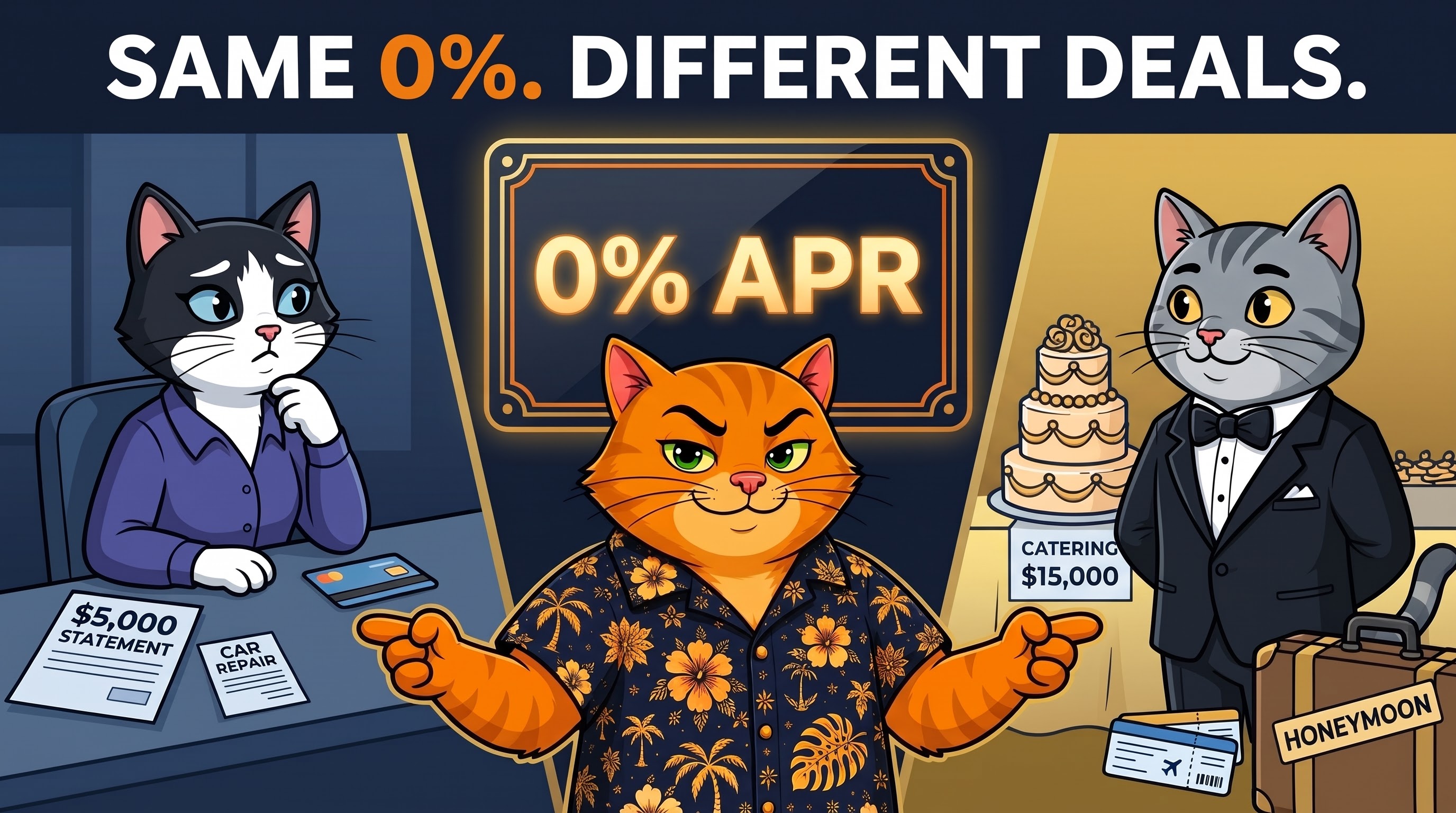
But check the fine print. Some offers apply to balance transfers—debt moved from another card. Others apply to new purchases. Some cover both. A 0% balance-transfer offer doesn't automatically make new purchases interest-free.
And when the promotion ends, any unpaid balance generally starts accruing interest at the card's regular APR. The clock matters.
Maya: Can a Balance Transfer Help Her Get Ahead?
Maya had just gotten home from a much-needed vacation when her car started making a noise no car owner wants to hear.
The repair couldn't wait. Unfortunately, neither could the credit card bill.
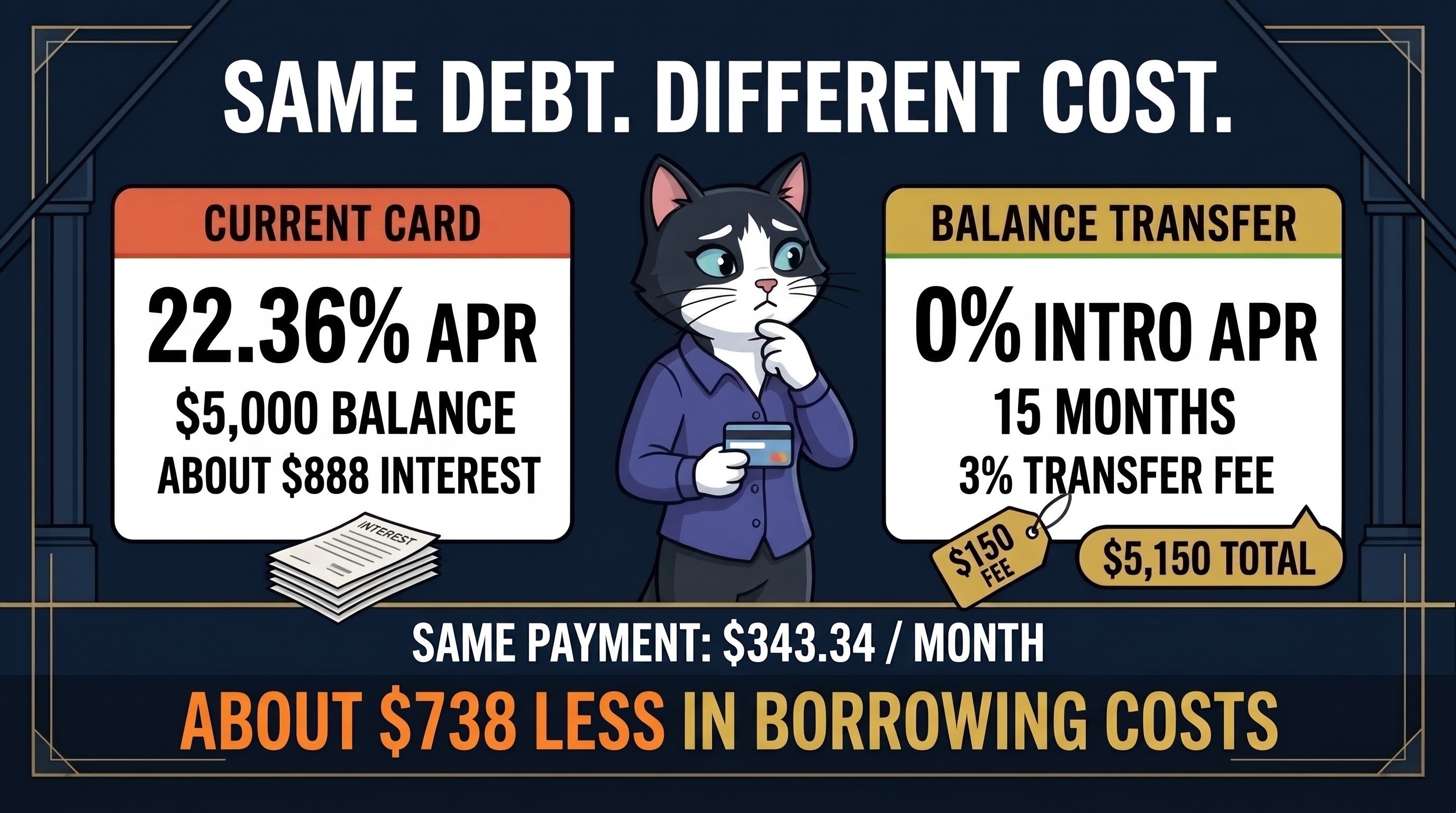
Between her vacation expenses and the unexpected repairs, Maya was staring at a $5,000 balance on a card charging 22.36% APR. She was making her payments, but the interest was eating into her progress.
Then she spotted a balance transfer offer: 0% APR for 15 months, with a 3% transfer fee.
For the first time in months, Maya saw a way to get ahead of the interest instead of chasing it.
But would moving the debt actually save her money? Moving the balance won't erase it. The numbers will tell her whether it helps.
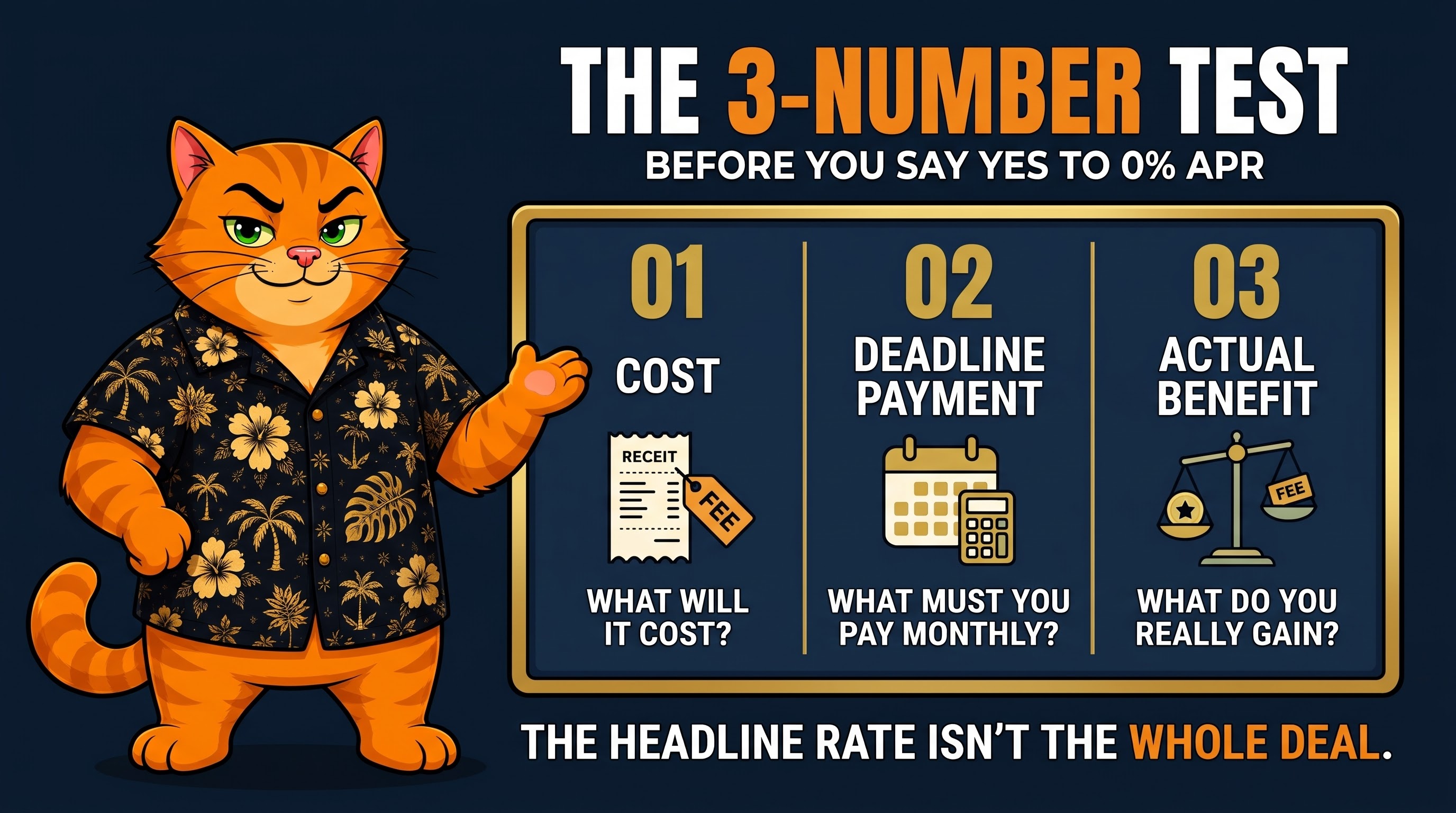
Maya's 3-Number Test
| The number | Maya's math | Result |
|---|---|---|
| 1. What does the deal cost? | $5,000 × 3% transfer fee | $150 |
| 2. What's the deadline payment? | ($5,000 + $150) ÷ 15 months | $343.34/month |
| 3. What could she save? | Interest on the old card if she pays $343.34/month instead | About $888 |
If the fee is added to her transferred balance, Maya would owe $5,150 on the new card. Paying $343.34 each month for 15 months would clear it, assuming no other charges or fees.
What if she skips the transfer and pays that same $343.34 toward her old card? At 22.36% APR, she'd pay roughly $888 in interest before paying it off in about 18 months.
With the transfer, her borrowing cost in this simplified example is the $150 fee. That's roughly $738 less than the interest she'd pay by staying put.
Calculation note: The old-card comparison uses APR ÷ 12, monthly interest on the declining balance, and a smaller final payment. Actual issuers generally calculate interest using daily balances, so statement totals will differ.
That sounds promising. Now comes the question I care about most:
Can Maya actually spare $343.34 every month?
She's also rebuilding her savings after the car repair. If the payment only works when nothing else goes wrong, the plan may be too tight.
How the transfer could hurt Maya
A transfer can still save money even if she doesn't finish by month 15. But the leftover balance will generally start accruing interest at the new card's regular APR, which could be higher than her old rate. She'd need to compare all the costs, not just the first 15 months.
She also has to watch for an insufficient credit limit, the possibility that the fee uses part of her available credit, and the temptation to use her newly cleared old card again. The transfer doesn't fix her debt if she immediately builds another balance.
And Maya should check when the promotional clock starts. A 15-month offer doesn't necessarily mean 15 months after the transfer posts.
Her decision isn't simply "0% is better than 22.36%." It's whether the fee buys enough savings at a payment she can sustain.
Jerry: Can a Wedding Bill Pay for Part of His Honeymoon?
Jerry is planning his wedding. The caterer's bill is $15,000, and he has an idea.
A new travel rewards card advertises 0% introductory APR on purchases for 15 months, plus 4X points on eligible dining and a welcome bonus for spending at least $3,000 in the first three months.
Jerry wants to charge the catering bill, collect the points, and use them toward his honeymoon. He's comfortable budgeting $1,000 a month, so he figures the bill will be gone in 15 months.
I like that Jerry has a payoff plan. But I want him to check the offer before counting a single point.
Jerry's 3-Number Test
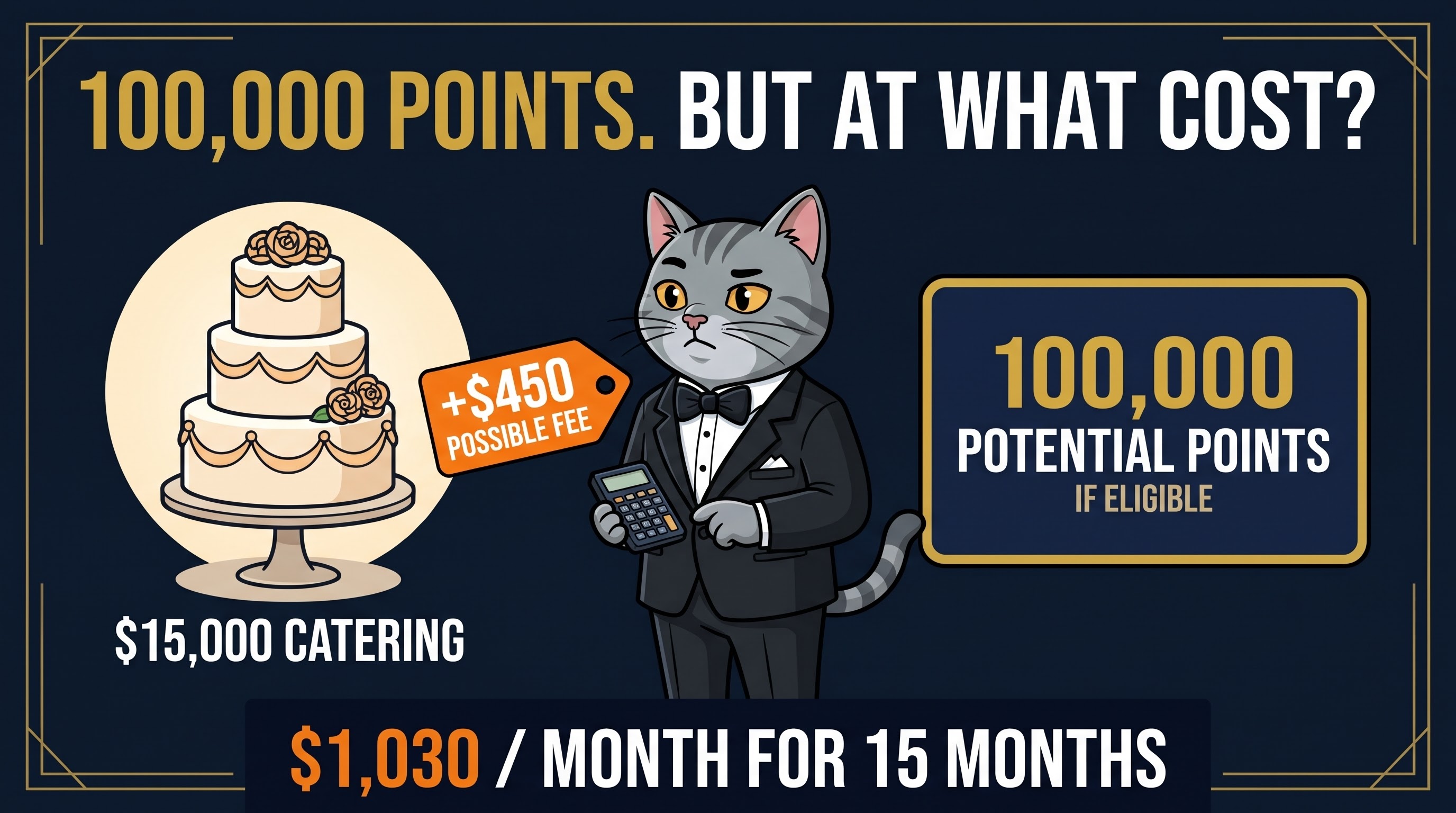
The offer Jerry is considering promises four points per dollar on qualifying dining and a 40,000-point welcome bonus if he meets the spending requirement. Run the same test: $15,000 catering, a possible surcharge, and 100,000 points on the table — but only if every condition holds.
That's 100,000 points only if the entire catering charge qualifies for 4X and Jerry earns the welcome bonus.
Here's the catch: a caterer isn't automatically classified as dining by a card issuer's rewards system. Merchant category codes determine eligibility, and a catering business may code differently from a restaurant. Jerry needs to confirm the category and the card's actual terms; he shouldn't assume the bill earns 4X.
The welcome bonus also has eligibility rules, deadlines, and exclusions. Spending $15,000 doesn't guarantee approval, the bonus, or even a high enough credit limit to make the charge.
And 100,000 points are not automatically worth $1,000. Their value depends on the rewards program and how Jerry redeems them. Flights, hotels, transfers to travel partners, and cash-like redemptions can produce very different values.
The fee that could spoil the honeymoon math
Suppose the caterer adds a 3% credit card surcharge.
On $15,000, that's $450.
If Jerry charges that surcharge too, his balance becomes $15,450, and paying it off over 15 months requires $1,030 a month, not $1,000. The surcharge might not earn bonus-category rewards, either.
Now he needs to compare the actual value of the points he expects to redeem with the surcharge, any annual fee, and any other costs. If paying the caterer another way avoids the fee, that's his real alternative.
Jerry's $1,000 plan works only if the financed balance stays at $15,000 and the promotional period covers the whole payoff schedule. I'd want him to pay a little ahead of the deadline rather than rely on the final day.
What about his credit score?
Jerry expects a credit-score hit from the application and the large balance. He's comfortable with that because he has a history of managing credit well.
That's his choice, but a big drop isn't guaranteed—and neither is a quick recovery. A hard inquiry, new account, and high reported utilization can affect his score differently depending on his credit profile, the credit limit, and how the balance reports. Paying the balance down may help utilization, but nobody can promise how quickly his score will recover.
The 3-Number Test
Compare the upfront cost, the payment needed before the deadline, and the financial benefit after costs.
For transfers: fee, deadline payment, interest avoided. For purchases: transaction costs, deadline payment, net rewards or interest savings.
If Jerry plans to apply for a mortgage or another major loan soon, the timing deserves extra thought.
Jerry's lesson: the interest-free months give him room to pay down the bill, and the rewards could help with the honeymoon. Neither benefit makes the $15,000 obligation disappear.
When the 0% Offer Isn't Worth It
Maya and Jerry have different goals, but a few warning signs apply to both.
The costs swallow the benefit. If Maya would pay off her old balance in a month or two, a transfer fee might exceed the interest she'd avoid. If Jerry's surcharge and annual fee cost more than the rewards are worth to him, the points aren't much of a prize.
The payment doesn't fit. The minimum payment printed on a statement is usually not the amount needed to clear a promotional balance by the deadline. Calculate your own target.
The offer encourages more spending. Maya doesn't need another growing balance. Jerry shouldn't add wedding extras just to earn more points.
The regular APR catches you by surprise. A true 0% APR promotion doesn't normally charge interest retroactively on the promotional balance. But any amount left when it ends generally starts accruing interest at the regular rate.
You mistake deferred interest for 0% APR. An offer saying "no interest if paid in full" may be deferred interest. If you don't satisfy its conditions, interest that accumulated during the promotional period can be charged retroactively. That's a very different deal. The CFPB explains the distinction here.
Late payments can also mean fees and other consequences. Federal rules limit when issuers can raise certain promotional APRs, but they don't make missed payments harmless. Set up at least the minimum payment automatically, then separately schedule the amount needed for your payoff goal.
Before You Apply, Run Your Own 3-Number Test
For a balance transfer like Maya's:
- Cost: What's the transfer fee, including any minimum fee?
- Payment: How much must you pay each month to clear the transferred balance before the promotion ends?
- Benefit: How much interest would you otherwise pay on your current card at that same payment amount? Is the difference worth the fee and any remaining risks?
For a new-purchase rewards offer like Jerry's:
- Cost: Are there merchant surcharges, annual fees, or other costs?
- Payment: Can you clear the entire financed amount before the promotional deadline?
- Benefit: What rewards will you actually qualify for, and what are they realistically worth when you use them?
For either offer, confirm that the 0% APR applies to the transaction you're planning, check the regular APR, and read the terms before applying.
If you need help building the monthly payoff plan, see How to Pay Off Credit Card Debt. For the mechanics behind Maya's interest charges, see How Does Credit Card Interest Work?.
So, Is a 0% APR Credit Card Worth It?
Maya wants to stop losing money to interest. Jerry wants to earn points toward his honeymoon while giving himself 15 interest-free months to comfortably pay off the catering bill.
Neither needs me to tell them which card to open.
Maya needs to know whether the transfer fee buys her meaningful savings without stretching her budget too thin. Jerry needs to know whether the rewards are worth the costs, whether the catering bill qualifies for those points, and whether his $1,000 monthly payment will clear the balance before the promotion ends.
A 0% offer can be a useful financial tool. But the value isn't just in the big 0% printed on the advertisement. It's in what you can accomplish during those interest-free months.
The rate gets your attention. The three numbers tell you whether the deal deserves it.

Chuck Finance is for entertainment and informational purposes only. I'm a personal finance enthusiast, not a licensed financial advisor. This article is educational, not individualized financial, legal, or tax advice. Maya, Jerry, and their offers are fictional; no card or issuer is endorsed. Check current card terms and consult a qualified professional when appropriate.
Sources and calculation notes
- Federal Reserve, G.19 Consumer Credit, October 7, 2026 release: August 2026 rate of 22.36% for commercial-bank credit card accounts assessed interest.
- CFPB, promotional financing and deferred interest: distinctions between true 0% APR and deferred-interest offers.
- CFPB, Regulation Z § 1026.55: limitations and exceptions relating to APR increases.
- CFPB, credit card contract definitions: separate balance categories and promotional rates.
All card offers, rewards rates, welcome-bonus amounts, fees, credit limits, and character circumstances are hypothetical unless specifically identified as published data. Maya's old-card interest uses a simplified monthly calculation rather than issuer-specific daily-balance calculations. Actual rewards depend on merchant coding, issuer terms, eligibility, and redemption choices.