
Table of Contents
- What the $95 Actually Buys
- The Cleanest Test: One Checked Bag
- What the Card Asks You to Do
- The Companion Fare Is an Option, Not a Baseline
- Everything Else Counts Only If You'd Use It
- Why I Keep It—and Who Should Skip It
- What You Do With This Information
- Run Your Own $95 Test
This post isn't sponsored by Alaska Airlines or Bank of America, and Chuck Finance is not an affiliate of either company.
What the $95 Actually Buys
Bank of America currently lists these benefits for the Atmos Rewards Ascent card:
- Companion fare: Starting at $99 plus taxes and fees (from $122 all-in), after $6,000 or more in purchases in the prior anniversary year.
- Free checked bag: For you and up to six guests on the same reservation when you pay for the flight with the card, subject to benefit terms.
- Preferred boarding: For you and up to six guests on the same reservation when you pay for the flight with the card, subject to benefit terms.
- 20% inflight rebate.
- $100 discount on an Alaska Lounge+ membership.
- Points on purchases: Three, two, or one point per dollar, depending on the category.
- 10% points bonus with an eligible Bank of America account.
That's a substantial menu. But a menu isn't a savings statement.
I'm not counting the welcome offer in this decision. A one-time bonus doesn't answer whether an annual fee makes sense year after year.
The Cleanest Test: One Checked Bag
The checked-bag benefit is where this gets concrete.
Alaska Airlines lists a $45 first-checked-bag fee for most applicable routes as of October 14, 2026. For travel within Hawaiʻi, it's $30.
At $45 per bag charge, here's how quickly otherwise-paid fees can cover the $95 annual fee:
| First-bag charges avoided | Fees avoided | After the $95 annual fee |
|---|---|---|
| One | $45 | −$50 |
| Two | $90 | −$5 |
| Three | $135 | +$40 |
| Four | $180 | +$85 |
Three $45 charges cover the annual fee. Two don't quite get there.
A checked bag on a round trip generally means a charge in each direction. One round trip with one bag each way would ordinarily mean two $45 charges, or $90. A second comparable round trip would push the avoided fees beyond $95.
For travel within Hawaiʻi, the math is different: $95 ÷ $30 = 3.17, so you'd need four otherwise-paid $30 charges.
This is why the benefit matters to me. I have flown Alaska Airlines on many trips and checked bags. I haven't kept a formal tally of every bag fee I've avoided, so I'm not going to claim a precise annual savings figure. But I believe the benefit has covered my fee over time.
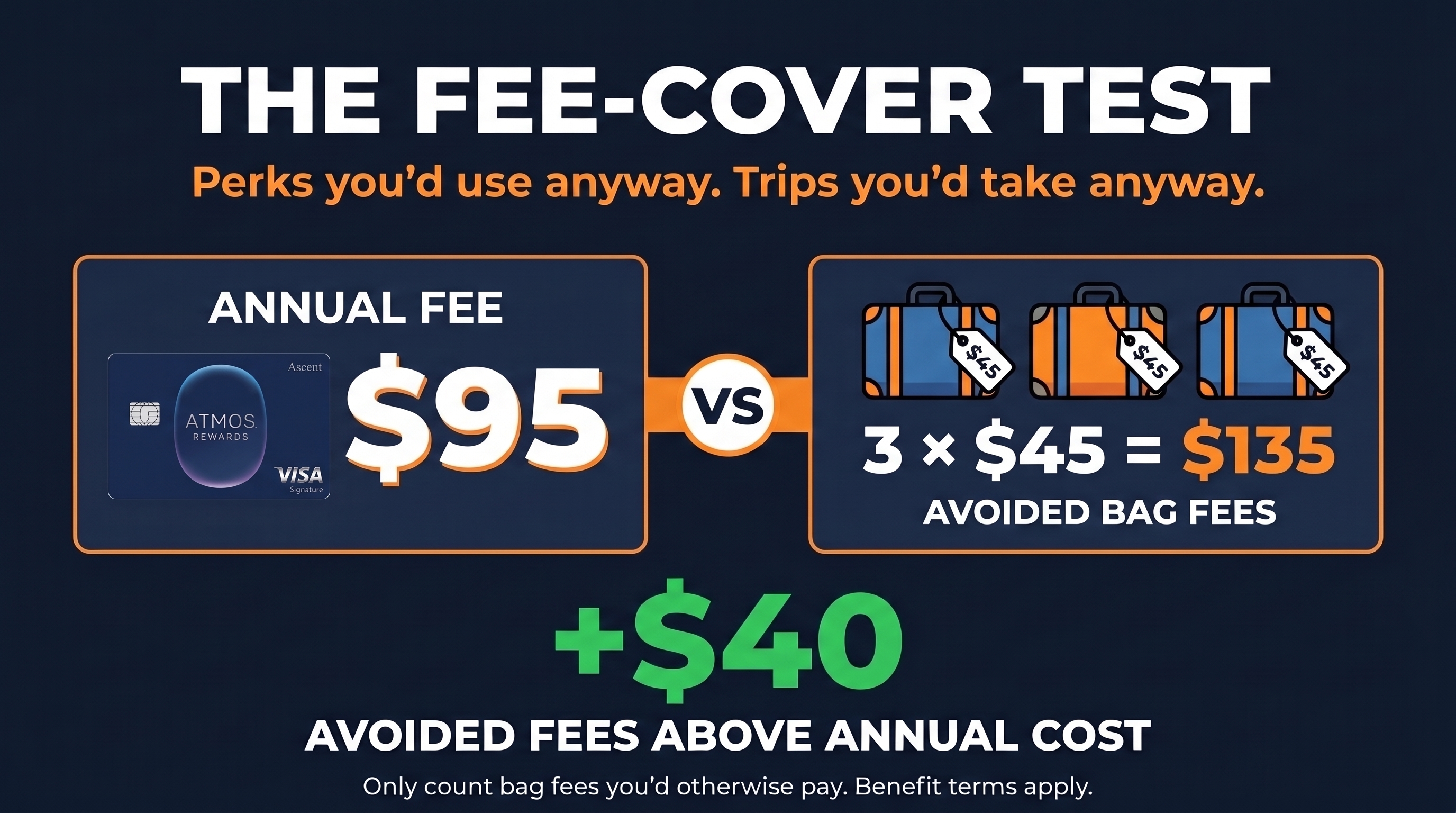
The Fee-Cover Test
A $95 card is worth it when the perks you'd use anyway, on trips you'd take anyway, cover the fee
Count only the perks that replace money you'd already spend. If you have to invent spending or trips to justify the card, the fee is all it's earning.
Two rules keep the comparison honest. You must meet the card's payment and benefit conditions, including paying for the flight with the card. And you can only count a bag you would have paid to check without the card. If you normally carry on, a free checked bag isn't $45 in savings.
Check Alaska's current baggage-fee table and the benefit terms applicable to your reservation and ticket before relying on the savings. Fees and eligibility can vary.
What the Card Asks You to Do
This card works best when its requirements fit habits you already have.
- Pay for qualifying flights with the card to receive the bag and boarding benefits.
- Actually fly Alaska. Airline-specific benefits won't do much for trips on other carriers.
- Meet the companion-fare spending threshold if you plan to count that perk.
Here's why the card works for me: I already fly Alaska Airlines for trips I want to take, including my annual salmon-fishing trip to the Pacific Northwest. I regularly use the checked-bag benefit, and I don't have to change my travel habits or spend extra money to justify keeping the card.
That's the difference between a credit card that fits your lifestyle and one you're changing your lifestyle to fit.
Bank of America also includes the Atmos Rewards Ascent card on its current list of cards with no foreign transaction fee. That can be useful if you already travel internationally. I haven't used my card overseas; Vancouver is a trip I'd like to take, not an international benefit I've tested.
The Companion Fare Is an Option, Not a Baseline
The companion fare sounds like the big prize. Bank of America currently advertises it starting at $99 plus taxes and fees, from $122 all-in, after $6,000 or more in purchases during the prior anniversary year.
I've never redeemed the companion fare. Its realized value to me has been $0.
That doesn't make it worthless. It means I can't use it to justify my own annual fee.
If you already have a second traveler, already plan a qualifying trip, and would naturally meet the spending requirement, the fare could add meaningful value. But don't buy things you don't need just to reach $6,000. And don't assume the advertised starting price tells you exactly how much you'll save; the trip and booking rules matter. Read the current terms before counting on it.
One rule matters more than every perk here: Rewards never justify carrying revolving credit card debt. Bank of America lists a variable purchase Annual Percentage Rate (APR) of 19.74% to 27.74%. Interest can overwhelm rewards and fee savings. If you're carrying a balance month to month, focus on paying that debt down instead of chasing airline perks. How Does Credit Card Interest Work? explains the mechanics.

Everything Else Counts Only If You'd Use It
The other perks can be useful. They aren't automatically cash savings.
Alaska Lounge+ discount. I travel to Seattle and Portland, and both airports have Alaska Lounges. I'd love to try them someday. But I don't currently buy lounge memberships, so the $100 Lounge+ membership discount saves me $0 today. It's a discount on a paid membership—not free lounge access with the card. If you frequently travel through airports with Alaska Lounges and would already buy and use a Lounge+ membership, that discount could fit your lifestyle much better than mine. You still need to decide whether the membership itself is worth its price.
Inflight rebate. A 20% rebate helps if you'd already buy something inflight. Buying an extra snack just because there's a rebate isn't saving money.
Preferred boarding. It may make a trip more comfortable. But unless it replaces something you'd otherwise pay for, don't put an invented dollar amount next to it.
10% points bonus. You need an eligible Bank of America account. I don't have another Bank of America relationship, so I don't count this benefit in my own decision.
Points. The card earns three, two, or one point per dollar depending on the purchase category. How much those points are worth depends on how you redeem them. I don't assign a made-up cash value to them to make the $95 look smaller. The cash back vs. travel points breakdown covers that separate decision.
I don't have an Alaska lounge membership, and I'm not a rewards optimizer. I don't need to be. The checked-bag benefit is the reason I keep evaluating this card favorably.
Why I Keep It—and Who Should Skip It
Here's my verdict: The $95 fee makes sense for my travel habits. I've carried an Alaska co-branded card for roughly a decade, typically take two or three trips a year, and use the checked-bag benefit. I believe the fees I've avoided have covered the annual fee, even though I haven't calculated an exact historical total.
I'd keep it without the welcome offer or companion fare. Those aren't the benefits doing the work for me.
I wouldn't recommend paying an annual fee for any credit card just because someone else finds it worthwhile. The card has to earn its place in your wallet, not just mine.
You should probably skip it if:
- You rarely fly Alaska Airlines or usually fly on another airline.
- You generally travel with a carry-on and don't pay checked-bag fees.
- You'd need to book extra trips or make unnecessary purchases to justify the perks.
- You don't already value a paid lounge membership or the other benefits you're counting.
- You're carrying expensive credit card debt and need to prioritize repayment.
- You can't identify enough expenses the card would genuinely replace.
There's nothing wrong with paying a bag fee on the occasional trip instead of paying an annual fee every year. Sometimes that's cheaper. If you're considering the tradeoff against a card with no annual fee, the no-annual-fee card breakdown explores the broader choice.

What You Do With This Information
Don't ask whether the Atmos Rewards Ascent card has enough perks. Ask whether you would use enough of them to cover $95.
For me, it's checked bags on trips I already take. For someone else, it might be a different combination of benefits. For a traveler who rarely flies Alaska, the answer could be no.
You don't have to use every perk to get your money's worth. But you shouldn't change your spending or travel plans to make a card look valuable.
The card should fit your life. Your life shouldn't have to fit the card.
Run Your Own $95 Test
Use the last 12 months of actual travel—not the trips you hope you'll take someday.
- Count your otherwise-paid checked bags. How many eligible first-bag charges would you have paid without the card?
- Multiply by the applicable fee. Use Alaska's current fee table for your routes; the examples here use $45 for most applicable routes and $30 within Hawaiʻi.
- Add only genuine savings from other benefits. Count what you'd otherwise have paid, not what a perk sounds like it's worth. Include companion-fare savings only when you can realistically meet the terms and use it.
- Compare with the $95 annual fee. If dependable savings exceed the fee and you can pay your statement balances in full, you have a case for the card. If not, you can skip it.
Next year, I'll be heading back to the Pacific Northwest for another salmon-fishing trip. The fish might not cooperate, but at least I know why I'm keeping this card.
A long perks list isn't proof of value. One benefit you'd actually use can be.
Chuck Finance is for entertainment and informational purposes only. Chuck is not a licensed financial advisor, and nothing in this post constitutes professional financial, investment, legal, or tax advice. Always consult a qualified professional before making financial decisions.
Card terms, fees and benefits described here are as of October 14, 2026, and can change. Personal cardholder experience described here is historical and does not establish eligibility for every current card benefit.
Sources
- Bank of America, Alaska Airlines Visa Signature credit card product page — bankofamerica.com, read October 14, 2026 ($95 annual fee, companion fare, bag and boarding benefits, inflight rebate, Lounge+ discount, earn rates, 10% bonus, purchase APR range)
- Bank of America, Credit cards with no foreign transaction fee — bankofamerica.com, read October 14, 2026
- Alaska Airlines, "Update on bag fees" — news.alaskaair.com, read October 14, 2026 ($45 first checked bag; $30 within Hawaiʻi)