Table of Contents
Start With the Swipe
When Penny taps her card at the grocery store, the store doesn't receive every cent of her purchase. Accepting that card costs money.
The total fee the store pays is usually called a merchant discount or merchant service charge. One part is interchange, which goes to the bank that issued Penny's card. Other parts pay the card network and the company handling payments for the store.
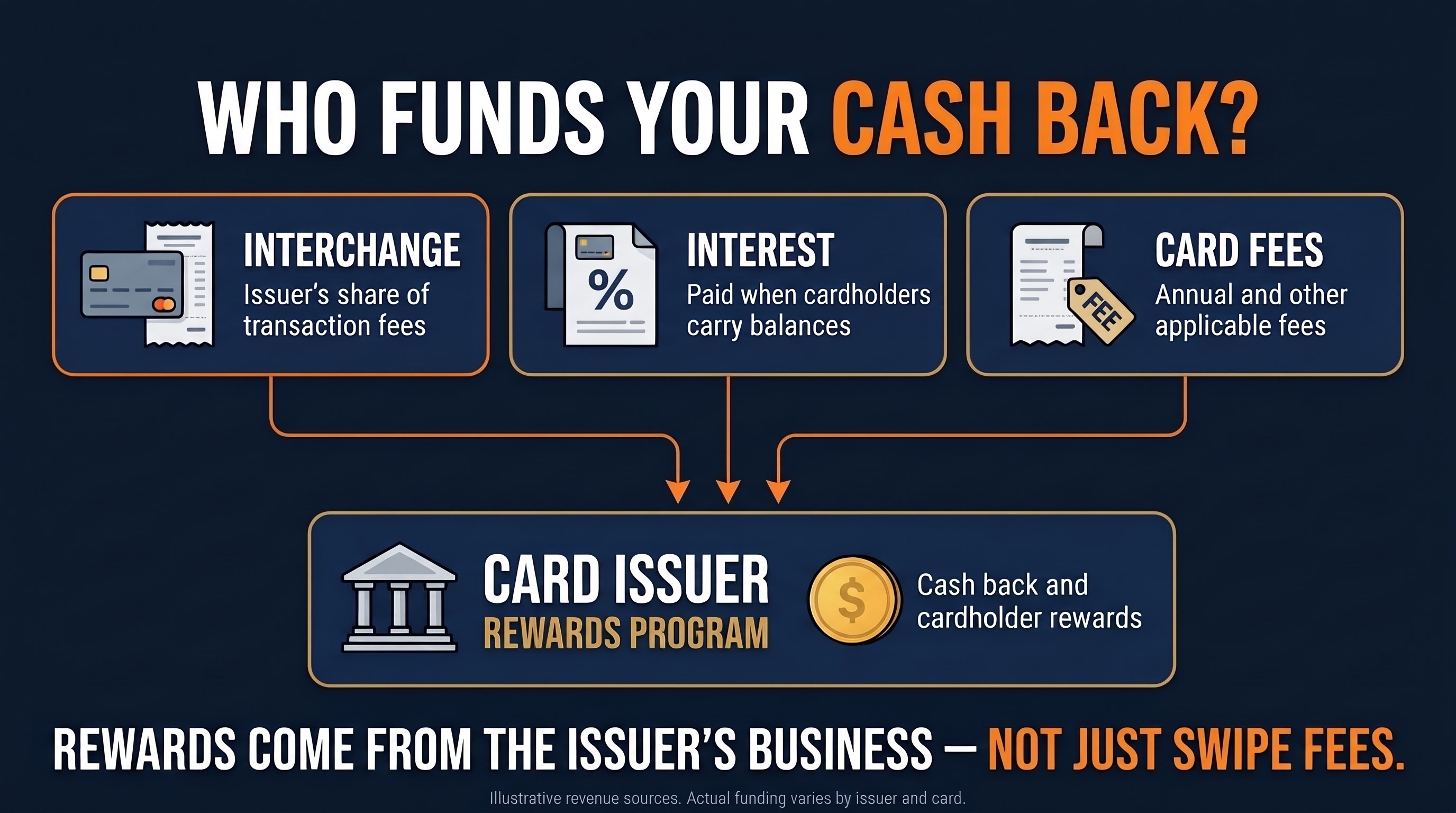
The bank can use some of its interchange revenue to help pay for Penny's cash back. It doesn't have to wait for her to carry a balance or pay interest.
That's an important distinction. Penny's rewards aren't automatically being paid for by Rufus's interest. The CFPB found that, among the large issuers it studied, interchange revenue was generally sufficient to cover rewards costs for customers who paid in full and those who carried balances.
Follow $100 Through the System
Here's a simple way to see the money move. Researchers at the Federal Reserve Bank of Kansas City and the Bank of Canada used an illustrative $100 card purchase—not a claim about what every store pays.
| What happens | Amount |
|---|---|
| Penny buys groceries | $100.00 |
| Penny earns 1% cash back | $1.00 |
| The issuing bank receives interchange | $2.00 |
| The network and merchant's payment processor receive | $0.30 combined |
| The grocery store receives after card-acceptance fees | $97.70 |
The store sold $100 worth of groceries but received $97.70 after the illustrated $2.30 in fees. The issuer received $2 in interchange and owes Penny a $1 reward. The remaining dollar isn't necessarily profit: the issuer has other costs, too.
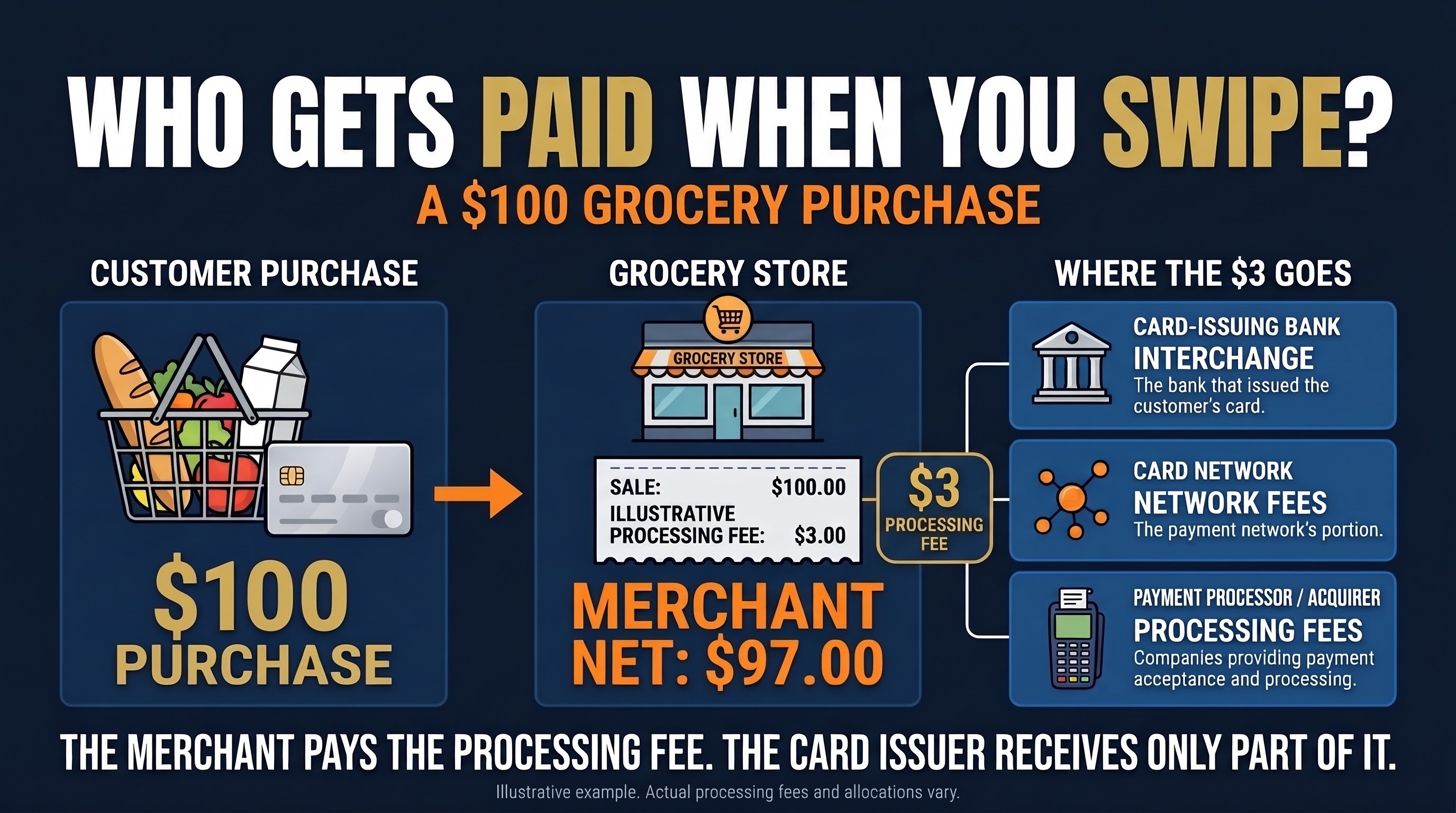
That cash back wasn't created out of thin air. It came from a payment system that charges businesses to accept cards.
How Big Is the Rewards Market?
If it seems like everyone has a rewards card, there's a reason. The CFPB reported that rewards cards accounted for 92% of general-purpose credit card spending at the large issuers it studied in both 2023 and 2024.
That's a huge share of card spending flowing through rewards programs. It also explains why banks compete so hard for the next swipe.
Who Pays for Credit Card Rewards After the Merchant?
Here's where the question gets interesting.
The grocery store pays its card-processing bill. But does it absorb that cost, or does it build some of it into the price of groceries?
If a store charges the same price whether Penny uses credit or another customer pays cash, it's possible that some card-acceptance costs are spread across everyone's purchases. That would mean customers who don't earn rewards could still bear part of the cost.
Researchers at the Kansas City and Boston Federal Reserve banks and the Bank of Canada explored that possibility. Their model shows how merchant costs could be passed along through prices, including to cash and debit customers.
But a model isn't a receipt from every store in the country. The researchers made assumptions about how much merchants pass through, and the real-world share is difficult to measure. Some businesses absorb costs, some adjust prices, and some offer payment-method discounts or surcharges where permitted.
So I won't tell you that every cash customer is secretly paying a precise amount toward Penny's rewards. The evidence doesn't support a universal number.
What we can say is that the merchant pays the acceptance fee up front, and the cost may reach other shoppers through prices.
Issuers Earn From Cardholders Too
Banks don't rely only on interchange. They also collect interest from customers who carry balances, along with various cardholder fees.
That brings us back to Rufus.
His credit card was manageable until his hours at work were cut for a few weeks. He used it to cover groceries and a couple of household bills while his paycheck was smaller. His hours have recovered, but the balance hasn't disappeared.
He still uses the card for ordinary purchases because the rewards feel like a small win. And when his statement arrives, he sees the familiar cash-back total beside a much less welcome interest charge.
Penny and Rufus: Same Card, Different Month
Penny has a habit that isn't glamorous: every payday, she sets aside money for the purchases already on her card. When her statement arrives, she pays the full statement balance by the due date. Because her card's purchase grace period applies, she generally avoids interest on those purchases.
Rufus is working his balance down, but he hasn't been able to pay it off. He's carrying $3,000 at 24% APR. His grace period on new purchases has generally been lost, so those purchases can start accruing interest too.
Both spend $2,000 in a month on cards earning 1.5% cash back. That's $30 in rewards each.
The Pay-in-Full Test
Pay your full statement balance by the due date while your purchase grace period applies, and you can generally avoid purchase interest.
At 1.5% cash back on $2,000 in purchases, Penny earns $30 and pays $0 in purchase interest. Rufus earns $30 too, but a $3,000 carried balance at 24% APR costs roughly $60 in interest over a 30-day month, before accounting for other purchases or changing balances.
| This month | Penny | Rufus |
|---|---|---|
| Eligible purchases | $2,000 | $2,000 |
| Cash back at 1.5% | $30 | $30 |
| Balance carried into the month | $0 | $3,000 |
| Illustrative interest on carried balance | $0 | About $60 |
Rufus's $60 is a quick estimate: 24% APR ÷ 12 = 2% per month; 2% × $3,000 = $60. Real card interest is usually calculated from daily balances, so the amount changes with payment dates, purchases, and the number of days in the billing cycle. The estimate also doesn't include possible interest on Rufus's new purchases.
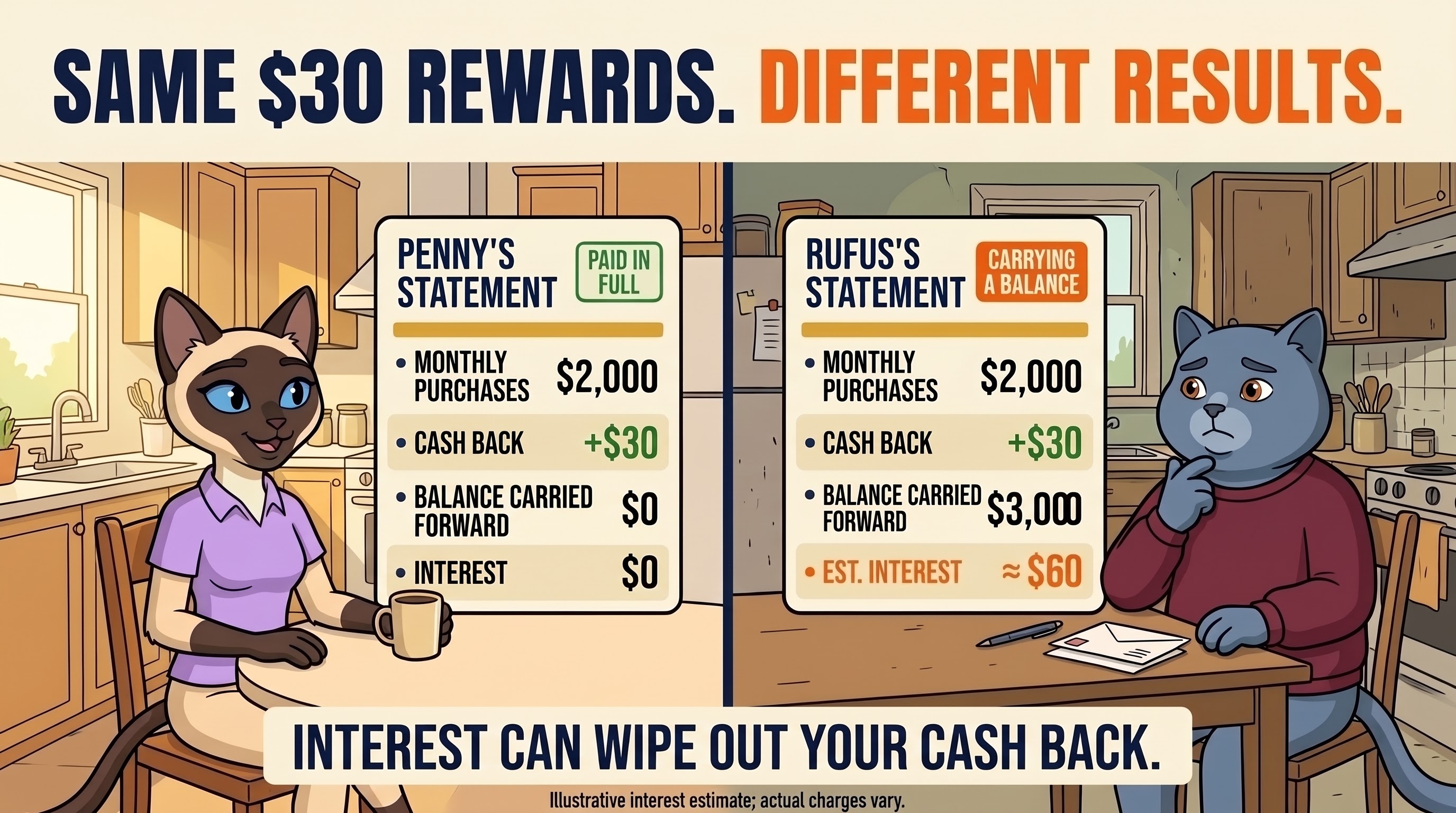
Penny can enjoy her $30 reward without a purchase-interest charge eating it up. Rufus earned the same $30, but even this simplified $60 interest estimate leaves him $30 behind on rewards versus interest for the month.
That doesn't mean Rufus is careless, or that his interest payment gets sent directly to Penny. His reduced hours created a real cash-flow problem. The bank earns interchange when he shops and separately charges interest when he borrows. Those are different revenue streams.
The CFPB found that customers carrying balances at the large issuers it studied generally paid much more in interest and fees than they received in rewards. Rufus is experiencing the same basic problem: the rewards feel good, but the borrowing costs are bigger.
The Part Chuck Wants You To Actually Do
Rufus doesn't need a lecture about being more like Penny. He needs a plan that stops the interest from taking so much of his money.
First, he checks the interest charge on his latest statement instead of focusing on the rewards total. Then he looks at what he can put toward the balance each month without falling short on necessities. While he's paying it down, he considers using debit or cash for new purchases so he isn't adding more interest-bearing charges to the card.
Penny's habit is worth keeping, too. She pays the full statement balance, not just the minimum, by the due date. She doesn't have to pay every purchase the moment it posts, and she doesn't have to spend extra to earn a reward.
If you're carrying a balance, start with how credit card interest works and how to pay off credit card debt. If you're already paying in full, cash back vs. travel points can help you decide which rewards fit your actual spending.
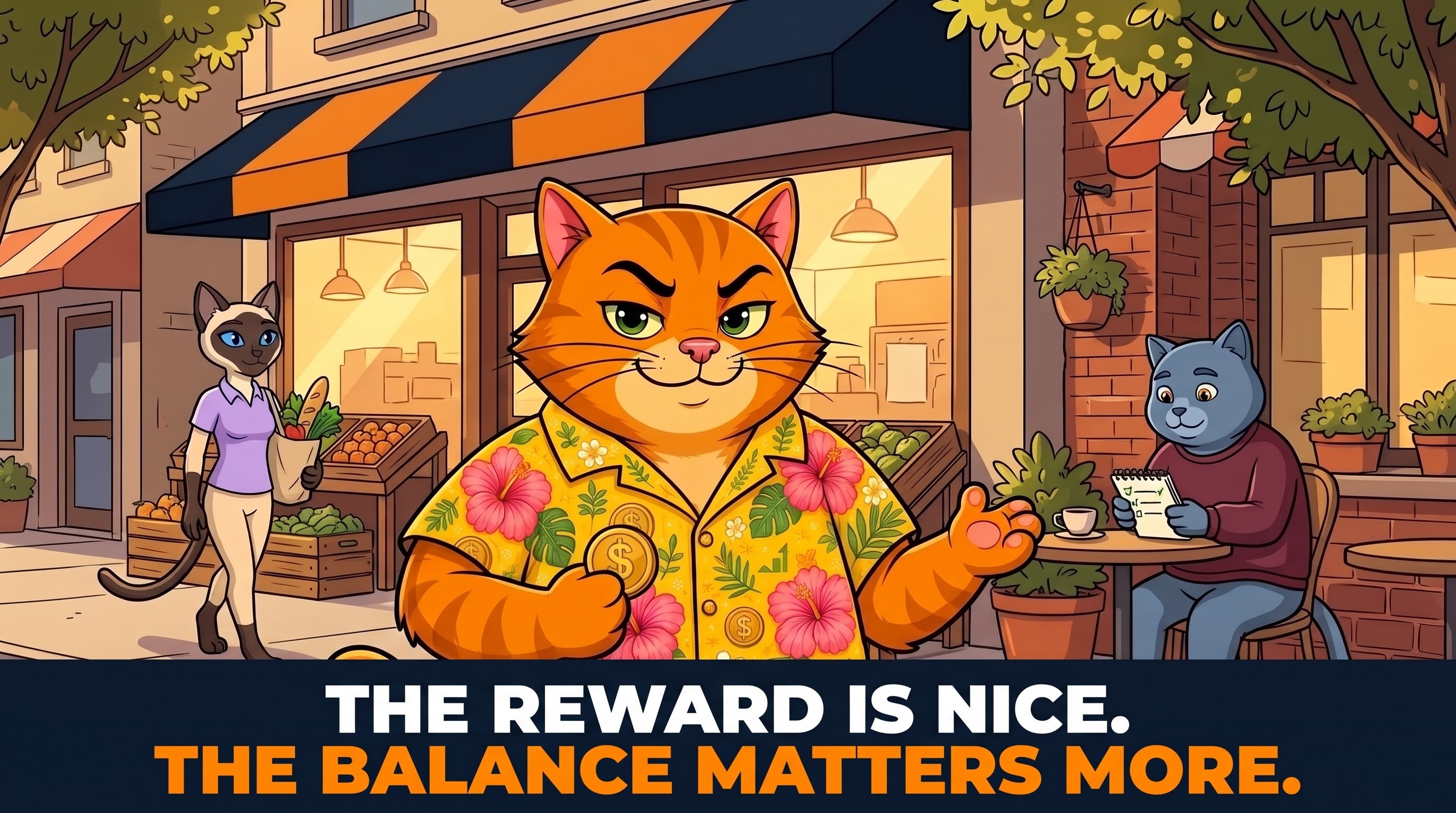
So who pays for credit card rewards? Merchants pay acceptance fees. Interchange helps issuers fund the rewards. Some of the merchant's cost may be reflected in what shoppers pay. And banks also make money from cardholders who carry balances—but that doesn't mean those interest payments directly fund every cash-back dollar.
The part you can control is what happens after you swipe.
Check your latest statement. If you paid the full statement balance and your grace period applies, your purchases generally avoided interest. If you're carrying a balance, look at the interest charge first. That's the number worth shrinking.
Sources
- CFPB, The Consumer Credit Card Market Report to Congress (December 2025): rewards cards represented 92% of general-purpose card spending at the studied large issuers in 2023 and 2024; discussion of grace periods.
- CFPB, The Consumer Credit Card Market (October 2023): interchange revenue and rewards costs; interest and fees paid by revolving cardholders; issuer revenue categories, using 2022 data.
- Felt, Hayashi, Stavins & Welte, Distributional Effects of Payment Card Pricing and Merchant Cost Pass-through in the United States and Canada, Federal Reserve Bank of Kansas City Working Paper RWP 20-18 (2020): illustrative $100 payment flow and merchant cost pass-through model.
- CFPB, What is a grace period for a credit card?: paying the full statement balance and the effect of carrying a balance on purchase interest.
The $100 payment flow is an illustration, not a current industry-average fee schedule. Penny and Rufus are fictional. Their rewards and APR are chosen to make the arithmetic easy to follow. Actual card terms, grace periods, merchant fees, and interest charges vary.
Chuck Finance is for entertainment and informational purposes only. Chuck is a personal finance enthusiast, not a licensed financial advisor. Nothing here is individualized financial, investment, legal, or tax advice. Consult a qualified professional when appropriate.