How to pay off credit card debt
To pay off credit card debt, stop paying only the minimum and set one fixed total payment for all your cards each month instead — enough to cover every card's minimum, with the rest going to one target card. If you qualify, move the balance to a lower rate with a balance transfer or a consolidation loan. Then attack one card at a time: highest interest rate first to save the most money, or smallest balance first to stay motivated. The plan you'll actually finish beats the perfect one you quit.
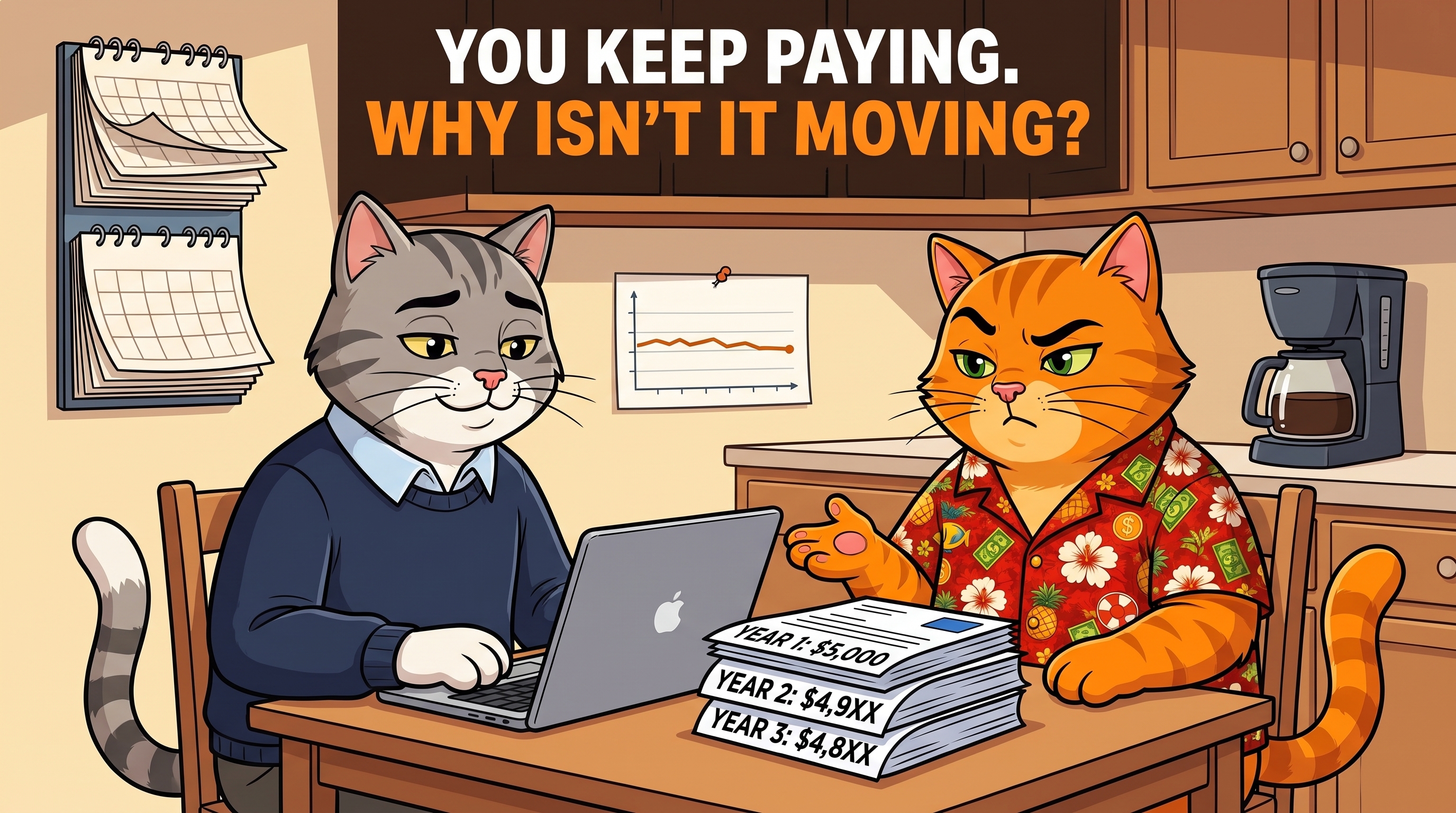
Owen pays his credit cards every month. He never misses. He always pays a little more than the minimum, and he treats it like rent — automatic, non-negotiable, handled. Three years in, he owes almost exactly what he owed when he started.
Owen isn't careless. He has a job, a budget, and a real plan to get this gone. The plan just doesn't work — not because he isn't paying, but because of how he's paying. Nobody ever showed him the difference.
Getting out of credit card debt comes down to three moves: change how much you pay, change the rate you're paying it at, and pick the order you clear the balances in. Do all three and the math finally runs in your direction instead of against you. Here's each one, with the numbers.
Why paying every month isn't working
This is not a rare problem. Americans are carrying about $1.26 trillion in credit card debt — just about the most it's ever been, according to the Federal Reserve Bank of New York. By one 2026 count, the typical person carrying a balance owes around $6,610.
And it doesn't move fast. In a 2026 Bankrate survey, 61% of people with card debt said they'd had it for at least a year, and about a third had been carrying it for three years or more.
Here's the one that matters. The Consumer Financial Protection Bureau found that in 2024, about 15% of general-purpose cardholders paid only the minimum — the highest share it has recorded in over a decade. And a growing share of that debt isn't vacations or splurges. It's groceries, childcare, utilities — the regular month.
So if this is you, you're not the exception. You're seeing what minimum payments actually do.
The minimum payment is a floor, not a plan
Here's what's happening on your statement. Most credit cards calculate interest daily, so while you're carrying a balance, interest keeps accruing between payments. The longer the balance sits there, the more of every payment goes toward interest instead of the debt itself. Right now the average rate on cards carrying a balance is about 22%, per Federal Reserve data.
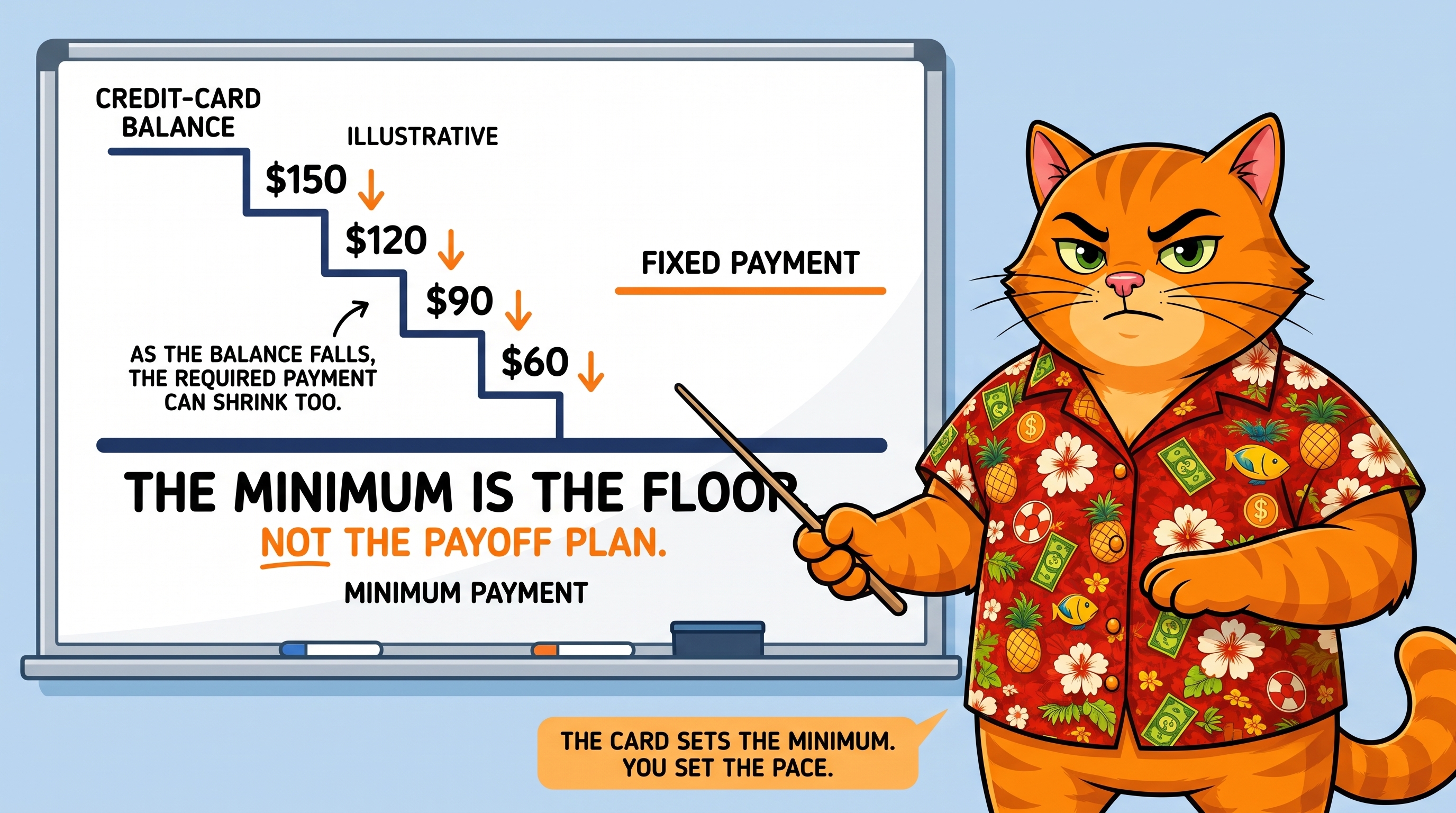
The minimum payment isn't built to end that. It's a floor — the least the card will accept to keep your account current. Pay exactly the floor and you can stay in debt for years while doing everything "right."
Nationally, that adds up: consumers paid more than $160 billion in credit card interest in 2024 alone, according to the CFPB.
Move 1: Pay a fixed amount
Stop paying the minimum. Pay a fixed amount instead.
That fixed amount is a total for everything you owe across your cards — not a separate fixed payment on each one. It has to cover the required minimum on every card, with everything left over going to one target card at a time. Once that target hits zero, the amount that had been going to it rolls into the next one.
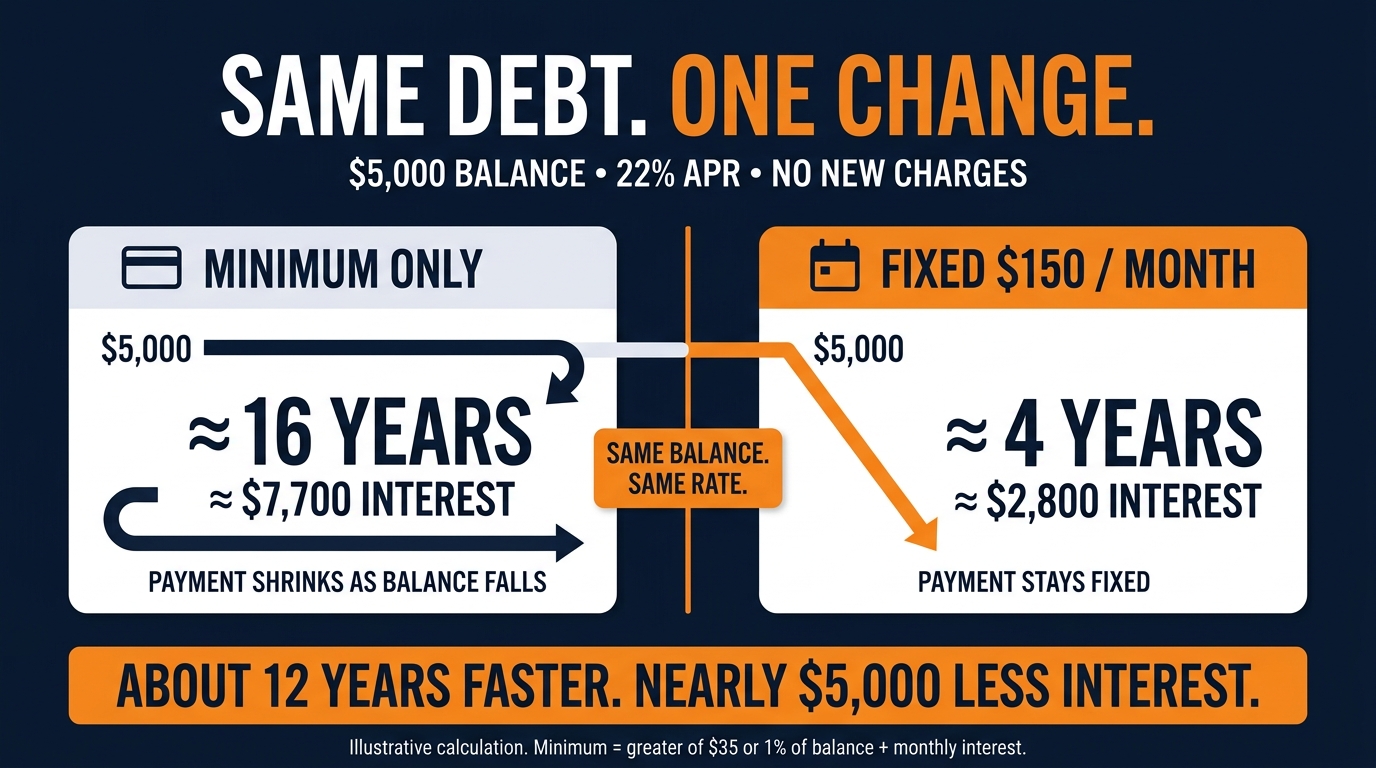
Here's why, with clean hypothetical numbers. Say you owe $5,000 at 22% and you make no new charges. Under a common structure — one percent of the balance plus that month's interest, with a $35 minimum floor — paying only what the card asks for takes roughly 16 years to clear the balance. Along the way you'd hand the bank about $7,700 in interest. That's more than you borrowed.
Now take the same $5,000 at the same rate, and instead of letting the required payment shrink with the balance, you commit to a flat $150 every month. You're done in about four years and four months, for roughly $2,800 in interest.
Same debt. Same rate. One change to how you pay — and you cut about 12 years off the payoff and save close to $5,000 in interest.
The Three Moves
Fix the payment. Cut the rate. Pick an order.
On a $5,000 balance at 22%, paying only the minimum runs about 16 years and roughly $7,700 in interest. A flat $150 a month on the same balance clears it in about four years for roughly $2,800. Same debt, same rate — the only change is how you pay.
Here's the trap inside the trap: under that minimum-payment formula, the payment shrinks as the balance drops. The more progress you make, the less the card asks for, and the slower you go. A fixed payment ignores all of that. You choose the number once and it keeps working the whole way down.
That's why you can make payments for years and still wonder why the balance barely moved.
Move 2: Cut the interest rate
Cut the rate while you pay it off. There are two ways.
A balance transfer. Another card gives you a promotional rate — often 0% — for a limited window, and you move your existing balance onto it. Two things to know. There's usually a transfer fee, charged as a percentage of the amount you move, so shifting $5,000 with a 3% fee costs about $150 up front. That fee is part of the cost of the move — a lower rate doesn't automatically mean a cheaper one. The interest you'd save has to outweigh what the transfer costs you up front. And when the promo window closes, whatever's left goes to that card's normal rate, which can be every bit as ugly as the one you left. A balance transfer is a runway, not a rescue. It only works if you have a real plan to clear most of the balance before the clock runs out, and you generally need solid credit to qualify.
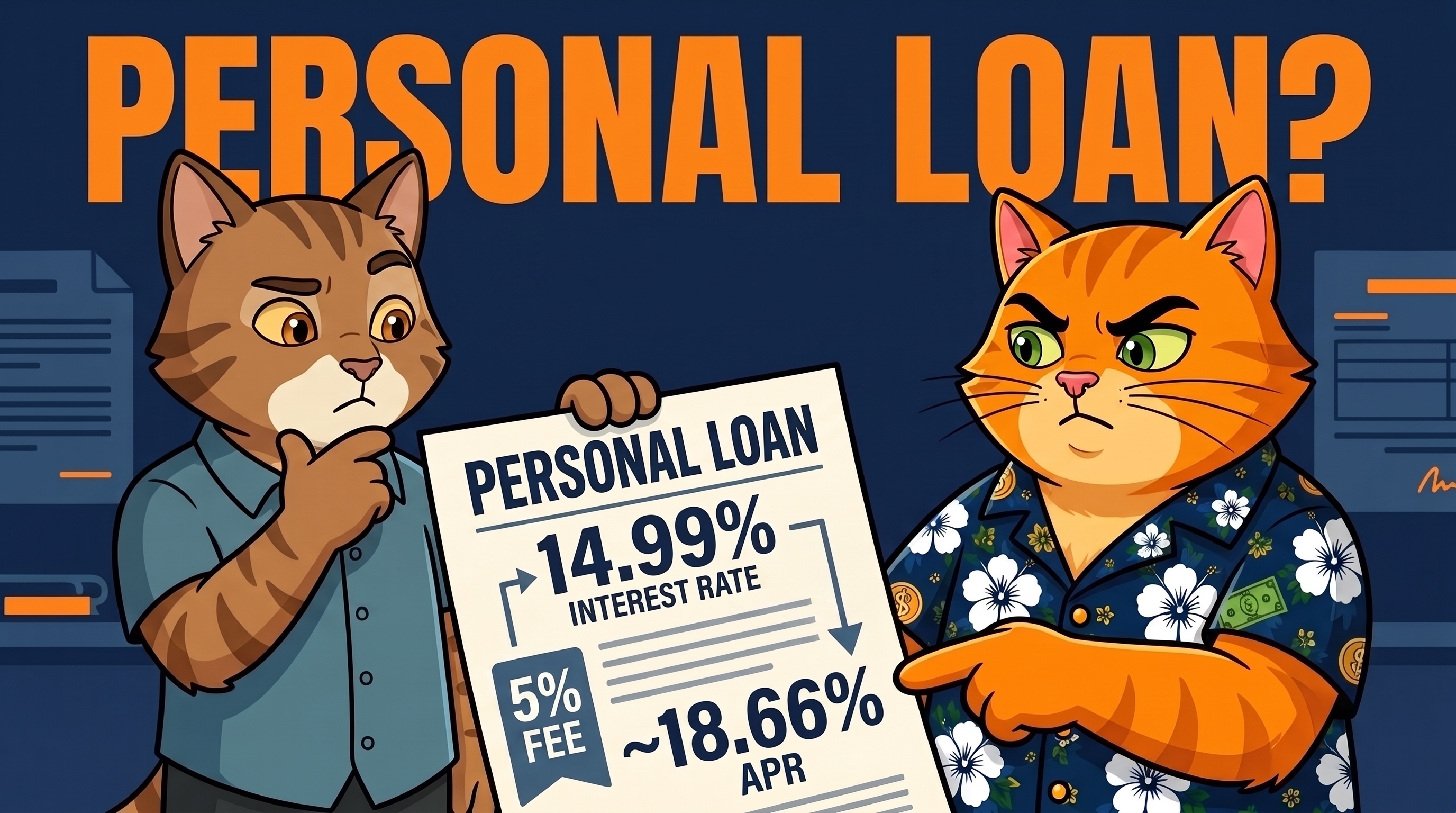
A consolidation loan. You take a fixed-rate personal loan and use it to pay the cards off. Now it's one lender, one rate, one end date. The Federal Reserve puts the average two-year personal loan at a commercial bank around 12% — but that's an average across all borrowers, not a quote. Your rate depends on your credit. It only helps if you actually qualify for a rate well under your cards, and only if you don't turn around and run the cards back up.
One more thing: a lower rate does nothing by itself. If you move the balance and then pay the new minimum, you've just relocated the debt to a nicer neighborhood. The rate cut only pays off if you keep the payment at least as big as it was before.
Move 3: Pick an order — avalanche or snowball
If you've got more than one balance, hit them one at a time — minimums on everything else, every extra dollar on one target card.
The avalanche. Every extra dollar goes at the card with the highest rate first. Under a straight comparison — same balances, same total payment, no new debt — this costs you the least interest overall. It's the efficient answer.
The snowball. You go after the smallest balance first, rate aside. You can pay a little more in interest doing it this way. Research from the Kellogg School of Management, published in the Journal of Marketing Research, looked at people in a debt-settlement program and found that those who knocked out individual balances were more likely to eliminate their overall debt. The researchers pointed to those "small victories" as a possible psychological edge to starting with smaller balances.
The math says avalanche. The psychology sometimes says snowball. Run whichever one you'll still be doing eight months from now — because a plan you quit saves you nothing, and a slightly slower plan you finish beats a perfect one you abandon in March.
Here's what actually fixes this
If you've been paying on these cards for years and the number has barely moved, that is not a character flaw. You were handed a minimum payment and told to be responsible, and you were. Nobody mentioned that "responsible" and "minimum" were pulling in opposite directions. The minimum keeps you current. It does not exist to get you out of debt quickly.
You've been clawing at this every month for years. The problem was never the effort — it was the aim.
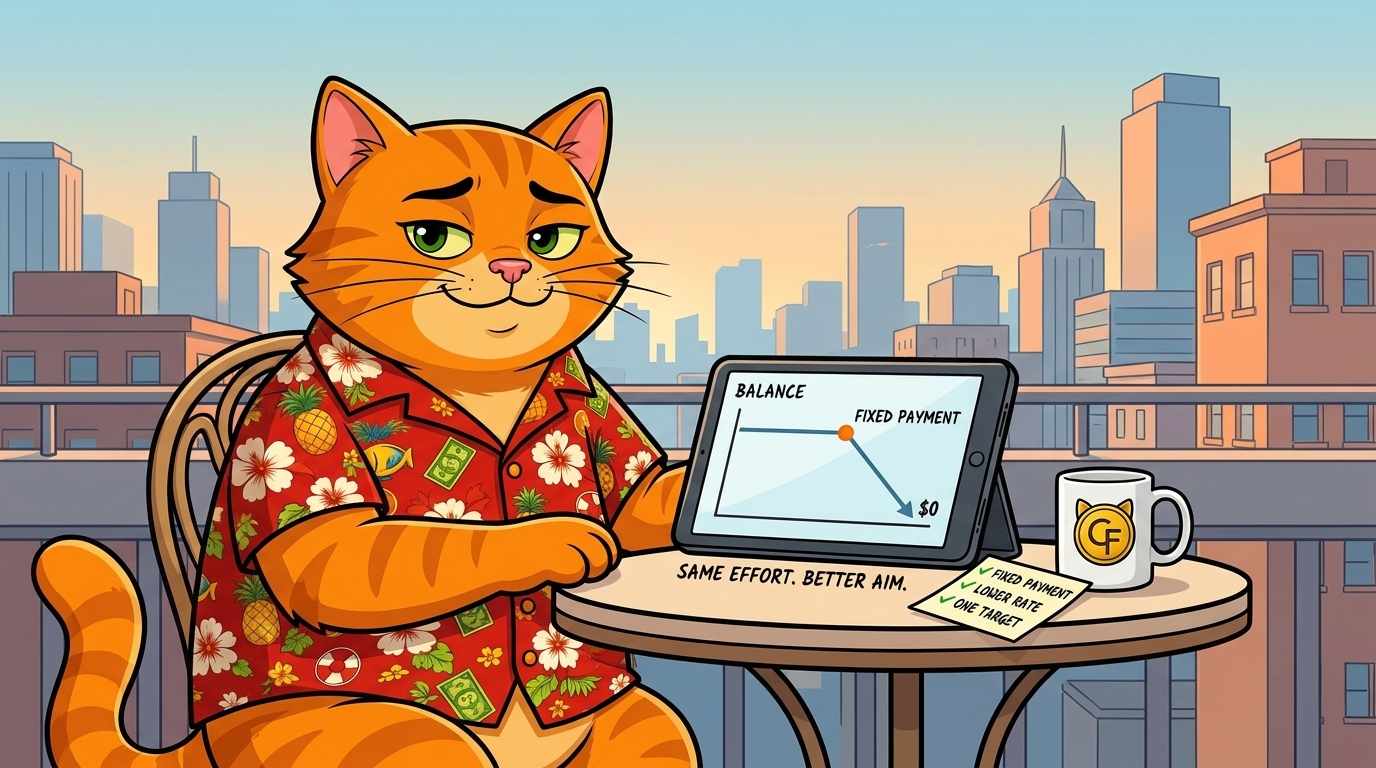
If you've already been making payments every month for years, more effort isn't the missing piece. You need those payments pointed: a fixed amount, a lower rate if you can get one, and an order. Same effort, completely different ending. You set the pace now, not the card.
Don't refill the card
Clearing a card is step one of two. Step two is not filling it back up.
Every tool here — the fixed payment, the transfer, the loan — only solves the balance you're dealing with now. If you pay a card down to zero and leave whatever caused the balance in the first place untouched, you've created room for the same balance to come back. The move that actually ends this is boring on purpose: the balance goes down, and it stays down. It quietly stops being a line on your statement.
Your four steps this week
- List every card in one place — balance and APR for each. On paper, in a note, wherever you'll see it. You can't plan around numbers you're avoiding.
- Set one fixed monthly payment — bigger than your minimums added up — and automate it. Keep making the required minimum on every card; send everything above that at one target card.
- Check, honestly, whether you qualify for a balance transfer or a lower-rate loan. If you do, treat it as a runway. If you don't, skip it — don't chase it. The rate is optional. The payment plan isn't.
- Pick avalanche or snowball today and put your extra money on the first card with your next payment. Not someday. Not when the statement reminds you.
Owen didn't get a raise and he didn't get lucky. He listed his cards, set one fixed payment, lowered the rate where he could, and picked an order. For the first time in three years, the balances actually started moving — not because he suddenly became more responsible, but because he changed how the money was aimed.
The debt doesn't respond to how hard you're trying. It responds to how you're paying.
Related reading: Debt Snowball vs. Debt Avalanche: Which Should You Use? · What Is Debt Consolidation? (And When Does It Actually Help?) · How Does Credit Card Interest Work?
Sources
- Total U.S. credit card debt (~$1.26 trillion, Q2 2026): Federal Reserve Bank of New York, Quarterly Report on Household Debt and Credit — https://www.newyorkfed.org/microeconomics/hhdc
- Average balance for cardholders carrying a balance (~$6,610, 2026): LendingTree, 2026 credit card debt statistics — https://www.lendingtree.com/credit-cards/study/credit-card-debt-statistics/
- Average APR on cards assessed interest (~22%, Q2 2026): Federal Reserve, G.19 Consumer Credit — https://www.federalreserve.gov/releases/g19/current/
- 61% in card debt 1+ year; ~1 in 3 for 3+ years; day-to-day expenses a leading cause: Bankrate, 2026 Credit Card Debt Survey — https://www.bankrate.com/credit-cards/news/credit-card-debt-report/
- ~15% of general-purpose cardholders paid only the minimum in 2024 (highest in over a decade); $160B+ in credit card interest in 2024: Consumer Financial Protection Bureau, The Consumer Credit Card Market (Dec 2025) — https://www.consumerfinance.gov/data-research/research-reports/the-consumer-credit-card-market-2025/
- Average 2-year personal loan APR at commercial banks (~12%, 2026): Federal Reserve, G.19 Consumer Credit — https://www.federalreserve.gov/releases/g19/current/
- Debt-settlement "small victories" research: Gal, David, and Blakeley B. McShane, "Can Fighting Small Battles Help Win the War? Evidence from Consumer Debt Management", Journal of Marketing Research (2012), Kellogg School of Management — studies consumer debt-settlement behavior; supports the discussion of psychological "small victories," not a claim that the snowball method is universally superior.
- The $5,000 payoff figures are an illustrative calculation (22% APR, no new charges, minimum = greater of $35 or 1% of the balance plus that month's interest) — a worked example, not a quote.
Chuck Finance is for entertainment and informational purposes only. Chuck is not a licensed financial advisor, and nothing here constitutes professional financial, investment, legal, or tax advice. Always consult a qualified professional before making financial decisions.