What Actually Protects Your Money
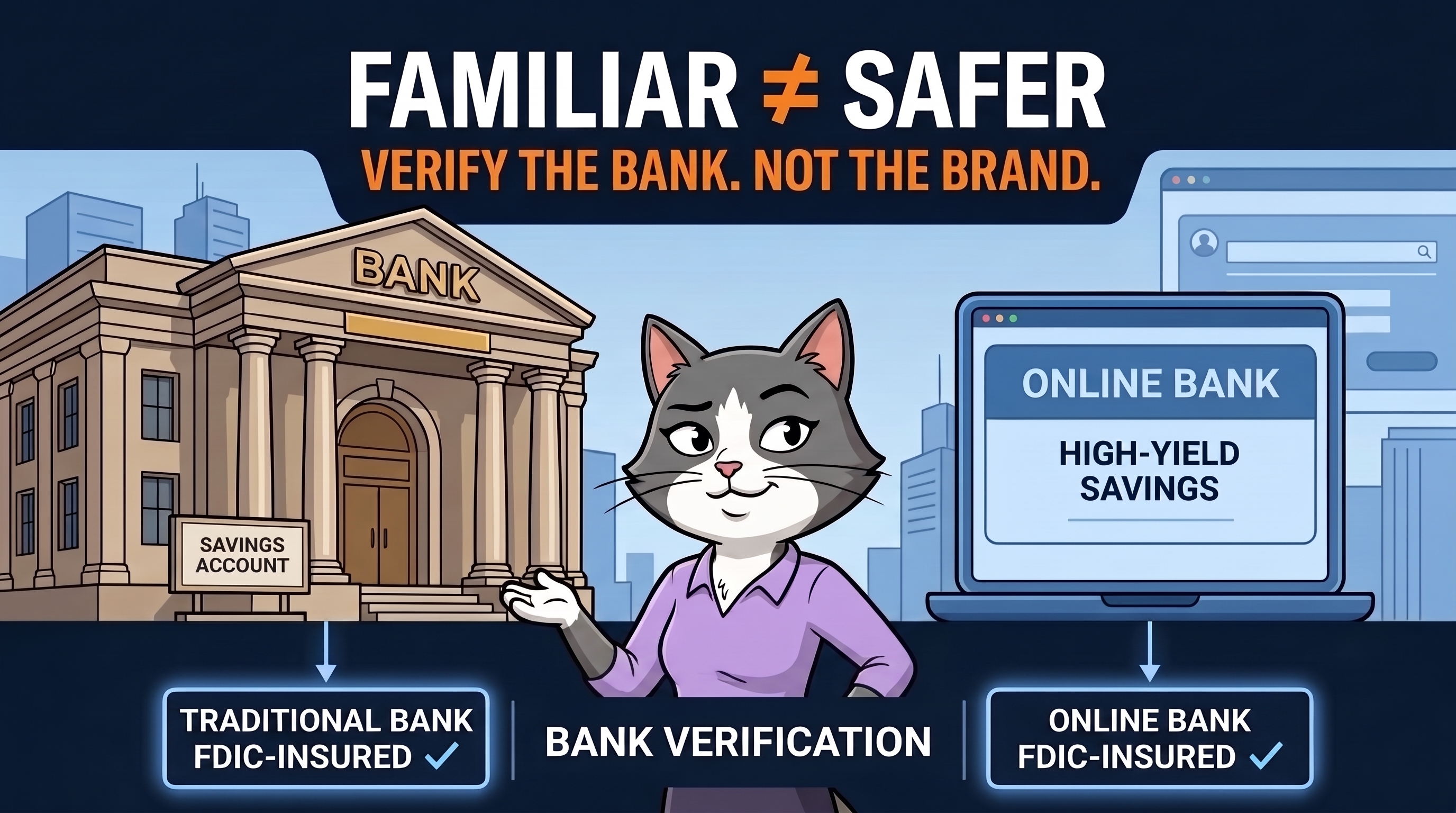
Here's the thing worth checking instead of how familiar a bank's name sounds: whether it's FDIC-insured. If it is, your deposit is protected up to $250,000 per depositor, per bank, per ownership category. That coverage is automatic when you open a covered deposit account at an FDIC-insured bank. There's no separate application or opt-in. Coverage doesn't depend on how long the bank has existed or how many commercials you've seen for it.
This covers savings accounts, checking accounts, money market deposit accounts, and CDs. It doesn't cover stocks, bonds, mutual funds, or crypto — even if you bought them through a bank's app. Since the FDIC's creation in 1933, no depositor has ever lost a penny of insured deposits. If an insured bank fails, the FDIC works to provide depositors prompt access to their insured funds, either by transferring deposits to another insured bank or paying the insured amount directly.
One nuance worth knowing rather than assuming: $250,000 is the baseline for a simple individual account, but it's not identical for everyone. Joint accounts, trust accounts with named beneficiaries, and other ownership structures can change your actual coverage — sometimes well above $250,000, if the requirements for that ownership category are met. If your situation is more complicated than one account in your own name, the FDIC's own EDIE calculator is built to work out your specific number rather than guessing at it here.
Federally insured credit unions offer similar federal protection through the National Credit Union Administration, with the same $250,000 baseline for individual accounts. Most HYSAs are offered by banks, so FDIC is the relevant lens for this post — but the underlying idea is the same either way.
How to Actually Check
Here's the actual verification step that replaces "have I heard of this bank" as your test: go to fdic.gov and use the BankFind tool. Search the bank's name or its website address.
If it shows up as FDIC-insured, the exact same coverage rules apply to it as apply to the biggest, oldest bank in the country. An unfamiliar name doesn't mean weaker protection. Size and brand recognition aren't inputs to the FDIC coverage formula at all. If it doesn't show up, that's the moment to find out what you're actually looking at before putting money into it — not after.
The Verification Chain
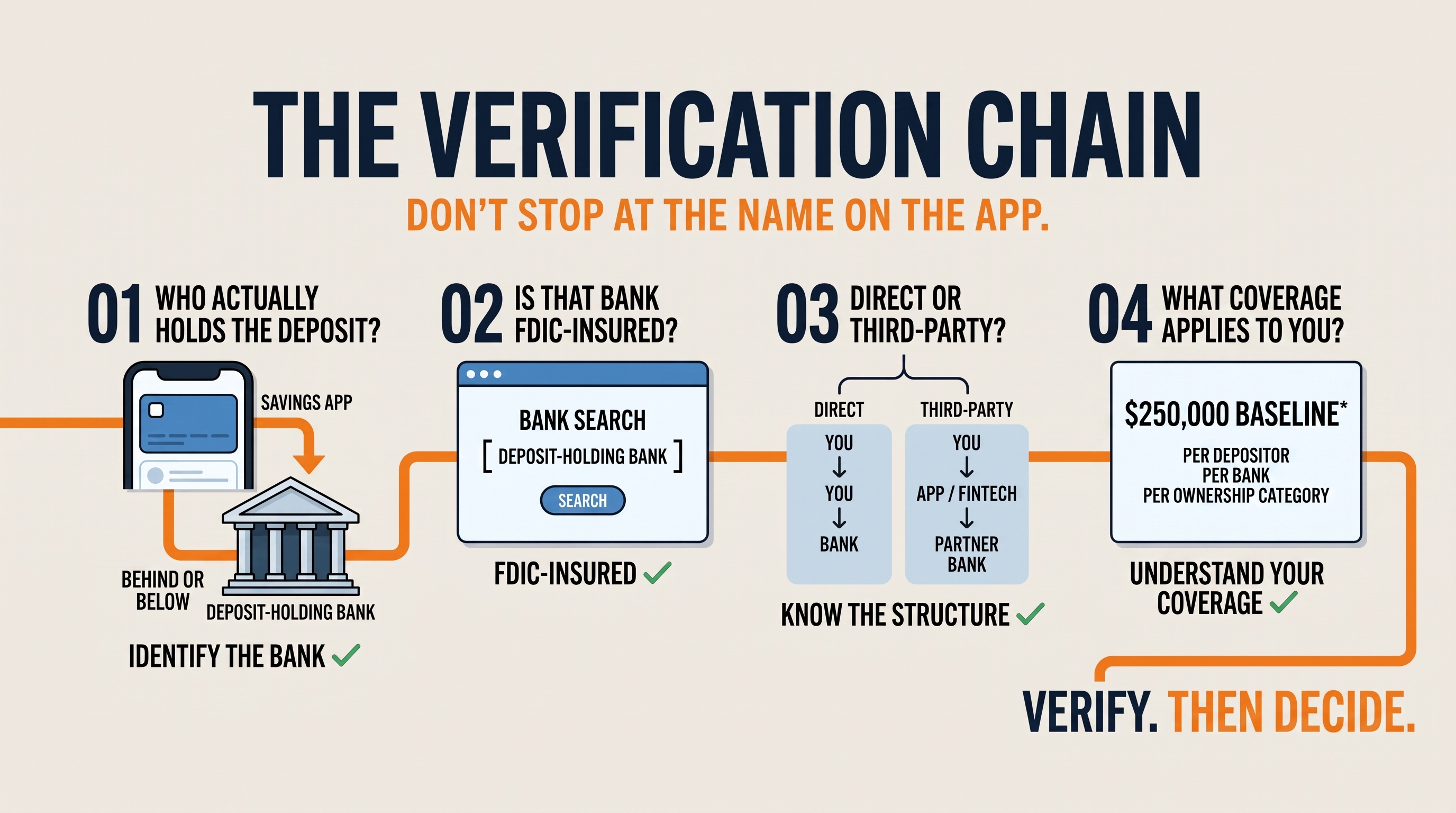
Who actually holds the deposit? Is that bank FDIC-insured? Is this a direct bank account or a third-party arrangement? What coverage applies to your specific situation?
Brand familiarity was never the thing protecting Naomi's money. FDIC status was. One is a feeling; the other is a fact you can check in under a minute.
Why the Rate Gap Exists
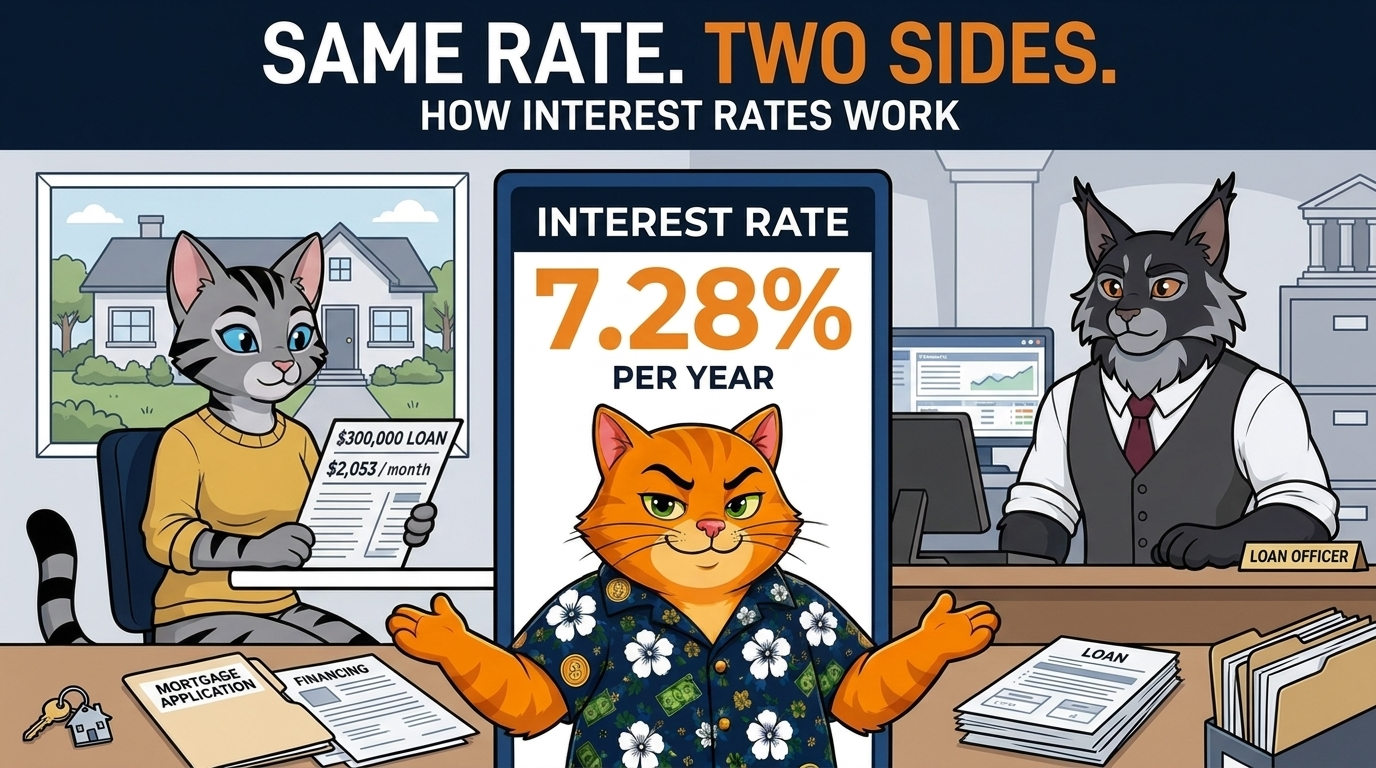
If the coverage is genuinely identical, why would an unfamiliar bank pay so much more than the one Naomi already knows?
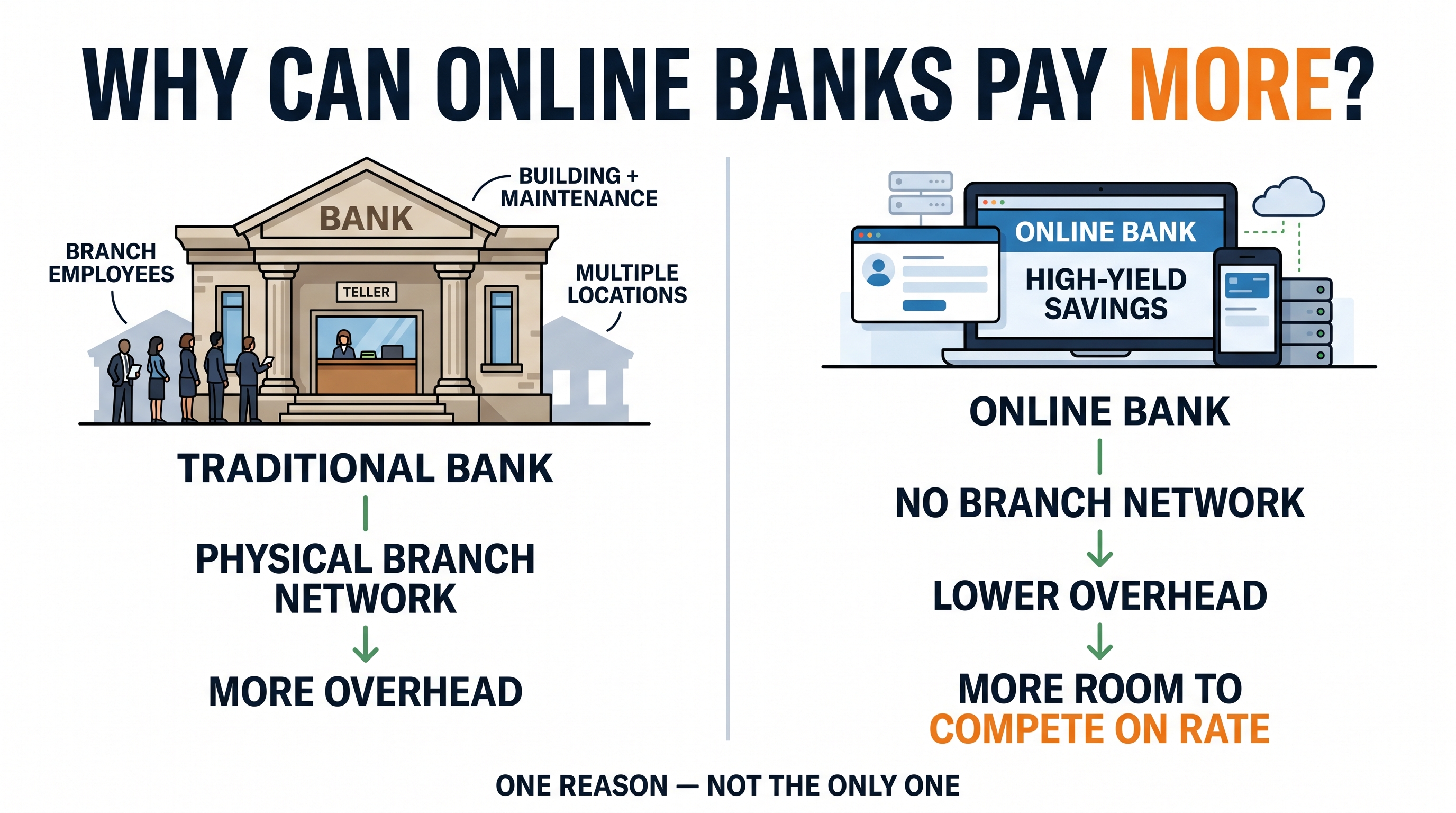
Banks generally make money on the spread between what they earn on loans and other assets and what they pay out for deposits. An online-only bank typically carries lower overhead than one running a network of physical branches — no branch leases, no branch staff, no branch maintenance — and can use some of that difference to offer a more competitive rate to win customers who might otherwise never look past the bank they've always used.
That's part of the story, not the whole thing — it's not the only reason any specific bank's rate lands where it does. But it does explain a pattern worth mentioning: banks with physical branches tend to keep customers for a very long time. Bankrate's 2025 survey found that savings-account holders had kept their accounts for an average of 18 years at institutions with physical locations, versus six years at online-only institutions. For checking accounts, it was 19 years versus six. Customers who've had the same account for eighteen years aren't shopping around, so their bank doesn't need to compete as hard on rate to keep them. A newer online bank doesn't get that luxury — it has to earn the account, often by paying more for it.
None of this means a higher rate automatically comes with weaker FDIC protection. It means the bank's cost structure and competitive position may be different.
One Thing Worth Knowing If It's Not a Bank
One more distinction, worth having before you open anything: is the product actually offered by a bank, or by a company that isn't a bank at all?
Plenty of savings products are offered by fintech companies that aren't themselves chartered banks — they hold your money at a partner bank behind the scenes instead. When that's set up correctly, your deposit may qualify for pass-through FDIC insurance if the underlying insured bank fails. But the money has to actually reach an FDIC-insured bank and the pass-through requirements have to be met. FDIC insurance protects against failure of the insured bank — it does not insure the fintech company itself or protect you from the fintech's own insolvency, bankruptcy, or operational problems.
Practical version: if what you're looking at is a company rather than a bank, ask which bank actually holds the deposits, and check that specific bank at fdic.gov — not the fintech's name, the bank's.
What FDIC Insurance Doesn't Cover
FDIC insurance doesn't freeze a rate in place — HYSA rates are variable and can change. It doesn't cover deposits above your applicable insurance limit, which is what the EDIE calculator exists to sort out for complicated situations. And it has nothing to do with fraud or cybersecurity — those are handled by other protections and bank security practices, not deposit insurance.
Naomi's Answer
Naomi runs the actual check: Who holds the deposit? The bank named on the account itself. Is that bank FDIC-insured? She searches it on BankFind — yes. Is this a direct bank account or a third-party arrangement? Direct. What coverage applies? The standard $250,000 limit, which comfortably covers her balance.
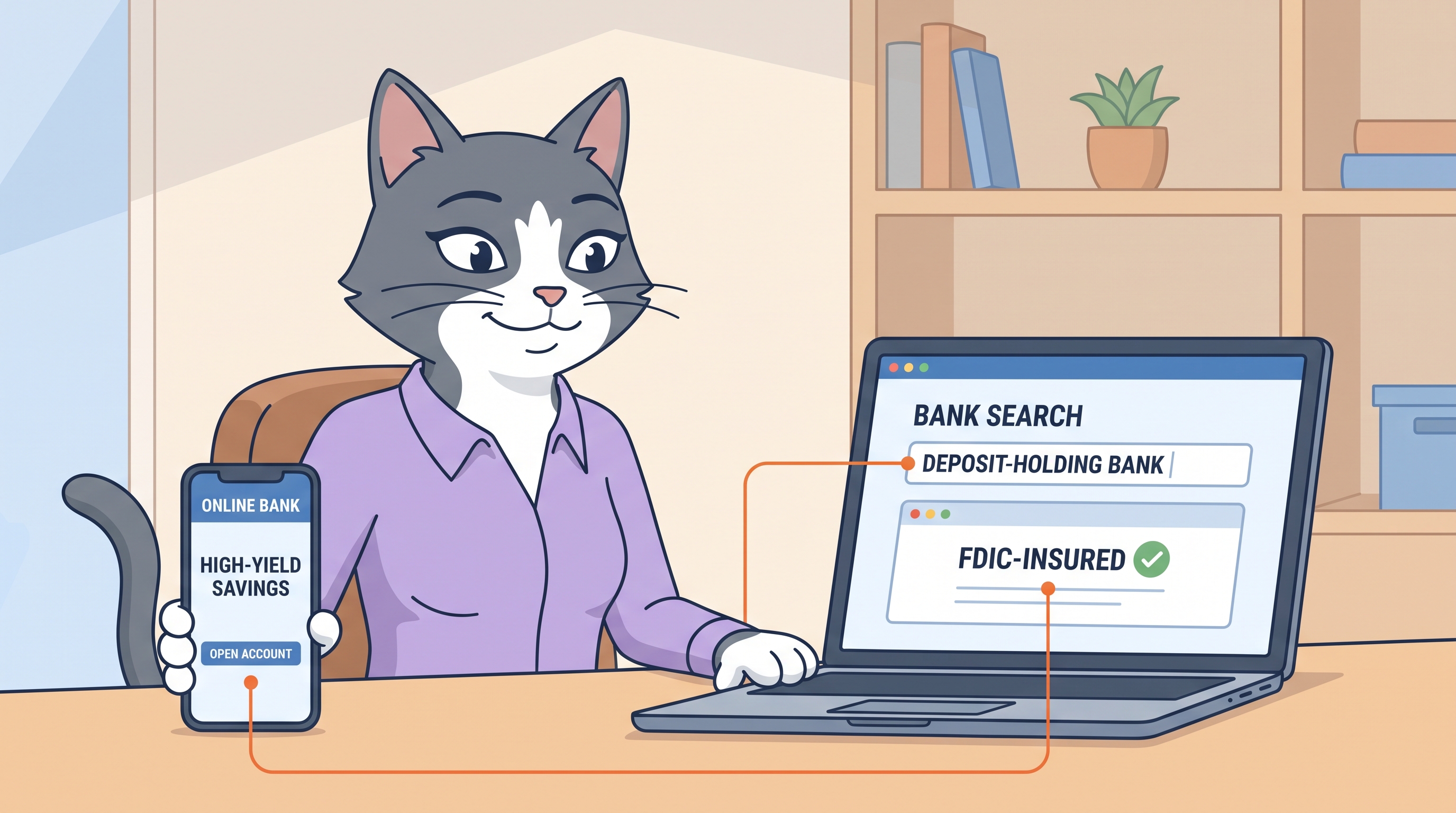
She opens the account. Her instinct to verify wasn't wrong at any point in this. Brand familiarity was just never the right thing to verify.
Before You Open Anything
Go to fdic.gov and search BankFind for any bank you're actually considering. That search is the verification brand familiarity can't replace.
If you're trying to decide whether switching to a HYSA is worth it in the first place, Is a High-Yield Savings Account Still Worth It? covers that decision directly. If the real question is where an emergency fund specifically should live, that's already answered here too.
Chuck Finance is for entertainment and informational purposes only. Chuck is not a financial advisor, and nothing in this post constitutes professional financial advice. FDIC insurance rules, coverage limits, and requirements are subject to change — verify current information at fdic.gov before making any banking decision. Any interest rate figures referenced reflect conditions at the time of publication; HYSA rates are variable and will change.
Sources
- Federal Deposit Insurance Corporation, "Deposit Insurance" and "Deposit Insurance at a Glance" — fdic.gov, current
- Federal Deposit Insurance Corporation, "Deposit Insurance FAQs" — fdic.gov/resources/deposit-insurance/faq
- Federal Deposit Insurance Corporation, "Trust Accounts" and "Your Insured Deposits" — fdic.gov (trust account coverage rules effective April 1, 2024)
- Federal Deposit Insurance Corporation, BankFind — fdic.gov, confirmed current
- Federal Deposit Insurance Corporation, "An Update on Reforms to the Regulatory Toolkit" — fdic.gov, 2026 (pass-through deposit insurance)
- Bankrate, Checking Account Survey — bankrate.com (average account tenure by institution type)