
Six Months Isn't a Calculation. It's a Benchmark.
"Three to six months of expenses" is perfectly reasonable advice. The trouble starts when you treat the range like someone already did the math for your household. They didn't.
Look at how wide that range already is. Three months to six months is a 100% difference. If your essential expenses run $4,000 a month, that's the gap between $12,000 and $24,000 — same rule, twice the target. The range is quietly telling you that your situation is supposed to decide where you land. Jenny skipped that part. Most people do.
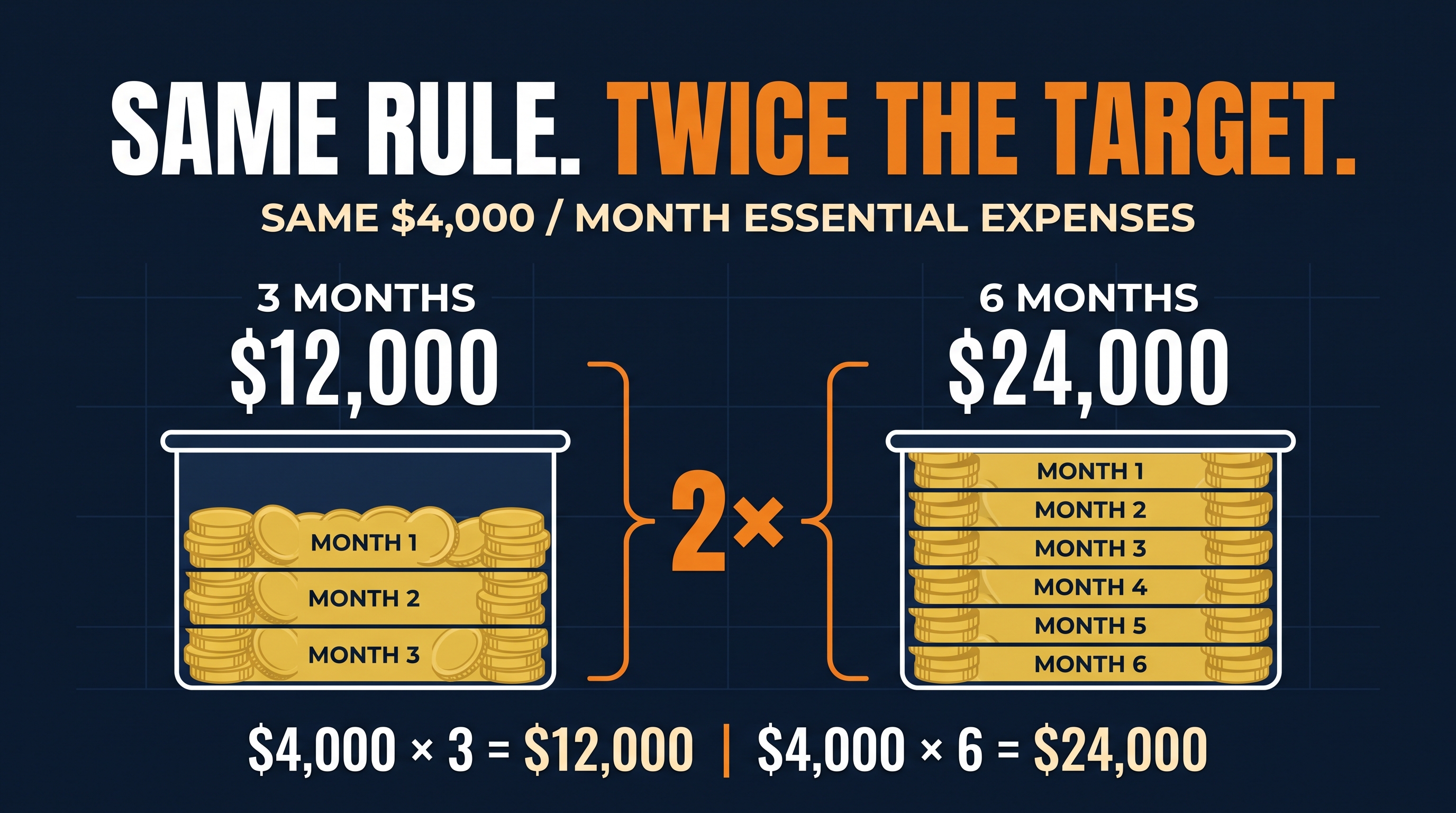
The 3–6 Month Rule
3–6 months of essential expenses set aside in cash
On $3,000 a month of essential expenses, that's a target somewhere between $9,000 and $18,000 — and the rule doesn't tell you which end is yours.
This Isn't About Whether You've Saved Enough Yet
Quick clarification before the framework. This isn't about whether you've managed to save three months yet. According to Bankrate's 2026 Emergency Savings Report, about 24% of Americans have no emergency savings at all, and fewer than half — 46% — could cover three months of expenses. That's a real problem. It's just a different problem. That's a question about what you're able to save. This post is about what you should be aiming at in the first place — and you can get that target wrong in either direction.
How Much Should Your Emergency Fund Be? Start With What It Covers
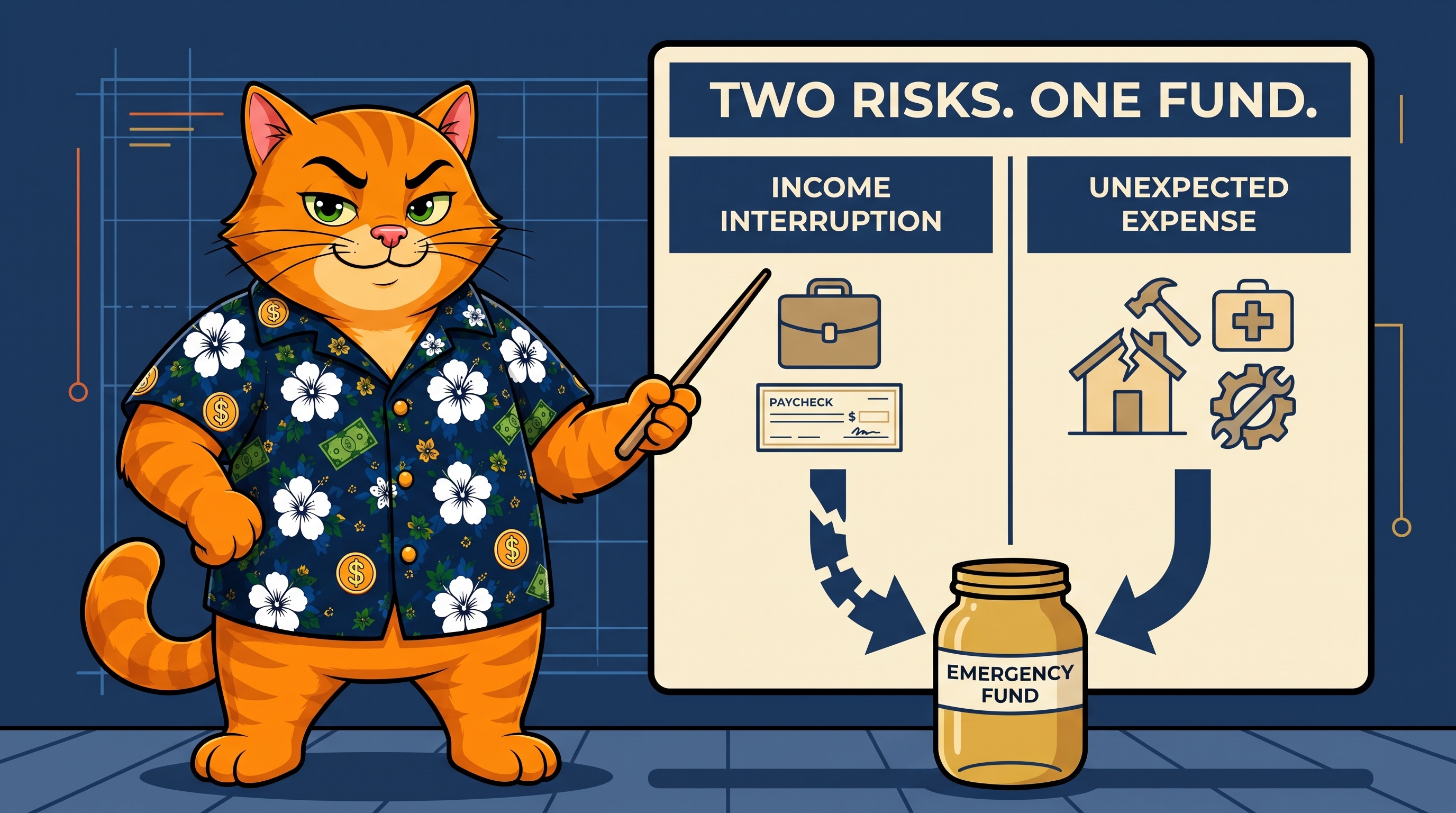
An emergency fund protects you from two different kinds of events, and one flat number can't price both.
The first is an income shock: you lose a job, lose a major client, lose a chunk of commission. Your paycheck stops or shrinks, but the bills don't.
The second is a spending shock: a medical bill, a major car repair, a dead water heater. Your income might be completely fine — you just suddenly need cash.
Those are not the same problem, and "six months of expenses" doesn't automatically cover both. So the real question splits in two: how long could the disruption last, and how much of it would your household actually have to absorb?
Income Shock: How Long Could Your Paycheck Stop?
Start with duration, because for most working households, lost income is the bigger risk.
In July 2026, the U.S. Bureau of Labor Statistics put the median duration of unemployment at about nine and a half weeks. The average was almost twenty-five. Both numbers are true at the same time: most job searches wrap up fairly fast, but a smaller group runs long — sometimes much longer — and that group drags the average up. Neither figure is your target. They just show that income disruptions vary enormously.
What is your target depends on how vulnerable your income is:
- How many paychecks does your household run on? One income has no shock absorber. Two incomes rarely stop in the same week.
- How stable is that income? A salary that's held for years is one thing. Contract, commission, freelance, or seasonal income that already swings month to month is another — part of that emergency fund is already covering normal dry spells, so the emergency layer on top has to be bigger.
- How replaceable is your specific role? Common skills that transfer easily mean a quick replacement. Specialized work, unusual pay for the title, or an industry that hires in slow bursts puts you closer to the long tail.
Then subtract what would keep coming in. If a partner still earns enough to cover part of the essentials, the fund is filling a gap, not replacing the whole budget. Unemployment benefits may replace part of a paycheck for a while. Contractually guaranteed severance counts too. But be conservative: money you know will be there belongs in the math. Money you're hoping shows up does not.
Spending Shock: The Hits That Skip the Monthly Installment Plan
Here's where "months of expenses" gets awkward. A broken appliance doesn't care what your monthly budget is. Neither does an insurance deductible or a large medical bill.
According to KFF's 2025 Employer Health Benefits Survey, among covered workers with an out-of-pocket maximum for single coverage, 72% had a maximum above $3,000, and 21% were above $6,000. A routine car repair usually runs $500 to $600 — annoying, not dangerous. A health event is a different category, and it doesn't scale with "months of expenses" at all. It's a wall. You either have cash for it or you don't.
That doesn't mean you bolt your entire out-of-pocket maximum onto six months of expenses. And it doesn't mean stacking every possible disaster on top of each other either — you don't need enough cash to simultaneously lose your job, replace the roof, max out your health insurance, and blow a transmission in the same month. The same dollar can cover whichever emergency actually happens first. You price the risks you actually have, not every bad thing that could theoretically occur.
Same Rule, Two Households: Jenny and Laura
Run the framework on two real-world cases.
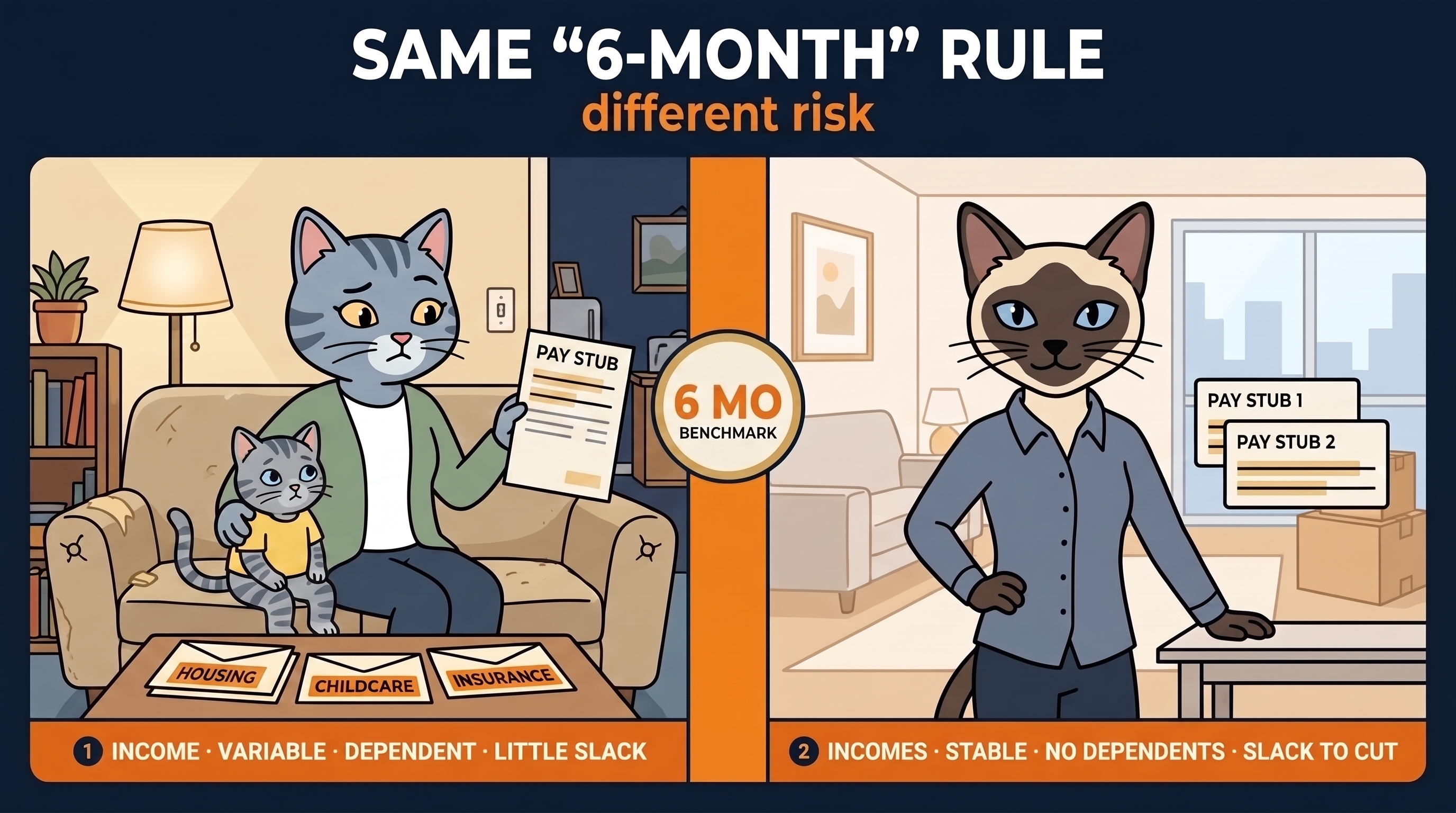
Jenny has one household income. Her work is specialized — only a handful of nearby employers hire what she does, so replacing that paycheck would likely take a while. She has a child, so a large share of her monthly spending is genuinely fixed and can't be cut fast. If her income stops, very little else is coming in. Run the four questions and every answer points the same way: her target belongs toward the high end of the range, and — depending on how hard her role is to replace — possibly past it. That's not paranoia. That's what her inputs say.
Laura has two household incomes. She's salaried, six years in a stable field, in a role that gets refilled in weeks. She rents, so no surprise roof or furnace. No dependents. Her health plan's out-of-pocket maximum is low. Same four questions, and every answer points the other way: for Laura, the low end of the range is honestly defensible.
Neither of them broke the rule. The rule just couldn't tell them apart. Two households, one benchmark, opposite conclusions — reached by running the same four questions, not by looking up a table.
What You Do With This Information
Don't swap "three to six months" for a new fixed number. Do this instead.
- Calculate your essential monthly expenses. Not your normal spending — what actually has to keep getting paid: housing, food, utilities, insurance, childcare you still need, minimum debt payments, necessary transportation. Say your normal spending is $4,000 but you could cut $1,000 fast; your runway rides on roughly $3,000, not $4,000. Six months of one is $24,000; six months of the other is $18,000. Same household, $6,000 apart, and you never touched the number of months.
- Look at your income replacement risk. One income or two? Stable or variable? Broad job market or narrow one?
- Calculate the gap. What reliable income or benefits would still arrive if your paycheck stopped? Your fund covers what remains.
- Price your large spending shocks separately. Insurance deductibles, your health plan's real out-of-pocket maximum (go look it up), likely repairs — the expensive things that don't give you six months to prepare.
Now compare that reality with your current balance. Maybe three months fits. Maybe six does. Maybe your situation gives you a legitimate reason to hold more. Too little leaves you exposed; too much ties up cash that could be working toward another goal. The number comes after the questions.
Three to six months is a good place to start. It's a bad place to stop thinking. Jenny hit six and checked the box — but the better question was never "did I reach six?" It was "what does this money actually need to protect me from?" Answer that first, and the number starts belonging to you.
Related reading: Where to Put Your Emergency Fund · Is a HYSA Still Worth It? · How Many Bank Accounts Should You Have?
Sources
- Bankrate — 2026 Annual Emergency Savings Report (survey conducted by YouGov, December 2–8, 2025)
- U.S. Bureau of Labor Statistics — The Employment Situation, July 2026 (duration of unemployment, Current Population Survey)
- KFF — 2025 Employer Health Benefits Survey (published October 2025)
Chuck Finance is for entertainment and informational purposes only. Chuck is not a licensed financial advisor, and nothing here constitutes professional financial, investment, legal, or tax advice. Always consult a qualified professional before making financial decisions.