

Table of Contents
Why FDIC Insurance Matters
Banks can fail. FDIC insurance exists so that when an FDIC-insured bank fails, eligible deposits are protected up to the applicable limits. The FDIC is a federal agency established in 1933, and FDIC-insured deposits are backed by the full faith and credit of the United States.
That distinction matters when the money has a job to do. Mabel and Theo aren't planning to gamble their house fund on the financial condition of a particular bank. They want to know what protection applies to their deposits if something goes wrong.
FDIC-insured doesn't mean a bank cannot fail. It means qualifying deposits have federal insurance if it does.
Money above the insurance limit isn't automatically lost in a bank failure. An uninsured depositor may recover some or all of that money through the bank's resolution process, but that recovery isn't guaranteed by FDIC deposit insurance. That's why knowing the limit is useful before a problem arises.
What FDIC Insurance Protects
The FDIC insures eligible deposits, not investments. Banks fund the insurance system through assessments paid by insured institutions.
| Generally eligible deposits at an FDIC-insured bank | Not FDIC-insured |
|---|---|
| Checking accounts, including NOW accounts | Stocks and bonds |
| Savings accounts | Mutual funds, including money market mutual funds |
| Money market deposit accounts | Annuities and life insurance policies |
| Certificates of deposit (CDs) | Safe deposit boxes and their contents |
| Cashier's checks, money orders and certain other official bank-issued items | U.S. Treasury securities, municipal securities and crypto assets |
A NOW account is a type of deposit account that functions much like an interest-bearing checking account. A money market deposit account is a deposit; a money market mutual fund is an investment. Similar names, different protections.
Buying a mutual fund through an insured bank doesn't make the fund FDIC-insured. U.S. Treasury securities have a different federal backing—the full faith and credit of the United States—but aren't FDIC-insured deposits.
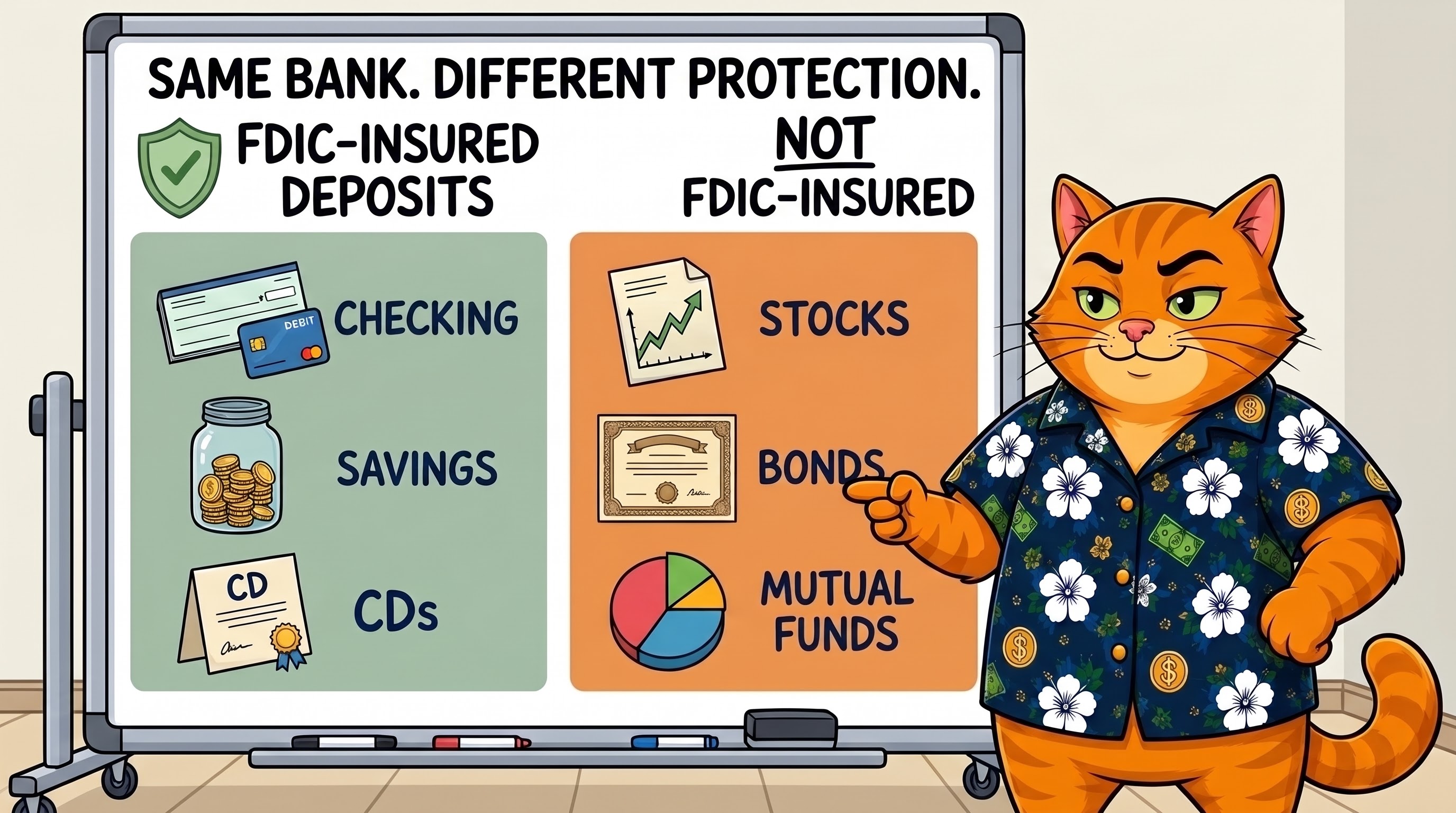
Mabel's HYSA and CD are deposit products that can qualify. Her next question is how their balances are counted.
The Three-Part Rule
$250,000 per depositor, per FDIC-insured bank, per ownership category.
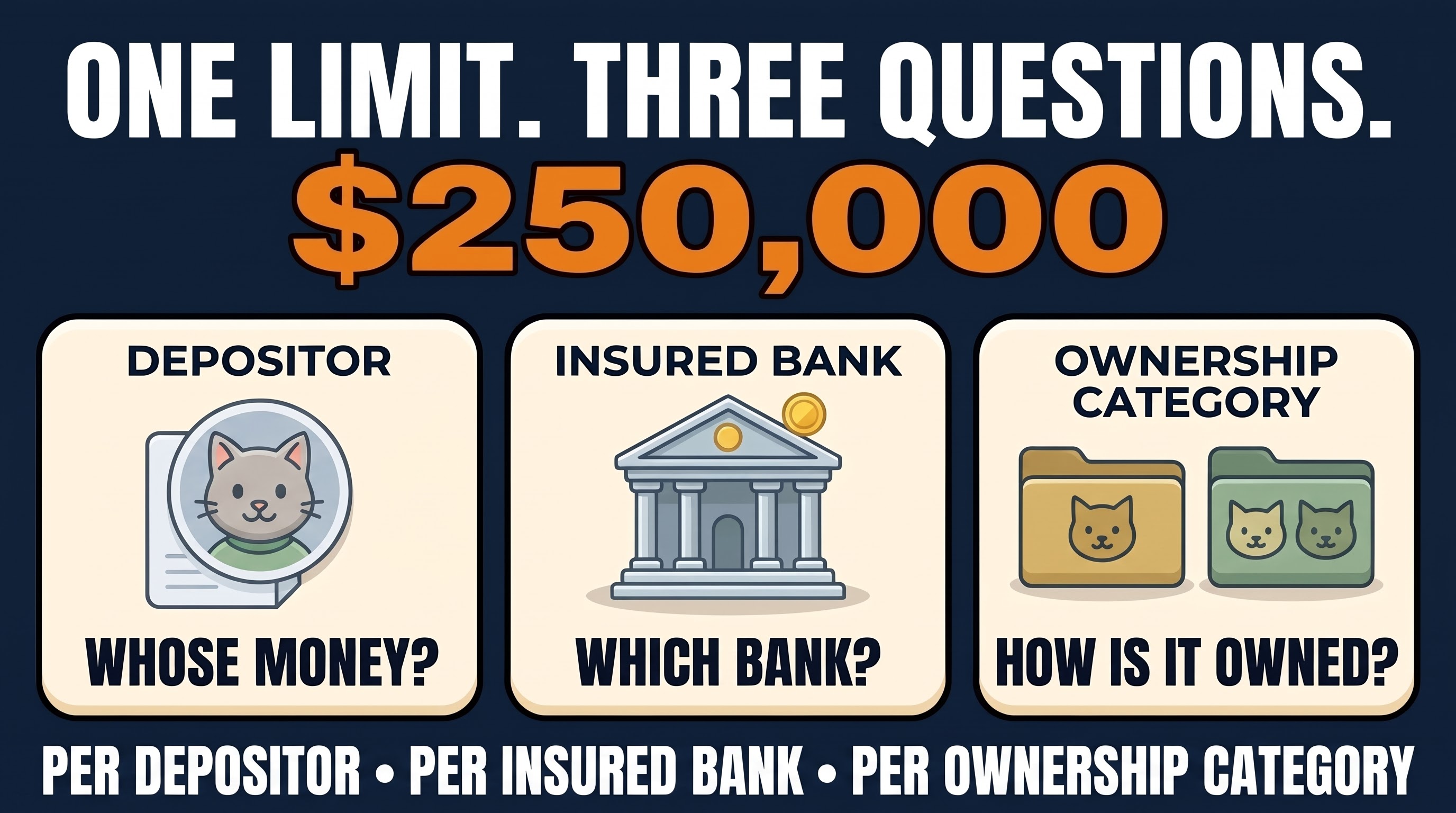
Per depositor: The limit follows the owner, not the account number. Mabel's single-name HYSA and CD at Bank A are generally combined.
Per insured bank: Each genuinely separate FDIC-insured bank has its own calculation. Two branches of one bank don't create separate limits. Two app names might also refer to the same insured bank.
Per ownership category: Qualifying single accounts and qualifying joint accounts are counted separately. Being partners—or even spouses—doesn't automatically change the legal ownership of an account.
The FDIC has other categories, including certain retirement, trust, business, employee benefit and government accounts. Their requirements aren't covered here. Our examples focus on ordinary single accounts and qualifying joint accounts without beneficiaries.
Interest counts too. Principal and accrued interest are included in the insurance calculation, up to the applicable limit.
Mabel's Five FDIC Calculations
As Mabel and Theo get closer to buying their house, we'll follow the same dollars through five stages. Each step builds on the last, including the interest Mabel earns and the money Theo brings from his condo sale.
1. Mabel has $300,000 at one bank
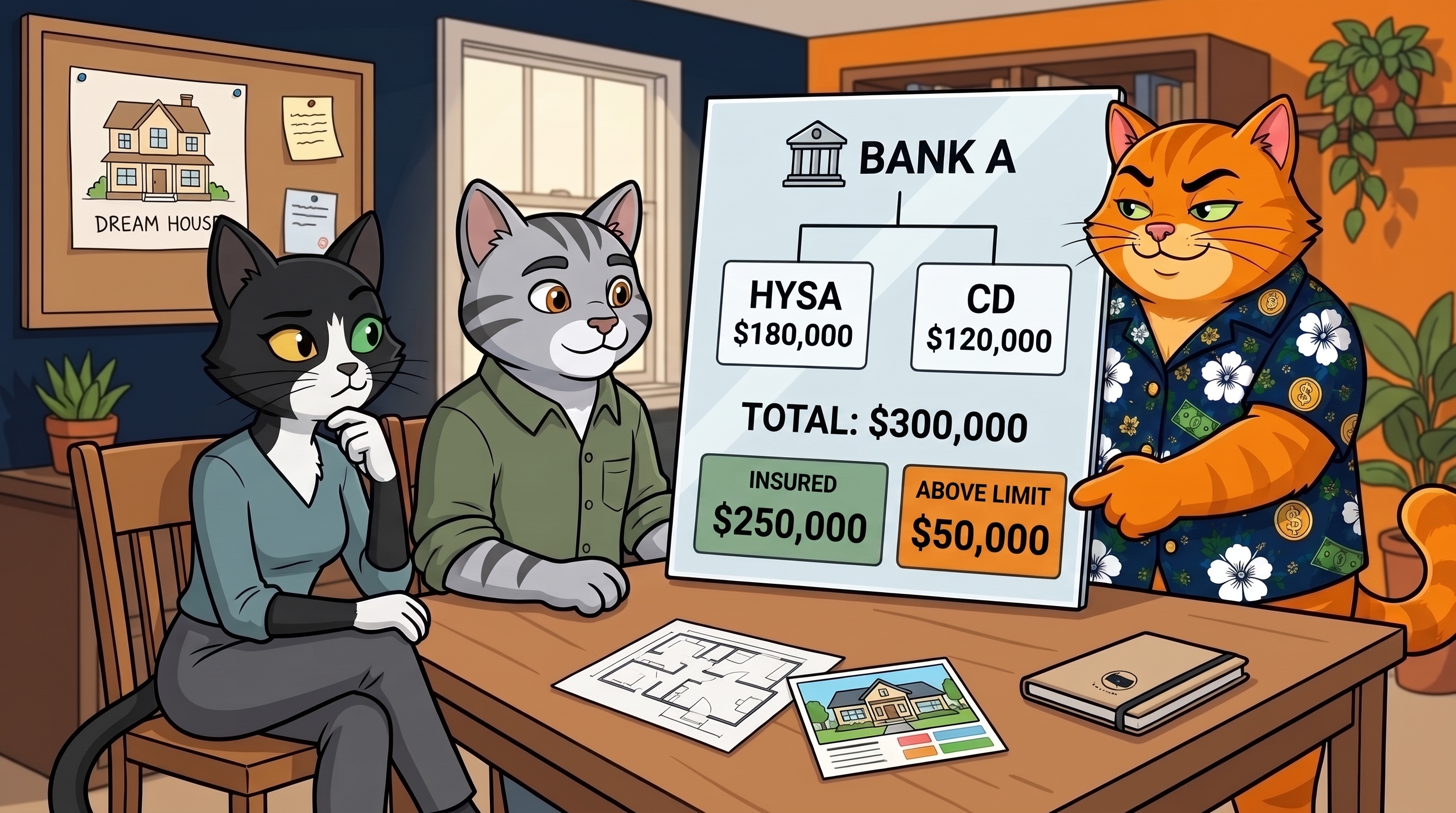
At Bank A, Mabel's HYSA holds $180,000. Her CD will pay $120,000 at maturity; for this first calculation, that's its balance including the interest payable at maturity. Both accounts are in her name alone and are treated here as ordinary single accounts.
| Mabel's Bank A deposits | Balance |
|---|---|
| HYSA | $180,000 |
| CD | $120,000 |
| Combined single-account deposits | $300,000 |
| FDIC-insured | $250,000 |
| Above the insurance limit | $50,000 |
The CD doesn't get its own $250,000 limit. It's the same depositor, the same insured bank and the same ownership category, so the FDIC adds the balances together.
This is the first surprise for Mabel: two accounts aren't necessarily two insurance limits.
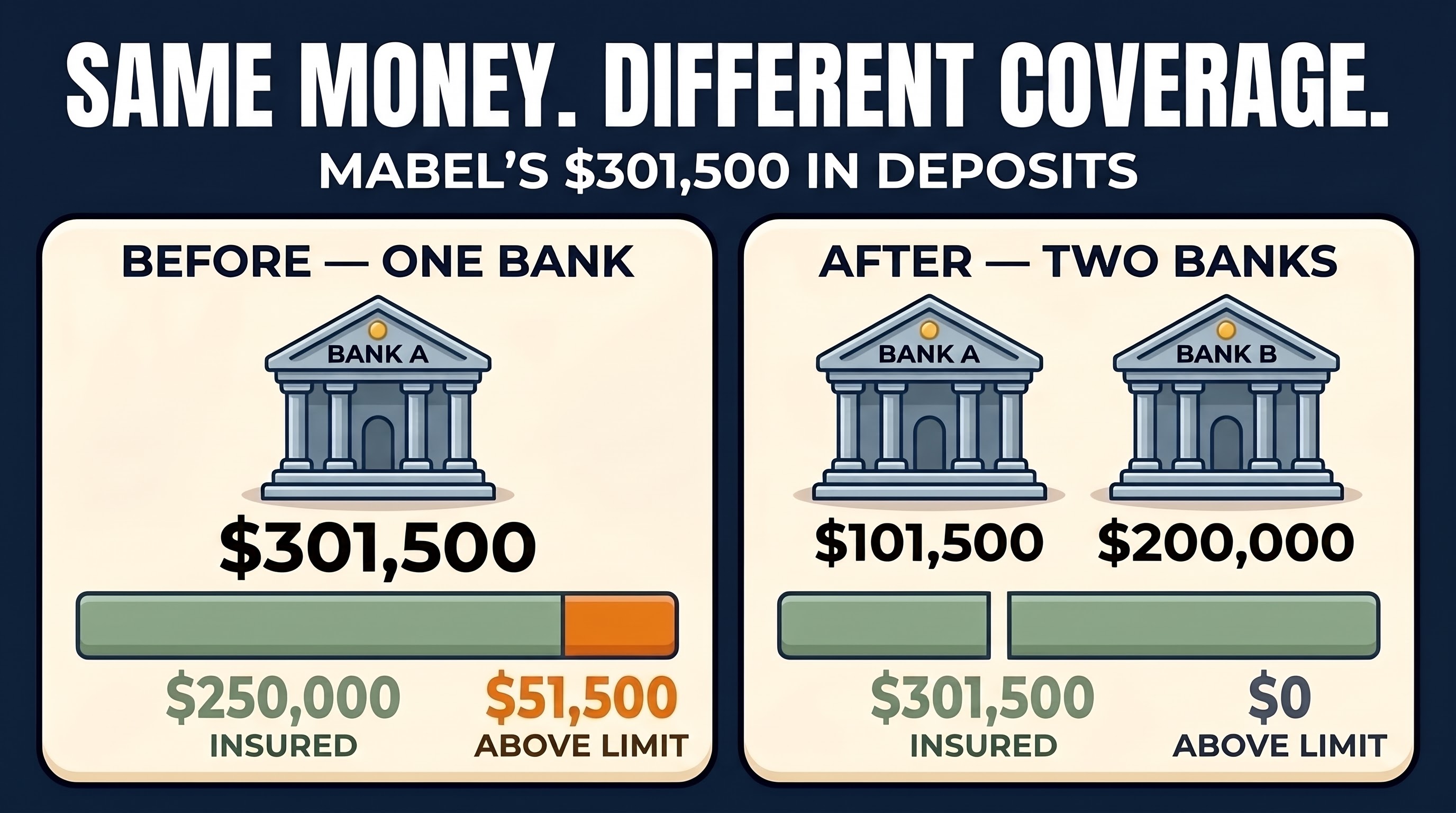
2. Her interest brings the balance to $301,500
While Mabel waits for her CD to mature, her HYSA earns $1,500 in interest. Its balance rises to $181,500. Her CD's $120,000 maturity value stays the same in our calculation; that figure already includes the CD interest due at maturity.
| Mabel's Bank A deposits | Balance |
|---|---|
| HYSA, including interest | $181,500 |
| CD | $120,000 |
| Combined single-account deposits | $301,500 |
| FDIC-insured | $250,000 |
| Above the insurance limit | $51,500 |
Mabel hasn't deposited another dollar, but the amount above the limit has grown. The FDIC includes accrued interest when calculating insured deposits through the date a bank fails.
3. Her CD matures, and she moves $200,000
A few weeks later, Mabel's CD matures and pays out $120,000, including its interest. She has already checked the maturity notice and given the bank the instructions needed to cash out rather than automatically renew. She hasn't broken the CD early or paid an early-withdrawal penalty.
Having learned how the per-bank rule works, Mabel decides to move $200,000 to Bank B, a separate FDIC-insured bank. She uses the $120,000 from her matured CD and $80,000 from her HYSA. The remaining $101,500 stays at Bank A.
| Mabel's single-name deposits | Bank A | Bank B |
|---|---|---|
| Balance after transfer | $101,500 | $200,000 |
| FDIC-insured | $101,500 | $200,000 |
| Above the limit | $0 | $0 |
Total: still $301,500. Nothing was added or spent. Her deposits are now counted separately at two insured banks.
This is Mabel's decision in her own circumstances, not a recommendation that every reader move or divide deposits. The lesson is that the insured bank—not the number of accounts, apps or branches—is the unit used in this part of the rule.
4. Theo's condo sale introduces joint ownership
Theo's condo sale closes, leaving him with $260,000 in net proceeds after the sale's costs and obligations. He puts the proceeds in a single-name deposit account at Bank A while they decide how to handle their house money. Mabel still has $101,500 at Bank A and $200,000 at Bank B. The condo proceeds explain why they have more cash available than Mabel's savings alone.
Together, they now have $561,500 earmarked for their home purchase and reserves: Mabel's $301,500 plus Theo's $260,000.
They decide to open a qualifying joint deposit account at Bank B. Mabel contributes $100,000 from her Bank B savings, and Theo transfers $200,000 from his Bank A account. Their new joint account holds $300,000.
Here's where every dollar sits afterward:
| Account | Balance | How it's counted |
|---|---|---|
| Mabel's single account at Bank A | $101,500 | Mabel's single category at Bank A |
| Mabel's single account at Bank B | $100,000 | Mabel's single category at Bank B |
| Theo's single account at Bank A | $60,000 | Theo's single category at Bank A |
| Mabel and Theo's joint account at Bank B | $300,000 | Joint category at Bank B; $150,000 share each |
| Combined savings | $561,500 |
At Bank B, Mabel's $100,000 single-account balance and her $150,000 interest in the qualifying joint account are counted in separate ownership categories. Neither exceeds its own $250,000 limit. Theo's $150,000 joint share is counted separately from Mabel's share. Their remaining single-name balances at Bank A are also within their respective limits.
For qualifying joint accounts, the FDIC generally assumes equal co-owner shares unless the bank's deposit records clearly indicate otherwise. Joint coverage also has requirements, including equal withdrawal rights. Two names on an account don't establish eligibility in every situation.
And here's the distinction Mabel needed: being Theo's partner never automatically changed the insurance category of her individual accounts. Opening and funding a qualifying joint account did.
5. They consider keeping the whole house fund jointly
With a down payment, closing costs and renovation bills ahead, Mabel and Theo talk about whether one joint account would make their house spending easier to manage. Before they combine anything else, they calculate what would happen if they consolidated all $561,500 into their qualifying joint account at Bank B.
That would mean adding Mabel's remaining $100,000 at Bank B, her $101,500 at Bank A, and Theo's $60,000 at Bank A to the existing $300,000 joint balance. No new money appears: $300,000 + $100,000 + $101,500 + $60,000 = $561,500.
Assuming equal ownership shares and no other joint deposits at Bank B, the calculation would be:
| Joint-account calculation | Mabel | Theo |
|---|---|---|
| Share of $561,500 | $280,750 | $280,750 |
| FDIC-insured | $250,000 | $250,000 |
| Above the limit | $30,750 | $30,750 |
Total insured: $500,000. Total above the limit: $61,500.
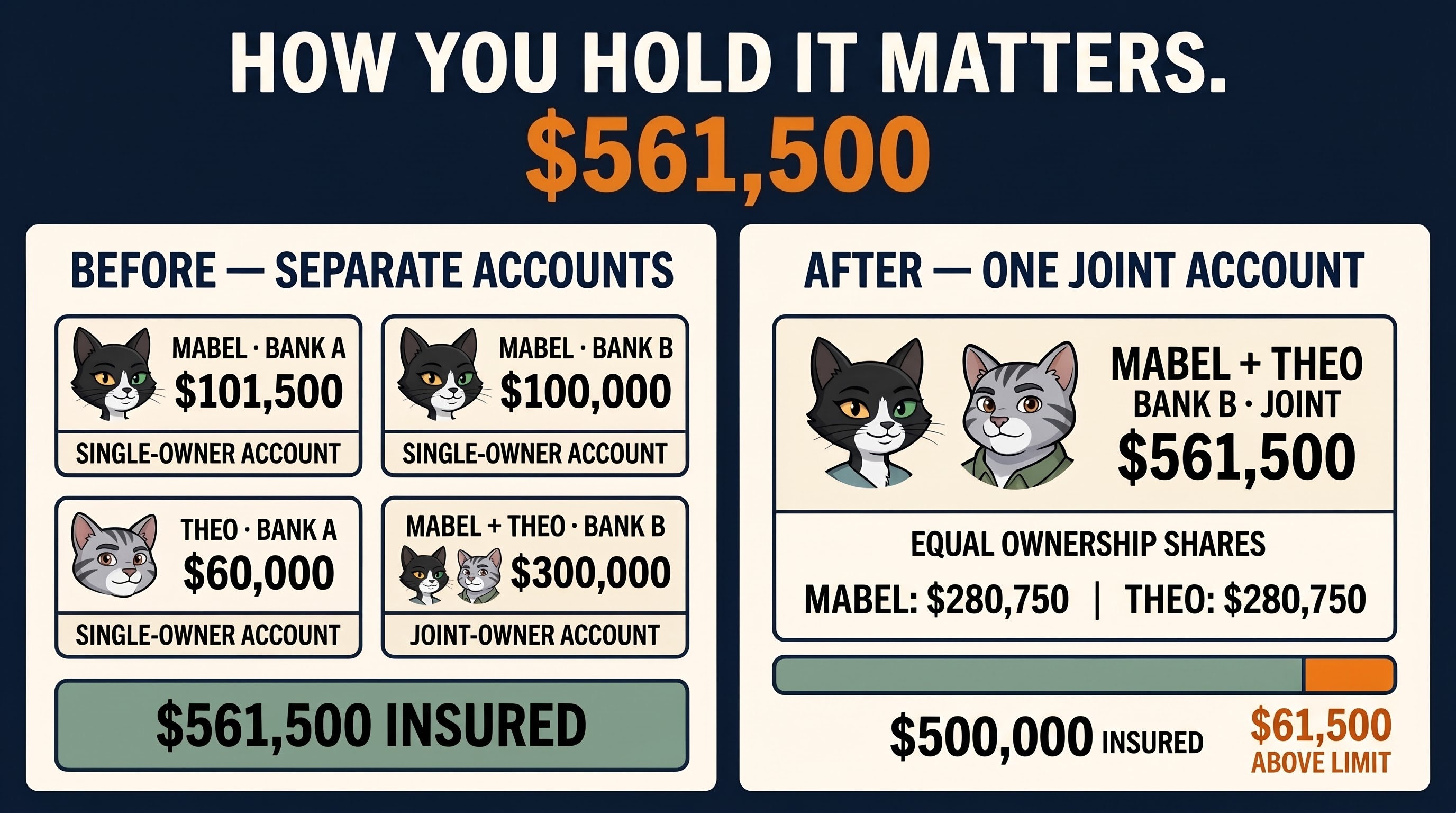
Notice the contrast. In Example 4, their entire $561,500 fell within the illustrated limits across their separate accounts and ownership categories. If they put it all into one qualifying joint account at one insured bank, $61,500 would exceed that account category's combined coverage.
The Three-Part Rule
$250,000 per depositor, per FDIC-insured bank, per ownership category
Mabel has $180,000 in savings and $120,000 in a CD at the same insured bank, both in her name alone. Of her $300,000 total, $250,000 is insured and $50,000 is above the limit.
The amount of money hasn't changed. The way it's owned and held has. That's why Mabel can't determine coverage just by looking at one big balance or the bank's FDIC sign.
What About Credit Unions?
Federally insured credit unions use a different federal insurer: the National Credit Union Administration (NCUA), through the National Credit Union Share Insurance Fund, rather than the FDIC.
The standard NCUA amount is also $250,000 per member-owner, per ownership category, at each federally insured credit union, subject to its own rules. Not every credit union has federal share insurance, so the institution's insurance status matters there too.
That's the distinction to know here. Mabel's calculations concern FDIC-insured banks, not the full NCUA rulebook.
How to Check Your Own Coverage
Before Mabel and Theo make an offer, she sits down with their account statements. She's no longer asking whether Bank A sounds established enough. She's asking what the insurance rules actually protect.
You can follow the same approach: identify the insured bank holding each deposit; note who legally owns each account and its ownership category; then total eligible balances, including accrued interest, within the applicable categories and banks.
If your accounts involve beneficiaries, trusts, retirement accounts or other special ownership arrangements, don't extend Mabel's simplified examples to them. The FDIC has separate requirements for those categories.
The FDIC's free Electronic Deposit Insurance Estimator (EDIE) can help calculate coverage from actual account information. And if your larger question is where to keep cash for near-term needs, Your Emergency Fund Is in the Wrong Place addresses that separate decision.
The Bottom Line
Mabel and Theo haven't bought their house yet. The kitchen still needs remodeling, the yard still needs work, and they still have decisions to make about their savings before they make an offer.
Mabel began by worrying about leaving so much of their future house money at a smaller online bank she knew little about. She hasn't learned to predict whether Bank A will succeed or fail. She's learned something more useful: FDIC insurance protects eligible deposits if an insured bank fails, and the amount covered depends on the depositor, the insured bank and the ownership category.
You don't have to predict whether a bank will fail to understand what happens to your deposits if it does.
The money Mabel spent years saving deserves more than an assumption. Now she knows what to check.
And that knowledge gives her something valuable: peace of mind.
Mabel and Theo can move forward knowing they've taken the time to understand how their savings are protected. They can't predict what might happen to a bank, but they can make informed decisions about the money they've worked so hard to earn.
A few months later, they've moved into their new home. The kitchen renovation is complete, and they're finally enjoying the life they spent years planning.

Because financial literacy isn't just about protecting the money you've earned.
It's about having the confidence to build the life you've been saving for.
Chuck Finance is for entertainment and informational purposes only. Chuck is not a licensed financial advisor, and nothing in this post constitutes professional financial, investment, legal, or tax advice. Always consult a qualified professional before making financial decisions.
Rules and figures are presented as of November 2, 2026, and may change. Verify current information at fdic.gov before making banking decisions. Mabel and Theo are fictional characters used to illustrate the rules. This post is not sponsored, contains no affiliate or referral links, and does not recommend any bank, credit union or product.
Sources
- Federal Deposit Insurance Corporation, Understanding Deposit Insurance — standard coverage, per-bank aggregation, ownership categories and eligible deposits.
- Federal Deposit Insurance Corporation, Your Insured Deposits — single and joint accounts, interest and exclusions.
- Federal Deposit Insurance Corporation, Deposit Insurance at a Glance — insured and uninsured products and ownership rules.
- Federal Deposit Insurance Corporation, Electronic Deposit Insurance Estimator — calculations based on actual account details.
- Federal Deposit Insurance Corporation, What We Do — agency purpose and insurance-fund funding.
- National Credit Union Administration, Share Insurance Coverage and Share Insurance FAQs — federal credit-union share insurance.