Table of Contents
The Differences That Are Real
The difference between a credit union and a bank starts with how they're organized. That matters. But it doesn't automatically tell you which account will work better.
Ownership. The NCUA describes a credit union as a member-owned financial cooperative. Members elect its volunteer board of directors. Many banks are stock-owned, meaning shareholders own them; some banks are mutual institutions owned by depositors. So the blanket claim that bank depositors are never owners would be wrong.
Purpose. Credit unions operate on a not-for-profit cooperative model. The NCUA says that model is intended to return benefits to members through things such as rates and fees. That's how the model works in principle, not a promise that every credit union will beat every bank on a specific account.
Eligibility. Credit unions have a field of membership that determines who can join. Depending on the credit union, eligibility may be connected to an employer, family relationship, association or community. Banks generally don't have that credit-union-style membership restriction, though individual accounts can still have opening requirements.
Both types of institutions can offer familiar services such as checking, savings and certificates of deposit (CDs). Here's the structural comparison:
| Credit union | Bank | |
|---|---|---|
| Ownership | Member-owned cooperative | May be shareholder-owned or mutually owned |
| Operating model | Not-for-profit cooperative | Depends on bank structure |
| Eligibility | Must meet the credit union's field of membership | No equivalent credit-union membership test; account requirements may apply |
| Federal deposit/share insurer | NCUA, if federally insured | FDIC, if FDIC-insured |
| Standard federal insurance amount | $250,000 per member-owner, per ownership category, per federally insured credit union | $250,000 per depositor, per insured bank, per ownership category |
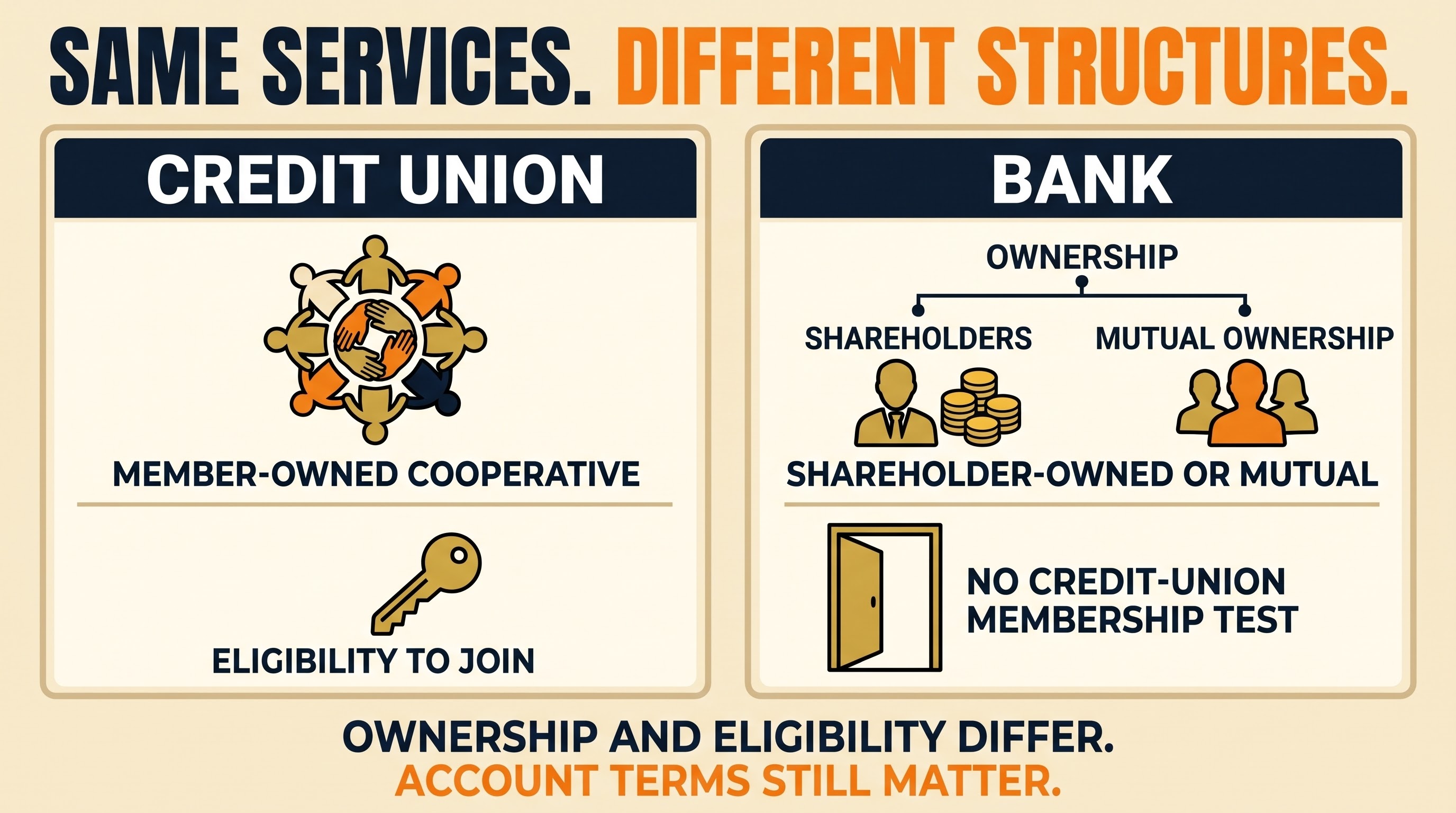
The ownership distinction is real. But I wouldn't use it as a shortcut for judging an account's actual terms.
Insurance: Same Standard Amount, Different Agency
FDIC-insured banks have FDIC deposit insurance, while federally insured credit unions have NCUA share insurance. Both programs have a standard $250,000 limit, subject to their respective ownership and coverage rules. Not every state-chartered credit union is federally insured: all federal credit unions and most state-chartered credit unions have NCUA coverage. Check the official NCUA sign or the NCUA Credit Union Locator for a credit union, and verify a bank through the FDIC's BankFind Suite. If you need to understand how FDIC coverage is counted, read What Is FDIC Insurance? How the $250,000 Limit Works. Insurance is one essential check, not a blanket guarantee about every balance or a reason to declare one institution type the winner.
What the Rate Data Shows
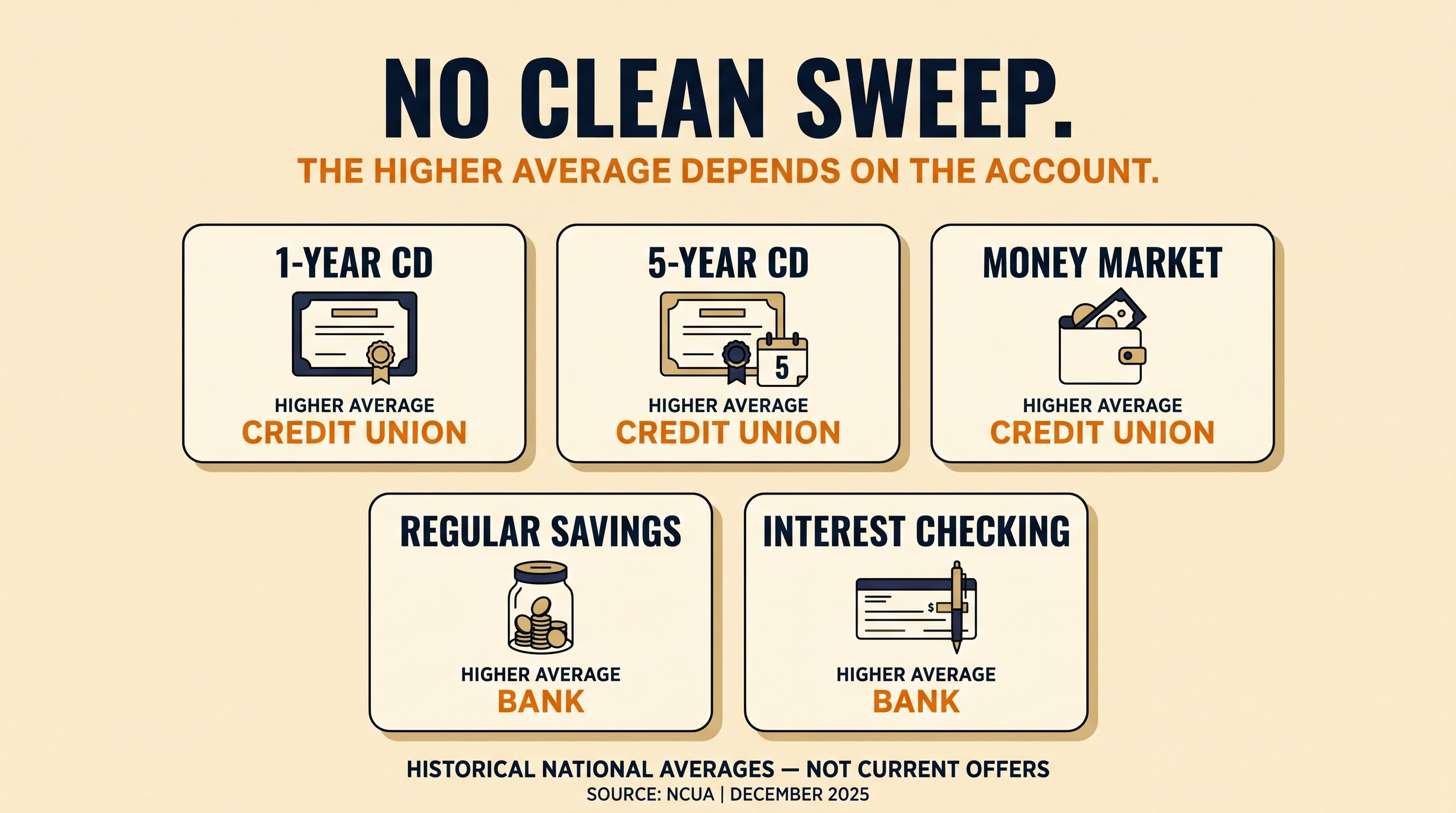
The NCUA publishes a comparison of national average rates at credit unions and banks using S&P Global Market Intelligence data. These are the deposit figures from December 26, 2025:
| Product (national average rate) | Credit unions | Banks | Higher average |
|---|---|---|---|
| 1-year CD ($10,000) | 2.95% | 2.29% | Credit unions |
| 5-year CD ($10,000) | 2.83% | 2.11% | Credit unions |
| Money market account ($2,500) | 0.74% | 0.52% | Credit unions |
| Regular savings account ($2,500) | 0.19% | 0.32% | Banks |
| Interest checking account ($2,500) | 0.15% | 0.20% | Banks |
Source: NCUA, Credit Union and Bank Rates, December 26, 2025. The final column simply identifies which of the two published national averages is higher. These are not advertised rates for a particular institution or the best available rates.
The pattern isn't a clean sweep. Credit unions had higher averages for the two CDs and money market accounts. Banks had higher averages for regular savings and interest checking.
Here's where I draw the line: I don't care which type of institution is supposed to offer better rates. I care what the account in front of you actually pays, what it charges, and whether you'll use it. National averages can tell you where to start looking. They can't make the decision for you.
Keep three things in mind when reading the table:
- Averages aren't offers. The actual rate at a specific bank or credit union may be higher or lower.
- Product categories matter. A regular savings average isn't the same as a competitive high-yield savings offer. For that separate question, see Is a High-Yield Savings Account Still Worth It?.
- Rates change. This is a snapshot from December 2025, not a quote you can accept today.
For completeness, the same NCUA edition reported lower credit-union averages than bank averages across its listed loan categories. That observation doesn't tell you what loan you'd qualify for, and loans aren't the subject of this comparison. You can inspect the original NCUA rate table.
Fees and Access: What No Average Shows You
The NCUA's rate table gives us comparable averages. It doesn't give us a universal answer about which type charges less in fees. I won't pretend that a not-for-profit label guarantees a cheaper checking account. The fee schedule is where you find out.
For the account you're considering, check the monthly maintenance fee and how to waive it, overdraft and nonsufficient-funds fees, out-of-network ATM charges, and any minimum balance requirements. A fee that can be waived isn't necessarily a fee you'll pay; the waiver conditions matter.
Then check access. Are there ATMs where you work or travel? Do you need a branch? Some credit unions participate in shared-branch or ATM networks, but participation and available services vary. Confirm the specific network and locations rather than assuming they're included. And if mobile banking matters to you, test the app's features against what you actually need.
A great advertised rate is less exciting when the account adds costs or friction to your week.
Allison Runs the Numbers
Allison has been setting money aside for a future home purchase. She's considering a one-year CD while keeping a checking account for everyday expenses.
She also travels for work about two weeks each month. That makes access more than a minor convenience. Her employer makes her eligible to join a credit union, so she has both options on the table.
Allison has $10,000 set aside for a one-year CD, and she's comparing a bank with a credit union she qualifies to join through her employer. She also needs a checking account that works with her travel schedule. She's on the road two weeks a month, so convenient ATM access matters just as much as avoiding unnecessary fees.
The NCUA's national average CD rates give us a useful starting point for seeing how much the difference in interest could be worth.
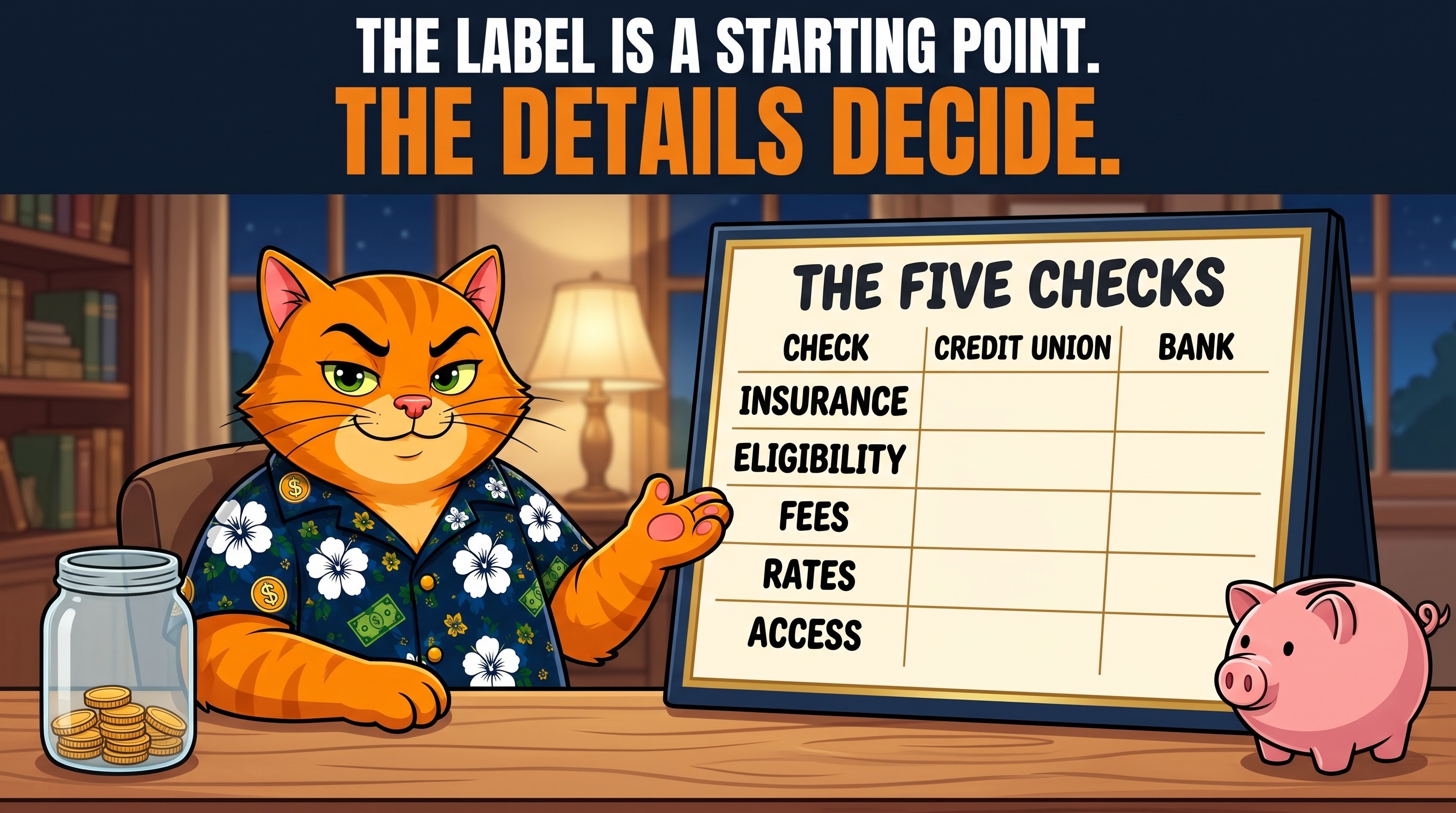
The Five Checks
Insurance, eligibility, fees, rates, access — checked at the specific institution, not assumed from its label
At the published national average 1-year CD rates, $10,000 earns $66 more in simple annual interest at 2.95% than at 2.29%. A $10 monthly fee, if charged, costs $120 a year. Check the actual rate and fee waiver.
| Check | Bank | Credit union |
|---|---|---|
| Federal insurance | FDIC-insured | Federally insured; NCUA coverage verified |
| Eligible to open account | Yes | Yes, through her employer |
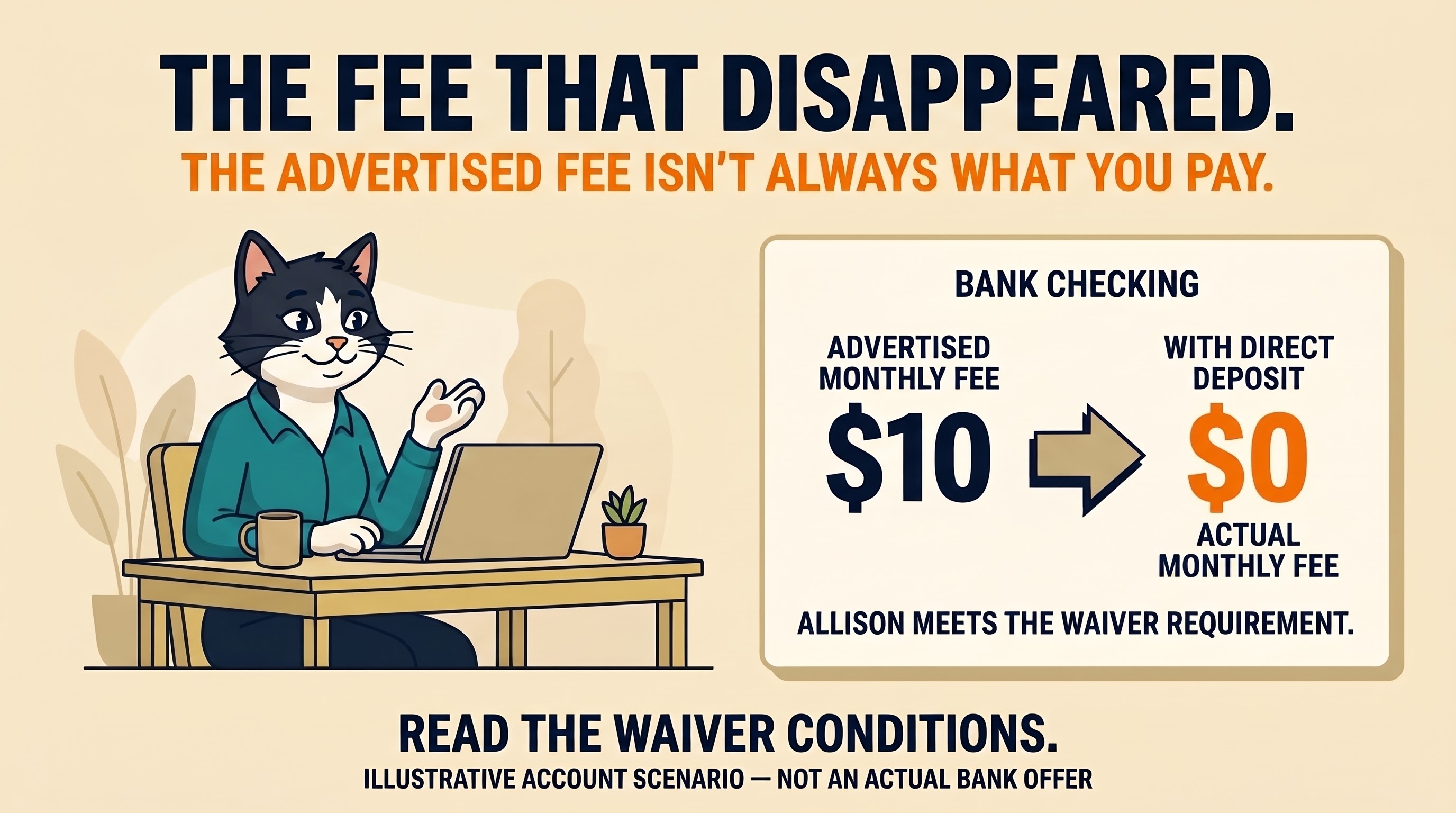
| Checking fee | $10 monthly, waived with direct deposit | No monthly maintenance fee |
| 1-year CD rate (national average) | 2.29% | 2.95% |
| Access while traveling | ATMs and branches in both cities she visits | One local branch; no shared-branch network in her travel cities |
Now the math. On $10,000 for one year, 2.95% earns $295 and 2.29% earns $229 using simple annual interest. That's a $66 difference before taxes, assuming the same starting balance and no compounding. Actual CD yields can differ based on compounding and account terms.
The bank's advertised $10 monthly checking fee would be $120 a year if Allison had to pay it—almost twice that $66 CD gap. But she receives her pay by direct deposit and meets the waiver requirement, so her actual bank checking fee is $0. That's why reading the waiver matters more than reacting to the fee printed in large type.
Allison doesn't need one institution to win every category. She keeps checking at the bank because its access works with her travel schedule. For the CD, the credit union's rate is higher, so that's the option she favors.
Allison isn't suggesting you divide your accounts the same way. She found what works for her: a checking account that fits her routine and a CD that earns more interest. Her decision came down to her needs and the account terms, not whether the institution was called a bank or a credit union.
What You Do With This Information
If you're comparing a bank vs credit union, run these five checks on the actual institutions and accounts you're considering:
- Insurance. Confirm FDIC coverage for a bank or federal NCUA coverage for a credit union. Don't assume coverage from the name alone.
- Eligibility. If it's a credit union, check its field of membership. For either institution, confirm you meet the account's opening requirements.
- Fees. Read the fee schedule and write down the fees you'd actually pay after any waivers.
- Rates. Compare the current rate and terms for the specific account you want—not the national average for its institution type.
- Access. Check the branches, ATMs, network participation and digital features against your routine.
You don't necessarily need to keep everything at one institution. If you're thinking about how to organize multiple accounts, There's No Right Number of Bank Accounts — Here's What Matters Instead addresses that separate decision.
Where That Leaves You
Allison didn't find one institution that won at everything. She found a checking account that fit her routine and a CD that paid more somewhere else.
That's what I want you to take away from this comparison. Don't give a bank your business just because it's familiar, and don't choose a credit union solely because it's member-owned. Make each account earn its place.
The label tells you what kind of institution you're looking at. The details tell you whether it's worth your money.
Chuck Finance is for entertainment and informational purposes only. Chuck is not a licensed financial advisor, and nothing in this post constitutes professional financial, investment, legal, or tax advice. Always consult a qualified professional before making financial decisions.
Rates and rules are as of the dates shown and can change. Verify current information at ncua.gov and fdic.gov before making any banking decision. Allison's circumstances and account comparisons are an illustrative narrative, not a documented customer case or actual institution offers; the national average rates are the published NCUA figures. This post is not sponsored, contains no affiliate or referral links, and does not recommend any particular bank, credit union or product.
Sources
- National Credit Union Administration, MyCreditUnion.gov, How Is a Credit Union Different From a Bank? — mycreditunion.gov (member ownership and control, not-for-profit cooperative model, membership eligibility and services).
- National Credit Union Administration, Share Insurance Coverage — ncua.gov (standard federal share insurance coverage, NCUA sign and institution verification).
- National Credit Union Administration, Frequently Asked Questions About Share Insurance — ncua.gov (federal and state-chartered credit union coverage).
- National Credit Union Administration, Credit Union and Bank Rates, December 26, 2025 — ncua.gov (national average rates; S&P Global Market Intelligence source).
- U.S. Government Accountability Office, GAO-04-91 (October 2003) — gao.gov (credit-union membership restrictions compared with banks; historical structural source).
- Federal Deposit Insurance Corporation, Understanding Deposit Insurance — fdic.gov (standard FDIC coverage amount and ownership categories).
- Federal Deposit Insurance Corporation, BankFind Suite — fdic.gov (verify whether a bank is FDIC-insured).
- Federal Deposit Insurance Corporation, Mutual Institutions: Owned by the Communities They Serve — fdic.gov (mutual savings banks and savings and loans are owned by their depositors).