
Table of Contents
The Savings Rate Formula
Savings rate = money saved ÷ income measured × 100
Say you bring home $4,000 this month and move $400 into savings.
$400 ÷ $4,000 × 100 = 10%
You saved 10% of your take-home pay. That's the calculation. Use the same month—or the same year—for both numbers.
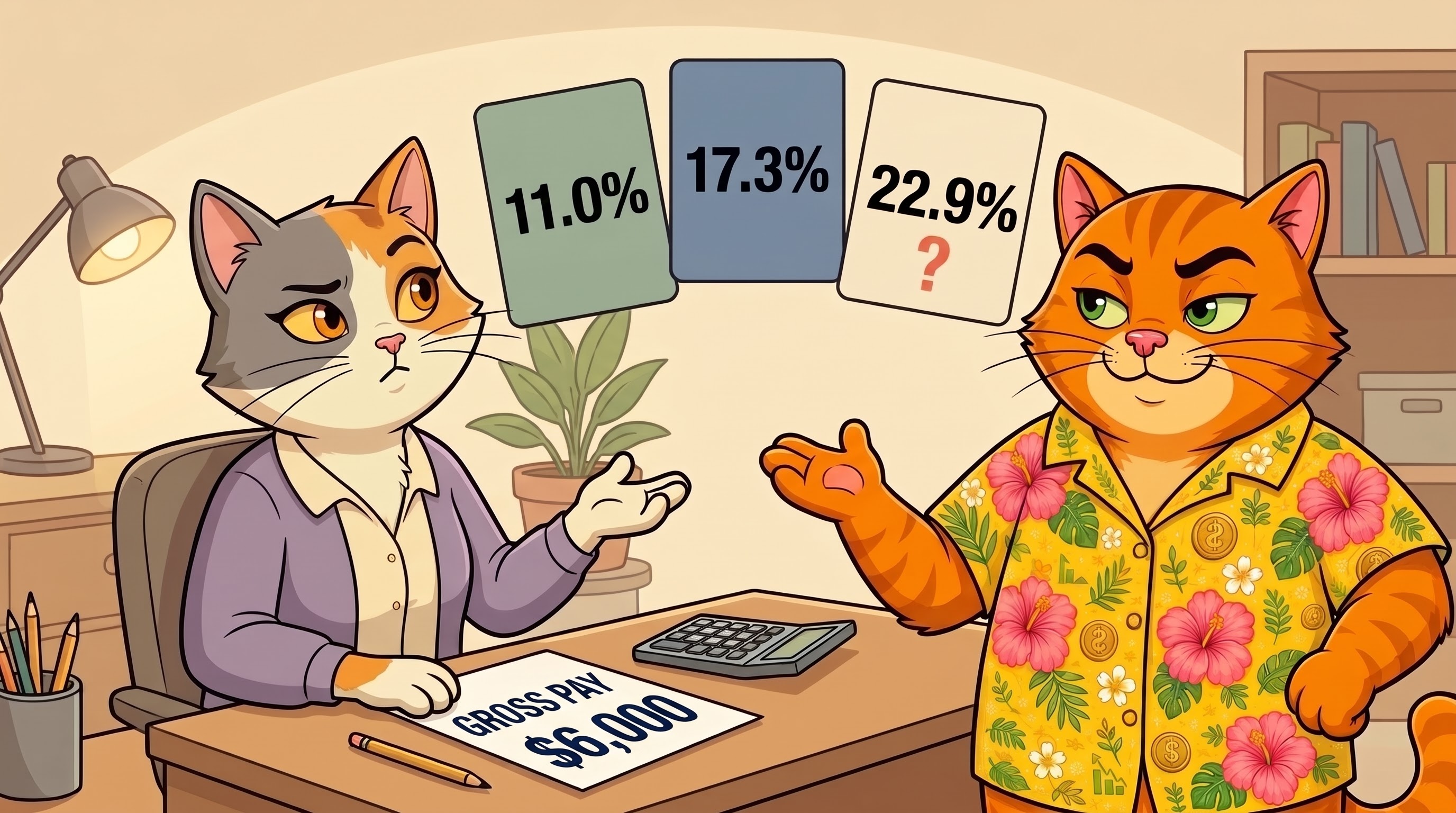
But a paycheck can have savings tucked away before you ever see it. That's where Beth's three answers came from.
Follow Beth's Paycheck
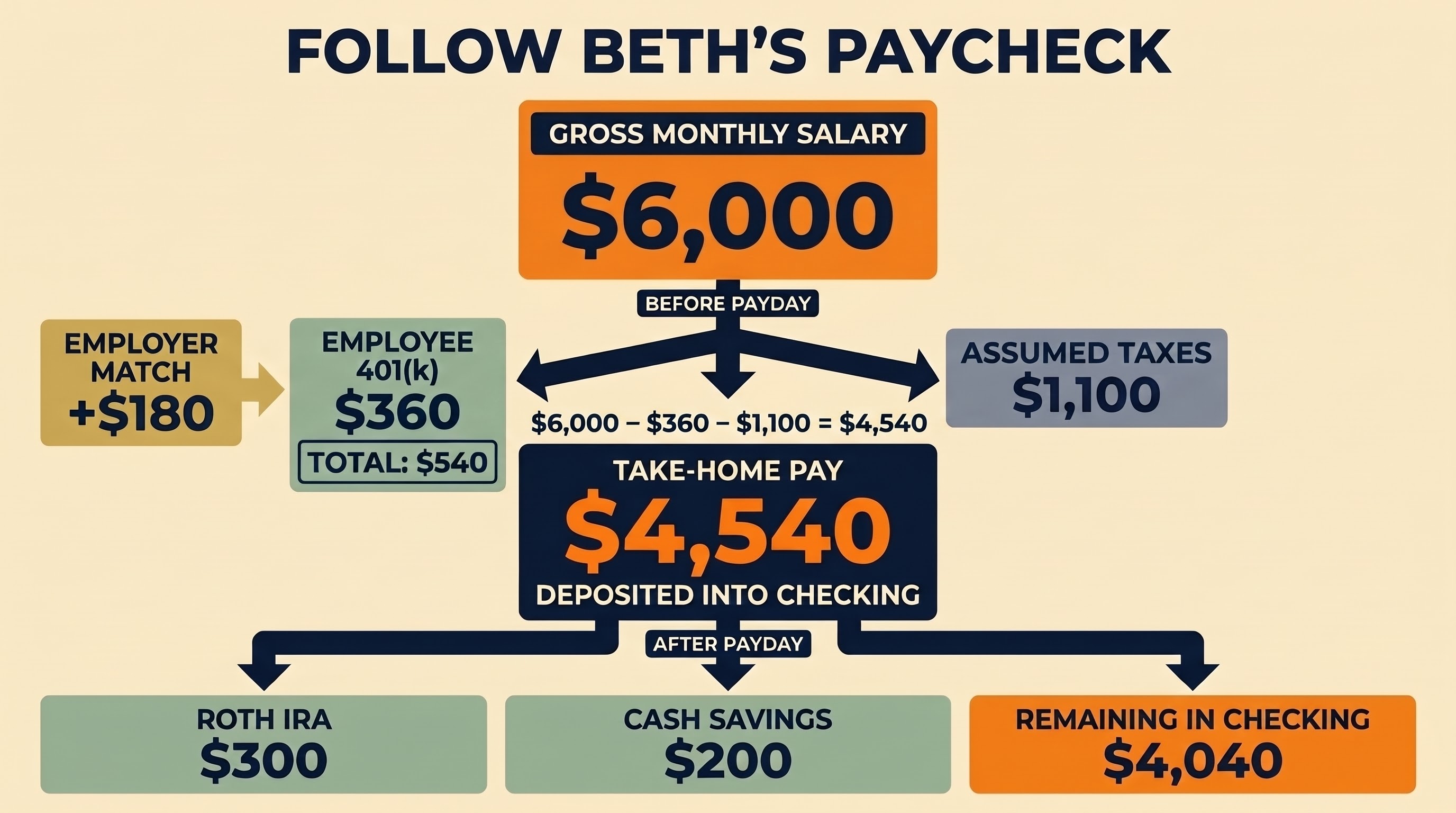
Beth earns $6,000 a month before deductions.
She puts $360 into her pre-tax 401(k). Her employer adds another $180 directly to that account. The match isn't taken out of Beth's salary.
After her $360 contribution and an assumed $1,100 in taxes, $4,540 lands in checking.
From that money, Beth puts $300 into a Roth IRA and $200 into cash savings.
Here's the part worth remembering: Beth saves money before her paycheck arrives and after it arrives. Her employer also contributes money she never receives as spendable pay.
So what should she divide by? That depends on what she's trying to measure.
Two Ways to Calculate Beth's Rate
1. From her take-home pay
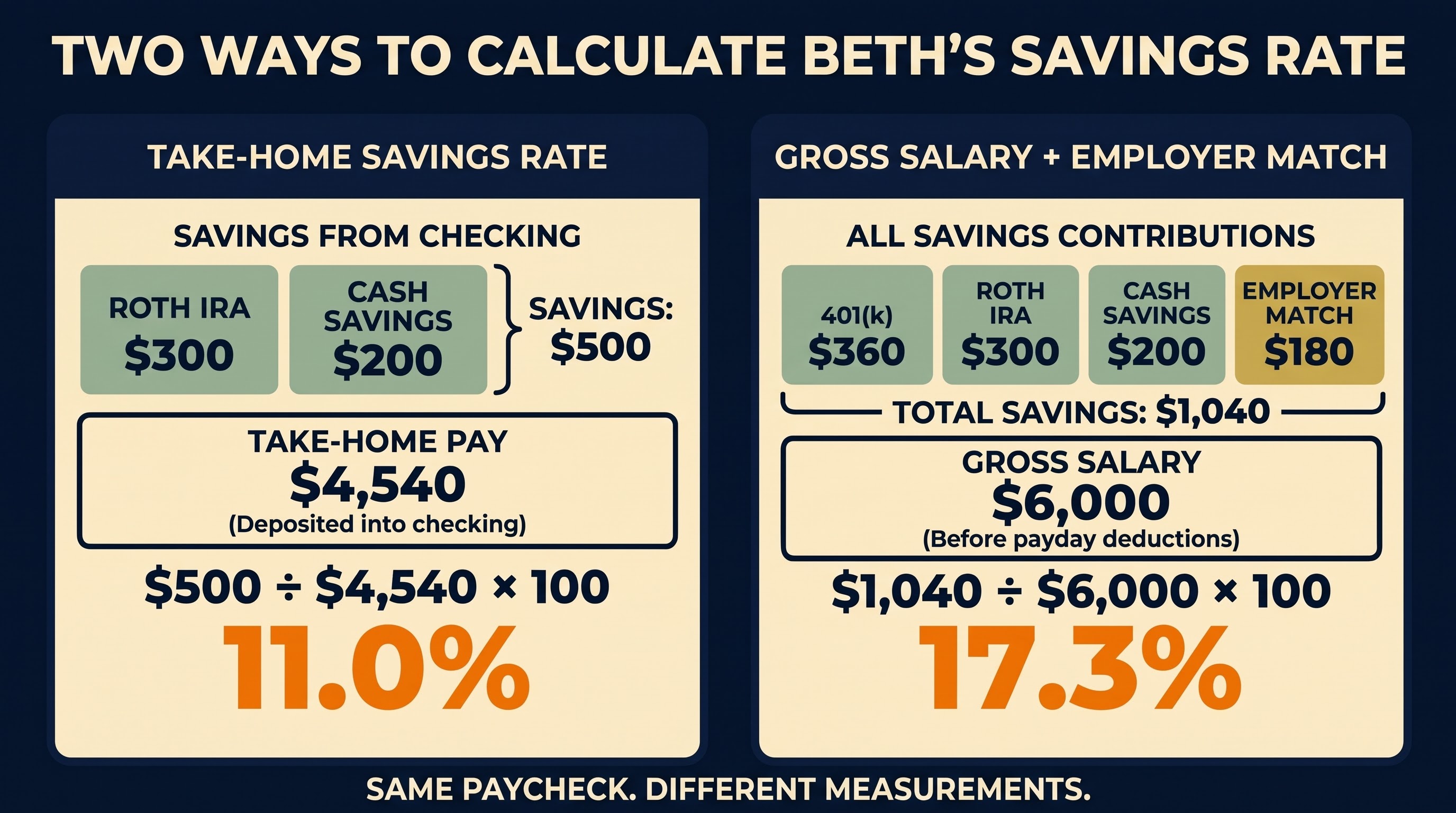
Beth receives $4,540 in checking. She saves $500 of that money: $300 in her Roth IRA and $200 in cash.
$500 ÷ $4,540 × 100 = 11.0%
That's her take-home savings rate. It answers a straightforward budgeting question: How much of the money deposited into my account did I save?
It doesn't count her pre-tax 401(k) contribution or the employer match, because neither came out of that $4,540 deposit.
2. Against her gross salary
Now Beth wants to measure all the contributions going toward her savings against her $6,000 salary.
Her $360 401(k) contribution, $300 Roth IRA deposit, and $200 cash savings add up to $860. If she also counts the $180 employer match, the total becomes $1,040.
$1,040 ÷ $6,000 × 100 = 17.3%
That's total savings contributions measured against gross salary, including the employer match. The match is extra money from her employer, not part of her $6,000 salary. We're explicitly counting it on top while comparing contributions with salary.
Neither 11.0% nor 17.3% is the one true answer. They answer different questions. Beth just needs to know which one she's using.
Where the 23% Answer Goes Wrong
Beth's third answer looked even better: 22.9%.
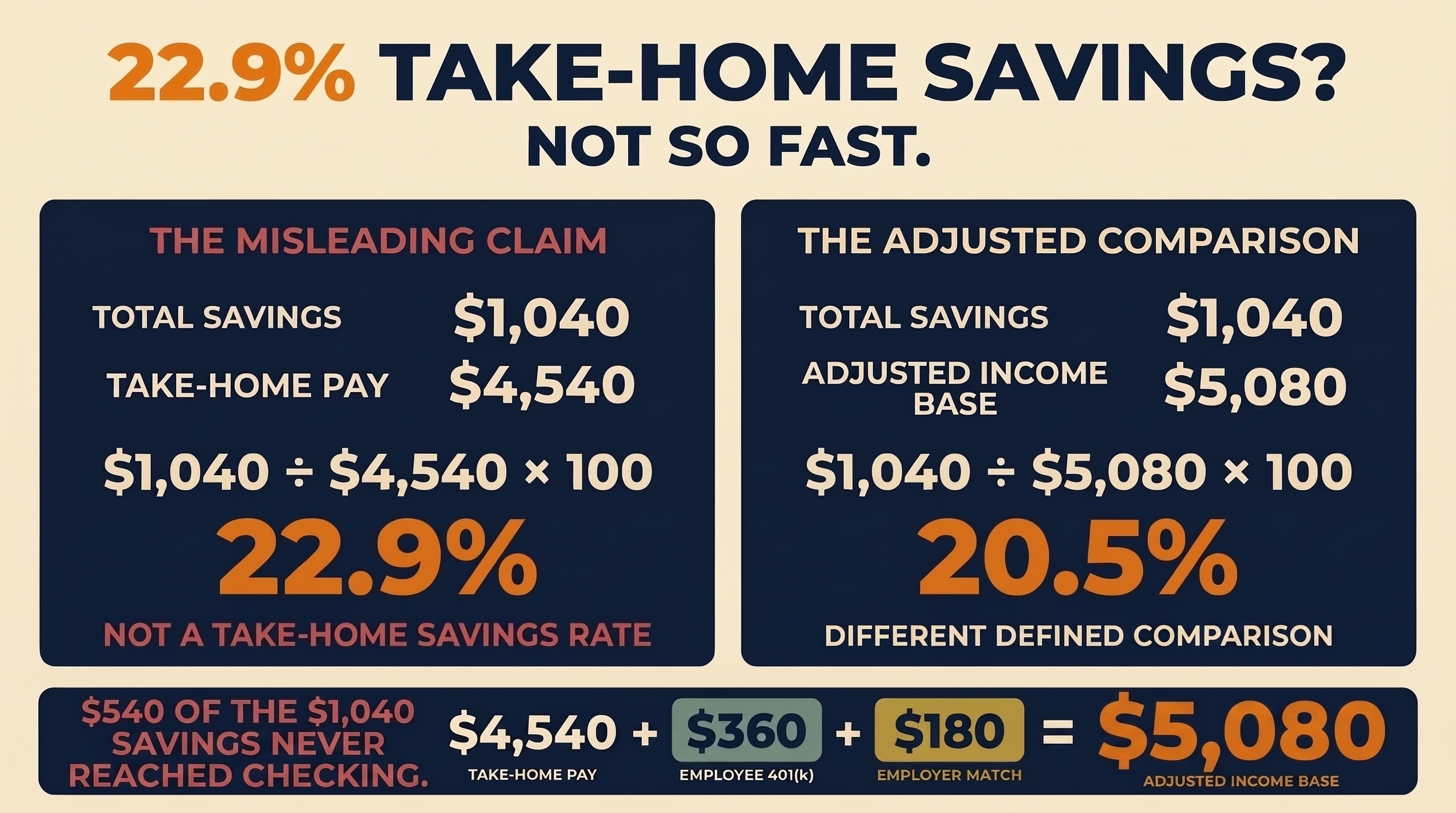
Someone took all $1,040 of her savings contributions—including the 401(k) money and employer match that never reached checking—and divided it by her $4,540 take-home pay.
$1,040 ÷ $4,540 × 100 = 22.9%
The calculator did its job. The problem is what Beth asked it to divide. 22.9% isn't the share of her take-home pay she saved. The calculation counts $540 on top that wasn't part of the take-home money on the bottom.
If Beth wants to compare all $1,040 of contributions with an adjusted take-home base, she can add that $540 back:
$1,040 ÷ ($4,540 + $360 + $180) × 100 = 20.5%
That's a different, clearly defined comparison—not a measure of money Beth could have spent, since the employer match wasn't available to her as cash.
The lesson: don't count savings from before payday as a share of take-home pay unless you adjust the income base too.
Beth didn't save an extra dollar when her rate appeared to jump from 20.5% to 22.9%. Only the denominator changed.
Know Your Top and Bottom
Savings rate = savings counted ÷ income you're measuring against × 100.
Beth saves 11.0% of her take-home pay, or 17.3% of gross salary when her employer match is counted as additional savings. Mixing all contributions with take-home pay produces a misleading 22.9%.
What About the Employer Match?
Beth's employer contributes $180 to her 401(k). It's real retirement savings, but Beth didn't contribute it herself.
If she wants to measure only her own saving against gross salary, she'd use $860 ÷ $6,000, or 14.3%. If she wants to include the employer match as additional saving against salary, she gets the 17.3% we calculated earlier.
The important question is what the rate is for. If you're comparing your contributions with a retirement guideline, check whether that guideline includes employer money and what it uses as the income base. The separate question of how much to contribute belongs in How Much Should You Contribute to Your 401(k)?.
The Judgment Calls
Some money decisions fall into a gray area when you're calculating your savings rate. Here are three worth thinking about.
Extra debt payments. Beth also pays an extra $150 toward her car loan each month. That reduces her debt, but it isn't money deposited into savings. She can track extra debt payoff alongside saving or keep it separate. If she includes it, she should call the result a broader saving-and-debt-paydown measure—not silently compare it with her old savings rate. That's also why the 50/30/20 budgeting framework can group extra debt payoff with future-oriented money without settling every savings-rate definition.
Mortgage principal. Part of a mortgage payment reduces what you owe; interest doesn't. You may track principal repayment separately or include it in a broader measure of wealth building. Home equity isn't the same as cash in the bank.
Short-term savings. Money set aside for a car or vacation is still money saved today, even if you'll spend it later. You might count it in your monthly savings rate or track long-term saving separately. Don't count it twice when you transfer it between accounts.
There's no need to calculate a new percentage for every choice. Decide what belongs in your measure, then stick with it.
What You Do With This Information
Start with the simplest version. You can add detail later.
- Open last month's bank activity. Find the take-home pay deposited into checking.
- Add what you saved from that pay. Include transfers to savings and investments funded from checking. Don't count money merely moved between two savings accounts twice.
- Divide and multiply by 100. If you saved $400 from $4,000 of deposited pay, that's 10% of take-home pay.
- Check what happened before payday. If you contribute to a 401(k), that saving won't show up in the take-home calculation. You can also calculate a gross-salary-based rate if you want a broader view. Decide whether to count any employer match.
- Compare the same kind of rate next month. Use the same income base and the same types of savings each month. Otherwise, a change in your percentage might just mean you changed the formula.
You don't have to choose between tracking take-home saving and retirement contributions. You can track both. Just don't mistake one for the other.
So, What's Beth's Savings Rate?
Beth started with three answers and no idea which one to trust.
Now she knows 11.0% tells her how much she saved from take-home pay. 17.3% measures all her contributions against gross salary, including the employer match. And the suspicious 22.9%? That calculation counted all of Beth's savings, including money that went into her 401(k) before payday, but divided it by only her take-home pay. It made her savings rate look higher without her actually saving another dollar.
Same paycheck. Same savings. Now she knows what the numbers actually mean.
Try the take-home calculation with your last paycheck. Then look at your pay stub to see whether you saved anything before the money reached checking. You'll know exactly what your first number includes—and what it doesn't.
Beth and the financial details in this article are fictional and are used to explain financial concepts.
This article is not sponsored and contains no affiliate or referral links.
Sources and assumptions
- Background distinction: U.S. Bureau of Economic Analysis — Personal Saving Rate (page showing the October 29, 2026 release; retrieved November 21, 2026). The BEA national personal saving rate is a different measure from the household calculations taught here. No national statistic or trend is used in the article.
- Beth's fictional month: $6,000 gross salary; $360 pre-tax 401(k) contribution (6%); $180 employer match (3%, separate from salary); assumed $1,100 in taxes; $4,540 deposited take-home pay; $300 Roth IRA contribution and $200 cash savings from checking; optional $150 extra car-loan principal. Taxes are a fixed assumption, not computed from tax tables.
- Arithmetic (rounded to one decimal): beginner example $400 ÷ $4,000 = 10.0%; take-home $500 ÷ $4,540 = 11.0%; gross salary including match as additional saving $1,040 ÷ $6,000 = 17.3%; gross salary excluding match $860 ÷ $6,000 = 14.3%; adjusted base $1,040 ÷ ($4,540 + $360 + $180) = 20.5%; mixed-base $1,040 ÷ $4,540 = 22.9%. An alternative total-compensation measure, not worked in the narrative, is $1,040 ÷ $6,180 = 16.8%.