Table of Contents
- The Floor: Get the Full Match First
- The Target: Why I Start With 15%
- Does Your Employer's Money Count Toward the Target?
- When 15% May Not Be Enough
- The Ceiling: The IRS Limit Is Not a Goal
- How to Raise Your Rate Without Overstretching Your Budget
- Here's What Actually Fixes This
- So, How Much Should You Contribute to Your 401(k)?
The Floor: Get the Full Match First
Some employers put money into your 401(k) when you contribute. That's an employer match. Not every plan offers one, and each plan sets its own rules. If yours does, I want you to know what it takes to get the full amount.
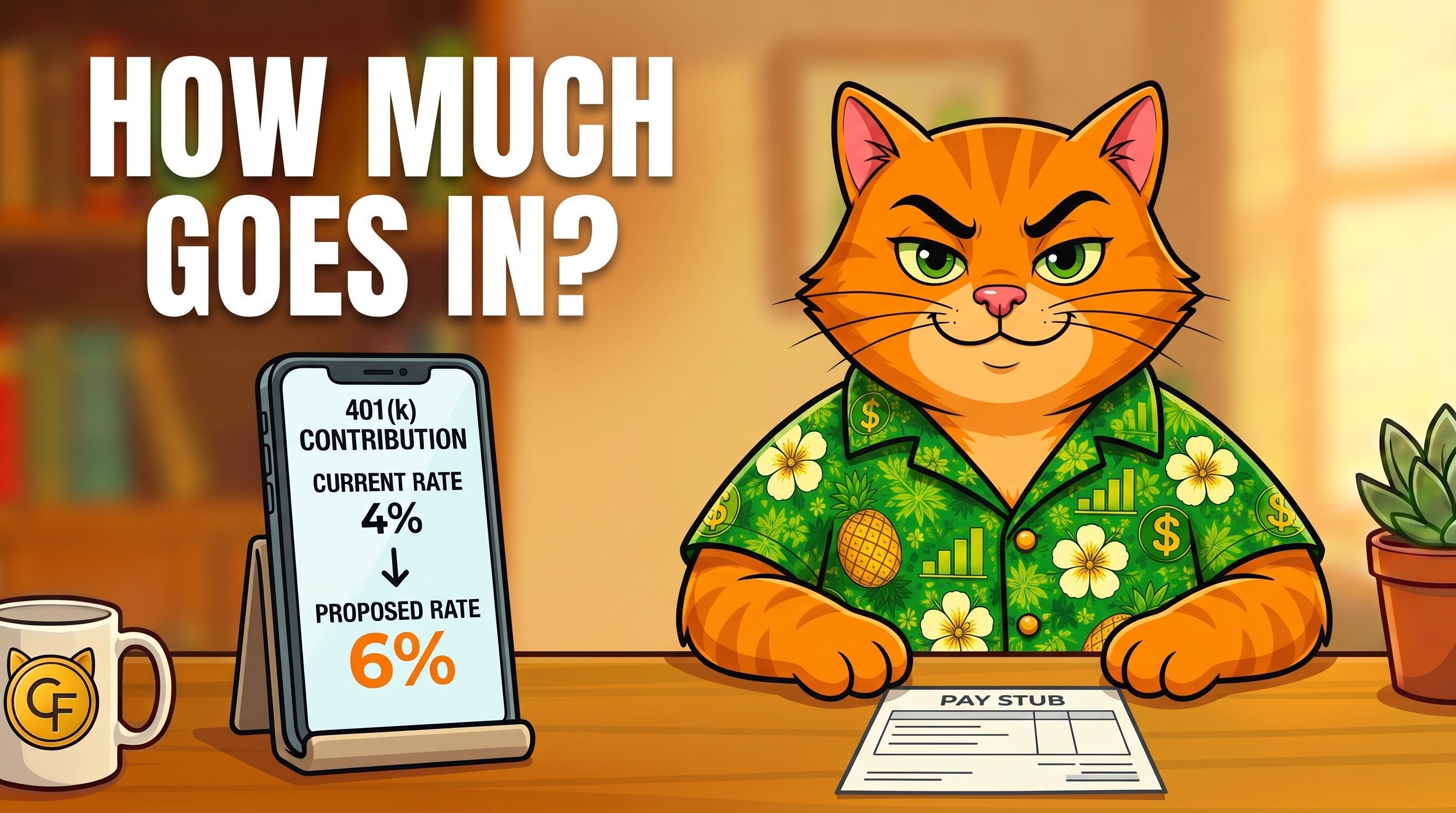
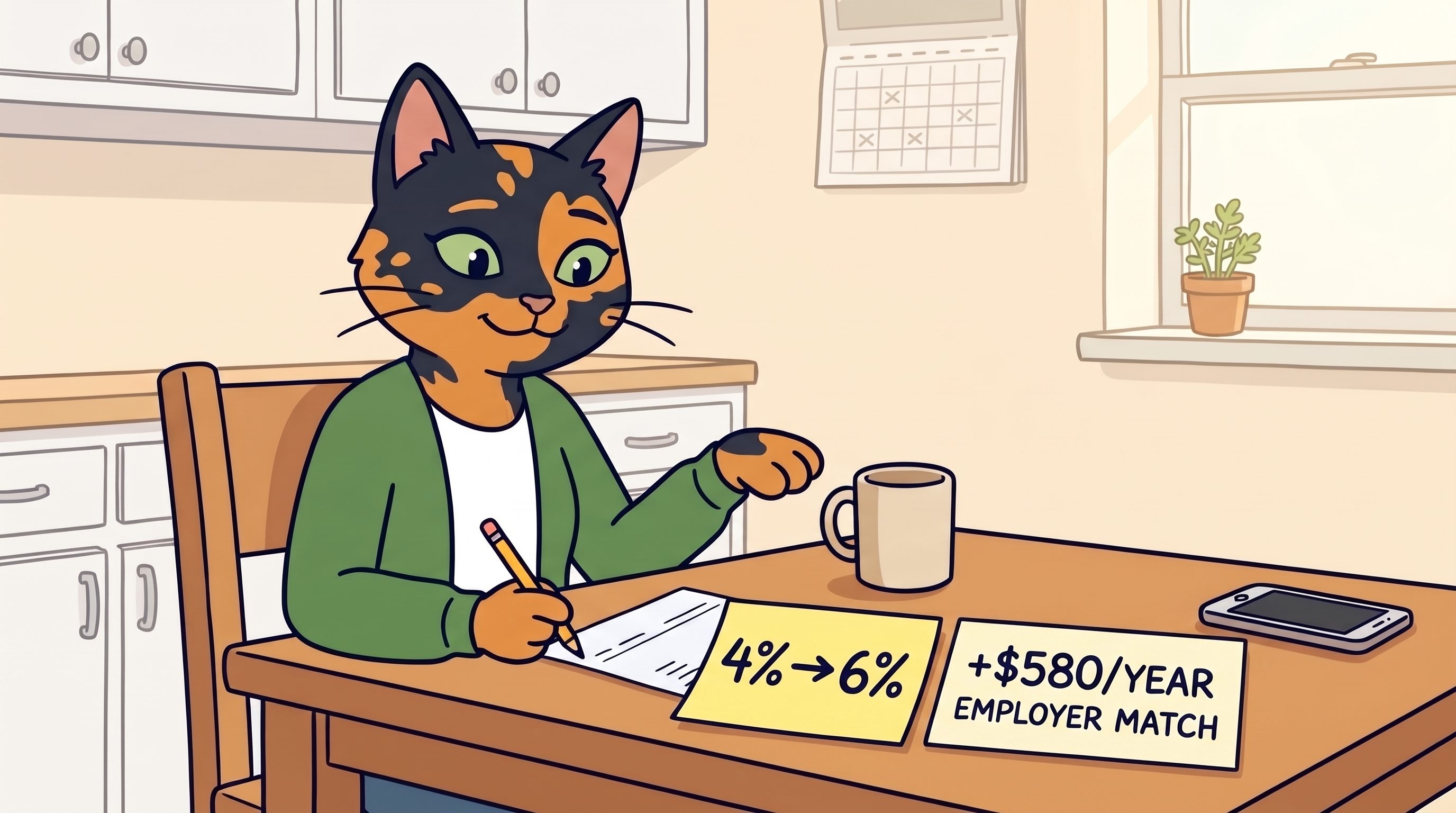
Rosa's employer offers a 50% match on the first 6% of her salary that she contributes to her 401(k). But Rosa has been contributing only 4%, which means she's missing out on some of that employer money.
She's leaving $580 a year in additional employer contributions on the table.
Here's the good news: Rosa can unlock that extra money by increasing her own contribution from 4% to 6%. On her $58,000 salary, that's another $44.62 per biweekly paycheck, before taxes. The $44.62 goes into her own retirement savings, and her employer adds more on top.
That's why I put the match first. It's a valuable benefit, and I'd rather Rosa collect it than miss it. But if that extra contribution would keep her from paying essential bills, she can work toward the full match as her budget improves.
Your plan's summary plan description can tell you the contribution rate needed to receive the full match.
The Target: Why I Start With 15%
Once you've looked at the match, you need a bigger-picture target. My starting benchmark is to save around 15% of your income for retirement, including money your employer adds and retirement savings you make in other accounts.
Why 15%? It's substantial enough to make retirement saving a real priority, while giving you a number you can build toward gradually. It's not a guarantee, and it won't be right for everyone. Your starting balance, retirement timeline and goals still matter.
My 15% benchmark is a practical starting point, and it lines up with guidance from two major retirement firms. Vanguard's published guideline suggests saving 12% to 15% of your income for retirement, while Fidelity's published guideline recommends at least 15%. Both include employer contributions in those totals. Vanguard names retirement age, expected lifespan and the lifestyle you want as the factors that move its range. Fidelity's 15% assumes you start saving at 25, retire at 67, have no pension, and need savings to cover about 45% of your pre-retirement income through age 93. Fidelity says the 15% holds fairly consistently for incomes of about $50,000 to $300,000.
But here's what matters: those numbers are starting points, not guarantees. How much you actually need depends on when you started saving, what you've already put away, and the retirement you're working toward.
For Rosa, I'd rather see a manageable path toward a meaningful target than a big percentage she can't afford to maintain.
Does Your Employer's Money Count Toward the Target?
Yes. Your employer's contributions count as retirement savings, too.
Let's use Rosa's plan. Once she contributes enough to receive the full match, her employer puts in the equivalent of 3% of her salary. If Rosa wants to reach 15% in total retirement savings, and this 401(k) is her only retirement account, she would put in 12% herself. Her employer's 3% completes the total.
That's the part I want you to remember: when you're measuring your overall retirement savings rate, count the money going in—not just the money coming out of your paycheck.
For IRS purposes, the employer match doesn't use up Rosa's personal employee-deferral limit. Employer contributions do count toward a separate overall limit on plan contributions.
When 15% May Not Be Enough
If you're aiming for FIRE—Financial Independence, Retire Early—you'll generally need to save considerably more than 15%. Retiring earlier means fewer working years to save and potentially more years your money needs to support you. The right savings rate depends on your target retirement age, expenses and existing assets.
And if you're starting retirement savings after 35, I'd seriously consider whether you need to aim higher than 15%. You've got fewer years for contributions and investment growth to do their work. Fidelity's published examples illustrate how a later start can raise the required savings rate, but those examples assume no prior savings; they aren't a personalized prescription.
Your current savings, other retirement accounts, pension, debts and emergency cushion also matter. A higher target isn't useful if it makes your everyday finances unmanageable. I want you to choose a rate you can sustain, then check it against the retirement you're actually planning.
The Ceiling: The IRS Limit Is Not a Goal
The IRS sets an annual limit on how much you can contribute from your pay to a 401(k), and your plan may impose a lower one. That's a ceiling, not a savings target everyone needs to hit. For more on how those limits work, see this year's 401(k) and IRA contribution limits or check the IRS contribution-limits page for the latest figures.
How to Raise Your Rate Without Overstretching Your Budget
Rosa doesn't need to leap from 4% to 15% overnight. First, she checks whether her budget can handle the extra $44.62 per biweekly paycheck needed to collect the full employer match. Then she can consider increasing her contribution by one percentage point at a time, perhaps when she gets a raise.
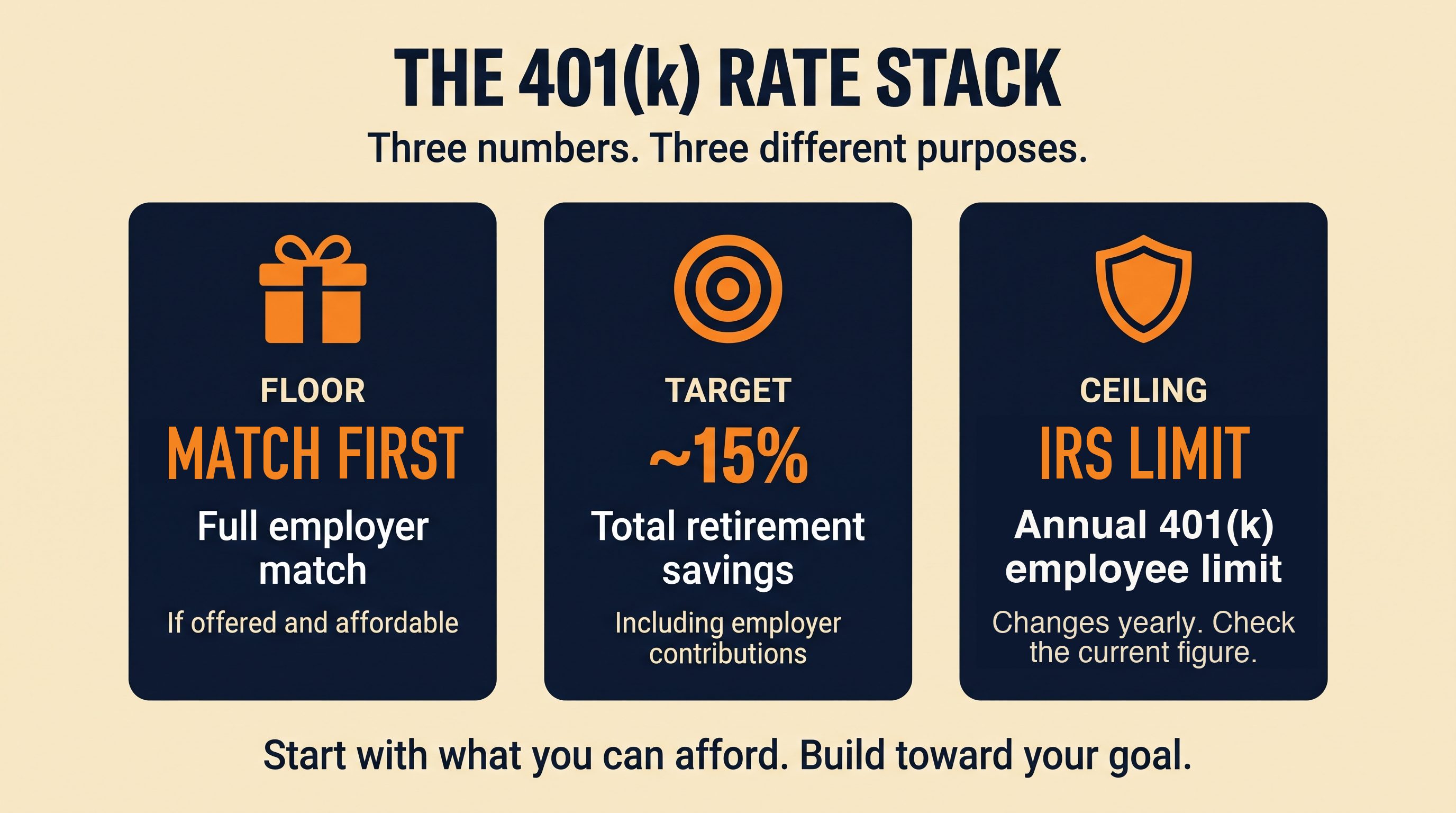
The 401(k) Rate Stack
Floor: work toward the full employer match if offered and affordable. Target: roughly 15% of pay for retirement as a starting benchmark, adjusted to your goals. Ceiling: the IRS limit.
Rosa can receive $580 more per year from her employer by contributing an additional $44.62 per biweekly paycheck before taxes. After collecting the full match, she can gradually work toward her own retirement savings target.
Many plans let you schedule future increases. It's also worth checking whether your default contribution settings are still what you intended.
A traditional pre-tax 401(k) contribution generally reduces take-home pay by less than the amount contributed because of its federal income-tax treatment. Roth contributions are different; here's the separate explanation of Traditional vs. Roth 401(k). Either way, the contribution still comes out of money you could otherwise use today.
Here's one possible path for Rosa after she reaches the full match:
| When | Rosa contributes | Total with employer match |
|---|---|---|
| Starting point | 6% | 9% |
| After one increase | 7% | 10% |
| After two increases | 8% | 11% |
| After three increases | 9% | 12% |
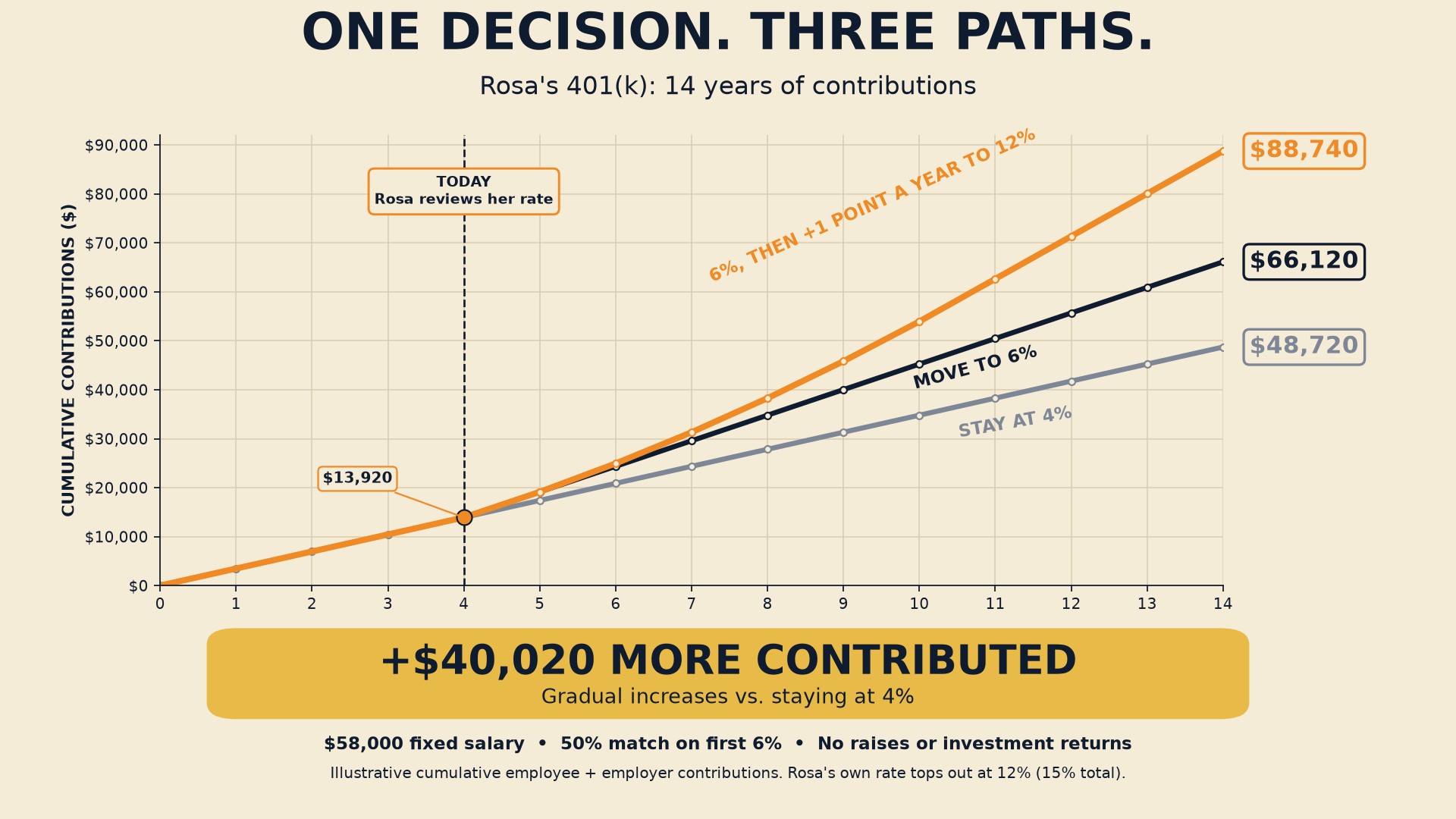
That's progress, not a finish line. If she wants to reach my 15% benchmark using only this account, she would eventually aim for 12% from her paycheck plus the 3% employer contribution—assuming the plan's match stays the same and her budget supports it.
Here's What Actually Fixes This
Rosa finally logs into her 401(k) account and changes her contribution from 4% to 6%. That's it. One small adjustment, and she's now collecting her full employer match. The extra $580 a year she'd been leaving on the table? That's now going toward her retirement.
And she isn't stopping there. She's made a plan to increase her contributions gradually, working toward that 15% savings benchmark as her budget allows.
So, How Much Should You Contribute to Your 401(k)?
Here's my take: Rosa didn't need a financial advisor, a complicated spreadsheet, or a perfect retirement plan to make a meaningful improvement. She just needed to take another look at a decision she'd made four years ago.
Four years of leaving match money on the table. One decision to stop.
So here's my answer to the title: contribute enough to get the full match when your budget allows, build toward about 15% of pay in total, and treat the IRS limit as a ceiling. That's the kind of financial progress I want you to make, too.
Once you've secured your employer match, there's another question worth asking: Should you put your next retirement dollar into your 401(k) or a Roth IRA? I've covered that decision in Should You Max Your 401(k) or Roth IRA First?.

Rosa and her story are fictional. Her pay, her plan's match and every dollar amount are invented, and her numbers are not market data. Savings guidelines are provider-published guidance with their own assumptions, not rules or individualized recommendations. Plan terms vary by employer. This article is general education, not tax, legal or investment advice. It is not sponsored and contains no affiliate or referral links.
Sources
- Internal Revenue Service — 401(k) Resource Guide: Plan Participants — 401(k) Plan Overview (page last reviewed or updated August 3, 2026). Elective deferrals, matching contributions "if the plan document permits", vesting, federal income tax and Social Security/Medicare treatment, the section 402(g) limit. US federal rules.
- Internal Revenue Service — Retirement Topics: 401(k) and Profit-Sharing Plan Contribution Limits (page last reviewed or updated April 8, 2026). Plan terms may set a lower limit; employer contributions count toward a separate overall annual-additions limit.
- Vanguard — How much should I be saving? (no page date shown; retrieved November 16, 2026). Provider-published guideline of 12% to 15% of pay including employer contributions; suggested 1-point increases.
- Vanguard — Saving for retirement (no page date shown; retrieved November 16, 2026). The same guideline and the factors it names.
- Fidelity — How much should I save for retirement? (page dated June 8, 2026; retrieved November 16, 2026). Provider-published guideline of at least 15% of pre-tax income including any employer match; its assumptions; start-age figures of 18% at 30 and 23% at 35 with no existing savings.