
Table of Contents
- First, the Match Isn't the Max
- Meet Jenny: $85,000 and Money Left to Invest
- Why Taxes Change the Answer
- Jenny at $150,000: A Different Choice
- Compare the Investments, Not Just the Accounts
- When Neither Account Is Your Next Move
- Where Jenny Lands
- What You Do With This Information
- Sources
First, the Match Isn't the Max
Two phrases get mixed up all the time.
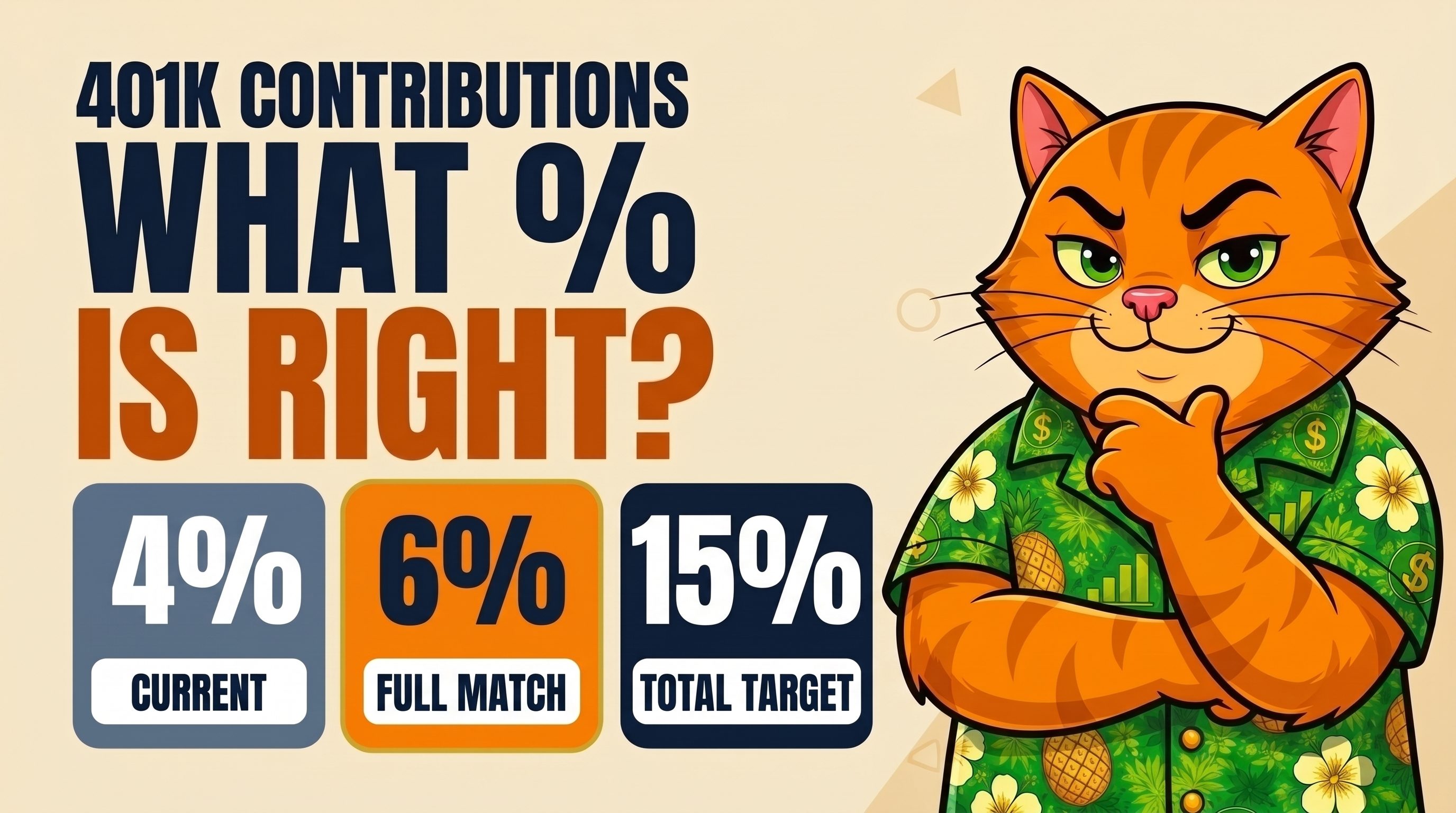
Getting the full match means putting enough into your workplace 401(k) to receive all the matching money your employer offers. If you need a refresher, start with how your 401(k) match works.
Maxing an account means contributing up to its annual limit.
For 2026, the standard employee 401(k) contribution limit is $24,500. The combined limit for traditional and Roth IRA contributions is $7,500 for someone under 50, subject to eligibility rules. Catch-up contributions can raise these limits for older savers. Employer matching contributions don't count against the $24,500 employee-deferral limit. For more detail, see the 2026 401(k) and IRA limits.
You don't have to reach either maximum to make a smart choice. We're deciding where your next retirement dollar should go after you've earned the full match.
Meet Jenny: $85,000 and Money Left to Invest
Jenny earns $85,000 a year. She contributes enough to her traditional 401(k) to get the full employer match, has money available for additional retirement savings, and wants to decide where to put it.
She could increase her 401(k) contributions. Or she could open and fund a Roth IRA.
For Jenny, the Roth IRA wins this round. But not simply because somebody handed her an account-order checklist.
Why Taxes Change the Answer
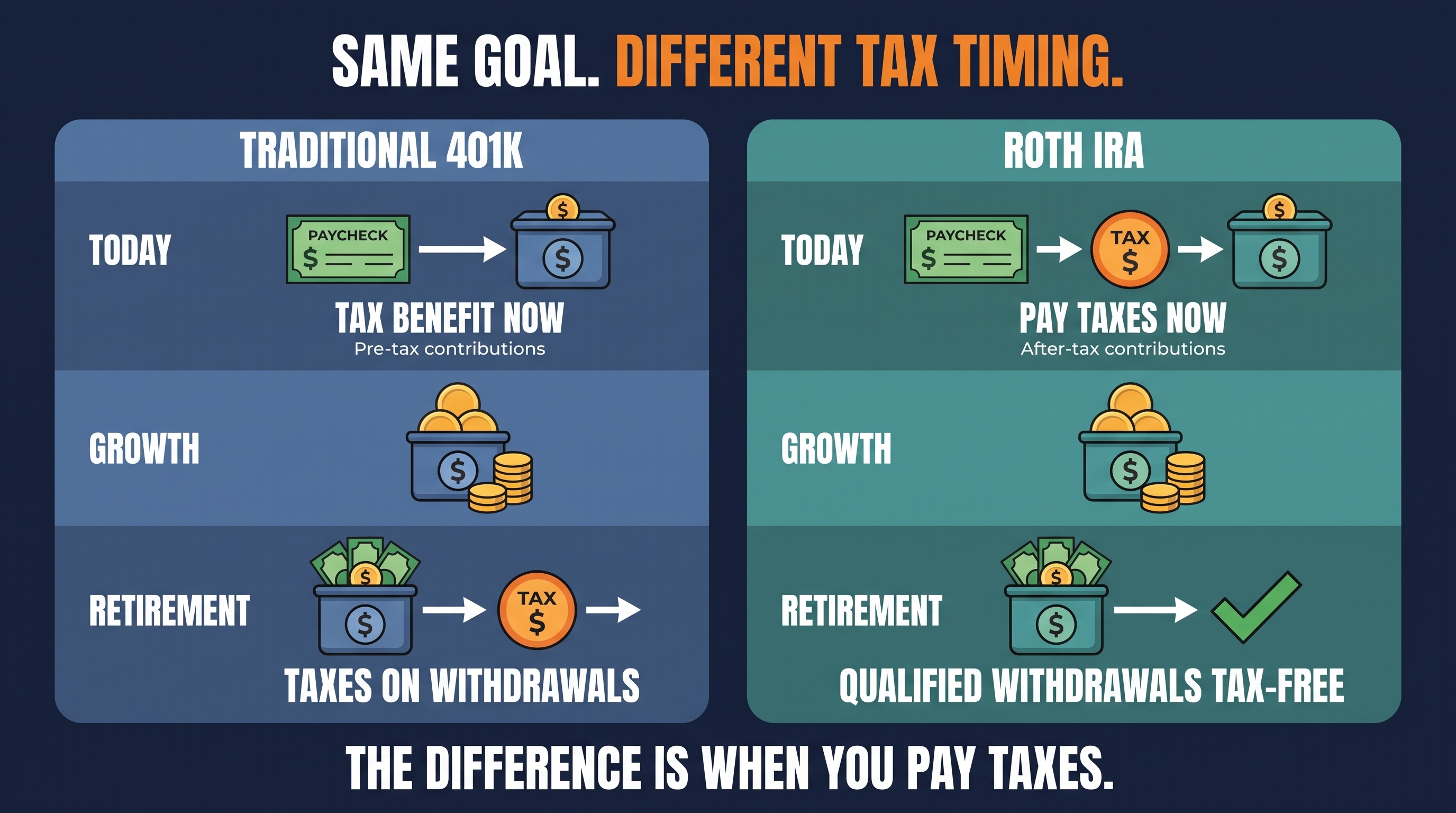
A traditional 401(k) generally lets Jenny reduce her federal taxable income when she contributes. She'll generally owe income tax when she withdraws that money in retirement.
A Roth IRA works differently. Jenny contributes money that's already been taxed, and qualified withdrawals can be federally tax-free later.
So I wouldn't automatically tell Jenny to max her Roth IRA next. First, I want to know whether paying taxes now or getting a tax break today makes more sense for her situation.
At $85,000, Jenny looks at her current taxes and decides she's comfortable paying tax on this money today instead of taking another traditional 401(k) deduction. She likes the possibility of qualified tax-free withdrawals later. She knows future tax rates aren't guaranteed, but she wants that flexibility in retirement.
She also confirms she can contribute directly to a Roth IRA and finds a low-cost investment that fits her goals.
That's enough for Jenny to choose the Roth IRA for her next dollars. If she has room in her budget, she plans to work toward its annual maximum before adding more to her traditional 401(k).
Want the deeper tax comparison? See Roth IRA vs. Traditional IRA and Traditional vs. Roth 401(k).
Jenny at $150,000: A Different Choice
Now Jenny has a much higher-income year. Instead of $85,000, she earns $150,000.
She's still getting her full employer match. She now has more money to invest. And she can still contribute directly to a Roth IRA.
But this year, she places more value on reducing her taxable income now. She also reasonably expects the dollars she puts into her traditional 401(k) to face a lower tax rate when she withdraws them in retirement.
She might be right. She might not. Nobody gets a guarantee about future tax rates.
Given that outlook, Jenny chooses to increase her traditional 401(k) contributions before funding her Roth IRA. If she can afford to, she'll work toward the 401(k)'s annual employee limit.
Same Jenny. Same retirement goal. Different tax situation. Different decision.
Here's what I don't want you to take from that story: $150,000 isn't a magic line where traditional suddenly beats Roth. Jenny's tax filing status, deductions, other income, and expectations about retirement all matter. So do the investments available to her.
And direct Roth IRA eligibility has its own rules. For 2026, a single filer's allowed direct Roth IRA contribution begins to phase out at $153,000 of modified adjusted gross income and disappears at $168,000. The phase-out for married couples filing jointly runs from $242,000 to $252,000. Other filing situations have different rules. Salary alone doesn't tell you whether you qualify.
Jenny's choice at $150,000 isn't a verdict for everyone earning that amount. It's what makes sense to her after looking at the tradeoffs.
The Next-Dollar Checks
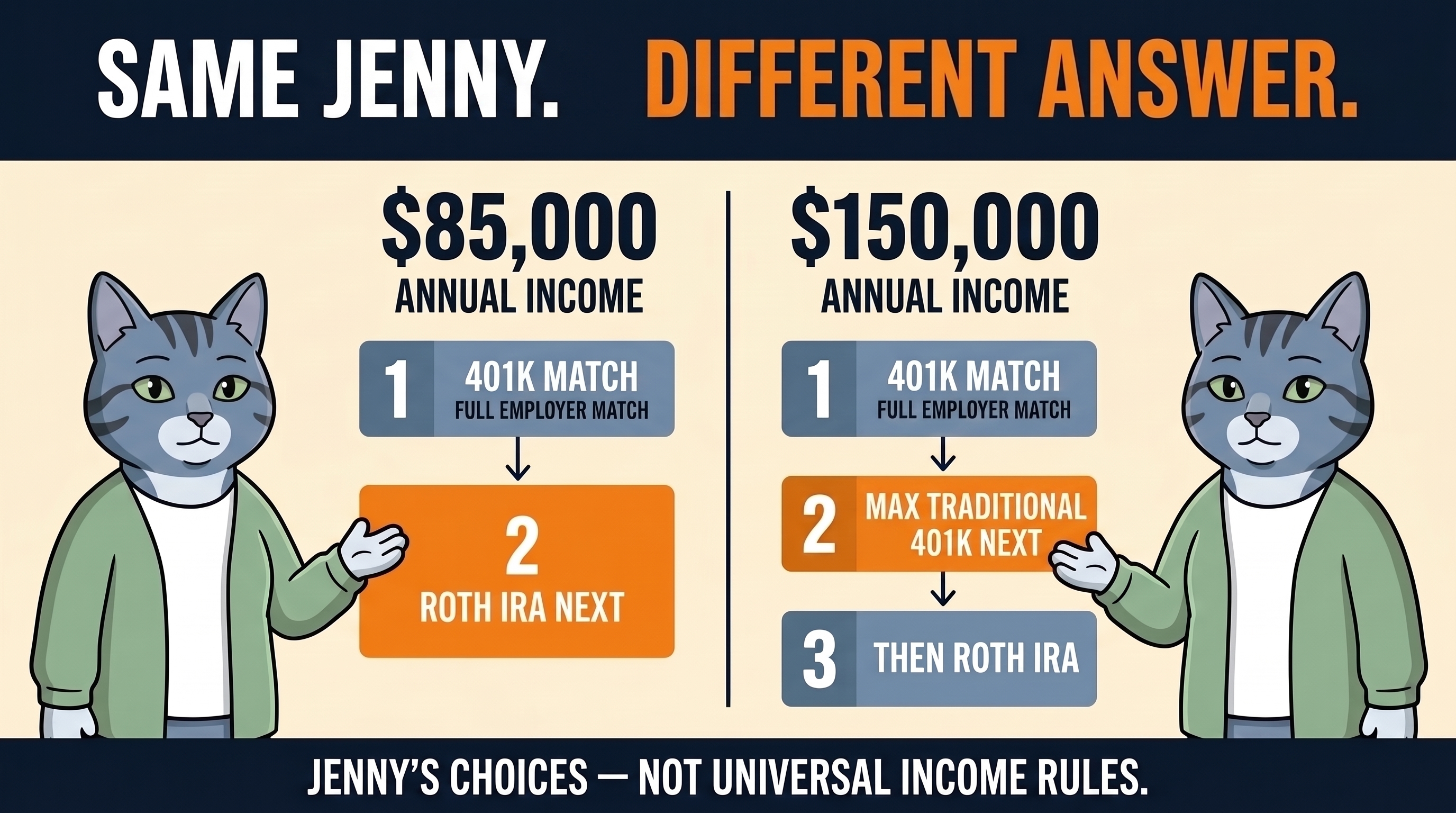
After the full match, check your tax situation, Roth IRA eligibility, and the investments and fees available in each account
At $85,000, Jenny chooses a Roth IRA next. At $150,000, she prefers more traditional 401(k) contributions. Her circumstances—not a universal account order—drive the decision.
Compare the Investments, Not Just the Accounts
Taxes aren't the only thing Jenny checks.
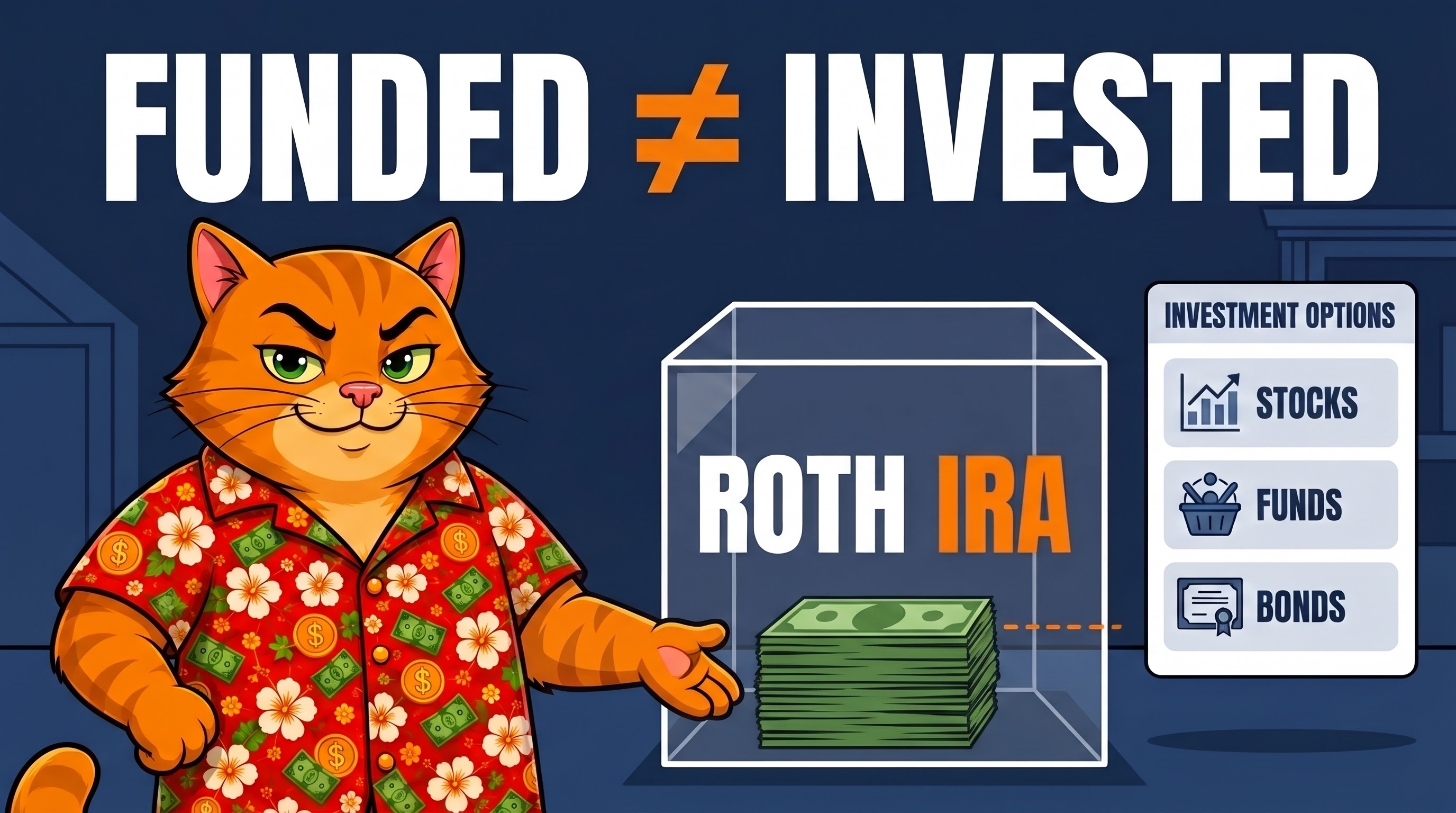
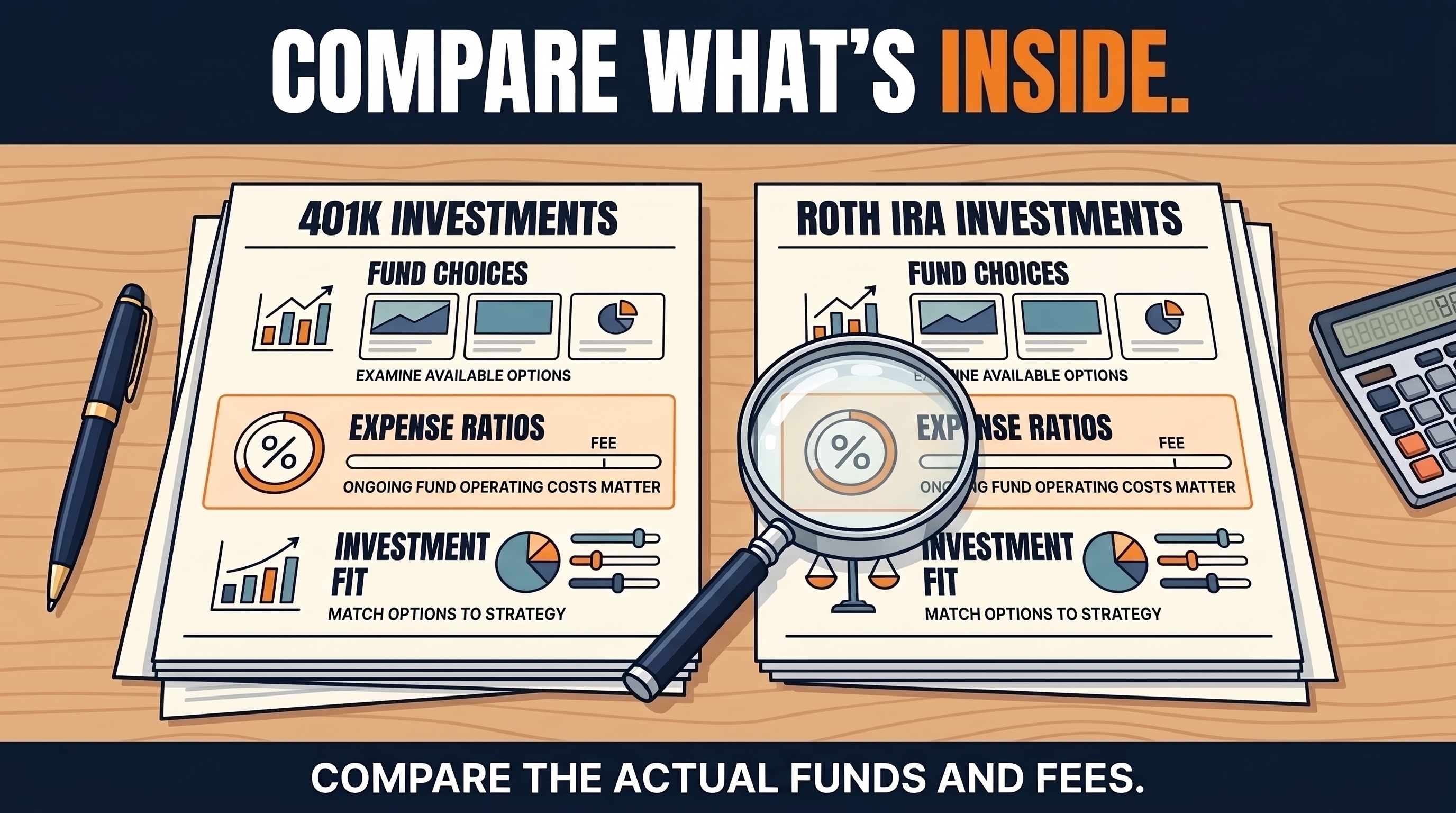
She also compares what she could actually invest in through her 401(k) and her Roth IRA.
Maybe her workplace plan already offers a low-cost index fund she likes. In that case, opening an IRA doesn't automatically give her better investment options.
Or maybe her 401(k) has a narrow selection and higher fees. That could make an IRA more attractive.
Jenny checks the expense ratios on the funds she'd choose, along with any additional plan or account fees. She wants a good fit for her goals at a reasonable cost—not simply the cheapest fund on a list.
Don't assume an IRA is better because it's an IRA. Compare what you'd actually own in each account.
When Neither Account Is Your Next Move
This whole conversation assumes Jenny has money available for additional retirement contributions.
If she has no emergency cushion or is carrying expensive credit card debt, the next move might not be maxing either account. The employer match still matters, but she should weigh those immediate needs before committing more money to retirement.
That's a separate decision. Should I Pay Off Debt or Invest First? walks through it.
Where Jenny Lands
At $85,000, Jenny gets the full match, considers the tax tradeoff, confirms her Roth IRA eligibility, and finds an investment she likes. She chooses the Roth IRA next.
At $150,000, she runs the same checks. This time, reducing her taxable income today matters more to her, so she chooses additional traditional 401(k) contributions.
Neither Jenny is following a universal rule. She's making a choice with the information she has.
A rule can give you a starting point. It can't make the decision for you.
What You Do With This Information
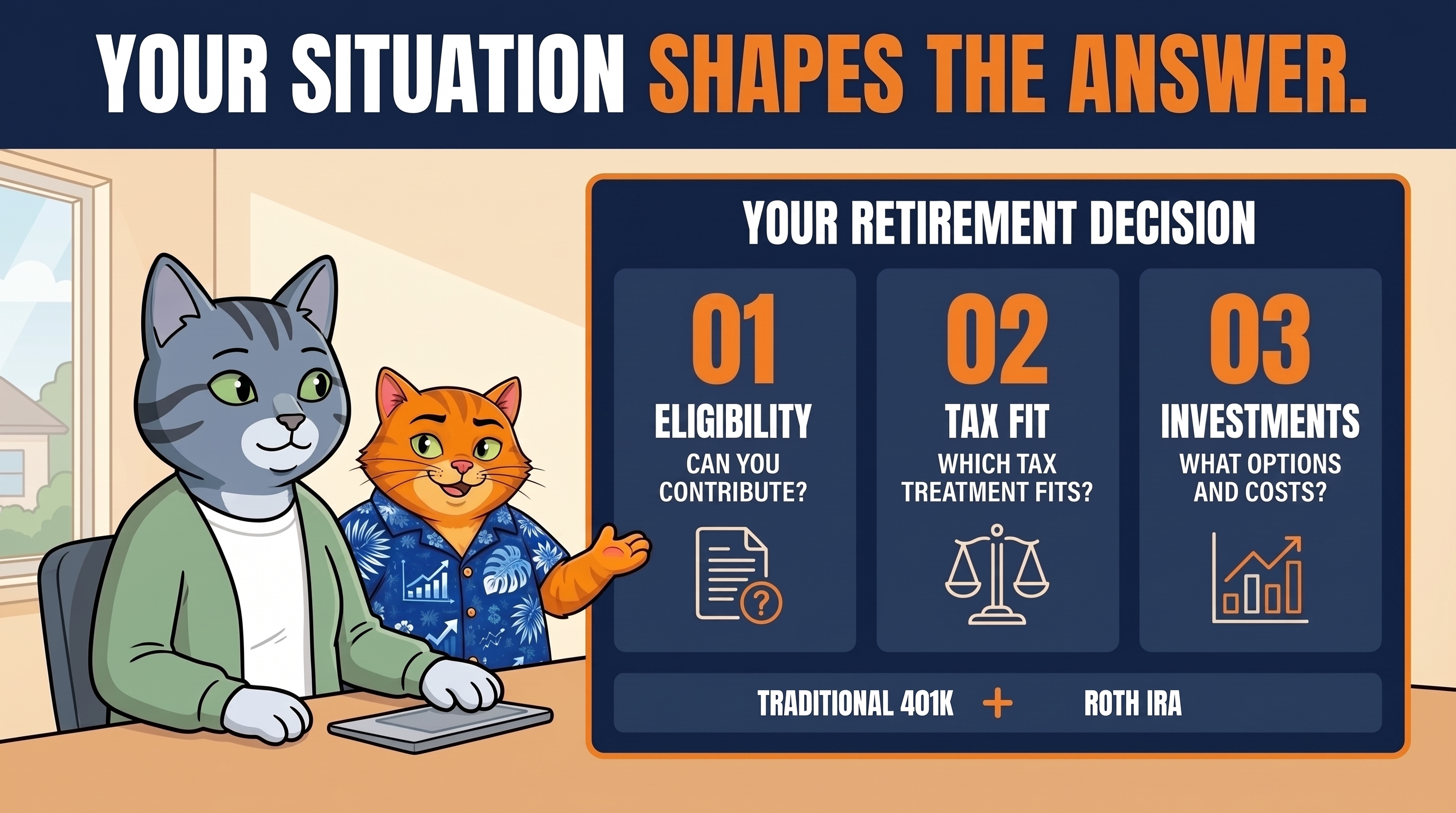
Before you increase your retirement contributions, run the same checks Jenny did. You don't need to predict the future perfectly. You need to understand the tradeoffs you're making today.
- Get the full match. Confirm how much you must contribute to receive every employer matching dollar. If emergency savings or expensive debt is a concern, weigh that before adding more retirement contributions.
- Look at the tax tradeoff. Would a traditional 401(k) deduction today be more valuable to you than the potential for qualified Roth IRA withdrawals later? Your current and expected future tax circumstances matter.
- Check Roth IRA eligibility. The Internal Revenue Service (IRS) bases direct contribution eligibility on modified adjusted gross income and filing status, not salary alone.
- Compare your actual investment choices. Pull up your 401(k)'s fund and fee disclosures. Compare the investments you'd choose there with the ones available in an IRA.
- Check the year's limits. Your 401(k) and IRA have separate contribution ceilings, and contributing to one doesn't automatically prevent you from contributing to the other.
Then make a decision about your next dollar. You don't have to promise to max one account before ever touching the other.
Start by opening your 401(k)'s investment chart and checking your current contributions. That gives you something more useful than a rule you found online: a decision built around your own numbers.
Sources
- IRS, 2026 401(k) and IRA contribution limits (IR-2025-111, November 13, 2025).
- IRS, 401(k) plans (traditional 401(k) tax treatment).
- IRS, Roth IRAs (Roth IRA rules and qualified distributions).
- IRS, Publication 590-A (2026 Roth IRA income phase-outs and contribution eligibility).
- IRS, Publication 590-B (IRA distribution rules).
- U.S. Department of Labor, A Look at 401(k) Plan Fees (investment and plan fees).
Figures are for 2026. Limits and rules can change. Jenny's situations illustrate how different tax circumstances and preferences can lead to different decisions; her incomes aren't decision thresholds.
Chuck Finance is for entertainment and informational purposes only. Chuck is not a licensed financial advisor, and nothing in this post constitutes professional financial, investment, legal, or tax advice. Always consult a qualified professional before making financial decisions.