
Table of Contents
What Financial Independence Actually Means
Financial independence (FI) is a simple idea with an expensive-sounding name. You reach financial independence when your savings, investments, and other income can sustainably cover your living expenses without relying on a paycheck.
That doesn't mean you never work again. You might love your job and keep it. You might change careers, work fewer hours, or do something you enjoy more, even if it pays less. The difference is that your living expenses no longer depend on income from a job.
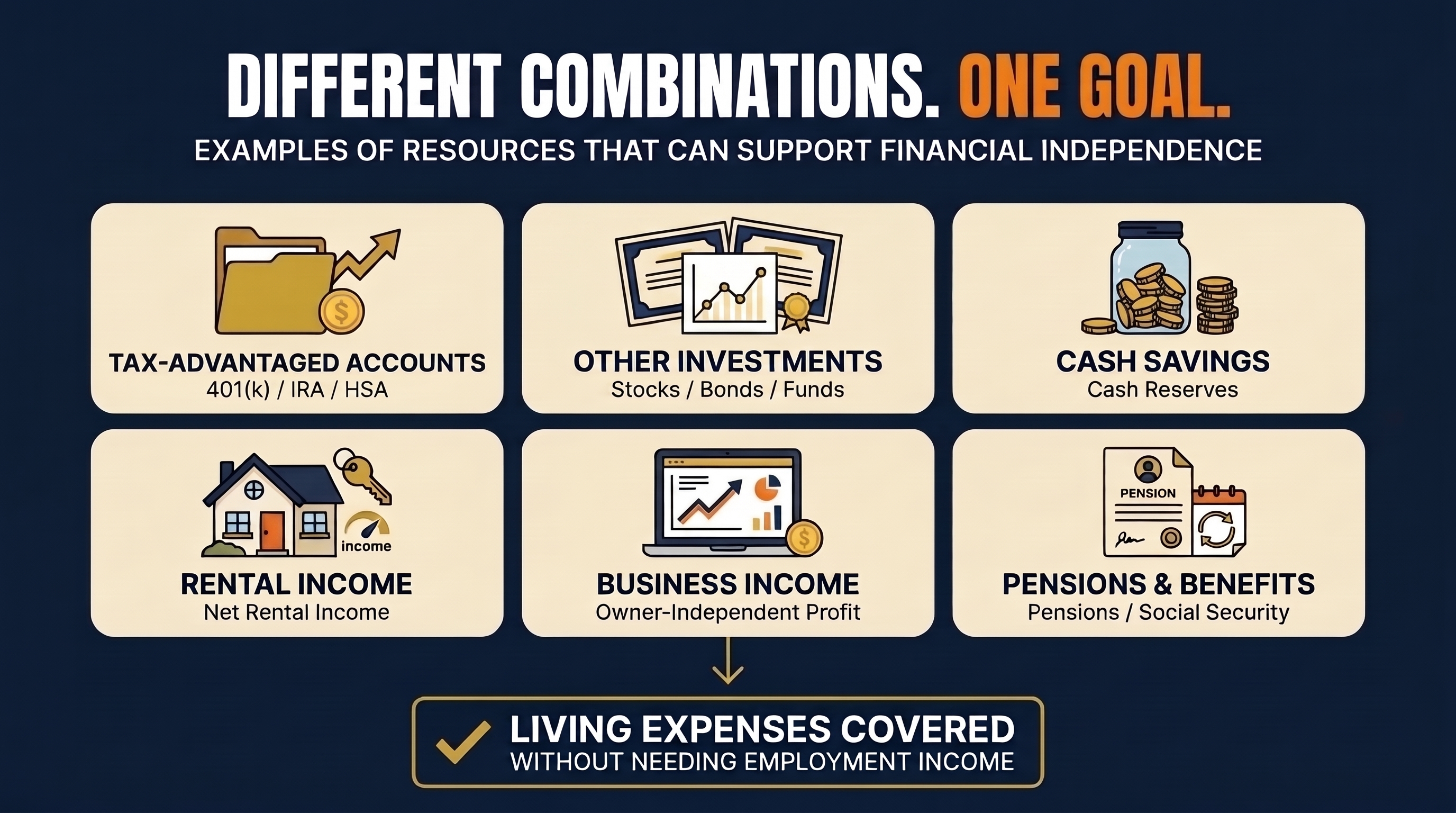
So what could actually pay those bills? Different people might rely on different combinations of:
- Retirement accounts, such as a 401(k) or individual retirement account (IRA), invested for the future. Access rules and taxes vary.
- Investments outside retirement accounts, including stocks, bonds, and funds you can sell or draw income from.
- Cash savings, which can cover near-term costs and emergencies, but generally aren't a long-term growth plan by themselves.
- Net rental income, after vacancies, repairs, taxes, and other property expenses—not the gross rent collected.
- Business ownership: Income from a profitable business that can operate without your day-to-day involvement, after accounting for operating expenses and taxes.
- Pensions, Social Security, or other continuing income, when you're eligible and the payments actually begin.
You don't need every item on that list. Owning a home, having a large retirement account, or even owning multiple rental properties doesn't automatically mean those assets can cover your living expenses. What matters is the money you can actually access and reasonably count on, compared with the cost of your life.
What Financial Independence Is Not
Three things get mistaken for FI all the time.
It isn't the same as being rich. A large account balance can come with equally large expenses. Wealth and financial independence often overlap, but the account balance alone doesn't settle the question.
It isn't the same as a high income. A high earner who spends nearly everything may still need every paycheck. Income matters because it can make saving easier, but it doesn't tell you what happens if the paychecks stop.
It isn't the same as retiring. Retirement is a decision about work. Financial independence is about whether you need employment income to pay your bills. You can reach FI and keep working. You can also leave a job and rely on a pension, benefits, or other support without having enough resources to make work entirely optional.
The Yardstick Is Your Spending, Not Your Salary
Your investments and other non-work income don't have to replace every dollar of your paycheck. They have to cover your expenses, with a plan for when each source of money is available.
That's why two cats with the same salary can be in completely different positions. One spends nearly everything. The other spends much less and saves the difference. Their paychecks match, but the amount their savings and investments would eventually need to support doesn't.
Your living expenses are the starting point, not the whole calculation. Taxes, healthcare, debt payments, and unexpected costs all affect how much money you'll actually need.
But before anything else, you need to answer one question: How much does my life actually cost?
Spending Works on Both Sides
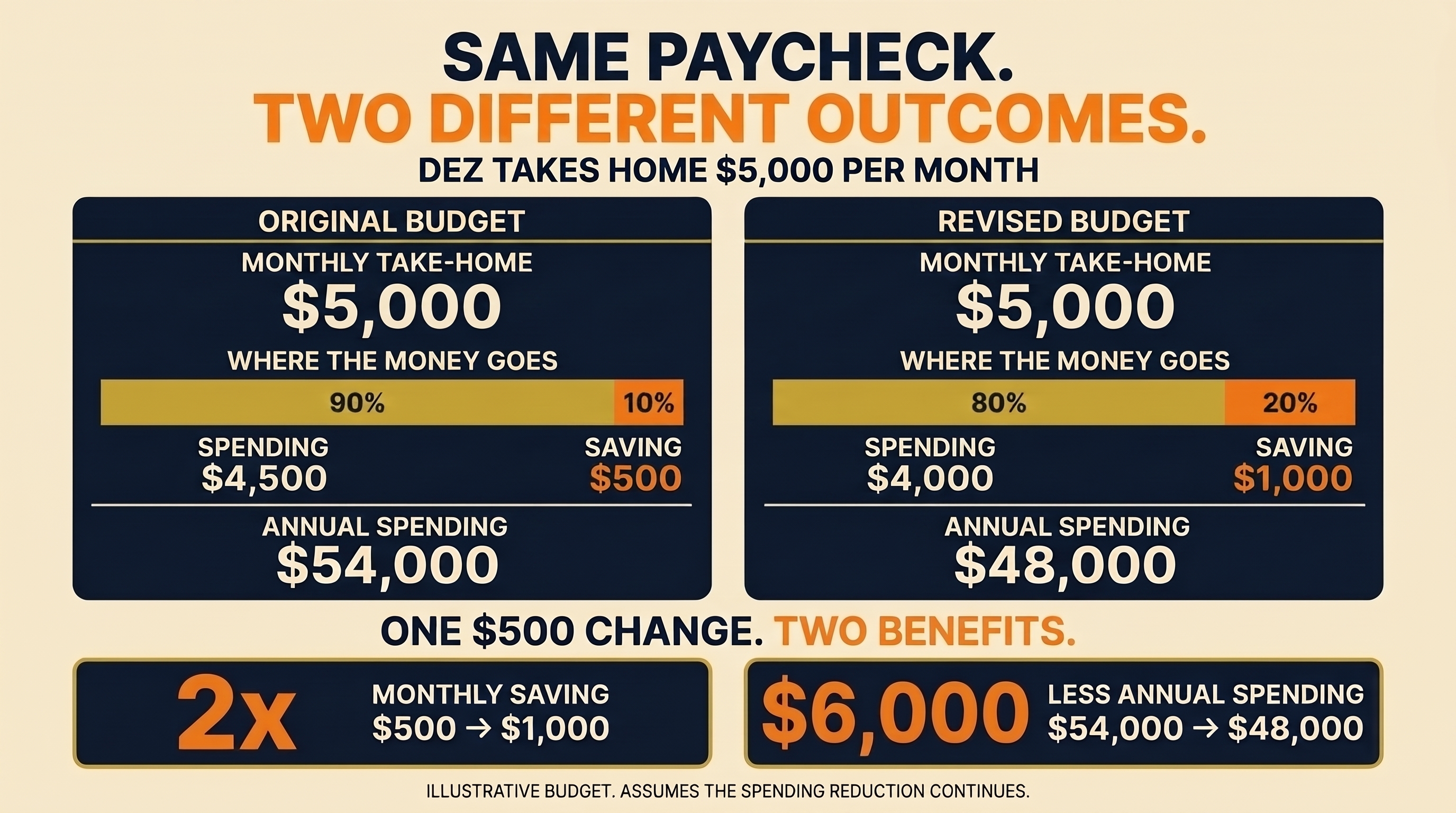
Back to Dez. Same $5,000 monthly take-home, two ways the money could go:
- Version A: spend $4,500, save $500.
- Version B: spend $4,000, save $1,000.
The difference is $500 a month. And if Dez can sustain that change, it works in two directions.
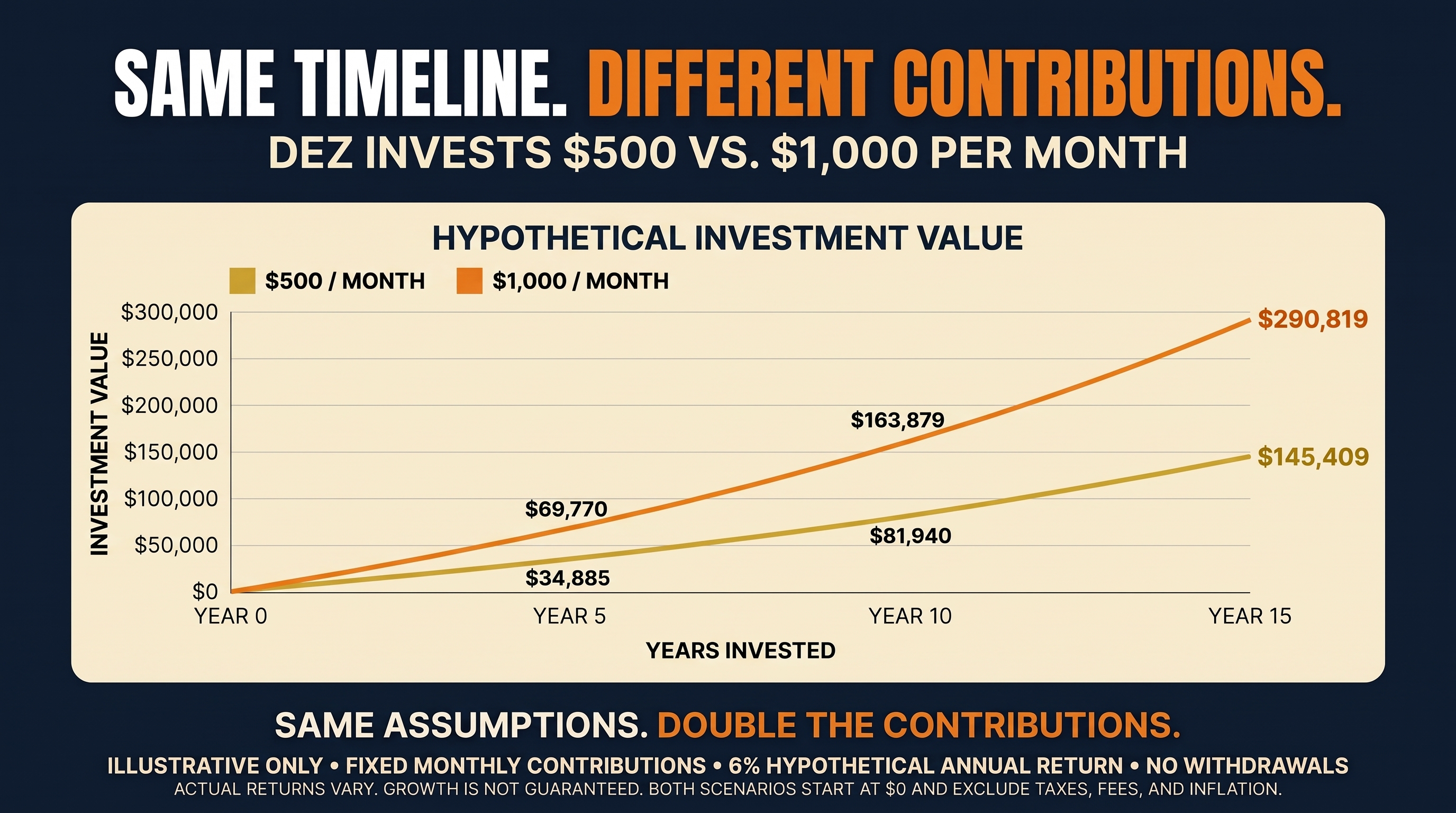
First, Dez can save more now. Monthly saving rises from $500 to $1,000. That's twice as much available to build savings and investments, without a raise.
Second, Dez has less to cover later. At $4,500 a month, spending is $54,000 a year. At $4,000, it's $48,000. If the lower-cost lifestyle continues, that's $6,000 less in annual expenses those savings and investments need to support.
Finding an extra $500 a month isn't easy. Dez might need to rethink a major recurring expense, combine several smaller changes, or find a way to earn more. For someone whose budget is already tight, increasing income may be the more realistic option.
But the mechanism is worth understanding: a lasting reduction in spending can help you build savings faster while lowering what your money needs to cover later.
A raise can help you save more, too. But if your spending rises right along with your paycheck, you haven't made much progress toward making work optional.
Where Time Comes In
Saving and spending aren't the only moving parts. Time matters too.
Money you invest has the potential to grow, and returns can build on earlier returns. That's compounding. I've explained the mechanics in What Is Compound Interest?. Investment returns aren't guaranteed, and markets don't grow in a straight line. Still, the combination of contributions and time is a major part of how people build the investments and savings that may eventually support them.
Dez's spending decision affects two parts of the picture: how much can be set aside and how much Dez will need to cover later. Time and investment results affect what those savings may become.
Dez's budget shows how spending affects the picture, but it can't tell us when Dez will reach financial independence. That depends on existing savings, future expenses, investment returns, and how long the money needs to last.
How Would You Know You've Reached It?
Here's the practical test: If you stopped working, could your savings, investments, and other income sources sustainably cover your living expenses for the years ahead?
Not just for a year or two. For a potentially long stretch of life, including the years when markets disappoint or expenses surprise you.
Spending Works Twice
When you sustainably reduce spending, you can save more today while lowering the annual expenses your future resources need to cover.
On the same $5,000 monthly take-home, Dez's $500 spending reduction doubles monthly saving from $500 to $1,000. If sustained, it lowers annual spending from $54,000 to $48,000.
That takes more than comparing your savings balance with one year's bills. You need to consider:
- What you actually spend, including irregular costs.
- What income would continue without employment, and when it would begin.
- What your savings and investments could reasonably support over time.
- Taxes, healthcare, inflation, and the risk of needing the money longer than expected.
You may hear the 4% rule mentioned as a commonly cited rule of thumb for portfolio withdrawals. Whether any withdrawal plan is sustainable depends on your circumstances, assumptions, and the years ahead. We don't need to solve that calculation to understand FI.
The test isn't whether an account balance looks impressive. It's whether the money available to you can support your actual spending without a job.
What You Do With This Information
You don't need to know when you'll reach financial independence to start understanding what it would take. Start with three questions.
How much does my life actually cost? Look at what you spend in a typical month, including housing, groceries, insurance, debt payments, and expenses that only come around a few times a year. Multiply that monthly average by 12 to get a starting estimate of your annual living costs.
What money could eventually cover those costs? Take stock of your savings, investments, retirement accounts, and other sources of income that could support you without a paycheck. You don't need to calculate an exact retirement number today. Just understand what you're building and what it could eventually provide.
Am I creating more room between what I earn and what I spend? Look at how much you're consistently saving or investing. Increasing your income, reducing an expense, or avoiding a new recurring payment can all create more room to build toward financial independence.
These questions won't tell you the exact day you can stop working. But they'll help you understand what financial independence would need to look like for your life.
If you're wondering how to decide what to invest each month, that's a separate question. I've covered it in How Much Should I Invest Per Month?.
So What Is Financial Independence?
Dez started with $5,000 a month and two different ways to spend it. The income stayed the same, but the amount available to save doubled—and the annual cost of the lifestyle those savings would eventually need to support went down.
That's the lesson. Financial independence isn't just about how much money you make. It's about what your life costs, what you're building to support it, and whether those resources can eventually cover your expenses without a paycheck.
And reaching financial independence doesn't mean you have to stop working. You might keep your job, change careers, start a business, or spend more time doing something you love.
The goal isn't to stop working. It's to reach a point where working becomes a choice.
How much does your life actually cost?
Find that number first. Everything else in financial independence is measured against it.
If you're curious about a related milestone, What Is Coast FIRE? explains how investments may grow toward a retirement goal without additional contributions. FIRE stands for Financial Independence, Retire Early.
Dez and the financial details in this article are fictional and are used to explain financial concepts. This article is general education, not individualized financial, tax, legal, or investment advice, and it does not estimate when anyone will reach financial independence. It is not sponsored and contains no affiliate or referral links.
Sources and assumptions
- Fictional budget: Dez takes home $5,000 per month in both versions. Version A spends $4,500 and saves $500. Version B spends $4,000 and saves $1,000.
- Arithmetic: $4,500 × 12 = $54,000 in annual spending; $4,000 × 12 = $48,000. The difference is $6,000 per year. Saving rises from $500 to $1,000 per month, a doubling.
- Assumption: The lower future spending requirement applies only if the lower spending level is sustained, with other costs and circumstances held constant. These are not projections of investment performance or an FI date.