Table of Contents
- The Two-Step Test
- Roberto Checks His $500
- Why Money Can Sit in Cash
- This Happens More Than You Might Think
- Is Cash in a Roth IRA Bad?
- What You Do With This Information
- Sources
The Two-Step Test
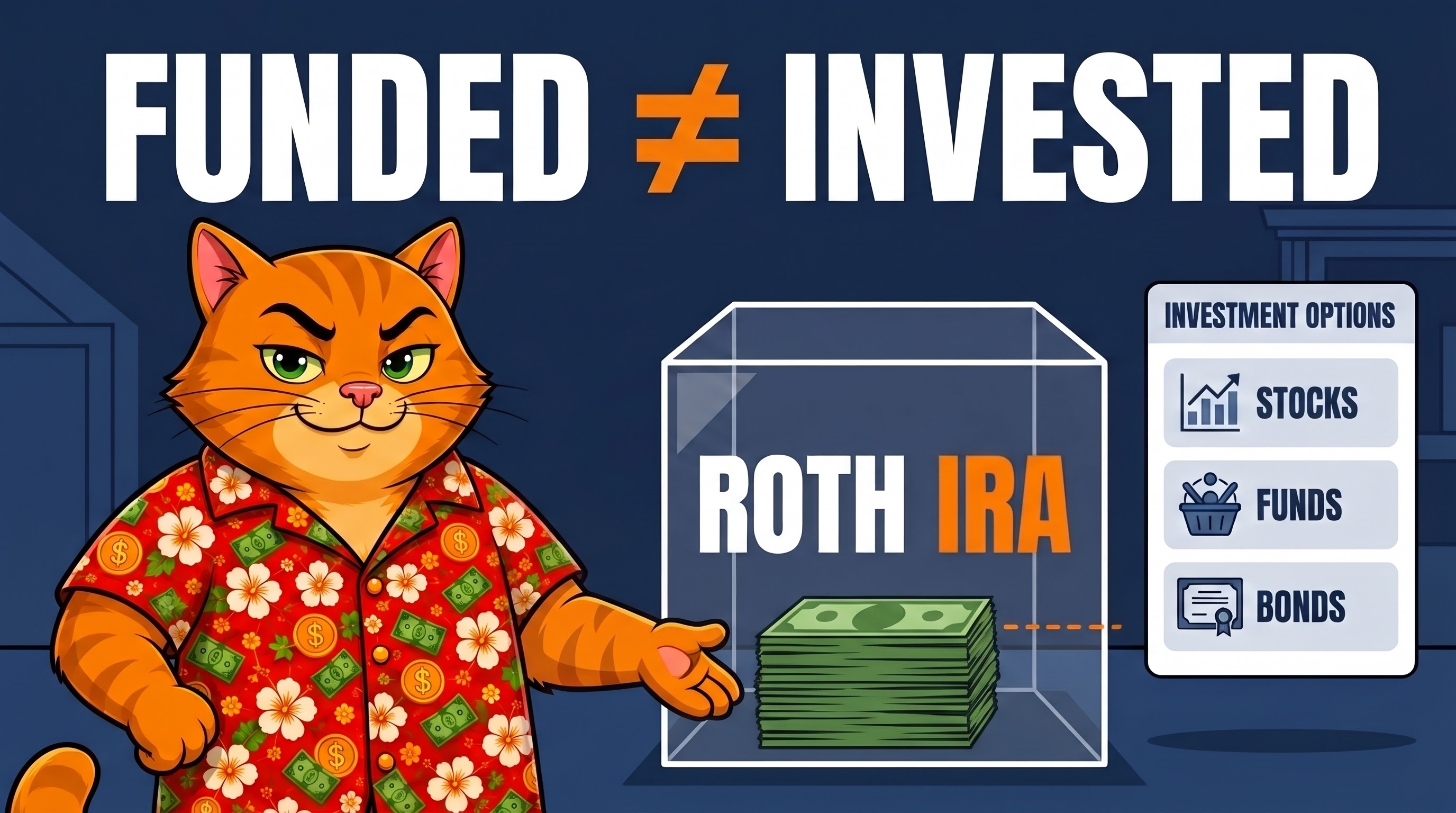
A Roth IRA is an account, not an investment you buy. Think of it as a container with special tax rules. You can hold different things inside it, including cash, money market funds, mutual funds, exchange-traded funds (ETFs), and stocks, depending on the account.
That distinction matters because opening the container and putting money into it doesn't always tell the provider what you want to own.
Here's my Two-Step Test:
- Did the money get into the Roth IRA? That's funding the account.
- What is the money held in now? That's the part you need to check before assuming it's invested the way you intended.
Some accounts follow investment instructions you've already set up. Others hold new deposits in a cash position until you place an order. You can't tell which happened just by seeing a dollar amount on the home screen.
If you're new to the account itself, start with what a Roth IRA is. For now, let's see what Roberto finds.
Roberto Checks His $500
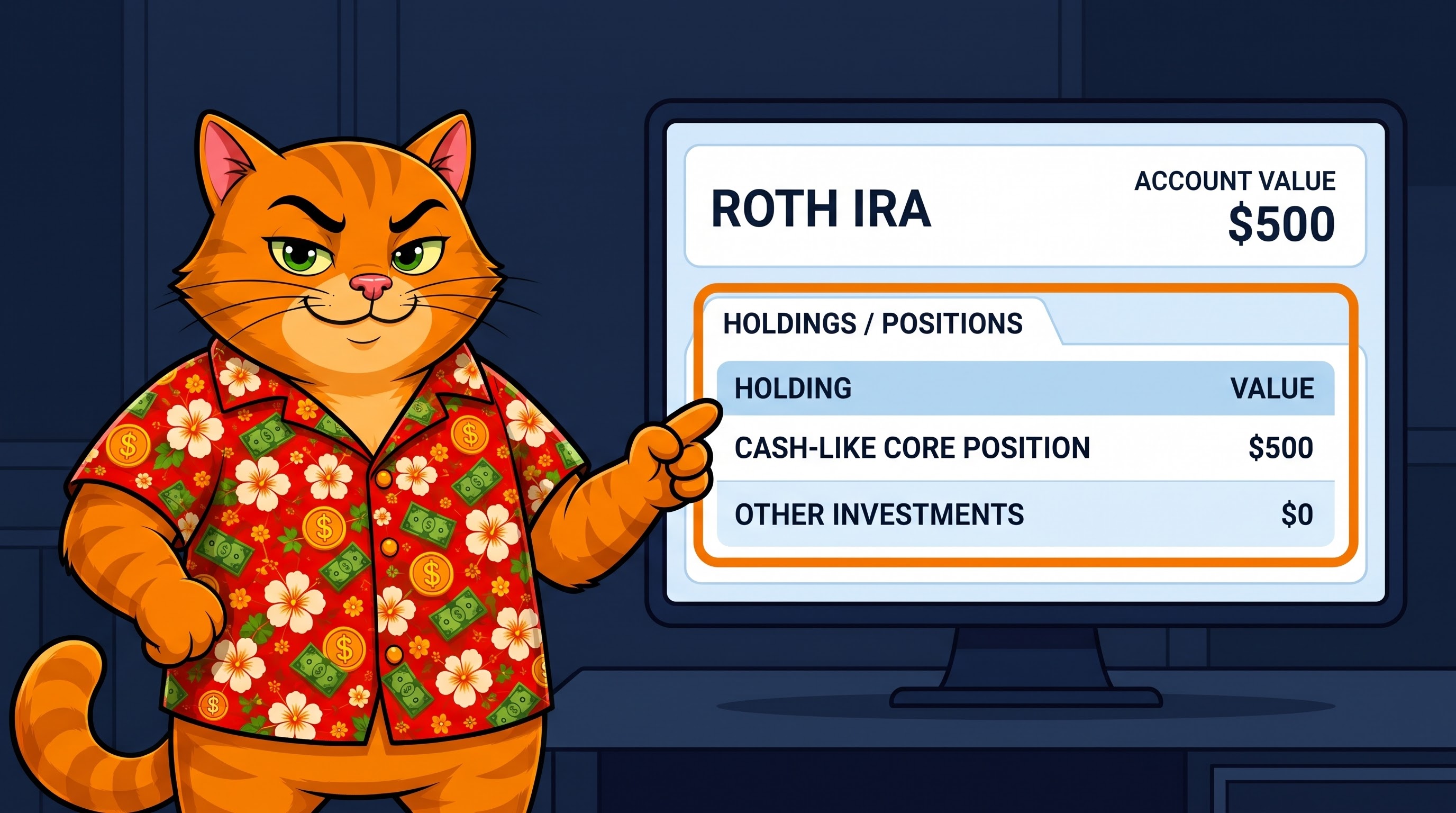
Roberto logs back in. The homepage still shows $500. He clicks into Positions and notices a line labeled Core Position.
He'd seen those words before but hadn't paid attention. This time he reads the details: his deposit is sitting in a money market fund used to hold uninvested cash.
The money hasn't disappeared. It may even be earning some income. But Roberto had pictured that $500 invested for retirement, and he hadn't chosen anything beyond the account's cash holding.
He starts reading about investment options that fit his goals, time horizon, and comfort with risk. Later, after making his own decision, he uses the money to buy an investment.
His account might still show roughly $500 immediately after the purchase. What changed is what's inside it.
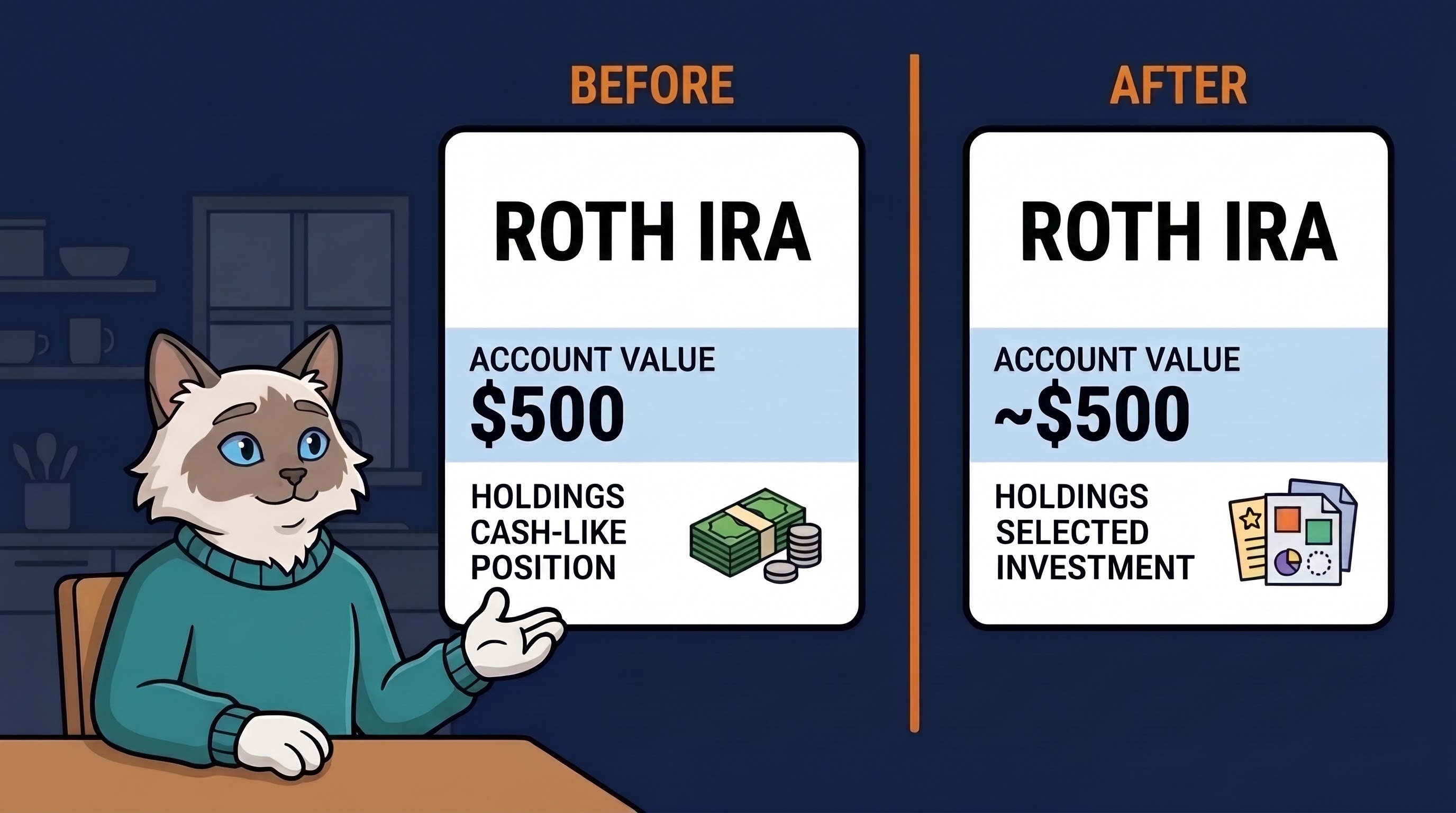
| What Roberto sees | After depositing | After buying an investment |
|---|---|---|
| Account value | $500 | About $500 immediately after the trade |
| Holdings | Cash or a cash-like core position | The investment he selected |
| What the number tells him | How much is in the account | Still only how much is in the account |
Of course, once he owns a market investment, its value can rise or fall. That's another reason the holdings page matters more than a single account total.
Roberto hadn't failed at retirement planning. He'd finished the first step and mistaken it for the whole job.
The Two-Step Test
Step 1: Put money into your Roth IRA. Step 2: Check what that money is actually held in. Funding the account doesn't necessarily invest it.
Roberto's $500 account balance looks the same immediately before and after he buys an investment. His holdings—not the total balance—tell him what changed.
Why Money Can Sit in Cash
You might wonder why a brokerage doesn't just invest every new Roth IRA deposit automatically.
Because the account doesn't necessarily know what you want to buy.
At Fidelity, for example, uninvested money goes into a core position. Depending on the account and available options, that may be a Federal Deposit Insurance Corporation (FDIC)-insured deposit sweep or a money market fund. It's where cash can wait until you invest it, withdraw it, or use it for another transaction.
A money market fund is technically an investment product, but it functions as a cash-like holding here. It isn't the same thing as owning a diversified stock or bond portfolio. And a money market fund is not an FDIC-insured bank deposit.
Your provider might use different names: cash, settlement fund, sweep, core position, or money market. Some accounts can also automatically invest contributions if you've already given instructions. The label alone isn't enough; check what the holding actually is and what your next deposit will do.
This Happens More Than You Might Think
Roberto isn't the only one who could miss that second step.
Vanguard examined a sample of contributions and rollovers into its IRAs during 2022. Twelve months later, 55% of investors in the sample who had made direct contributions still held those assets in cash or cash equivalents. Among investors who rolled money into an IRA, the figure was 28%.
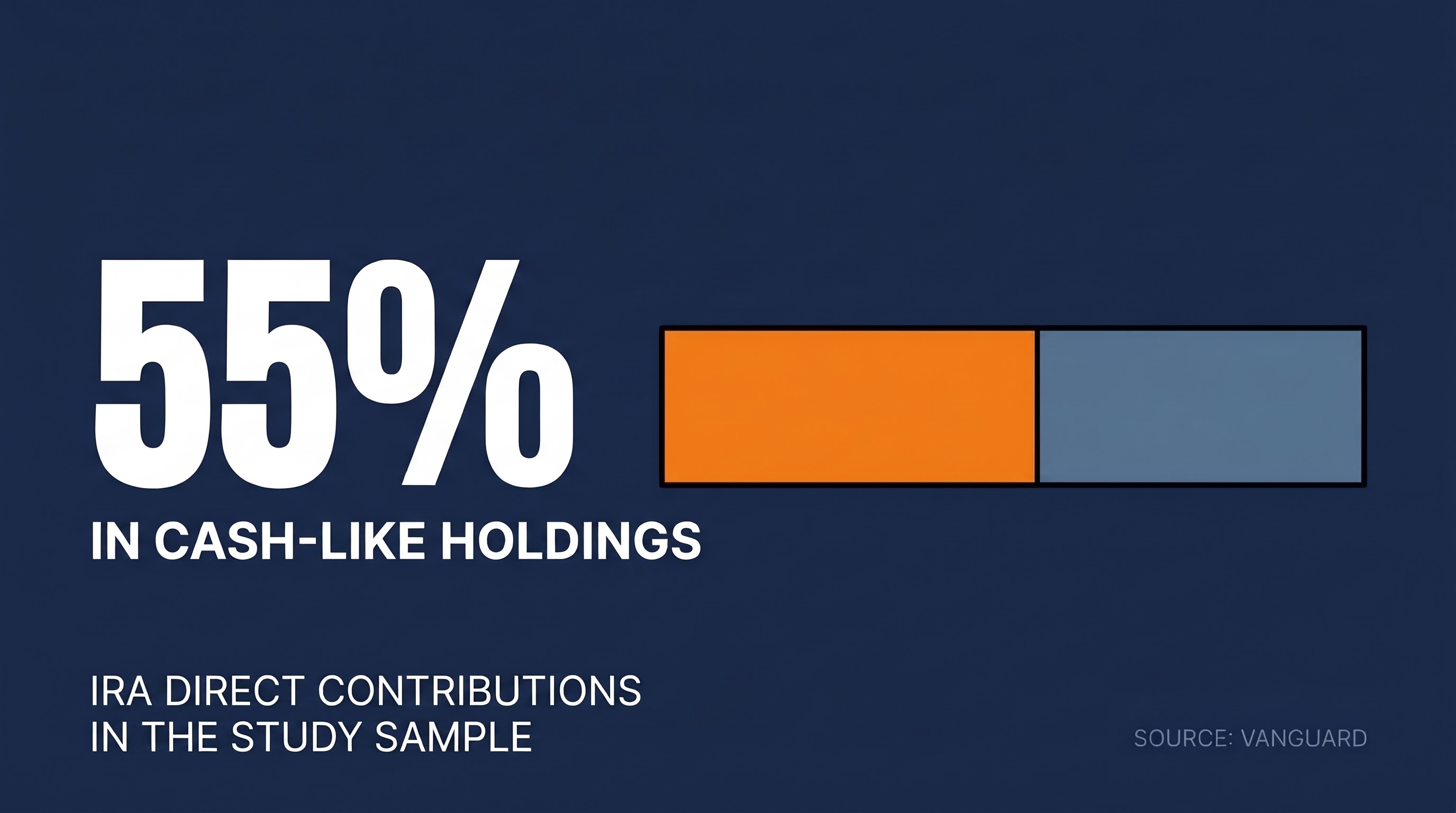
Those aren't national Roth IRA statistics. They come from one provider's IRA customers, don't break out Roth accounts separately, and describe that particular sample. But they show why it's worth taking a closer look at your own account.
In another Vanguard study, researchers surveyed 556 people who had rolled retirement money into a Vanguard IRA in 2023 and still held it in a money market fund in mid-2024. Close to half mistakenly believed IRA contributions were automatically invested.
That survey wasn't about first-time Roth IRA owners like Roberto. Still, I can see how the confusion happens. If your workplace 401(k) invested contributions according to choices you made earlier, you might expect a new IRA to work the same way.
And when the account dashboard says $500, nothing on that big number tells you to look deeper.
Is Cash in a Roth IRA Bad?
Not automatically.
Cash and cash-like holdings can earn interest or distributions. Some people hold cash on purpose because they need flexibility, are preparing to make an investment decision, or have a specific short-term reason. Others have investment instructions already in place and are simply waiting for a deposit to settle.
But if you're saving for a retirement that's decades away, leaving everything in cash without realizing it can mean missing the potential long-term growth of other investments. Cash returns can also struggle to keep up with inflation over time.
That doesn't mean the stock market owes you a profit. Investments can lose value, and nobody can tell you exactly what Roberto's $500—or yours—would have earned somewhere else.
The issue isn't that cash is forbidden. It's whether your money is where you meant it to be.
What You Do With This Information
Roberto now knows where to look. You can check your own Roth IRA in a few minutes, too.
- Open your holdings or positions page. Don't stop at the big total on your account dashboard. Look for the actual names of what's held in the account.
- Read the unfamiliar labels. If you see core, cash, sweep, settlement, or money market, find out whether that holding is your account's cash position. If you see a fund, ETF, or stock, check what it is rather than assuming the name tells you everything.
- Check your next deposit. Will future contributions be invested automatically under existing instructions, or will they land in cash until you take action?
If the screen isn't clear, ask your provider: "What is my Roth IRA money actually held in right now, and what happens when I make another deposit?"
That's a much better question than simply asking whether your account has money in it.
Roberto thought his retirement plan was underway because the transfer had gone through. Once he checked his holdings, he realized there was another choice to make. He could learn about the options and decide what suited him instead of letting an assumption make the decision for him.
You can do the same. If you're still learning the basics, here's what an ETF actually is and Roth IRA vs. Traditional IRA.
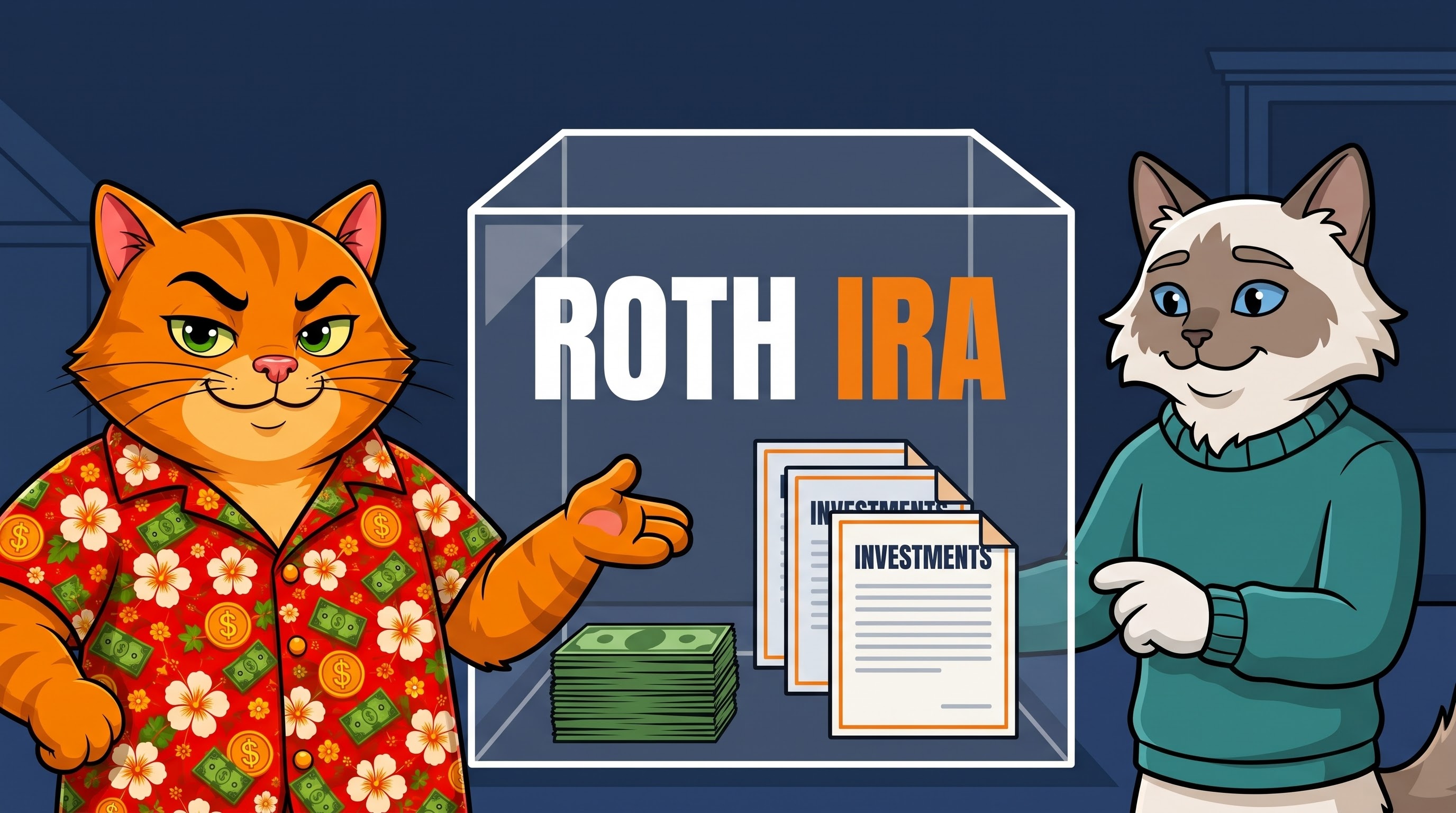
Your Roth IRA balance tells you how much is there. Your holdings tell you what's inside.
And that's the part worth checking.
Sources
- Vanguard, "The sticky IRA cash trap" (August 2024): sample of Vanguard IRA direct contributions and rollovers made in 2022; 55% and 28% remained in cash or cash equivalents after 12 months.
- Vanguard, "Out of sight, out of market: The IRA cash drag" (September 2024): survey of 556 Vanguard IRA rollover investors who held money in a money market fund; misconceptions about automatic investment.
- Fidelity, Roth IRA information and "What is a core position?": cash/core position mechanics, available types of core holdings, and the distinction between a money market fund and an FDIC-insured bank sweep.
Roberto and his circumstances are fictional. The $500 illustration ignores short-term price movements, fees, and any income earned. Provider features and investment choices vary; confirm the details of your own account.
Chuck Finance is for entertainment and informational purposes only. Chuck is not a licensed financial advisor, and nothing in this post constitutes professional financial, investment, legal, or tax advice. Always consult a qualified professional before making financial decisions.
Related: what a Roth IRA is, Roth IRA vs. Traditional IRA, and what an ETF actually is.