Table of Contents
- What Actually Differs
- The Rate Difference, in Dollars
- The Cost of Getting Your Money Back Early
- What Happens When Savings Rates Change?
- How to Decide by Time Horizon
- The Maturity Trap
- What Lola Does
- What You Do With This Information
- Sources
What Actually Differs
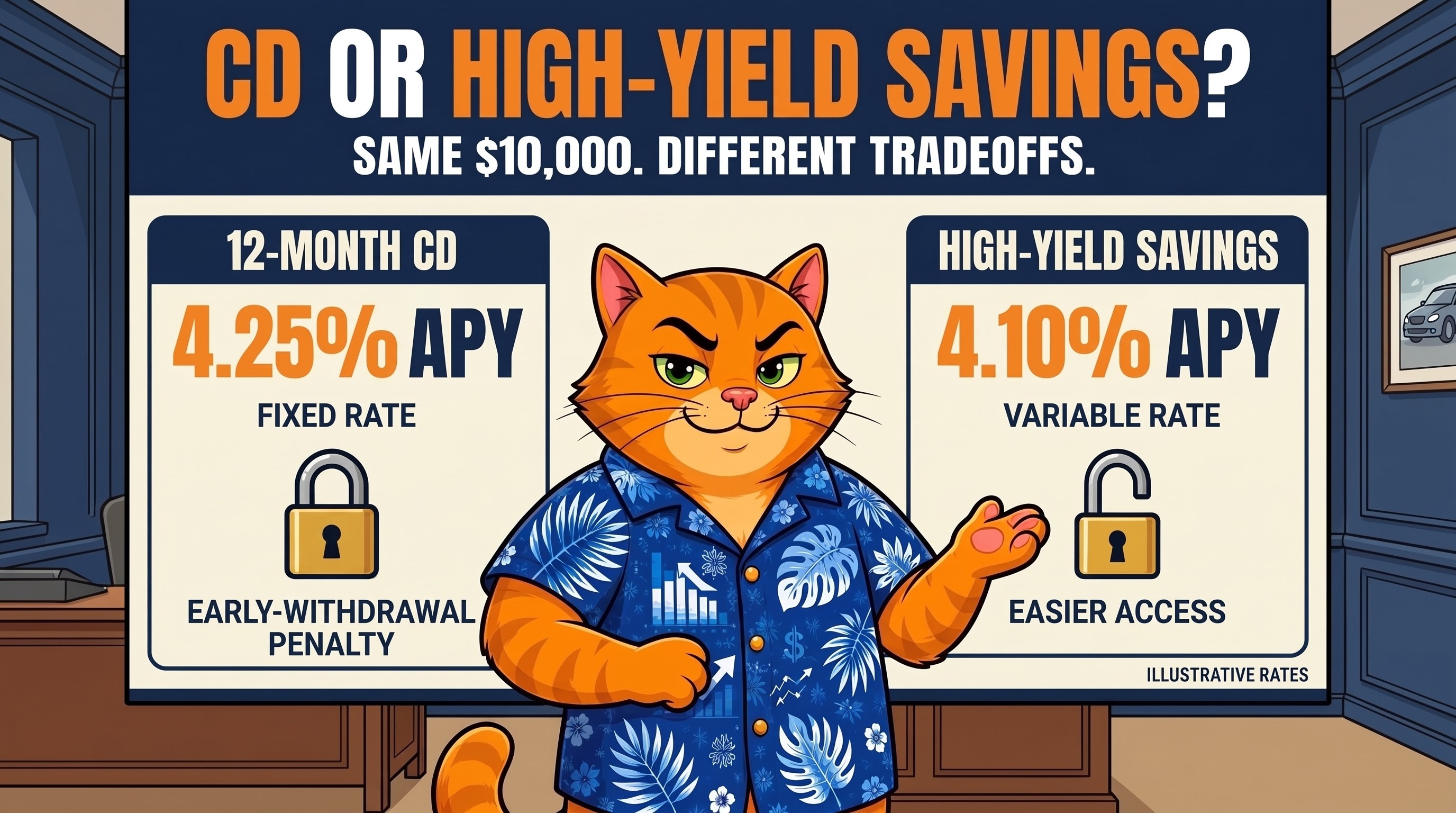
Both accounts earn interest on deposits. But they make different promises.
A CD is a time deposit. You agree to leave your money deposited for a set term, such as six months or one year. A traditional fixed-rate CD keeps the same rate for that term. Withdraw early, and you generally face a penalty. Some CDs have variable rates or special withdrawal provisions, so the agreement matters.
An HYSA is a savings account. It has no CD-style maturity date, and you can generally withdraw money when you need it, subject to account terms and possible transaction limits or fees. But its variable interest rate can rise or fall.
That's the trade: rate certainty versus access. A fixed-rate CD protects you if savings rates fall. An HYSA leaves you free to use your money without a CD early-withdrawal penalty.
Eligible deposits in both products can receive federal deposit insurance at insured institutions. The standard coverage limit is $250,000 per depositor, per insured bank or credit union, per ownership category, subject to applicable rules. I covered how to verify that protection in Are High-Yield Savings Accounts Safe?.
Lola's problem isn't choosing which account sounds safer. It's deciding how much flexibility her future car money needs.
The Rate Difference, in Dollars
Start with the two hypothetical offers and assume Lola makes no withdrawals or additional deposits during the year.
| Account | Starting balance | APY | Balance after 12 months |
|---|---|---|---|
| 12-month fixed-rate CD | $10,000 | 4.25% | $10,425.00 |
| HYSA, if its rate stays unchanged | $10,000 | 4.10% | $10,410.00 |
The CD wins by $15.
Not $150. Not $1,500. Fifteen dollars.
That's still money. But Lola is considering restricting access to $10,000 for an extra $15 if the HYSA rate stays where it is. Before taking that deal, she needs to know the price of changing her mind.
The Cost of Getting Your Money Back Early
Suppose Lola decides to replace her car before the CD matures.
With an HYSA, she can generally withdraw the savings without a CD-style early-withdrawal penalty, though she should still check for account-specific fees or limits.
With a CD, the withdrawal terms matter. Some penalties are based on a number of days or months of interest. Depending on the agreement and withdrawal date, a penalty can use up accrued interest and even reduce principal.
For Lola's hypothetical CD, assume the penalty is 180 days of simple interest at 4.25% on the $10,000 withdrawn. That's $209.59. This example does not cap the penalty at interest earned. Actual CDs can calculate penalties differently.
Assume interest accumulates at the stated APY, no additional fees apply, and the HYSA stays at 4.10% APY:
| Withdrawal time | HYSA balance | CD balance after penalty | HYSA ahead by |
|---|---|---|---|
| Month 4 | $10,134.84 | $9,930.12 | $204.72 |
| Month 6 | $10,202.94 | $10,000.70 | $202.24 |
| Month 9 | $10,305.95 | $10,107.50 | $198.45 |
| Month 12, at maturity | $10,410.00 | $10,425.00 | CD ahead by $15.00 |
At month four, the example penalty is larger than the interest the CD has earned. Lola would receive less than her original deposit. At month six, the HYSA is about $202 ahead. Wait until maturity, and the CD's $15 advantage returns, assuming the HYSA rate hasn't changed.
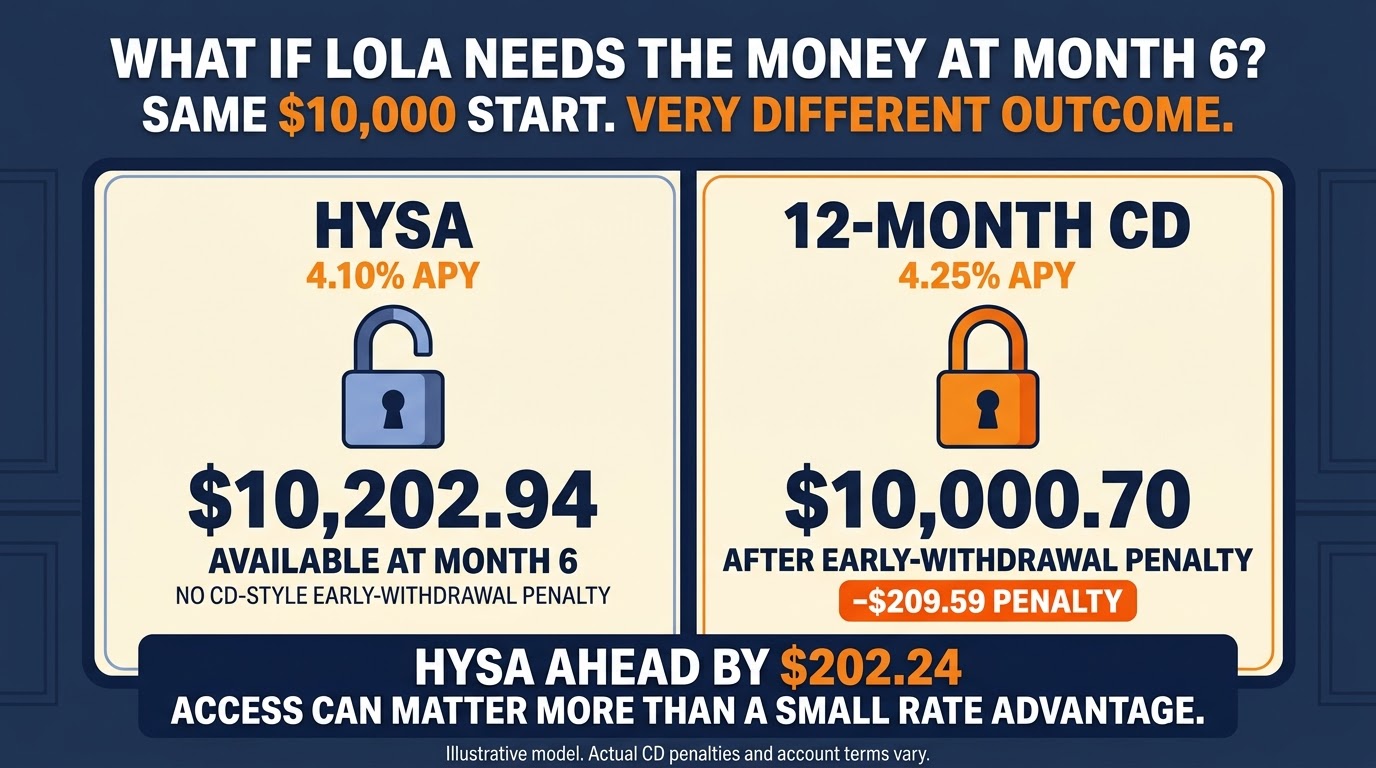
A $15 rate advantage isn't much comfort if getting the money early costs around $200 more.
That doesn't make CDs bad. It means Lola has to be confident about the term—and check the actual early-withdrawal provision before opening one.
What Happens When Savings Rates Change?
The fixed-rate CD stays at 4.25% for the year. The HYSA starts at 4.10%, but its rate might change after three months.
| HYSA rate scenario | HYSA after 12 months | CD after 12 months | Result |
|---|---|---|---|
| Stays at 4.10% | $10,410.00 | $10,425.00 | CD ahead $15.00 |
| Falls to 3.60% after month 3 | $10,372.48 | $10,425.00 | CD ahead $52.52 |
| Rises to 4.60% after month 3 | $10,447.48 | $10,425.00 | HYSA ahead $22.48 |
If the HYSA rate falls, locking the CD rate helps. If the HYSA rate rises, keeping money in savings can pay more. In this example, the HYSA would need to pay approximately 4.30% APY during months four through twelve to match the CD after starting at 4.10% for the first three months.
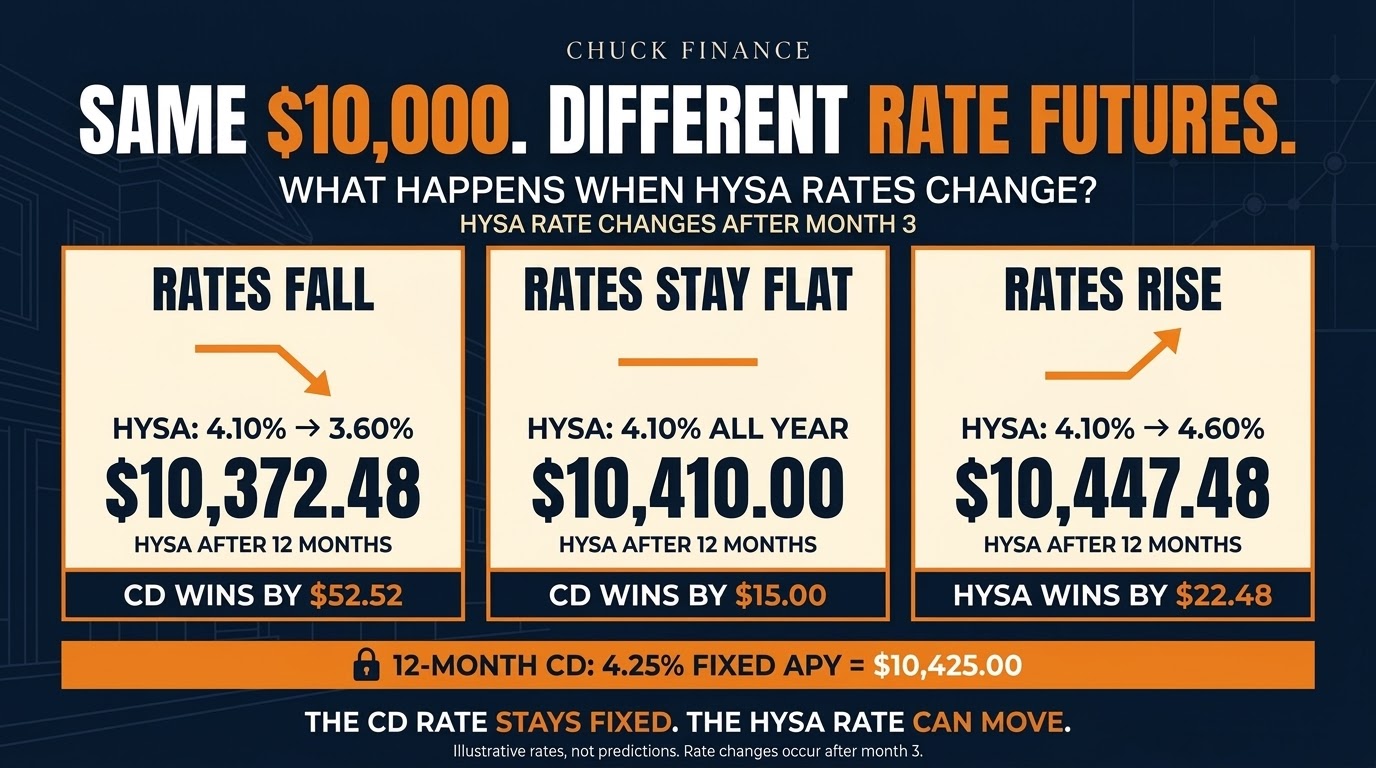
Banks set their own deposit rates based on market conditions, competition, and funding needs. Federal Reserve policy can influence them, but no one can promise Lola where her HYSA rate will go.
She doesn't need to predict rates to know that access has value.
How to Decide by Time Horizon
Before comparing APYs, ask what the money is supposed to do.
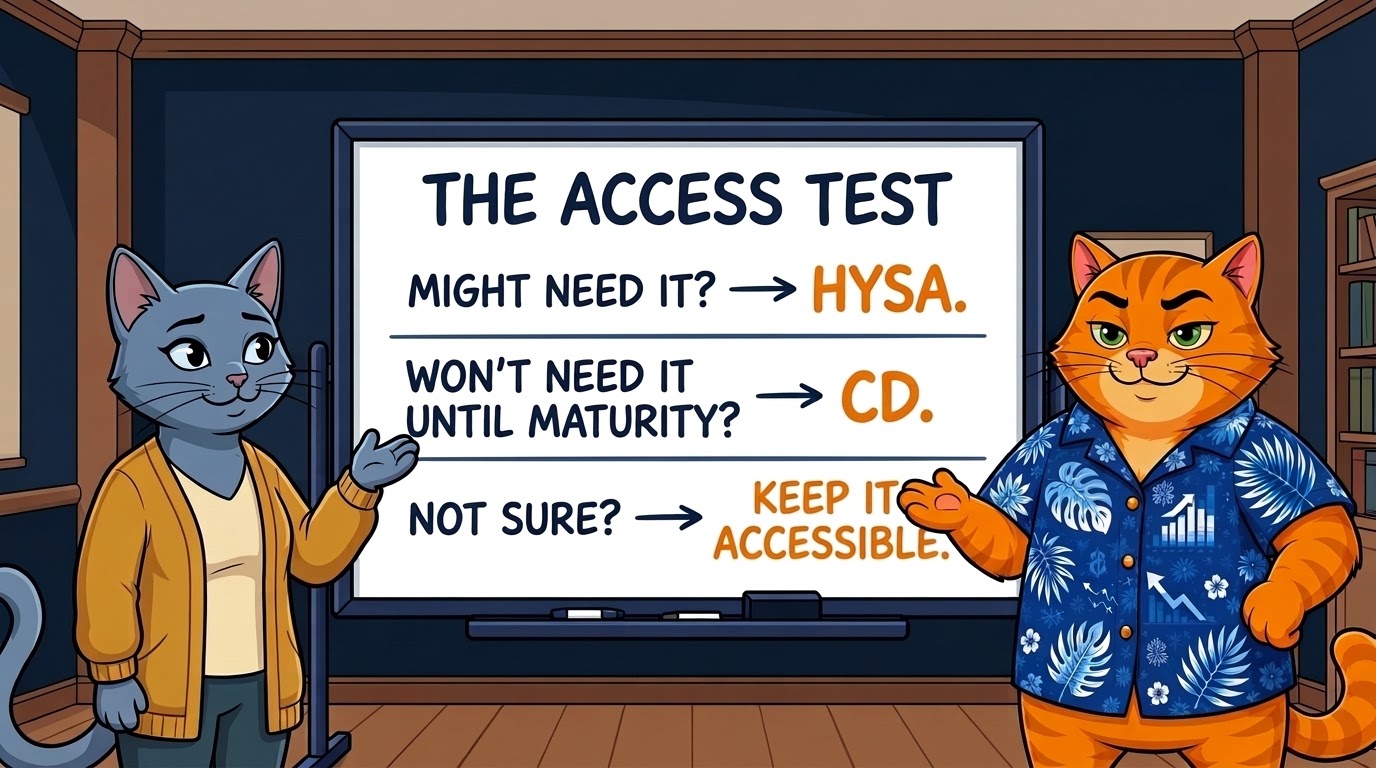
You might need it before the CD matures. An HYSA is usually the more flexible fit. That matters for a car replacement, a move, or another expense with an uncertain date.
You can leave it untouched for the full term. A fixed-rate CD can make sense if the rate is competitive, you have accessible funds for unexpected needs, and you accept the withdrawal terms.
You're not sure. Keep flexibility in the conversation. You could choose an HYSA, a shorter CD, or split the money. A no-penalty CD may also be worth comparing, but its withdrawal rules and APY can differ from a traditional CD.
It's your emergency fund. Keep enough readily accessible for the emergencies it's meant to cover. I explain that in Where to Put Your Emergency Fund.
If you're still weighing an HYSA against an ordinary savings account, that's a separate decision I cover in Is a HYSA Still Worth It?.
Interest from either account is generally taxable. The IRS requires taxable interest to be reported even if you don't receive a Form 1099-INT. Your after-tax earnings may be lower than the balances shown here.
The Access Test
Money you won't need during the full term can be locked. Money you might need should stay accessible.
Lola's CD could earn $15 more over 12 months if the HYSA rate stays unchanged. But an early withdrawal could cost far more than that advantage.
The Maturity Trap
A CD's term eventually ends. What happens next depends on its agreement.
Some CDs renew automatically into a new term, potentially at a different rate. Others do not. Some automatically renewing CDs offer a grace period when you can withdraw without the usual early-withdrawal penalty.
Before opening one, find the maturity date, automatic-renewal terms, and grace period, if any. Federal account-disclosure rules require institutions to describe relevant time-account features, and additional pre-maturity notice rules apply to certain CDs.
Put the maturity date on your calendar, then compare the available rates again before accepting a renewal.
Locking your money once is a choice. Accidentally locking it up again shouldn't be.
What Lola Does
Lola chooses the HYSA.
Not because she thinks savings rates will rise. Not because the CD is a bad deal.
Because she doesn't know exactly when she'll need to replace her car.
The CD's small interest advantage isn't worth the possibility of paying an early-withdrawal penalty when that day comes.
She'd rather keep her options open.
The money's purpose matters more than the advertised rate.
What You Do With This Information
Write down two things: how much you're saving and the earliest date you might realistically need it.
If that date falls inside the CD's term, think carefully before giving up easy access. If the money can comfortably stay put until maturity, compare the CD's fixed APY with the HYSA's variable APY.
Before opening either account, check the actual terms: early-withdrawal penalties, whether the rate is fixed or variable, withdrawal limits or fees, maturity and renewal rules, minimum-balance requirements, and federal deposit-insurance eligibility.
Don't let a small APY difference distract you from a much bigger difference in flexibility.
The best rate is the one attached to an account that actually works for your money.
Sources
- CFPB, What is a certificate of deposit (CD)?
- CFPB, Regulation DD, § 1030.4 — Account disclosures
- CFPB, Regulation DD, § 1030.5 — Subsequent disclosures
- CFPB, What is a CD rollover or renewal?
- CFPB, Why am I being charged for transactions in my savings account?
- FDIC, Deposit Insurance
- NCUA, Share Insurance Coverage
- IRS, Topic No. 403 — Interest Received
Calculation notes: All rates, balances, and penalties are hypothetical. The interest calculations use fractional-year APY growth: $10,000 × (1 + APY)^(months/12). For rate changes, each APY applies to its respective portion of the year. The CD's hypothetical penalty is $10,000 × 4.25% × 180/365 = $209.59, subtracted from accrued balance without a cap at interest earned. Actual CD terms and interest-crediting methods vary. Figures are rounded to the nearest cent.
Chuck Finance is for entertainment and informational purposes only. Chuck is not a licensed financial advisor, and nothing in this post constitutes professional financial, investment, legal, or tax advice. Always consult a qualified professional before making financial decisions.