Table of Contents
Why There's No Universal Missed-Payment Number
Here's the distinction I want you to remember: a missed payment, a late fee and a default are not necessarily the same event. And none of them comes with one nationwide repossession countdown.
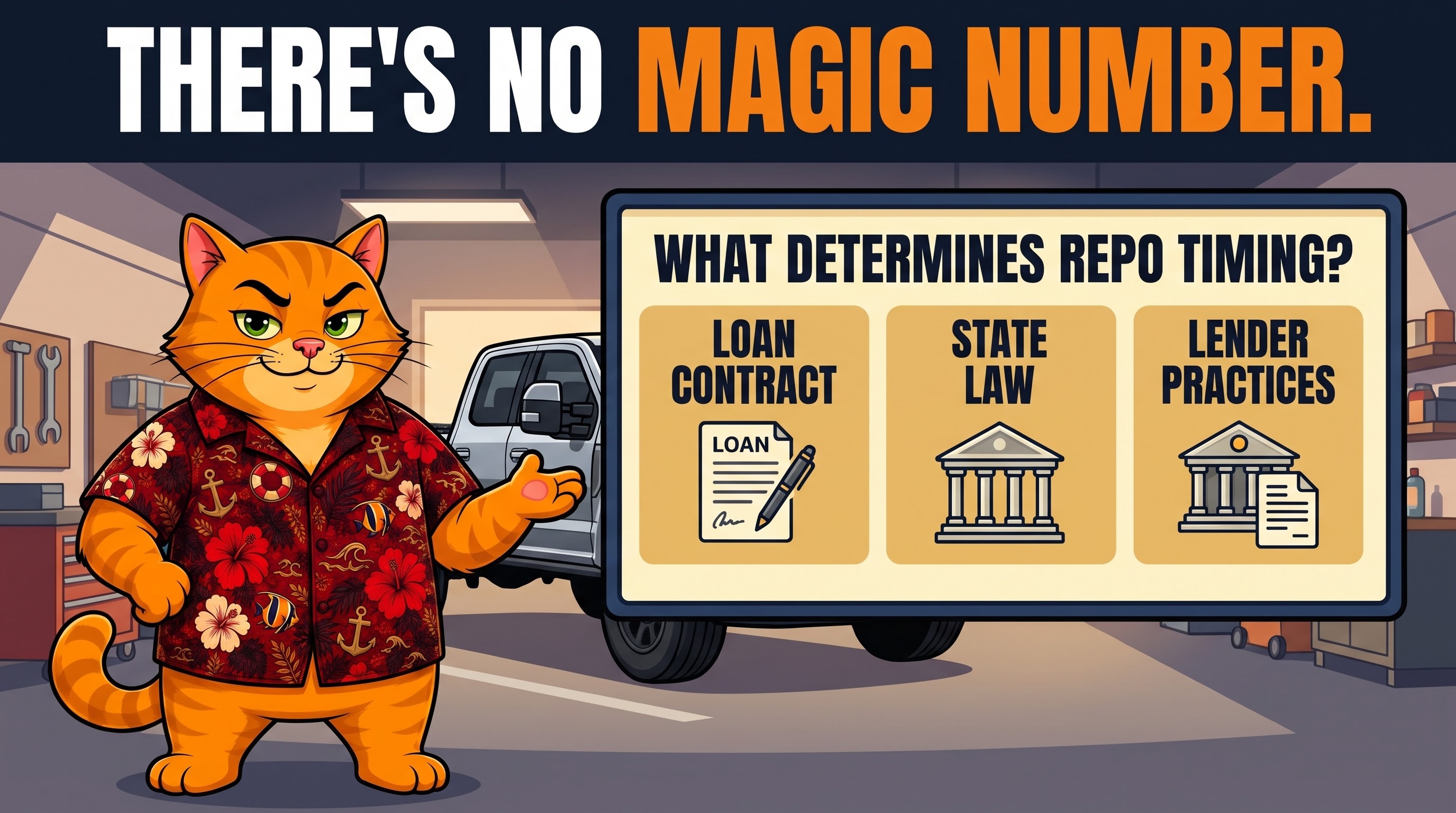
Three factors matter:
- Your contract. The FTC says your contract should explain what can put you in default. Missing a payment on time is a common example. The contract—not a rumor about missed-payment counts—sets the default terms.
- Your state. State law affects notice and repossession requirements. The CFPB says lenders in many states may repossess after a missed payment without warning or a court order; other states require notice and an opportunity to make up missed payments.
- Your lender. A lender or servicer may offer a different due date, payment plan or temporary forbearance. Those arrangements are possible, not automatic.
You might hear that somebody missed several payments and kept driving. That tells you what happened with their loan. It doesn't tell you what your contract permits.
Student loans have different default rules. If that's the debt you're dealing with, see What Happens If You Default on a Student Loan?.
Can Your Car Be Repossessed Without Warning?
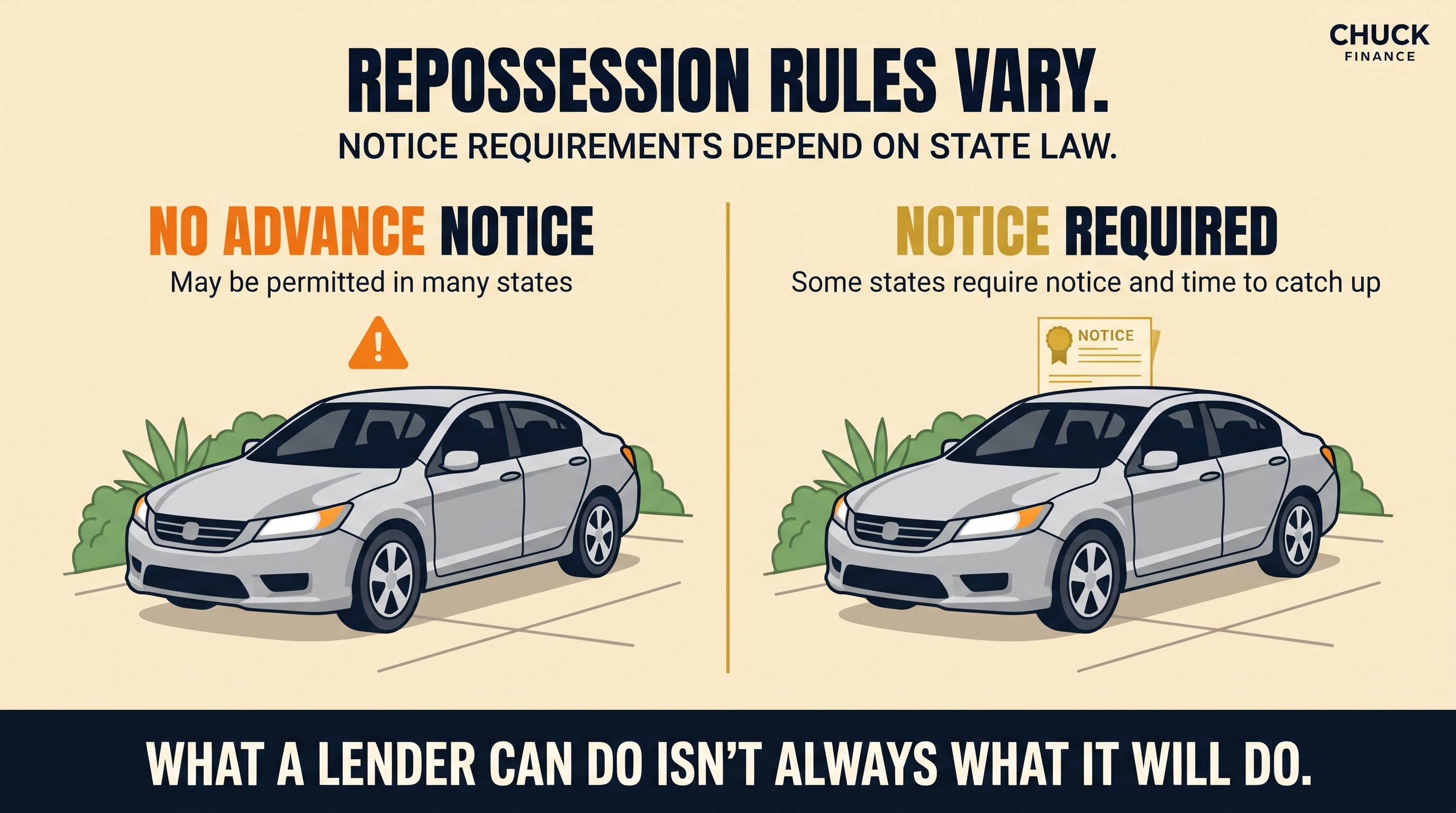
Here's the part I don't want you to underestimate: in many states, a lender may be able to repossess a vehicle without advance notice or a court order after a missed payment. That's not a prediction about your lender. It's a warning against assuming you'll always receive a final reminder first.
The CFPB also explains that other states require lenders or servicers to send notice identifying missed payments and allowing time to catch up. Which rule applies depends on where you live and your circumstances. For state-specific requirements, contact your state attorney general or local consumer protection office, or seek qualified legal advice.
And don't confuse can with will. A lender having a legal right to act doesn't mean it will act immediately. But the fact that a lender might wait doesn't give you a guaranteed waiting period either.
That is why how long before a car is repossessed has no reliable nationwide answer.
Why Grace Periods and Online Timelines Can Mislead You
A grace period sounds like breathing room. Sometimes it is—but you need to know what it protects you from.
The CFPB says some auto-loan contracts allow several days after the due date before charging a late fee. State law may also affect the fee and grace period. That does not mean every grace period prevents default or repossession. The fine print determines what that grace period actually covers.
The same caution applies to online answers about how many missed car payments before repossession. Someone else's experience isn't a rule for your loan. Even if a lender waited in one case, it might handle another differently within the law.
A forum can tell you what happened to someone else. It cannot tell you what protection you have.
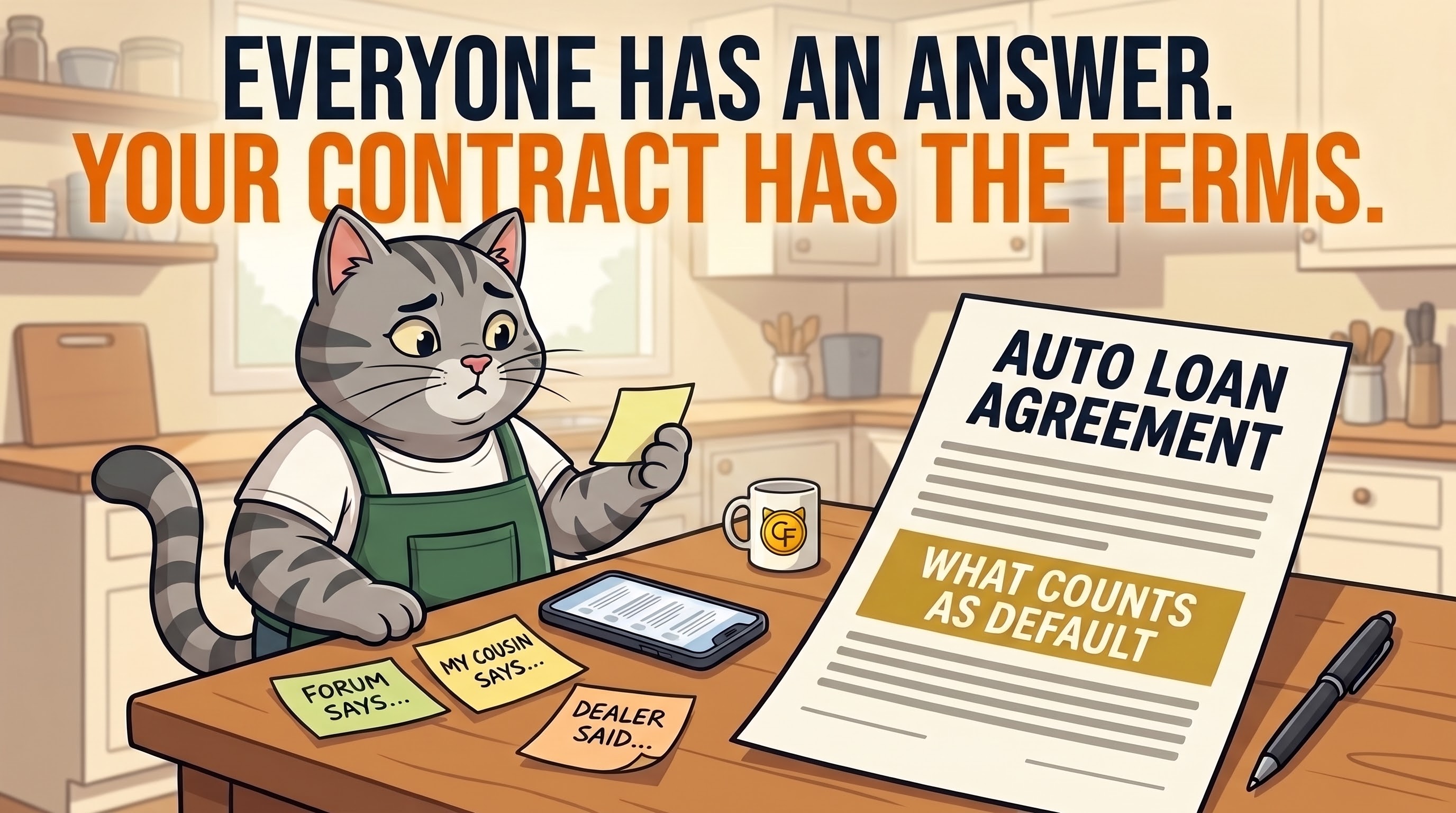
Rocco's $412 Car Payment
My buddy Rocco has a used sedan that gets him to his shifts at the hardware store. He takes pride in handling his own bills. Asking for help is not his favorite activity.
Then the store cuts his hours. His monthly car payment is $412. After covering his other essentials, he's $300 short of what he needs for that payment. His next paycheck arrives twelve days after the due date.
He isn't trying to walk away from the loan. He needs the car to get to work, and he wants to know whether he can wait until payday.
Rocco starts repeating missed-payment numbers he found online. I tell him: none of those people signed your contract.
He has three questions to settle:
| Rocco's question | Where he checks | What he needs to learn |
|---|---|---|
| What counts as default, and is there a late-fee grace period? | His loan contract and statement | The actual payment and default terms |
| Does his state require notice before repossession? | State attorney general or consumer protection office | The notice rules that apply to him |
| Can his payment date be moved past payday? | His lender or servicer | Whether a change is available, what it costs and how it will be documented |
Moving a payment isn't the same as forgiving it. The CFPB explains that a due-date change or forbearance generally means the borrower must make up the affected payment later. Rocco also needs to understand any fees and how the arrangement affects his next payment.
The Three Checks
Contract, state, lender. Check the default terms, the applicable notice rules and the options your lender will actually approve.
Rocco owes a $412 payment and is $300 short. A payment arrangement may change when he pays, but it does not automatically erase what he owes.
He could stay quiet and hope the lender waits. Instead, he decides to ask about changing the due date. The lender might say no, but at least he will know where he stands.
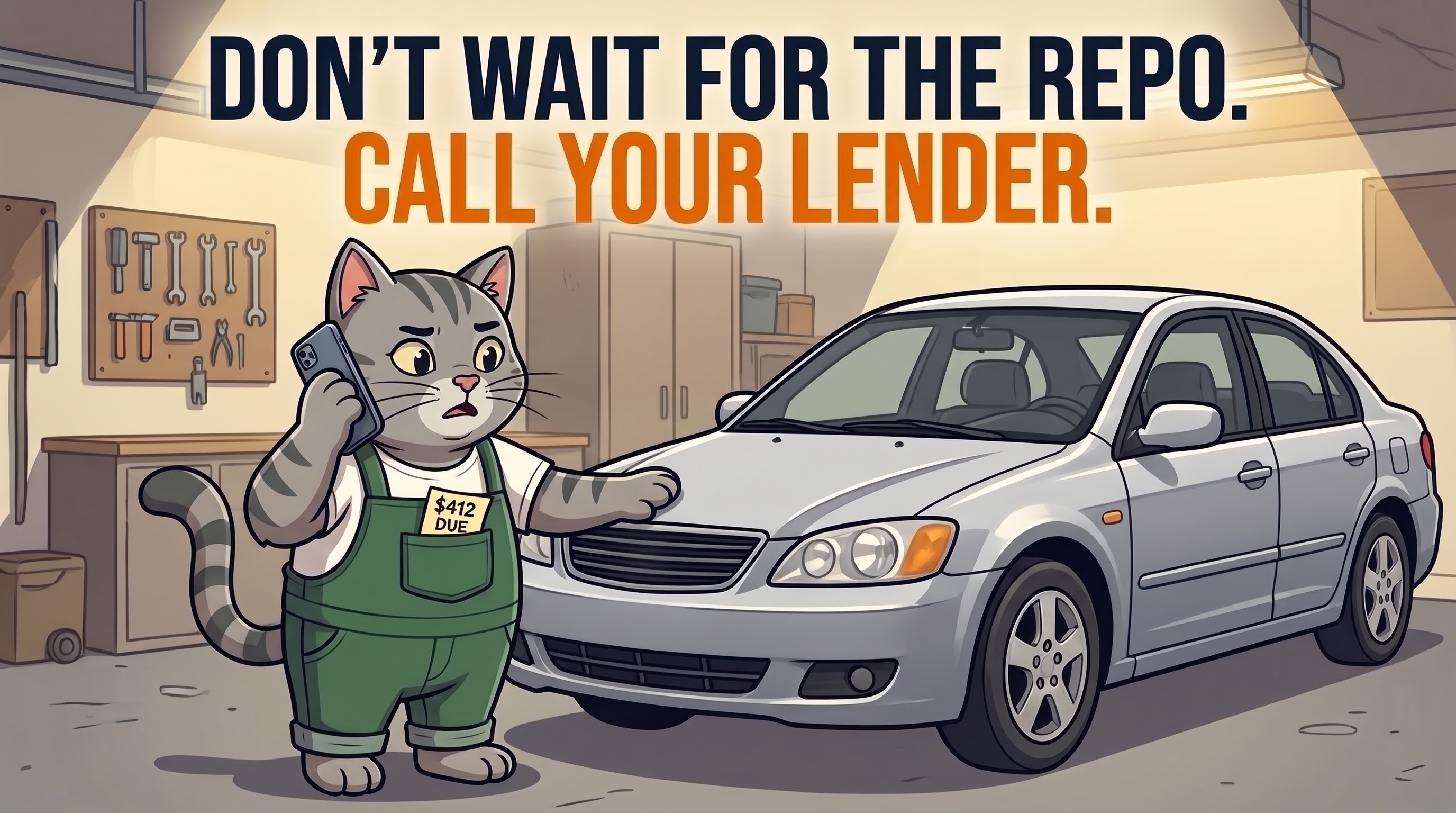
What to Do Before You Miss a Car Payment
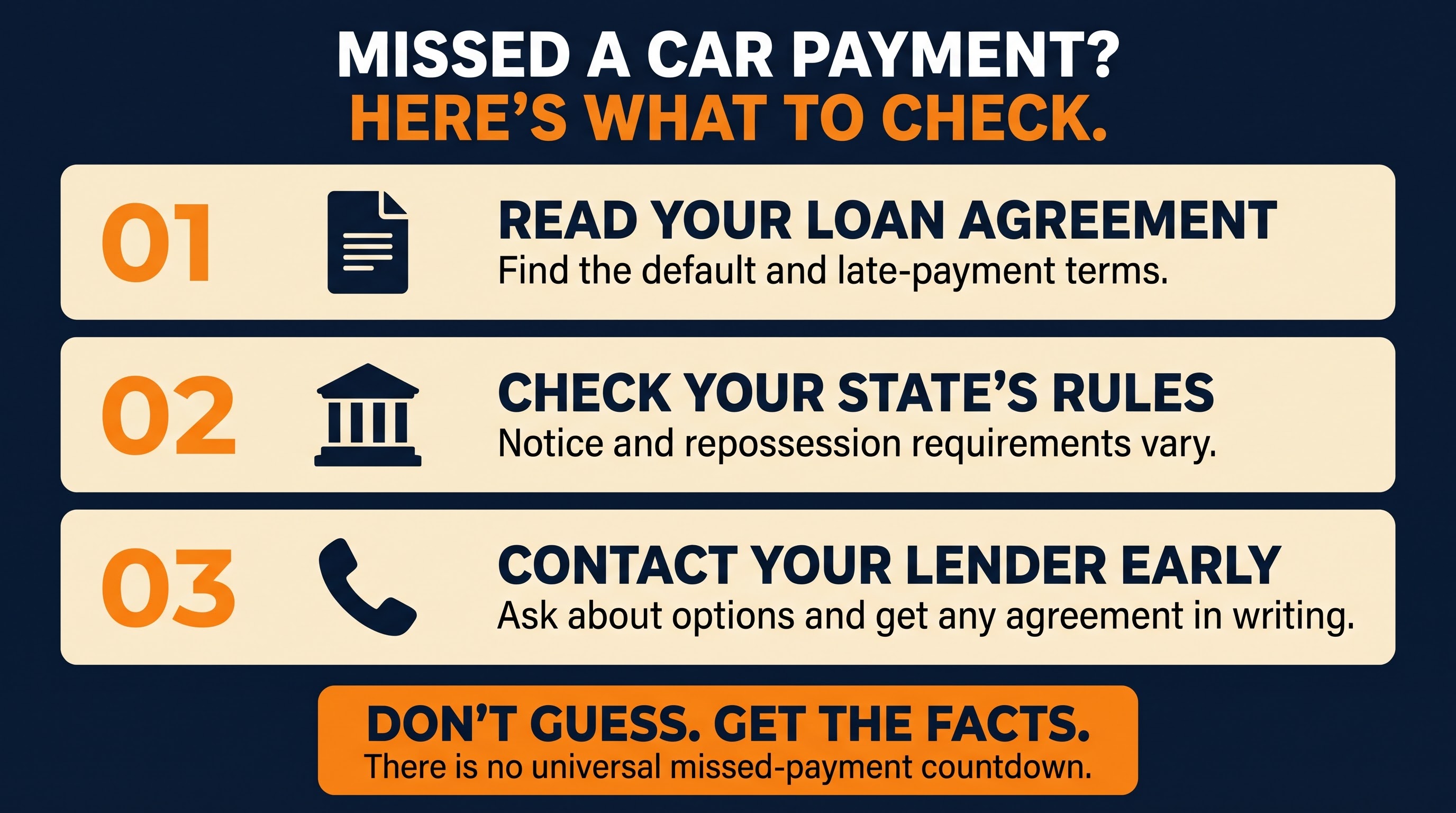
If your next payment is at risk, here is the practical checklist:
- Read the default and late-payment terms. Find the default language, late fee and any grace period. If the paperwork is missing, request a copy. For a refresher on the rest of the loan, see How Do Auto Loans Work? (And What Your Monthly Payment Doesn't Tell You).
- Contact your lender or servicer as soon as you know payment may be difficult. Explain when you can pay and ask about a payment plan, due-date change or temporary forbearance. The CFPB recommends contacting the lender promptly; approval is not guaranteed.
- Ask what the arrangement actually changes. Will the missed amount be added to a later payment? Will a fee or additional interest apply? Does the lender consider the account current under the arrangement? How could it affect credit reporting? Don't assume a new due date answers all four questions.
- Get the agreement in writing. Confirm the revised payment date, amount and other conditions. The FTC and CFPB recommend written agreements to avoid disputes and misunderstandings.
- Check your state's notice requirements. Your state attorney general or consumer protection office can help identify the applicable rules.
- If you're an active-duty servicemember, check the SCRA protections. For qualifying pre-service auto loans or leases, the Servicemembers Civil Relief Act generally requires a court order before repossession. Eligibility includes conditions about when the agreement was made and a payment made before military service. Review the CFPB's SCRA explanation or speak with military legal assistance about your situation.
The CFPB also discusses refinancing and selling a vehicle as possible ways to address payment trouble. Those choices depend on the loan balance, the vehicle's value and your longer-term finances; they deserve their own comparison rather than a rushed decision here.
The point is to learn your actual options while there is still time to act.
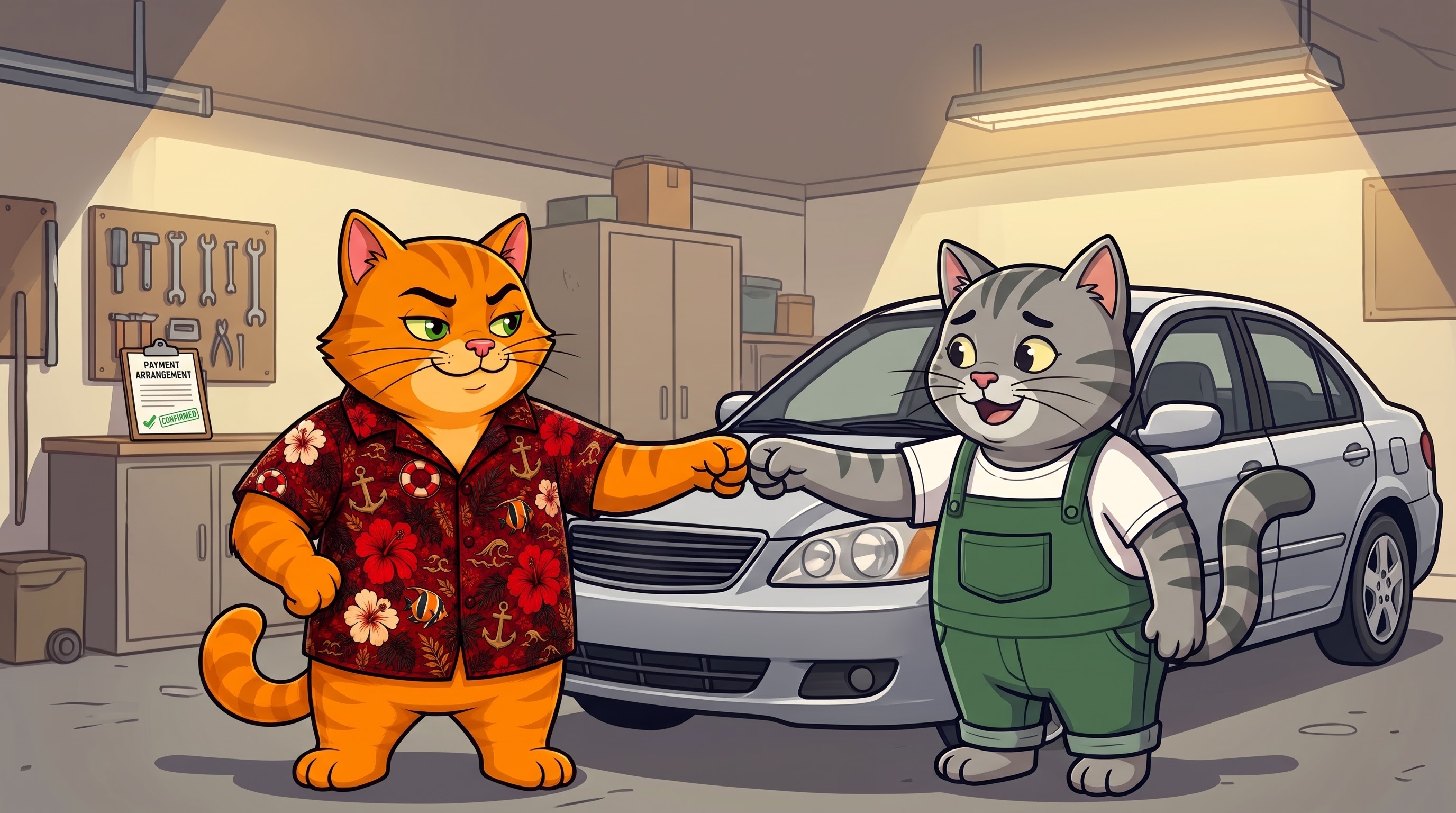
Where That Leaves You
Rocco calls the day before his payment is due. He doesn't love the conversation, but he explains the cut in his hours and the date of his next paycheck. In his case, the lender agrees to move the payment date past payday. He asks for written confirmation of the new date and terms before relying on the arrangement.
He still owes the $412. The agreement changes the payment date, not the debt. Another lender could refuse the same request; Rocco's outcome is not a promise about yours.
Here's my take: falling behind on a car payment is stressful enough without trying to guess how much time you've got. Rocco didn't have all the answers, but he took the first step, had an uncomfortable conversation, and found a way forward. You might not get the same answer he did, but knowing where you stand is a whole lot better than sitting around worrying about what might happen.
Chuck Finance is for entertainment and informational purposes only. Chuck is not a licensed financial advisor, and nothing in this post constitutes professional financial, investment, legal, or tax advice. Consult an appropriately qualified professional for advice about your circumstances.
Repossession rules vary by contract and state. This article is general education, not legal advice. Rocco and his story are fictional, and the dollar amounts are invented. This article is not sponsored, contains no affiliate or referral links, and does not recommend any lender, lawyer or debt-relief company.
Sources
- Consumer Financial Protection Bureau — What should I do if I can't make my car payments? (last reviewed September 12, 2023). Early lender contact, payment arrangements, written confirmation, refinancing and selling options.
- Consumer Financial Protection Bureau — What happens if my car is repossessed? (reviewed October 29, 2026, per source review). Variation in state notice rules and repossession without warning in many states.
- Consumer Financial Protection Bureau — When are late fees charged on a car loan? (last reviewed September 12, 2023). Late fees, grace periods and payment adjustments.
- Consumer Financial Protection Bureau — I'm in the military and having trouble paying my auto loan (SCRA) (last reviewed May 31, 2023). Eligibility and court-order protection for qualifying servicemembers.
- Federal Trade Commission — Vehicle Repossession (page dated September 2023; source metadata also indicates a July 2026 update). Default provisions, repossession and contacting the lender.