Table of Contents
- Is Buy Now, Pay Later Bad on Its Own?
- Meet Joyce: Three Plans, Three Small Numbers
- What Joyce Actually Owes
- Joyce Isn't Unusual
- What the Lenders Can't See Either
- Where Timing Costs You
- Is Buy Now, Pay Later Worse Than a Credit Card?
- Why Four Small Payments Feel Smaller
- The Part Chuck Wants You To Actually Do
Is Buy Now, Pay Later Bad on Its Own?
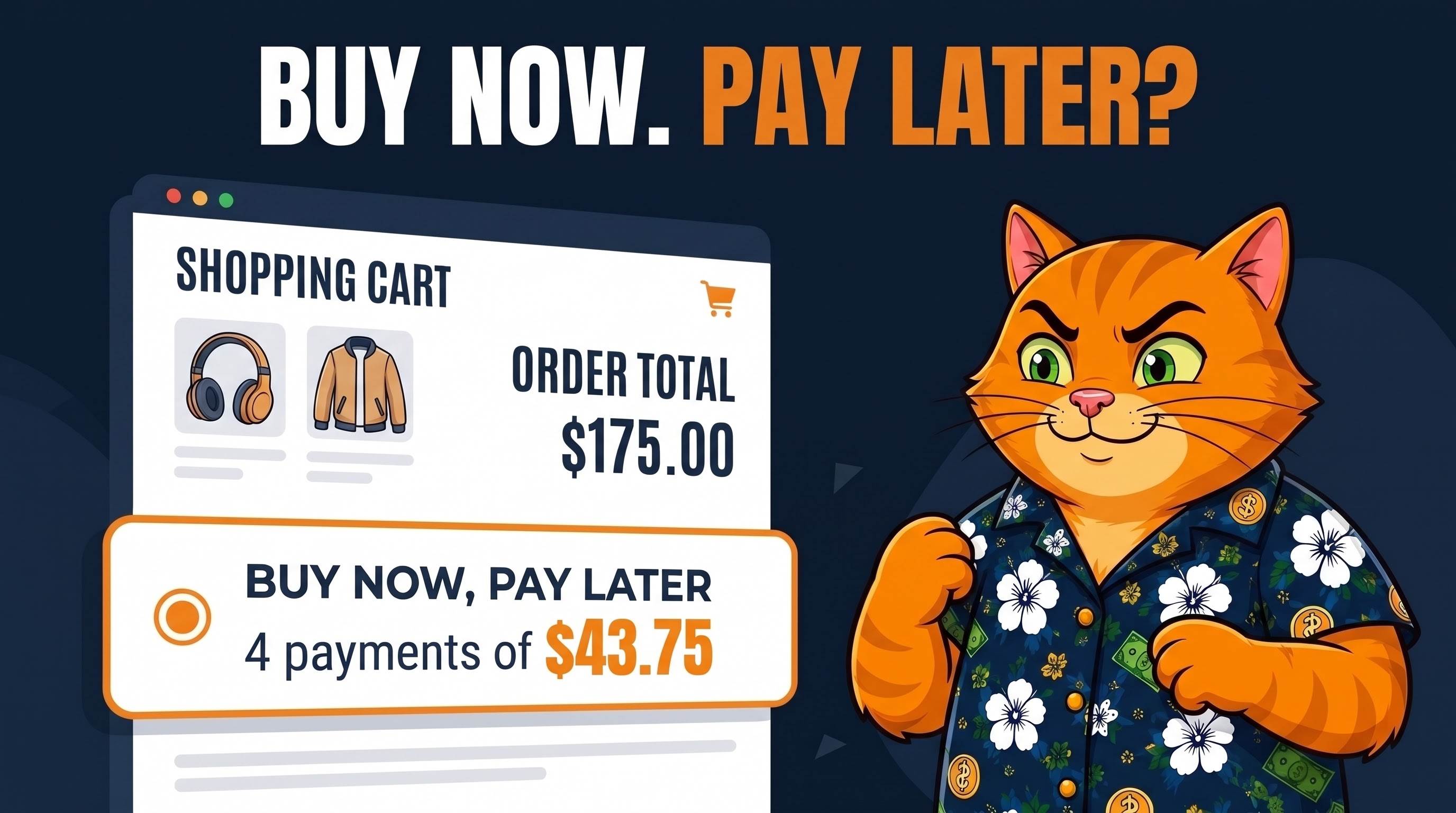
Here's how a typical pay-in-four plan works: you pay one-quarter of the price at checkout, then make three more payments, usually two weeks apart. If the plan charges no interest and you make every payment on time, the installments add up to the original purchase price. The Consumer Financial Protection Bureau (CFPB) describes this as a common form of short-term, interest-free installment borrowing.
That can be useful. But don't assume every offer labeled buy now, pay later has the same terms. Some longer-term installment plans charge interest. Affirm, for instance, advertises a 0% annual percentage rate (APR) on its Pay in 4 option, while its monthly-payment options can carry APRs ranging from 0% to 36%, depending on eligibility and the offer.
And even an interest-free plan can become expensive if a payment triggers a late charge or a fee from your bank. Check the actual terms, not just the number printed beside the checkout button.
For the rest of this article, we're talking about the familiar interest-free pay-in-four version. The problem I want you to see can happen even when the lender charges you no interest at all.
Meet Joyce: Three Plans, Three Small Numbers
Joyce has a regular paycheck, bills to cover, and a little room in her budget for things she wants. She's not out shopping with a plan to borrow $400. She's making three separate decisions.
First, she finds a jacket she's been eyeing. It's $200, but the checkout page offers four payments of $50. She can cover $50 today, so she takes the offer.
A week later, her old headphones are giving her trouble. The replacement pair costs $120, or four payments of $30. That seems manageable too.
The following week, she places an $80 order for a few things she needs. Four payments of $20. Why not?
Here's how those purchases line up:
- Week 0: $200 jacket — four payments of $50.
- Week 1: $120 headphones — four payments of $30.
- Week 2: $80 order — four payments of $20.
Each purchase uses a different pay-in-four app, and Joyce has autopay turned on for all three. She can open any one app and see its schedule. What she doesn't have is one screen showing all three together.
She remembers the $50 jacket payment, the $30 headphones payment, and the $20 order payment. It's easy to think of them as three small commitments instead of one growing obligation.
What Joyce Actually Owes
Let's check her balance just after the payments due in Week 2 have gone through.
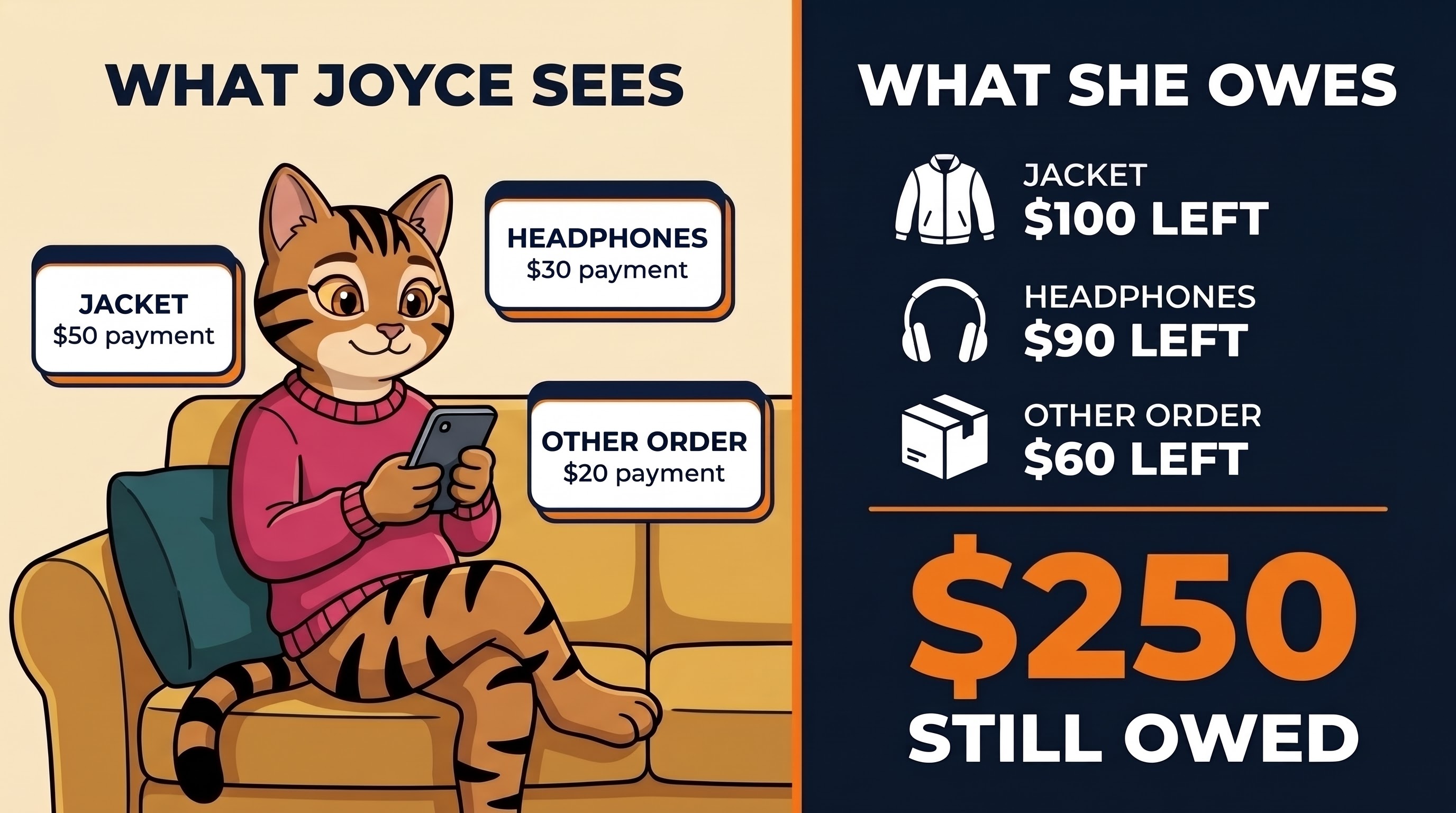
She's paid $100 toward the jacket, $30 toward the headphones, and $20 toward the newest order. That's $150 already paid on $400 worth of purchases.
She still owes:
| Purchase | Original price | Paid through Week 2 | Still owed |
|---|---|---|---|
| Jacket | $200 | $100 | $100 |
| Headphones | $120 | $30 | $90 |
| Other order | $80 | $20 | $60 |
| Total | $400 | $150 | $250 |
That's the Stack Check: $250 still owed, not just the next $50, $30, or $20 payment.
And the remaining payments aren't spread out neatly around her other bills. Look at the full schedule, assuming each plan takes its first payment at checkout and the next three every two weeks:
| Week | Payments leaving checking | Total that week |
|---|---|---|
| 0 | Jacket $50 | $50 |
| 1 | Headphones $30 | $30 |
| 2 | Jacket $50 + Order $20 | $70 |
| 3 | Headphones $30 | $30 |
| 4 | Jacket $50 + Order $20 | $70 |
| 5 | Headphones $30 | $30 |
| 6 | Jacket $50 + Order $20 | $70 |
| 7 | Headphones $30 | $30 |
| 8 | Order $20 | $20 |
| Total | $400 |
On Weeks 2, 4, and 6, $70 comes out on the same day in this example. If her rent, groceries, or another bill also lands around then, those small installments may not feel so small.
Joyce hasn't paid more than the sticker prices in this scenario. But she's committed future paychecks to purchases she's already taken home. That's worth seeing clearly.
Joyce Isn't Unusual
This isn't some rare trick only a handful of shoppers fall for.
In a CFPB study using 2022 borrowing data from six major buy now, pay later companies, about 63% of borrowers took out overlapping plans at some point during the year. About 33% borrowed from more than one company. Those figures describe borrowers in the study, not every American shopper, and they don't mean all those borrowers had repayment problems.
They do show how common it is for pay-in-four plans to overlap. Joyce's three apps are a made-up story, but the pattern behind them is real.
What the Lenders Can't See Either
You might assume that if Joyce is juggling several loans, the companies offering them must know.
Not necessarily. The CFPB has noted that buy now, pay later lenders may not know what a customer owes to competing lenders. Reporting and underwriting practices vary, and one company's approval doesn't mean anyone has checked the total payments leaving your account.
So when Joyce gets approved for that third purchase, it doesn't prove she can comfortably handle all three plans alongside everything else she pays for.
That's why the complete picture matters more than any individual approval screen.
Where Timing Costs You
The biggest risk with a typical interest-free pay-in-four plan may not be interest. It may be when the money leaves your account.
The Federal Reserve's survey of U.S. households in 2025, published in 2026, found that among people who had used buy now, pay later in the previous year:
- 26% said they'd paid late at least once.
- 17% said they'd been charged extra for paying late.
- 11% said a buy now, pay later payment had triggered an overdraft or insufficient-funds fee from their bank.
That last fee isn't necessarily charged by the pay-in-four company. It can come from the bank account the payment hits. The Fed also notes that many of these loans require autopay, often linked to checking.
Now picture Joyce on one of those $70 days. If her paycheck clears first, she may be fine. If a utility bill clears first, or her pay arrives later than expected, the timing could become a problem.
Autopay is convenient. It doesn't know whether you needed that money for something else.
Is Buy Now, Pay Later Worse Than a Credit Card?
Not automatically. But I wouldn't declare either one the winner based on a single statistic.
The CFPB's study found that, during 2019–2022, borrowers in its data defaulted on roughly 2% of their buy now, pay later loans, compared with roughly 10% of the credit card accounts they held. Those are different products with different repayment schedules, loan sizes, and definitions of trouble. The numbers aren't a head-to-head test proving pay-in-four is safer.
The Stack Check
Add up what you still owe across every plan — not just each app's next payment.
Joyce's plans show $50, $30 and $20 installments, but after her Week 2 payments she still owes $250 across all three.
A credit card can charge substantial interest if you carry a balance. An interest-free pay-in-four plan avoids that particular cost when you meet its terms. But the plan still creates a debt, still has due dates, and can still strain your checking account. Late fees, bank fees, returns, and disputes may also work differently depending on the provider and payment method.
There's another distinction I care about: why you're using it.
In the Fed's 2025 survey, people commonly said they used buy now, pay later to spread out payments. Others said it was the only way they could afford the purchase. Those aren't the same situation.
If you already have the money and want to manage the timing, you're making one kind of decision. If the purchase only works because the full price isn't due today, you're depending on money you haven't set aside yet. That's a bigger commitment than the checkout screen makes it feel.
Why Four Small Payments Feel Smaller
Think back to Joyce's jacket. At checkout, she sees $50 today. The jacket still costs $200.
That isn't a hidden fee or a mathematical trick. It's the same price, shown in a way that puts today's payment front and center. The other $150 becomes a problem for future Joyce.
Now add the headphones and the third order. Each app tells the truth about its own loan. But none of those individual screens tells Joyce that she's committed $400 in total or that some of her payments will land together.
The installments are small. The purchases aren't smaller.
And if you've ever found yourself with several plans running at once, I don't think that makes you irresponsible. It means it's time to look past the installment amounts and see the full balance.
The Part Chuck Wants You To Actually Do
Joyce doesn't need a lecture about never using buy now, pay later again. She needs one clear view of what she's promised to pay.
Here's what I'd check before opening another plan:
- Add up every remaining balance. Open each app and write down what you still owe across all active plans. Don't add up only the next installments. For Joyce, the answer just after Week 2 is $250.
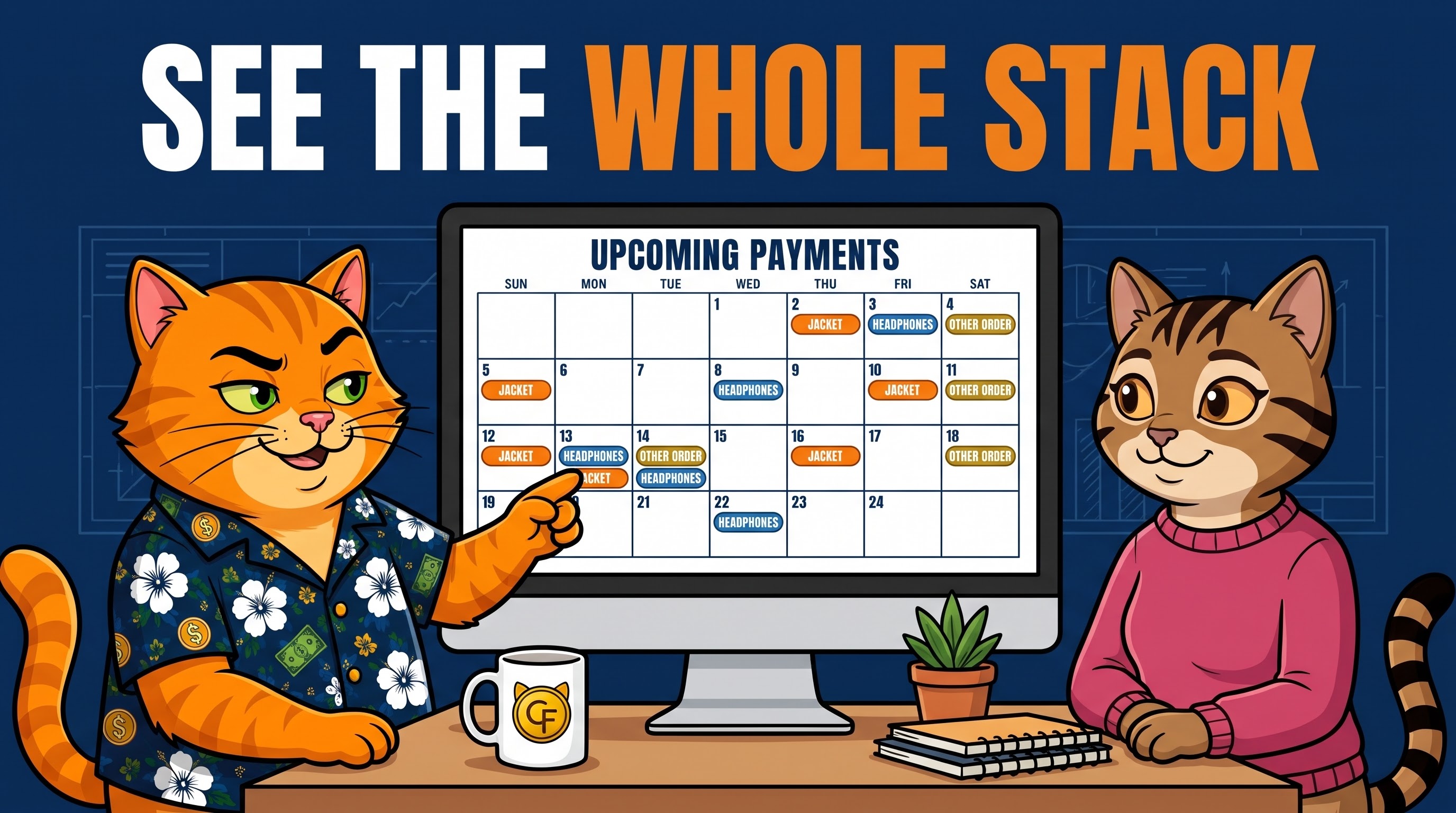
- Put every due date on one calendar. Include the amount, the account it'll come from, and your other bills. Joyce's $70 weeks are much easier to handle when she sees them coming.
- Ask whether the full purchase fits your budget. Could you pay for it today without sacrificing rent, groceries, or emergency savings? If not, what specific income will cover each future payment? A zero-interest offer doesn't make an unaffordable purchase affordable.
If you're already juggling these plans alongside credit card balances, how to pay off credit card debt can help you think through the next steps. And if every payday feels spoken for before it arrives, read why the 50/30/20 rule breaks.
Four easy payments can be exactly what they promise. Just don't forget about the other four easy payments you signed up for last week. And the week before that.
The price doesn't change. What changes is how much of it you can see.
Sources
- Consumer Financial Protection Bureau, "Consumer Use of Buy Now, Pay Later and Other Unsecured Debt" (January 2025). Analysis of 2022 borrowers at six firms: approximately 63% took out overlapping loans, 33% borrowed from multiple firms; report also compares BNPL loan and credit card account default outcomes during 2019–2022.
- Consumer Financial Protection Bureau, "The Buy Now, Pay Later Market" (December 2025). Describes common pay-in-four structures and limits on lenders' visibility into borrowing across providers.
- Federal Reserve Board, "Economic Well-Being of U.S. Households in 2025," Credit section (May 2026). Among BNPL users: 26% reported a late payment, 17% reported extra charges for paying late, and 11% reported a BNPL-triggered overdraft or insufficient-funds fee; also reports reasons for using BNPL.
- Affirm, "How it works" (accessed October 2026). Illustrates the distinction between advertised 0%-APR Pay in 4 and monthly installment offers that may charge interest. Terms and eligibility may change.
Figures are drawn from the dated studies listed above and may change. Joyce and her purchases are hypothetical; the payment schedule assumes a first installment at checkout and three more every two weeks, with no fees or missed payments. This post is not sponsored, contains no affiliate or referral links, and does not recommend any buy now, pay later provider. Always check the terms of the plan you're offered.
Chuck Finance is for entertainment and informational purposes only. Chuck is not a licensed financial advisor, and nothing in this post constitutes professional financial, investment, legal, or tax advice. Always consult a qualified professional before making financial decisions.