Table of Contents
- Statement Balance vs. Current Balance: What Each One Actually Is
- Gina's Grocery Week
- Why the Grace Period Decides Which Number Matters
- So Gina Pays $1,200. Not $1,440.
- But What About Gina's 801 Credit Score?
- Now Flip It: What if Gina Pays Only the Minimum?
- Already Carrying a Balance? Read This First
- What You Do With This Information
- Sources
Statement Balance vs. Current Balance: What Each One Actually Is
Your credit card keeps two tallies.
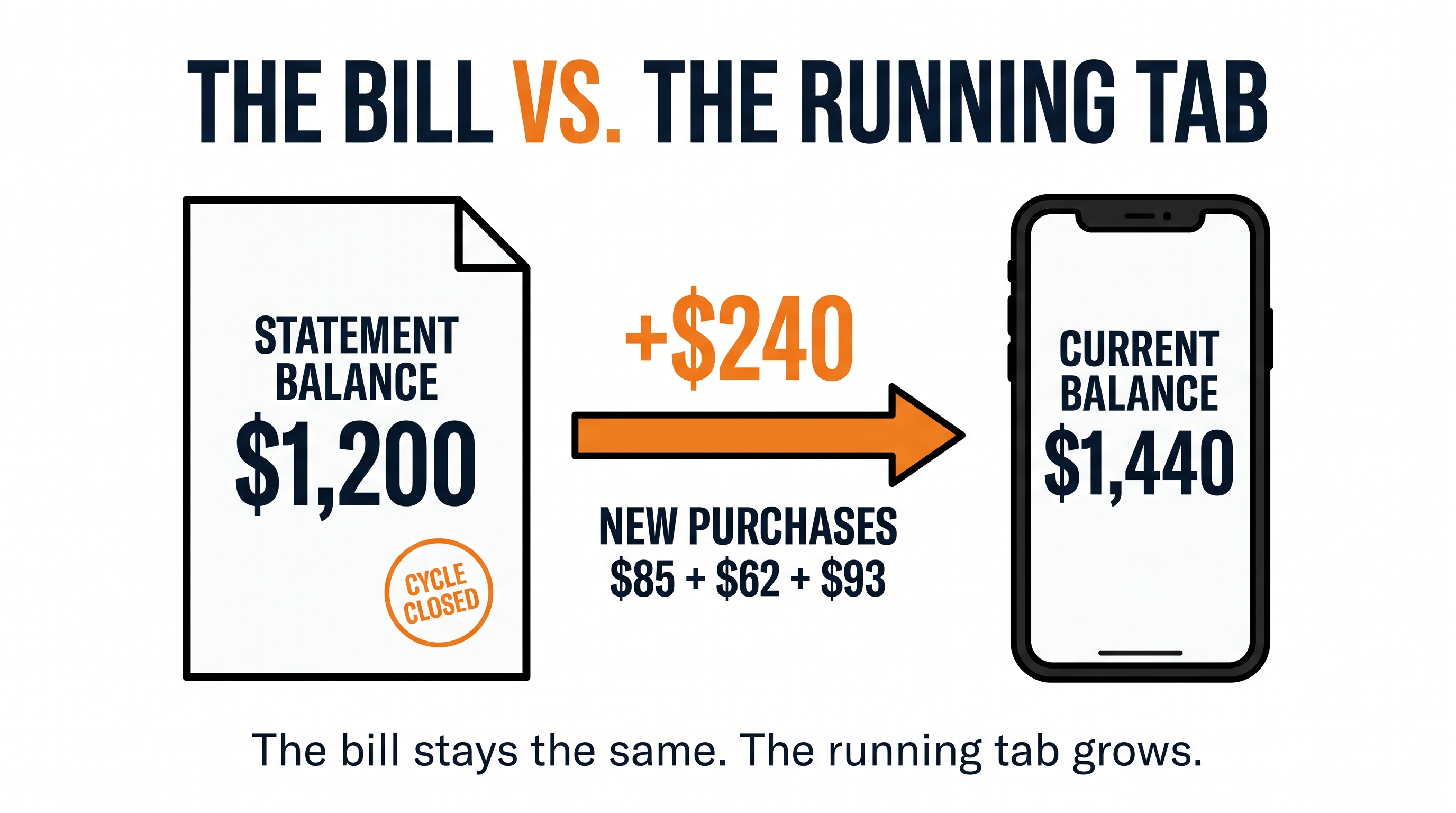
The statement balance is the amount on your bill when the billing cycle closed. That statement is a snapshot: later purchases don't rewrite it. Payments or credits made afterward can, however, reduce how much of that bill remains to be paid.
The current balance is the account's more up-to-date total, reflecting posted purchases, payments, credits, fees, and interest. Pending transactions may appear separately, depending on the issuer.
Here's my shorthand: the statement balance is the bill; the current balance is the running tab.
The bill tells you what that cycle closed with. The tab keeps changing.
Capital One's explainer describes the distinction. Your issuer's labels and payment screen may differ, so check your own statement.
Gina's Grocery Week
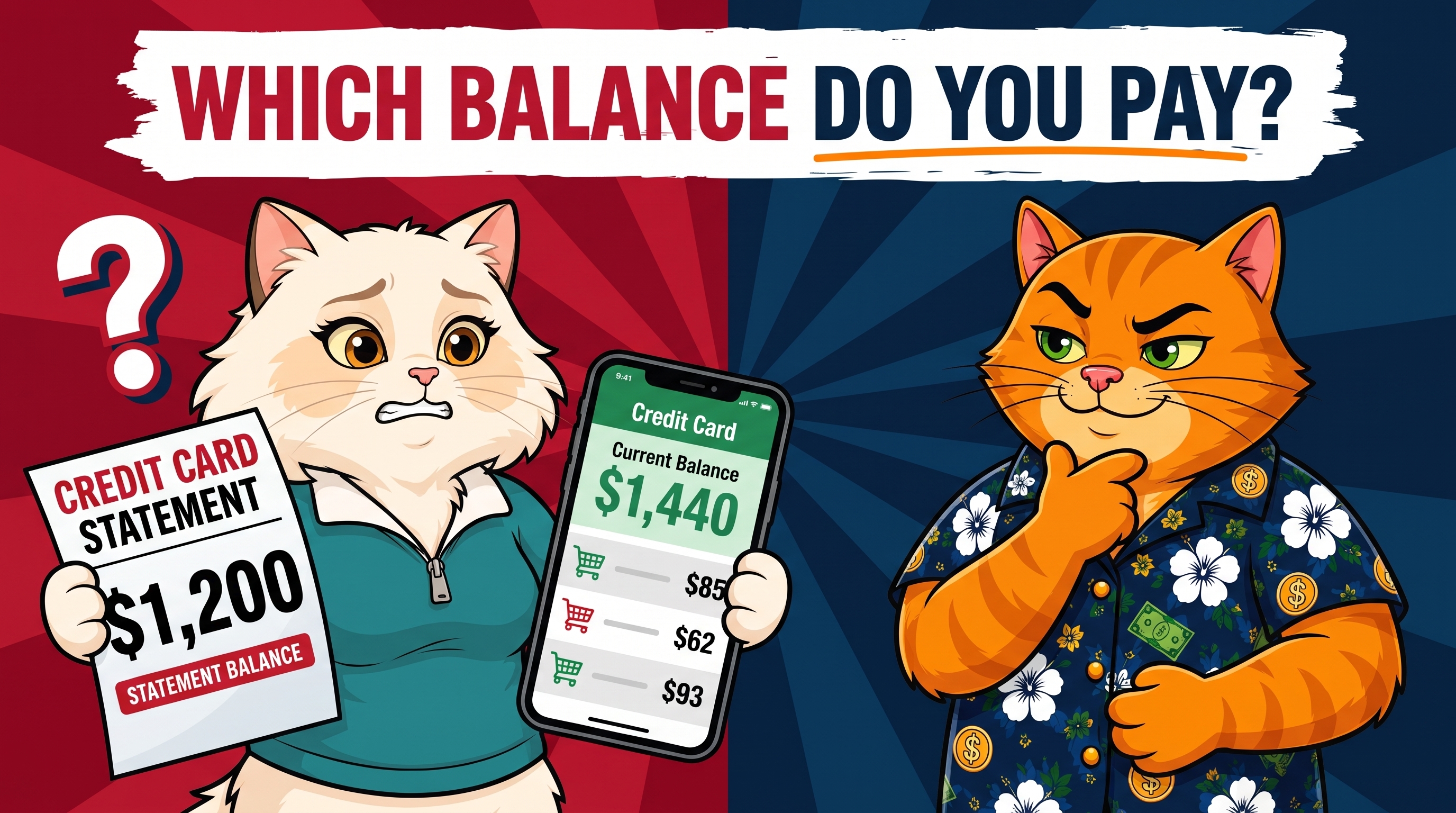
Gina's statement closes at $1,200. Her card has a purchase grace period, and she's been paying her statement balances in full. Those conditions matter.
After the statement closes, she makes three grocery purchases: $85, $62, and $93.
| Moment | Current balance shown in app | Statement balance on issued bill |
|---|---|---|
| Statement closes | $1,200 | $1,200 |
| $85 grocery purchase posts | $1,285 | $1,200 |
| $62 grocery purchase posts | $1,347 | $1,200 |
| $93 grocery purchase posts | $1,440 | $1,200 |
The math is simple: $85 + $62 + $93 = $240. And $1,200 + $240 = $1,440.
Her current balance grew. Her issued statement didn't change. Those groceries happened in the new billing cycle.
Now which amount needs to be paid by the due date?
Why the Grace Period Decides Which Number Matters
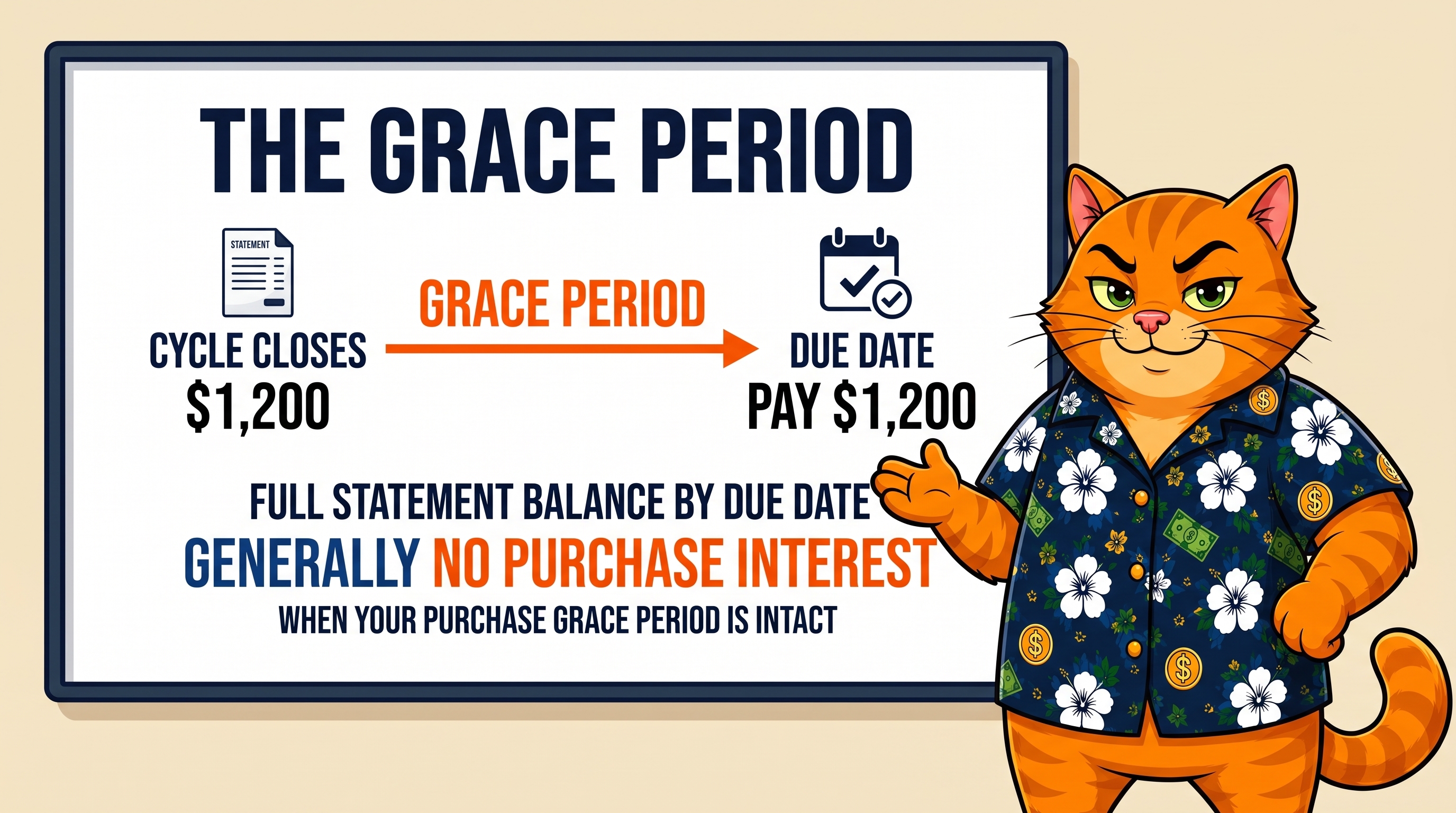
A grace period is the time between the end of a billing cycle and the payment due date. Credit cards aren't required to provide a grace period, though many offer one for purchases.
When a card offers a purchase grace period and you maintain it by paying as required, you can generally avoid interest on purchases by paying your full statement balance by its due date.
That is why Gina's $1,200 matters more than the $1,440 she sees in the app.
Her statement closed before she bought those groceries. The extra $240 is part of the next cycle, not an additional amount she must pay by this statement's due date to preserve her purchase grace period.
Important: That rule is about qualifying purchases. Cash advances generally begin accruing interest right away, and balance transfers or promotional balances can have different terms. Your card agreement determines the details.
So Gina Pays $1,200. Not $1,440.
Gina pays her $1,200 statement balance in full by the due date.
Because her purchase grace period is intact, she generally avoids purchase interest. The $240 in groceries stays on her account and will appear on her next statement unless she pays it sooner or other activity changes the balance.
Could she pay $1,440 instead? Absolutely. Paying the current balance isn't wrong. It simply isn't necessary to avoid purchase interest under Gina's circumstances.
The distinction isn't about finding the biggest number on the screen. It's about paying the amount required under her card's terms, on time.
But What About Gina's 801 Credit Score?
Gina still has one worry: she doesn't want that 801 to become 799.
Here's where two different systems get mixed together.
The grace period determines whether she can avoid purchase interest. Credit scoring models evaluate information reported to credit bureaus, including revolving balances and utilization.
A card issuer may report a balance around the statement closing date, but reporting practices vary. The balance a scoring model sees isn't necessarily the balance Gina has on her payment due date.
Paying the $1,200 statement balance on time can protect her grace period without guaranteeing her score stays above 800. Paying the entire $1,440 current balance doesn't guarantee that either. Her score depends on the model, the report data, and when it's calculated.
And 800 isn't a universal cliff where every lender suddenly changes its terms.
Gina can monitor her reported balances if she's preparing for a credit application. But she doesn't need to pay interest, or chase every new purchase in her app, just to prove she's responsible with credit.
Here's the more expensive mistake.
Now Flip It: What if Gina Pays Only the Minimum?
Suppose Gina doesn't pay the full $1,200. Instead, she makes only the required minimum payment by the due date.
That may keep her payment from being late. It does not necessarily preserve her purchase grace period.
If she loses the grace period, interest can accrue on the unpaid portion of the prior balance. New purchases may also start accruing interest from their transaction dates, rather than receiving the interest-free treatment Gina expected.
That includes her three grocery purchases. The $85, $62, and $93 charges may start costing her interest even though she made them after the statement closed.
The exact timing and charges depend on her issuer's agreement, APR, and how interest is calculated. Grace-period restoration can also take time after she resumes paying in full.
How much interest Gina pays depends on her card's APR, when she made her purchases, and when she makes her payments. The important part? Once she loses her grace period, interest can start adding up on purchases she thought were interest-free.
For the mechanics, see how credit card interest works. For the long-term consequences, see the minimum payment trap.
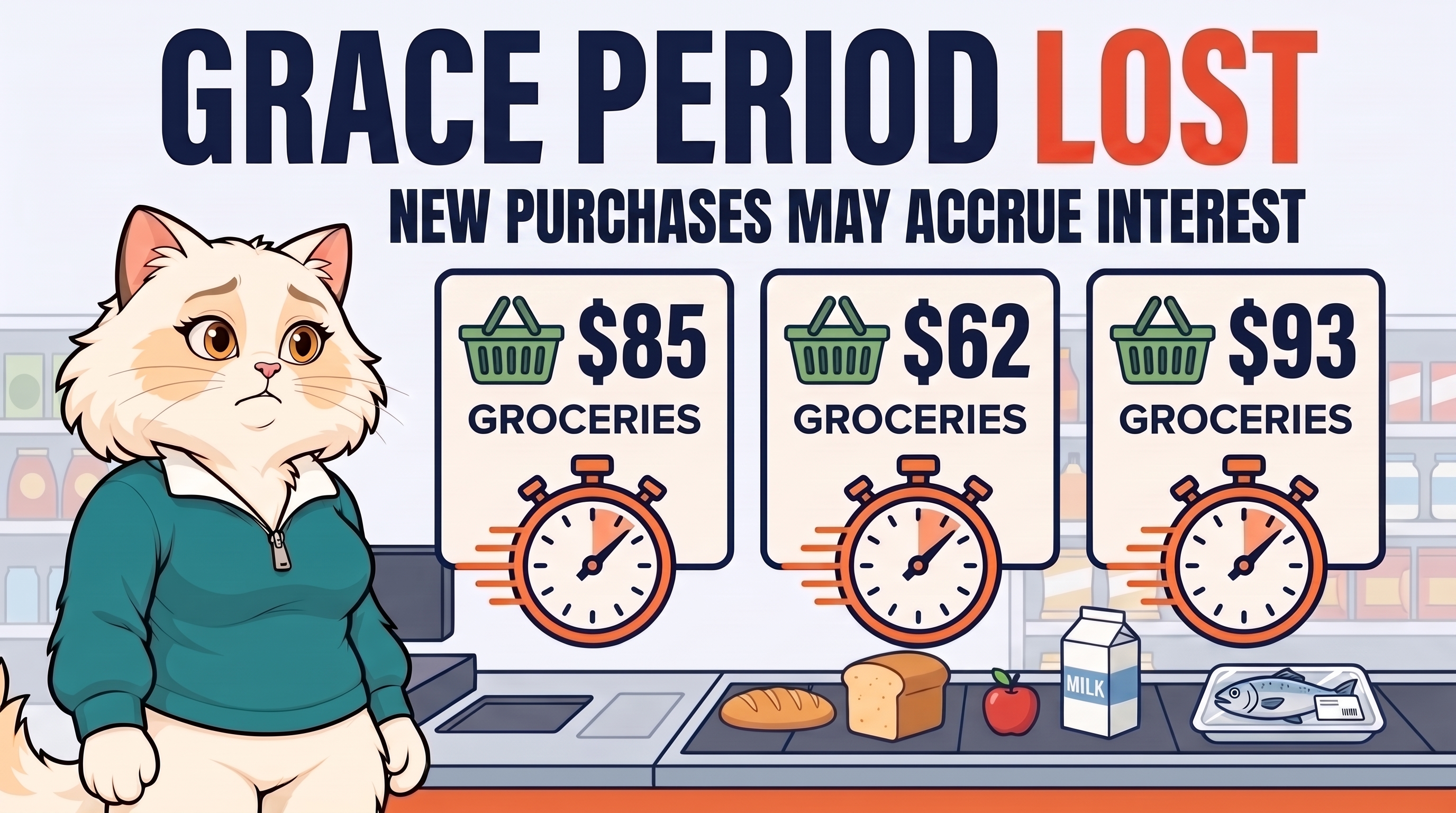
Paying the minimum and paying the full statement balance are not interchangeable. One may satisfy the minimum payment requirement; the other is generally what preserves the purchase grace period when its conditions apply.
Already Carrying a Balance? Read This First
Gina's example has an important starting condition: she isn't carrying a balance from an earlier cycle, and her purchase grace period is intact.
If you're already carrying a balance, your grace period may be lost. Paying only the newest statement balance might not immediately stop all interest charges, especially interest that accrued before your payment posted.
That's why some people see a small interest charge even after paying off a card. It's often called residual or trailing interest.
Your card's terms determine how the grace period is restored. If this is your situation, read why you were charged interest after paying off your card and check your agreement or contact your issuer for the payoff amount and timing.
The $1,200 rule works for Gina because of her specific starting conditions. It isn't a universal instruction to ignore the rest of a balance on every credit card.
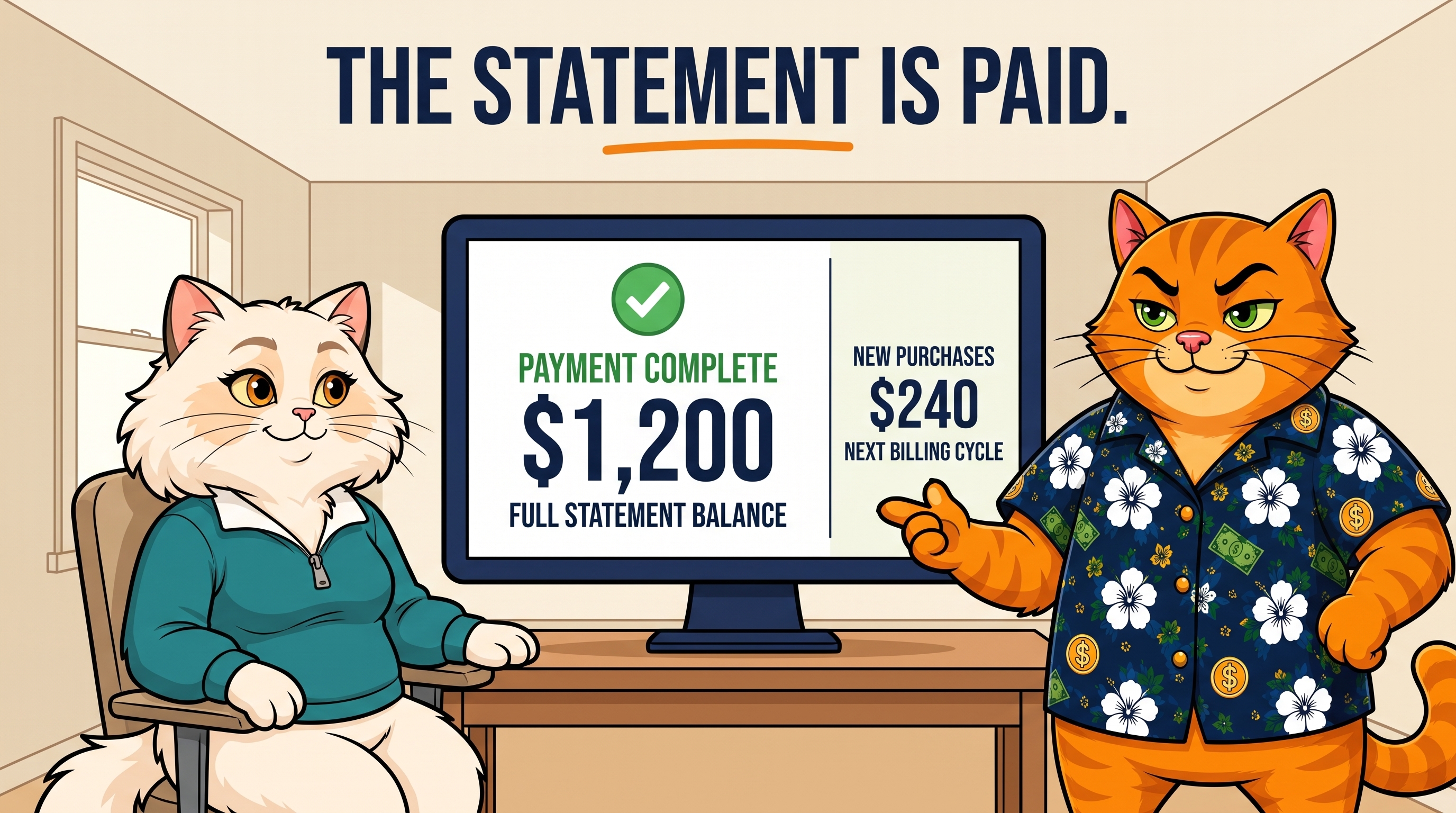
The Bill vs. the Tab
Pay the full statement balance by the due date
With her purchase grace period intact, Gina pays the $1,200 statement balance by its due date. Her $240 in later groceries belongs to the next billing cycle.
What You Do With This Information
My rule: Always aim to pay your full statement balance by the due date. It's one of the simplest ways to avoid credit card purchase interest and keep debt from piling up.
Gina opened her app worried about $1,440. Her bill said $1,200. She assumed leaving $240 on the card might mean interest—or that her 801 credit score was in danger.
Now she knows those are separate questions.
Her three grocery purchases belong to the new billing cycle. She pays her full $1,200 statement balance by the due date, keeps her purchase grace period intact, and lets the next statement handle the $240.
Her credit score might move as balances are reported. No one can promise her an 801 forever. But she doesn't have to confuse an unpaid new-cycle purchase with an overdue statement bill.
Here's what I want you to do this week:
- Open your latest statement. Find the statement balance, closing date, and payment due date.
- Check your grace-period terms. Make sure you understand whether you're currently eligible for interest-free purchases.
- Consider autopay for the full statement balance. If your issuer offers it, make sure the linked bank account has enough money to cover the payment.
The statement is the bill. The current balance is the running tab.
Pay the bill in full and on time when your grace period applies. The newer tab becomes the next bill.
Chuck Finance is for entertainment and informational purposes only. Chuck is not a licensed financial advisor, and nothing in this post constitutes professional financial, investment, legal, or tax advice. Always consult a qualified professional before making financial decisions. Gina's balances, purchases, and credit score are hypothetical. Credit-score outcomes and grace-period terms vary by scoring model, issuer, and account agreement.
Related: how does credit card interest work, the minimum payment trap, and why you were charged interest after paying off your card.