Why was I charged interest after paying off my credit card?
If you paid off your credit card and interest still appeared on the next statement, an interest-bearing balance may have kept accruing interest before your payment reached the account. Cash advances are a common example because they generally don't get the same grace-period treatment as eligible purchases. That's what happened to Percy: he paid his statement balance in full and on time, but one cash advance had been accruing interest under a different set of rules.
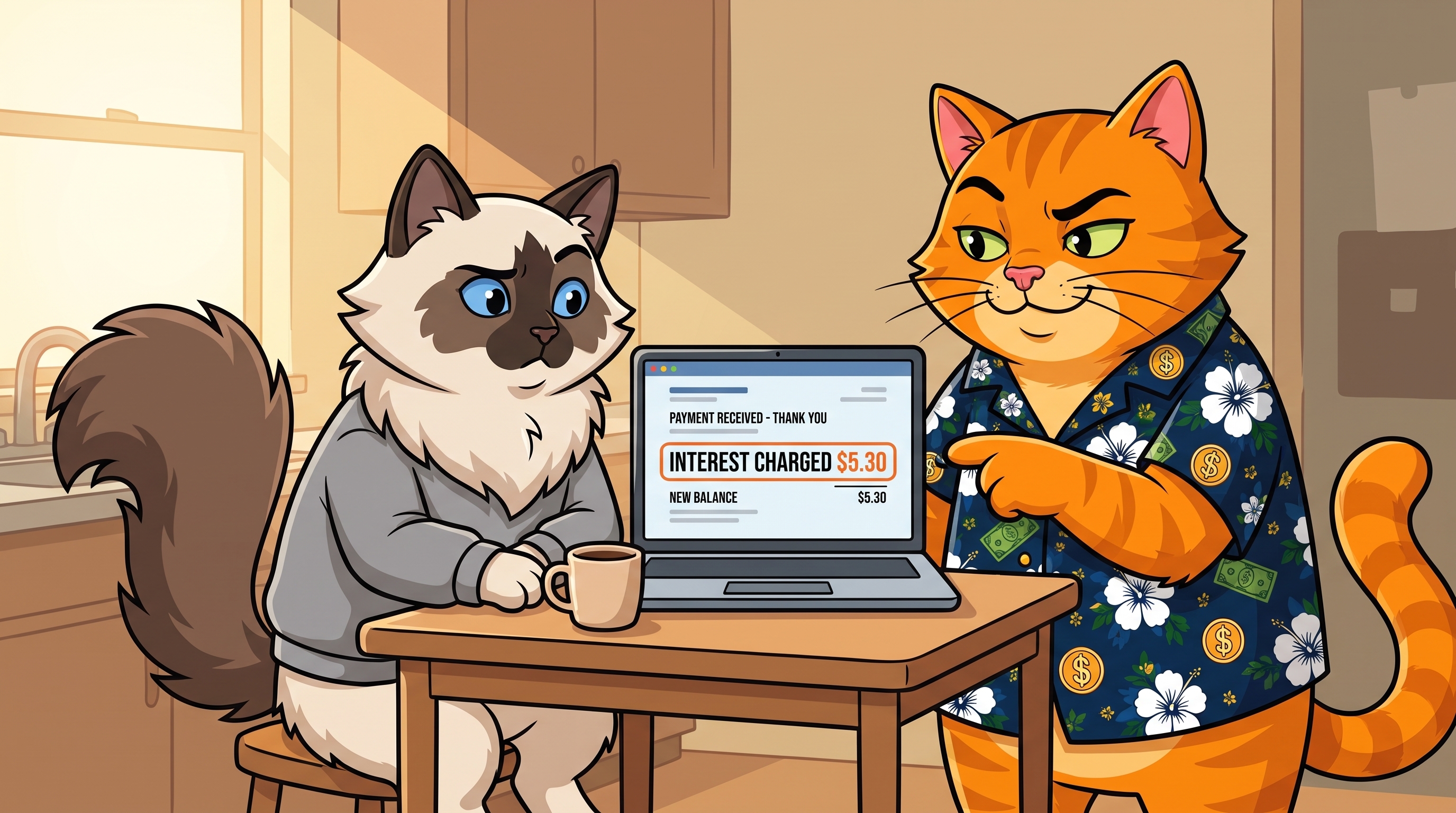
Percy paid his entire credit card statement balance. Every dollar. On time — like always. Then the next statement showed up with a line that had never been there before: Interest Charged, $5.30.
He hadn't paid late. He hadn't left anything unpaid. He'd paid exactly what the statement told him he owed. So where did the $5.30 come from?
The 30-second answer: one transaction on Percy's card was playing by completely different rules than the rest of his statement — and figuring out which one took a little detective work.
Your APR Is Not One Number
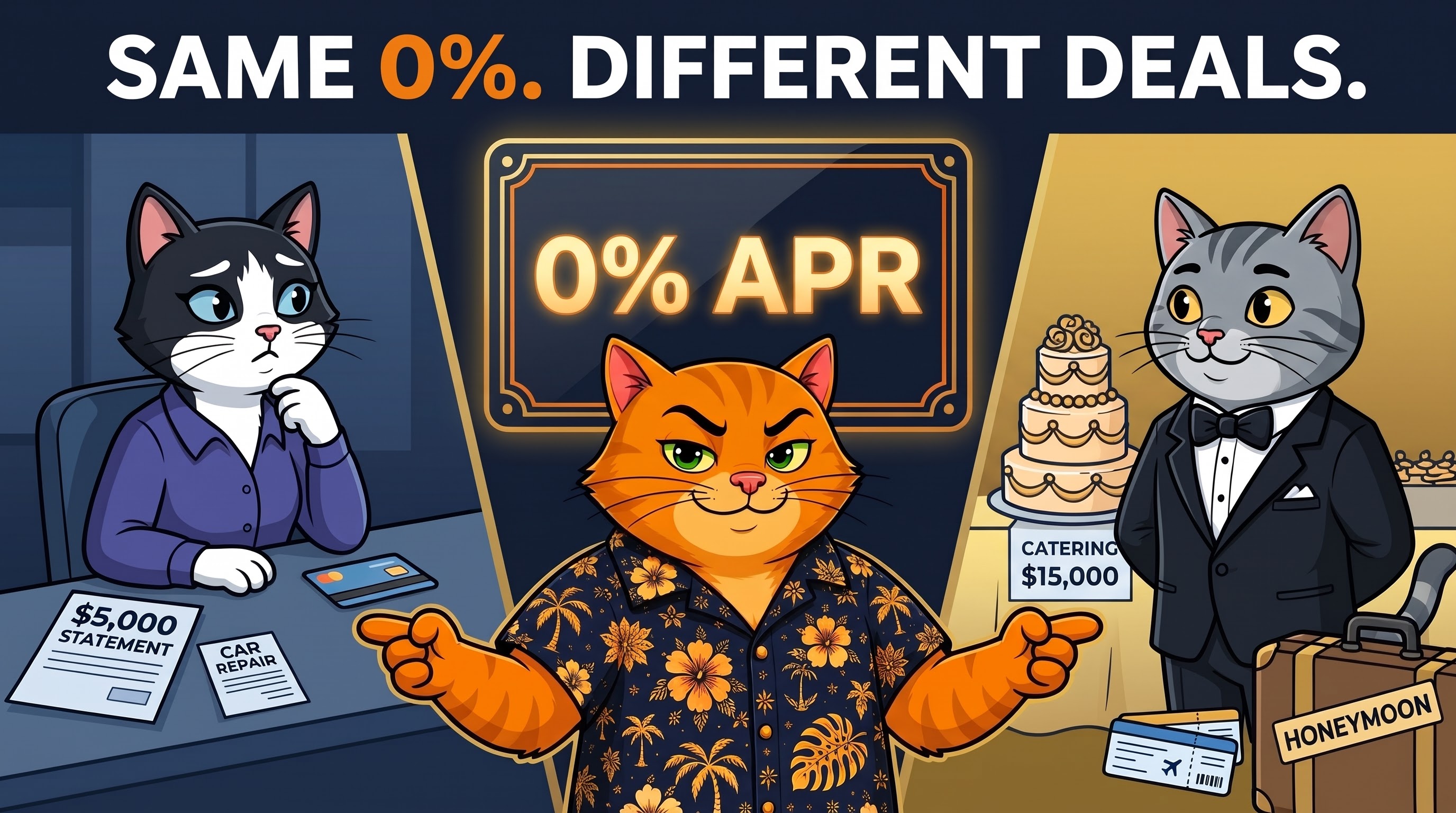
Here's the thing nobody tells you when you sign up for a card: your APR is not one number sitting on your whole balance. A credit card tracks separate categories — purchases, cash advances, balance transfers — and prices each one differently. The card can charge zero interest on one category while charging interest on another — in the same month, on the same statement.
Percy's card charged 27.24% on purchases. 29.24% on cash advances. (These are illustrative terms for Percy's example — your own card's rates and rules are in your cardmember agreement.) Same card, different categories, different rates — different clocks. And only one of those categories gave Percy the protection he assumed covered the entire card.
Have you ever paid your statement balance in full and then had interest show up anyway? If you have, you're not alone — and you're about to find out exactly why.
What Actually Happened to Percy
This isn't a story about Percy screwing up. He did the two things everyone's told to do: pay the statement balance in full, pay it on time. He'd done that for years.
Then one month, he used the card differently. Over the billing cycle, he put $1,200 on it the normal way — groceries, gas, a couple of subscriptions, a few packages. Those were all purchases.
Then, on the final day of his billing cycle, Percy was at the airport and realized he needed cash for the trip. His debit card was at home. His flight was boarding. So he used his credit card at the ATM and pulled out $300. The card charged a 5% cash advance fee — another $15. Under Percy's card agreement, that $15 fee became part of the cash-advance balance, bringing that category to $315 before interest — sitting in a completely different category from his purchases.
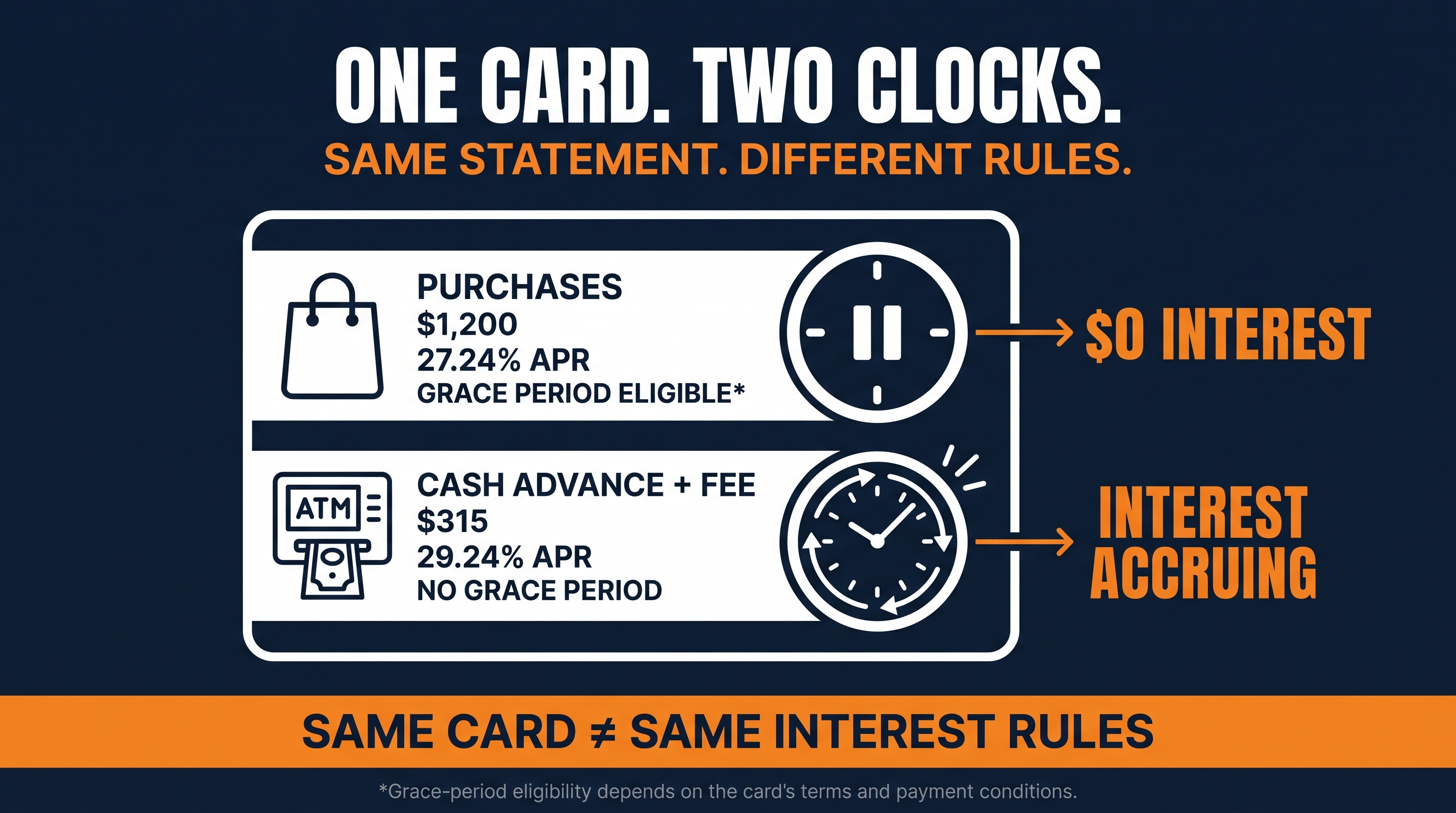
Percy's purchases had a grace period. Under the terms of his card, as long as he paid the required balance in full by the due date, those eligible purchases didn't accrue interest — exactly what Percy had been doing for years. But his cash advance didn't get that deal. Cash advances had no grace period on his agreement. Interest started on the transaction date. Not the next statement. Not the due date. The transaction date.
Because Percy took the cash advance on the final day of his billing cycle, that statement closed with the $315 cash advance balance sitting on it — but almost no time had passed yet for interest to accrue. Percy saw $300 in cash, a fifteen-dollar fee, and nothing that looked like a mystery. His payment was due 21 days later, and on the due date he paid the entire statement balance — the $1,200 in purchases, the $315 cash advance and fee, everything the statement told him to pay.
Here's the part Percy couldn't see on that statement: the cash advance clock had been running the whole time. The interest accumulating after the statement closed couldn't magically appear on a statement that had already been printed. It had to show up on the next one.
Calculating the $5.30
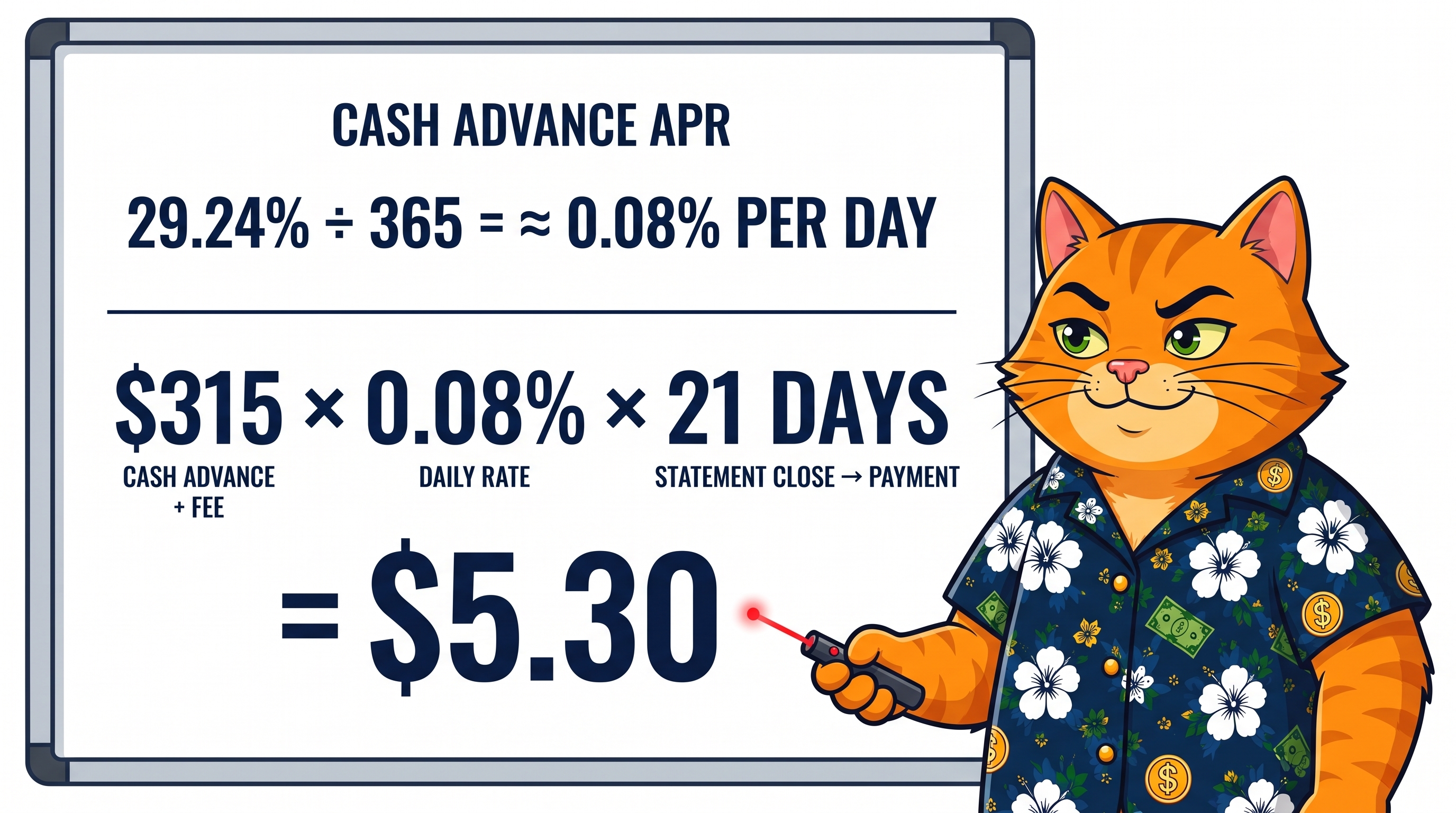
Percy's cash advance category started at $315. His cash advance APR was 29.24%, and his agreement calculates the daily periodic rate using 365 days — 29.24% divided by 365 is roughly 0.08% per day. That $315 balance accrued interest for the 21 days between the statement closing and Percy's payment reaching the account.
$315 × roughly 0.08% × 21 days ≈ $5.30.
The Grace Period Rule
Pay your full statement balance by the due date, and eligible purchases may avoid interest under your card's grace-period terms. Cash advances generally start accruing interest right away.
If you've ever tapped your credit card for cash, that balance was very likely accruing interest from the moment you got the cash — even though the rest of your statement math tells you "I always pay in full, so I never owe interest."
That's the whole mystery. Not a fee. Not a bank error. Not fine print designed to trap anyone — $5.30 of interest, priced exactly the way the agreement said it would, on the one category of the statement that was never eligible for the deal Percy thought covered everything.
That interest showing up after Percy thought he'd paid the balance off is often called residual or trailing interest. It can happen when an interest-bearing balance keeps accruing interest between the statement closing date and the date your payment actually reaches the issuer — which is exactly what happened to Percy's cash advance. "Statement balance" is a snapshot — it isn't a stop button. The cash advance didn't stop existing the day the picture was taken. It stopped when Percy's payment reached the account.
That's the hidden logic — and no, this isn't a cat-and-mouse game the bank is playing with you. It's just math most people never see explained.
Paying your statement balance in full protects transactions that qualify for a grace period. It does not manufacture a grace period for a transaction that never had one — and cash advances generally don't. That's why Percy's $1,200 in purchases and his $315 cash advance could sit on the same statement and behave completely differently. Same card, two different sets of rules.
The Insight Most People Never Learn
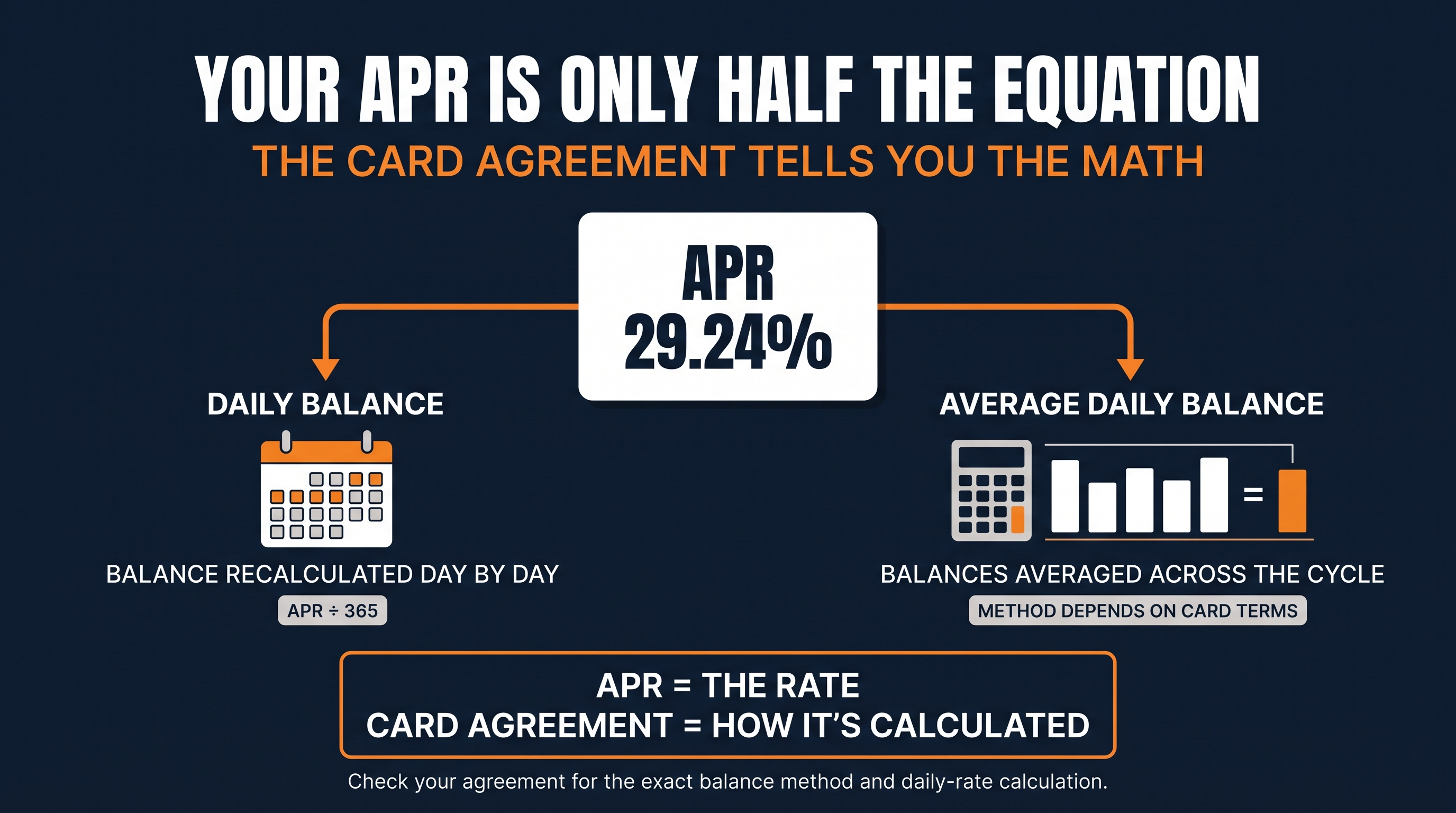
Understanding your credit card interest takes more than knowing one APR. You need to know two things: what rate applies, and what balance that rate is being applied to. Percy's cash advance ran 29.24% — but your card could use a different cash advance rate, a different purchase rate, a different balance-transfer rate, a different promotional-balance rate entirely.
The calculation method can vary too. Many issuers calculate interest using daily balances, but the exact method — and even how the daily rate is determined — depends on the card agreement.
Your APR tells you the rate. Your cardmember agreement tells you the math.
If you want to see the basic calculation from APR to daily rate to a dollar interest charge, start with how credit card interest is calculated.
When Percy finally read his own agreement after that second statement, it was all there: Purchases at 27.24%, cash advances at 29.24%, a grace period on eligible purchases when he met the payment conditions, and no grace period on cash advances. The $5.30 wasn't random. It wasn't another fee. It wasn't proof the issuer had ignored his payment. It was interest that accumulated after his statement closed but before his payment was received — nothing more exotic than that.
Why Cash Advances Cost More Than People Expect
Percy wanted $300 in cash. Before interest even entered the picture, the 5% fee turned that into $315. Then interest started immediately — and his 29.24% cash advance APR isn't some unusually punishing rate. Federal Reserve data puts the average APR on credit card accounts actually being charged interest at around 22% — and in a CFPB review of card agreements, the most common cash advance APR was 30%. Percy's rate sits right in that neighborhood, not as an outlier.
The scale isn't trivial either: according to CFPB data, major credit card issuers charged $717 million in cash-advance fees in 2022 — before counting the interest those advances go on to generate.
A cash advance shouldn't feel like pulling $300 out of an ATM, because financially, that isn't what happened. Percy borrowed $300 through one of the most expensive categories on his credit card. The ATM just made it look familiar.
Balance transfers can create another balance category with their own APR, transfer fee, promotional terms, and rules about when interest begins. Promotional balances can carry yet another set of terms. One piece of plastic, multiple balances living underneath it — and that matters when you make payments, too. If you carry balances at different rates and pay more than the required minimum, federal rules generally require the extra amount to go toward the balance with the highest APR first. The issuer generally keeps more discretion over where the minimum-payment portion itself goes.
There's one more reason the grace period matters going forward: if Percy stops meeting his card's conditions for the purchase grace period — for example, by not paying the required balance in full by the due date — new purchases can start accruing interest from the date they're made. The groceries, the gas, the coffee — transactions that used to get a free waiting period can suddenly start running their own clock.
Here's What Actually Fixes This
None of this requires memorizing your APR. It requires knowing where to look.
First, open your most recent statement and find the section that breaks out your APRs and interest charges by category — purchases, cash advances, balance transfers, promotional balances. Federal disclosure rules require your statement to show the APRs that apply to different types of transactions and the interest charged, itemized by type of transaction; the information is already there, you just have to know why you're looking at it.
Second, find the grace-period language in your cardmember agreement. Most credit cards provide a grace period on purchases. Cash advances generally don't. Your agreement tells you exactly what your card does.
Third, if you're about to use a credit card for cash, stop for ten seconds. Check the fee, check the cash advance APR, check when interest starts. A withdrawal from your own bank account, a backup debit card, or cash you already have typically costs less than a credit card cash advance.
Fourth, if your goal is to avoid interest on eligible purchases, setting autopay to the full statement balance can help you consistently meet the payment condition for your purchase grace period — a real advantage over the minimum. Just understand what it does and doesn't cover: autopay can help with eligible purchases, but cash advances can start charging interest immediately even when autopay is turned on.

Percy checks his statements differently now — not out of worry, but out of understanding. Categories, rates, grace-period terms, before the payment goes out. When a friend named Otto called with the exact same complaint — "I paid this card off, why did they charge me interest again?" — Percy didn't guess. He walked through the same checklist: category, rate, grace period, when the payment was received. Two minutes later, Otto had his answer too.
That's the actual win here. Not the $5.30. The fact that the number stopped being confusing — and stayed that way.
Related reading: How to Pay Off Credit Card Debt (You're Doing It Wrong) · The Minimum Payment Trap Nobody Warns You About · The Right Number of Credit Cards Isn't What You Think
Sources
- Consumer Financial Protection Bureau — How does my credit card company calculate the amount of interest I owe?
- Consumer Financial Protection Bureau — What is a "daily periodic rate" on a credit card?
- Consumer Financial Protection Bureau — What is a grace period for a credit card?
- Consumer Financial Protection Bureau — If I pay off my credit card balance when it is due, is the company allowed to charge me interest for that month?
- Consumer Financial Protection Bureau — Data Spotlight: Credit card cash advance fees spike after legalization of sports gambling (cash-advance fees; most common cash-advance APR in reviewed card agreements)
- 12 CFR § 1026.53 — Allocation of payments (Regulation Z)
- 12 CFR § 1026.7 — Periodic statement (Regulation Z)
- Discover Bank Secured Cardmember Agreement, effective 9/30/2025
- Federal Reserve G.19 Consumer Credit release
- Chase — Understanding residual interest on a credit card
Chuck Finance is for entertainment and informational purposes only. Chuck is not a licensed financial advisor, and nothing in this post constitutes professional financial, investment, legal, or tax advice. Always consult a qualified professional before making financial decisions.